
How Much Does SpaceX Starship Cost?
Published on | Written by Alec Pow
This article was researched using 14 sources. See our methodology and corrections policy.
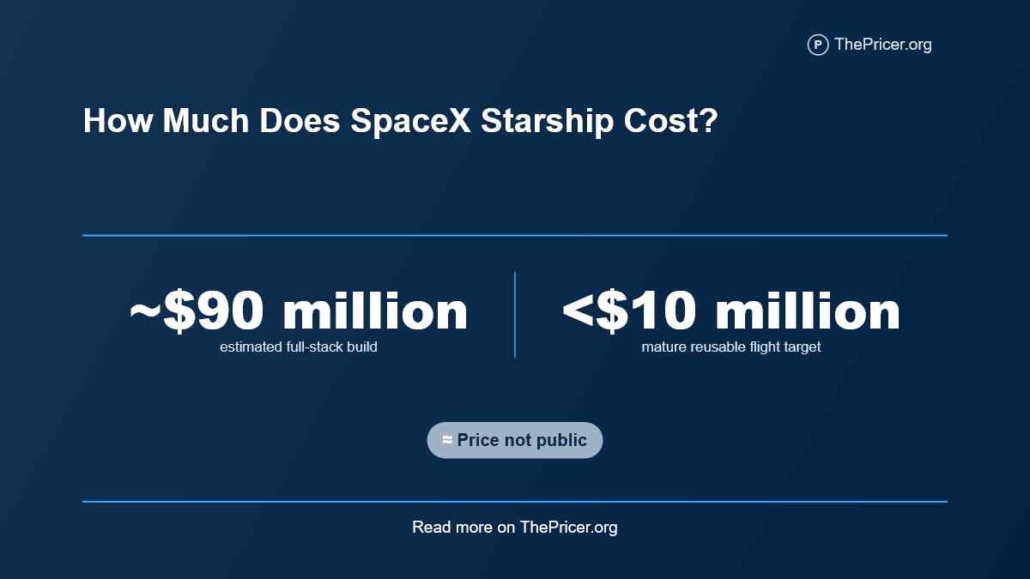
SpaceX has not published a standard commercial price for one Starship launch, but the cost picture is much clearer than a single missing rate suggests. Flight 14 reached orbit on September 28, 2026 and deployed 26 operational Starlink V3 satellites, which means Starship has crossed from test-only flying into real payload delivery. The best public benchmarks now range from an independent roughly $90 million full-stack manufacturing estimate to SpaceX’s long-run goal of a fully reusable flight costing under $10 million.
Those numbers answer different questions. A rocket can cost tens of millions to build and only a fraction of that to fly again if both stages survive and are reflown many times. Development spending, launch-site capital, customer pricing, Starlink deployment economics, and NASA’s lunar architecture sit in separate cost buckets. The useful answer is a cost stack, not one headline price.
Article Highlights
Jump to sections
- Flight 14 was Starship’s first orbital and revenue-generating payload mission, carrying 26 Starlink V3 satellites.
- An independent Payload analysis estimated a full Starship and Super Heavy stack at about $90 million (at $30 per hour, earning that amount would take about 1.4 thousand years of full-time work, before taxes) to manufacture.
- That model assigned about $39 million to Raptor engines and $35 million to labor.
- Musk’s older propellant estimate was about $900,000 per flight, while his mature operating-cost targets have ranged from about $2 million to below $10 million.
- Current Falcon 9 pricing is about $74 million for a dedicated launch, while Falcon Heavy is around $97 million.
- NASA’s lunar Starship contract has a potential value near $4.55 billion and requires more than 10 tanker flights for the Artemis architecture.
How Much Does SpaceX Starship Cost?
SpaceX does not disclose the manufacturing cost of a Starship upper stage or a Super Heavy booster. The most detailed independent estimate comes from a 2024 Payload analysis that put a near-term full-stack manufacturing cost at about $90 million (about 1.4 thousand years of full-time work at $30 per hour). The Starship cost model assigns $39 million to 39 Raptor engines, $35 million to labor, $13 million to structures, plumbing, heat-shield tiles, and other parts, and $3 million to avionics.
| Starship cost layer | Public benchmark | Scope |
|---|---|---|
| Full stack manufacturing estimate | About $90M | Independent Payload estimate |
| Raptor engines inside that estimate | About $39M | 39 engines at about $1M each |
| Labor inside that estimate | About $35M | Manufacturing labor |
| Historical propellant estimate | About $0.9M | One launch, Musk 2019 estimate |
| Mature reusable flight target | Under $10M | Internal cost goal, not customer price |
| Falcon 9 dedicated launch | About $74M | 2026 published service price |
| Falcon Heavy launch | About $97M | Current tracked launch price |
| NASA lunar Starship contract | About $4.55B | Lander development and service capability |
The model makes engines the largest hardware line at about 43.3% of the $90 million total. Labor follows at 38.9%, structure and plumbing at 14.4%, and avionics at 3.3%. The steel airframe is not the dominant cost in this estimate.
Flight 14 Changed the Cost Question
Before September 28, most Starship cost debates were about a rocket still proving that it could reach orbit, survive reentry, and deploy test payloads. Flight 14 changed the commercial context. Reuters reported that Starship reached orbit and deployed 26 operational Starlink V3 satellites, making the mission the vehicle’s first orbital and revenue-generating flight. The Flight 14 mission report also notes that an upper-stage engine shut down early and that the mission ended sooner than planned.
That mix of success and unfinished work matters for price. Starship has now demonstrated the part of the business that customers care about most, placing useful mass in orbit, but it has not demonstrated the operating model behind the cheapest cost claims. The booster splashed down, the ship splashed down, and neither stage flew again. A mature Starship business needs both stages to return, receive limited refurbishment, and fly repeatedly.
Flight 14 also gives the cost question a concrete payload. The 26 V3 satellites were not dummy mass. They joined Starlink’s working constellation. That makes it possible to compare Starship with the Falcon fleet using payload mass, network capacity, launch count, and current launch-service prices rather than comparing only engineering promises.
Raptor Cost
The same Payload work estimated Raptor 2 engines at roughly $1 million (about 16 years of full-time work at $30 per hour) each and cited a long-run SpaceX goal near $250,000 per engine. A 39-engine stack at the lower target would carry about $9.75 million of engine cost instead of $39 million. Holding every other line in the old model fixed, that alone would pull the stack estimate from $90 million to about $60.75 million.
That is a sensitivity test, not a 2027 or 2028 forecast. Designs, engine counts, labor, and hardware can change. It still shows why engine cost matters so much. Cutting Raptor from roughly $1 million to $250,000 saves $29.25 million across 39 engines before touching the airframe.
Reuse multiplies the effect. A $90 million stack used once carries all of its manufacturing cost into one mission. If the same two stages could both complete 10 flights, simple hardware amortization would fall to $9 million per flight before maintenance, propellant, launch-site operations, insurance, and mission-specific work. At 20 flights, the same simple allocation falls to $4.5 million. Real booster and ship lifetimes will differ, but the math shows why reuse matters more than shaving a few dollars from raw materials.
Fuel Is Cheap
Musk said in 2019 that a Starship and Super Heavy flight could use about $900,000 of methane and liquid oxygen and that a mature mission might cost about $2 million out of SpaceX’s pocket after other operating expenses. The contemporaneous Starship operating-cost report makes clear that this was an internal cost projection, not a commercial launch price.
Cheap methane and oxygen help, but propellant was never the expensive part of an expendable rocket. Hardware loss is. A mission that throws away a stack near the independent $90 million build estimate cannot behave economically like a flight that refuels and reuses the same hardware. Starship’s entire cost thesis depends on recovering expensive stages rather than repeatedly replacing them.
A more recent Aerospace Corporation model explored initial Starship launch costs of $50 million to $100 million, then pushed the cost per kilogram lower as manufacturing learning and repeated reuse accumulated. Ars Technica’s review of that model reports an optimistic case reaching about $67 per kilogram after nine use cycles. Flight 14 proves orbital delivery. It does not prove that reuse curve.
Flight 14
The 26 Starlink V3 satellites flown on Flight 14 were described at roughly 2,000 kilograms each in post-flight satellite coverage. That puts the deployed satellite mass near 52,000 kilograms, or 52 metric tons. Against SpaceX’s 100-metric-ton reusable V3 design target, the satellite mass alone was roughly half of planned capacity.
This creates a useful alternative-cost calculation. A Falcon 9 is rated for up to 22.8 metric tons to low Earth orbit in an expendable configuration. At current $74 million standard pricing reported after SpaceX’s 2026 price increase, the Falcon 9 price benchmark implies that 52 metric tons would require at least three Falcon 9 launches by mass alone. Three launches total $222 million at list price.
Falcon Heavy can lift 63.8 metric tons to low Earth orbit and is currently tracked at $97 million per launch in a current Falcon Heavy listing. A Heavy can carry 52 metric tons on paper, although fairing volume, deployment hardware, target orbit, and V3 integration make this a mass comparison rather than a substitute mission. A future Starship customer price below $97 million would cross a useful heavy-lift benchmark.
Starlink V3
SpaceX’s 2026 investor filing says one mature Starship can deploy up to 60 V3 satellites and 20 times the Starlink downlink capacity of a Falcon 9 launch. That matters even before SpaceX sells many external Starship missions because its own network can absorb the capacity. Current Starlink service pricing gives that added network capacity a direct revenue path through paying customers.
Flight 14 carried 26 V3 satellites. At 1 Tbps of designed downlink capacity each, the mission deployed 26 Tbps of theoretical capacity. A full 60-satellite load would carry 60 Tbps. Since SpaceX says that full batch represents 20 Falcon 9 launches’ worth of downlink capacity, its comparison implies roughly 3 Tbps per Falcon 9 deployment.
That gives Flight 14 about 8.7 Falcon 9 deployments’ worth of network capacity under SpaceX’s comparison. At a $74 million Falcon 9 list price, that equals roughly $642 million of customer-facing launch value. SpaceX does not pay itself retail, so this is not a claimed saving. It is a retail-equivalent measure of the capacity deployed, and it shows why Starlink changes the economics.
Small Payloads
Starship does not automatically make every launch cheaper. SpaceX’s current rideshare program starts at $350,000 for 50 kilograms to sun-synchronous orbit, with extra mass at $7,000 per kilogram. The published rideshare rate is a real bookable price. Starship’s Earth-orbit customer rate is not.
A 50-kilogram satellite does not need a 100-ton-class dedicated rocket. If a customer can accept a shared Falcon 9 mission and its orbit schedule, paying $350,000 can make far more sense than buying any dedicated heavy-lift launch. This is the missing counterweight in many Starship cost discussions. Lower cost per kilogram does not guarantee the lowest total invoice for a small customer.
The same logic applies to Falcon 9 and Falcon Heavy. A dedicated Falcon 9 is around $74 million. Falcon Heavy is around $97 million. Starship only becomes the obvious commercial choice when its price, payload volume, schedule, orbit, or unique mission capability beats those established products for the customer’s actual payload. SpaceX has already begun phasing Falcon 9 toward eventual replacement, which makes Starship pricing more important for the wider launch market, but customers still need a real quote before the comparison becomes complete.
The Moon
 Lunar Starship is far more expensive than one Earth-orbit launch because NASA is buying a landing system and the mission architecture requires repeated orbital refueling. NASA’s Inspector General says SpaceX’s Human Landing System contract had an original potential value around $4.3 billion and had grown by roughly $253 million by December 2025. The resulting potential value is about $4.55 billion. The NASA HLS audit also describes more than 10 tanker launches feeding an orbital propellant depot.
More than 10 tankers means at least 11. Add a depot launch and the lunar lander launch and the architecture needs at least 13 Starship flights before counting any extra contingency missions. At a hypothetical mature internal cost of $10 million per flight, those launches alone would represent at least $130 million. At $50 million per flight, the same minimum count becomes $650 million.
Neither figure is NASA’s contract bill. The $4.55 billion contract covers development, hardware, demonstrations, engineering, mission capability, and risk far beyond launch operations. It does show why a Moon trip cannot be priced from one Starship launch. Private passengers face the same mission-stack problem, which is why a trip to the Moon sits in a different cost class from reaching low Earth orbit.
The Infrastructure
Rapid reuse needs factories, launch towers, propellant systems, water infrastructure, roads, power, and enough processing capacity to turn vehicles around quickly. Those assets do not appear in a simple propellant bill or factory estimate. They are one reason a very low marginal flight cost can coexist with enormous capital spending.
SpaceX has disclosed more than $15 billion invested in Starship, compared with roughly $400 million for Falcon 9, according to a review of SpaceX filings. If $15 billion were spread across 1,000 future flights, the simple allocation is $15 million per flight. Across 10,000 flights it falls to $1.5 million. SpaceX does not publish pricing this way, but the sensitivity shows why cadence changes the economics.
The capital footprint is also expanding beyond Texas. The planned Starbase Louisiana buildout adds launch, industrial, power, shipping, and propellant infrastructure on a separate campus. A customer launch price will eventually need to support not only the vehicle and its fuel but a network of facilities built for high-frequency operations across multiple launch sites. High flight rates spread those fixed costs.
Which Starship Price to Use
For the physical rocket, the best detailed outside estimate is about $90 million for a full stack, with roughly 70% assigned to Super Heavy and 30% to the upper stage in that model. For a mature reusable flight, public targets fall below $10 million, while independent modeling starts much higher. For an Earth-orbit customer, the price remains undisclosed.
Flight 14 narrows the gap between engineering estimates and commercial reality. Starship has now carried an operational payload to orbit. The next cost proof is repeated recovery and reflight, because a $60 million to $90 million vehicle only behaves like low-cost transport when expensive hardware survives enough missions to spread its manufacturing cost.
Use these figures when
- About $90 million means an independent near-term manufacturing estimate for a full stack.
- $50 million to $100 million means modeled early launch-cost scenarios, not a SpaceX quote.
- Under $10 million means a mature fully reusable internal-cost target.
- About $4.55 billion means NASA’s potential HLS contract value, not one rocket.
Do not use these figures when
- You need a current commercial Earth-orbit Starship quote.
- You need the accounting cost of Flight 14.
- You want to price a small rideshare payload that can already fly for $350,000.
- You want to turn a development program or lunar service contract into a vehicle sticker price.
What we verified
- Checked the official V3 satellite specifications, which give each V3 about 1 Tbps of downlink and 160 Gbps of uplink capacity.
- Confirmed through independent Flight 14 coverage that Starship reached orbit, delivered 26 satellites, and still ended with both major stages in the ocean.
- Cross-referenced SpaceX’s current Starship specifications for the vehicle’s present payload and propulsion configuration.
Answers to Common Questions
How much does it cost to build a SpaceX Starship?
SpaceX does not disclose a factory cost. A detailed independent Payload estimate put a full Starship and Super Heavy stack near $90 million, including engines, labor, structures, plumbing, tiles, and avionics.
How much does a Starship launch cost?
There is no public Earth-orbit customer price. Mature internal cost targets have ranged from roughly $2 million in an older Musk projection to below $10 million in later projections, while independent models use much higher early-flight assumptions.
How much fuel does Starship use per launch?
Musk estimated the propellant bill at about $900,000 in 2019. The current vehicle is larger and has changed since that estimate, so it should be treated as historical cost guidance rather than a verified 2026 fuel invoice.
Is Starship cheaper than Falcon 9?
Not as a published customer product yet. Falcon 9 has a current dedicated-launch benchmark around $74 million and rideshare starts at $350,000. Starship could become much cheaper per kilogram if full reuse works, but its commercial Earth-orbit rate is still private.
How much has SpaceX spent on Starship?
SpaceX has disclosed more than $15 billion of cumulative Starship investment. That is development and infrastructure spending, not the cost of one rocket or one launch.
Disclosure: Educational content, not financial advice. Prices reflect public information as of the dates cited and can change. Confirm current rates, fees, taxes, and terms with official sources before purchasing. See our methodology and corrections policy.