
How Much Does Tesla Model Y Ownership Cost?
Published on | Written by Alec Pow
This article was researched using 13 sources. See our methodology and corrections policy.
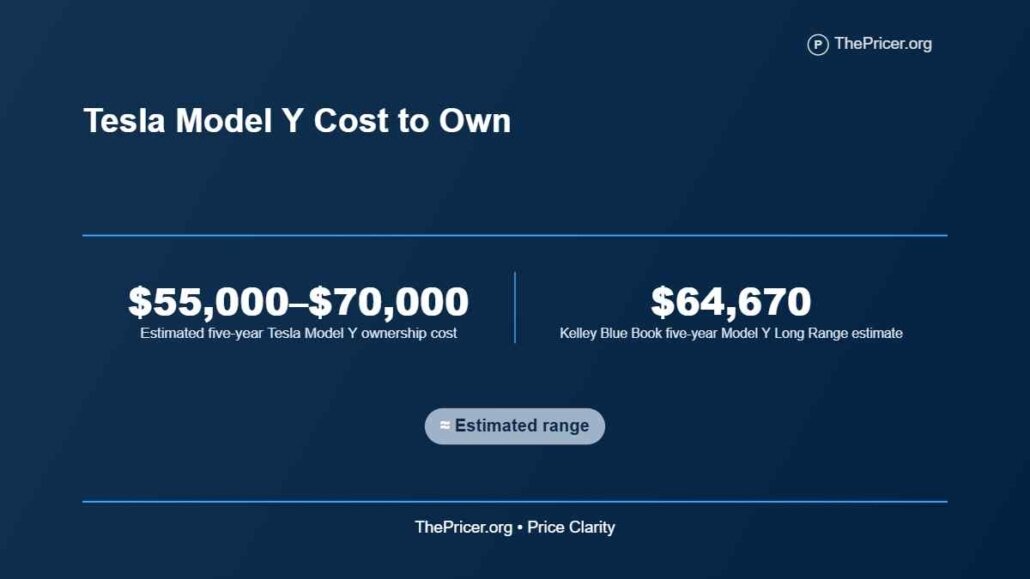
A Tesla Model Y costs approximately $55,000 to $70,000 to own over five years in the United States when depreciation, insurance, electricity, financing, registration, maintenance, and repairs are included.
Kelley Blue Book’s current estimate for a 2026 Model Y Long Range is $64,670 over five years, equivalent to about $12,934 annually or $1,078 per month.
The purchase price is only one component. A new Model Y Rear-Wheel Drive starts at $39,990 before applicable taxes, destination and order fees, options, and other charges.
Insurance and depreciation can cost substantially more than electricity and routine maintenance combined.
Ownership costs depend on the trim, financing arrangement, state, annual mileage, insurance profile, charging access, and resale value. A driver who charges at home and pays cash may spend far less than someone financing a Performance model and relying on public fast chargers.
Article Highlights
Jump to sections
- Five-year ownership estimate: Approximately $55,000 to $70,000 for many new Model Y scenarios, with $64,670 in Kelley Blue Book’s current Long Range calculation.
- Starting vehicle price: $39,990 for the Model Y Rear-Wheel Drive, before taxes and additional charges.
- Insurance: Recent studies place full-coverage premiums around $3,100 to $3,800 annually, although individual quotes vary considerably.
- Home charging: Approximately $650 annually in a modeled 12,000-mile scenario using current national electricity prices and charging losses.
- Depreciation: Kelley Blue Book projects $30,612 in five-year value loss for its 2026 Model Y Long Range example.
- Maintenance: Routine service requirements are relatively limited, but tires, filters, repairs, and eventual out-of-warranty work remain owner expenses.
How Much Does Tesla Model Y Ownership Cost?
Ownership cost is not the same as the amount paid to purchase the vehicle. A buyer owns an asset that retains some resale value, while expenses such as insurance, electricity, interest, and maintenance are consumed over time.
For a 2026 Model Y Long Range, Kelley Blue Book’s ownership model currently estimates the following five-year costs:
| Ownership expense | Estimated five-year cost | Average per year |
|---|---|---|
| Depreciation | $30,612 | $6,122 |
| Insurance | $15,615 | $3,123 |
| Financing | $5,438 | $1,088 |
| Taxes and state fees | $6,359 | $1,272 |
| Electricity | $2,986 | $597 |
| Maintenance | $1,156 | $231 |
| Repairs | $2,504 | $501 |
| Total | $64,670 | $12,934 |
Figures are rounded to the nearest dollar. This is a modeled ownership estimate for a particular vehicle configuration and market, not a guaranteed bill or national average.
The two largest expenses are depreciation and insurance. Together, they account for $46,227, or approximately 71.5% of the projected five-year total.
Electricity accounts for only about 4.6%. This explains why comparing an EV’s electricity spending against a gasoline vehicle’s fuel spending cannot, by itself, establish which vehicle is cheaper to own.
Edmunds’ ownership methodology provides another useful framework. Its five-year calculations incorporate depreciation, insurance, financing, fees, energy, maintenance, and repairs while assuming 15,000 miles of annual driving, a 10% down payment, and a 60-month loan. Those assumptions may differ from a buyer’s actual circumstances.
What Does the Model Y Cost to Purchase?
Tesla’s current U.S. vehicle configurator lists the entry Model Y Rear-Wheel Drive at $39,990 before applicable additional charges.
The Model Y lineup also includes more expensive all-wheel-drive, Premium, and Performance configurations. Equipment, range, wheel size, seating arrangements, and performance affect the final price.
An August 2026 Model Y pricing comparison listed approximately $51,630 for Premium AWD and $59,630 for Performance, using its published pricing basis. Tesla changes vehicle prices and available configurations, so the current order summary should control any buying decision.
Sales tax also matters. A hypothetical $45,000 Model Y purchase in a jurisdiction charging 7% sales tax adds $3,150 before registration or other fees. A state without comparable vehicle sales tax could produce a materially different initial bill.
Federal incentives have also changed. The Internal Revenue Service confirms that the former federal clean-vehicle purchase credits are unavailable for vehicles acquired after September 30, 2025. A buyer ordering a Model Y in November 2026 should not subtract the former $7,500 new-EV credit from the purchase price.
State, local, and utility incentives may still exist, depending on location and eligibility.
For the broader Tesla lineup and different configurations, compare current prices with Tesla vehicle purchase costs. Older published Tesla prices should not be treated as current configurator offers.
How Much Does Charging a Model Y Cost?
 Home charging is one of the Model Y’s most predictable operating expenses. Electricity consumption depends on the drivetrain, wheels, driving conditions, speed, weather, and climate-control use.
The EPA’s 2026 Model Y Standard RWD rating lists 24 kWh per 100 miles with 18-inch wheels. Its separate Long Range AWD rating lists 27 kWh per 100 miles.
The U.S. Energy Information Administration’s latest residential electricity figures put the August 2026 national average near $0.1816 per kWh.
At 12,000 miles annually, a Long Range AWD using 27 kWh per 100 miles consumes an estimated 3,240 kWh at the vehicle:
- Annual driving: 12,000 miles
- Rated energy use: 27 kWh per 100 miles
- Vehicle energy consumption: 3,240 kWh
- Illustrative additional charging energy: 10%
- Electricity purchased: 3,564 kWh
- Electricity price: $0.1816/kWh
- Estimated annual home-charging cost: $647.22
That equals approximately $53.94 monthly or 5.39 cents per mile. The 10% allowance is an illustrative charging-loss assumption, not a fixed Tesla efficiency figure.
Using the same energy demand at a hypothetical public fast-charging price of $0.45/kWh would cost $1,603.80 annually. The difference is $956.58 per year, or almost $4,783 over five years.
Public charger prices are location-specific, so this comparison demonstrates sensitivity rather than a national Supercharger average. Drivers can review charging scenarios in the Tesla charging cost comparison.
Home charging may also require an initial installation. Tesla currently lists its Wall Connector hardware at $585, excluding electrical installation. Depending on the home’s panel and parking arrangement, installing a dedicated circuit can add hundreds or thousands of dollars.
For electrical work involving a new circuit, permits, wiring, or panel upgrades, see EV charger installation costs.
How Much Is Tesla Model Y Insurance?
Insurance is often one of the largest annual expenses for a Model Y owner, especially when full collision and comprehensive coverage is required by a lender.
In its September 2026 vehicle data, Insurify’s insurance statistics showed an average annual full-coverage figure of approximately $3,799 for the Model Y.
Another 2026 insurance pricing study estimates approximately $3,836 annually for full coverage, compared with around $1,139 for liability-only insurance under its assumptions.
These figures are not guaranteed premiums. A person’s age, ZIP code, accident record, coverage limits, deductible, annual mileage, selected insurer, and Model Y year can change the quote substantially.
A buyer paying $3,800 annually for insurance spends $19,000 over five years if rates remain constant. Someone securing otherwise comparable coverage for $2,400 annually would spend $12,000, saving $7,000.
That difference exceeds several years of home charging in the earlier calculation. Obtain insurance quotes using the exact vehicle identification number before placing a nonrefundable order.
Maintenance, Tires, and Repairs
The Model Y does not need engine oil changes, spark plugs, engine air filters, or conventional transmission-fluid service. That reduces routine service requirements but does not eliminate maintenance spending.
Tesla’s published Model Y intervals call for tire rotation every 6,250 miles or when tread-depth differences reach the specified threshold. Other scheduled items include cabin-filter replacement, brake-fluid health checks, wiper blades, and brake-caliper cleaning in areas where winter roads are salted.
Tires are a major variable. A Model Y driven aggressively on large performance-oriented wheels may need replacements sooner than a car driven conservatively on standard wheels.
For planning, assume a hypothetical set of replacement tires costs $1,000 installed and lasts 35,000 miles. The implied tire expense is approximately 2.86 cents per mile, or $343 annually at 12,000 miles.
If the same driver receives only 25,000 miles from a set, the cost rises to 4 cents per mile, or $480 annually. These are illustrative tire-price and lifespan assumptions, not verified national Model Y averages.
The Model Y also has a manufacturer warranty. Tesla’s U.S. warranty terms include a four-year, 50,000-mile basic vehicle warranty. Battery and drive-unit protection extends longer, with the applicable mileage limit depending on the configuration and a stated minimum battery-capacity retention requirement.
Warranty coverage lowers exposure to some early defects but does not protect against every repair, accident, cosmetic problem, tire replacement, or excluded type of damage.
Battery replacement is a separate long-term risk. Research into Tesla battery replacement costs places out-of-warranty pack replacement in the five-figure range in some circumstances. An owner should check warranty eligibility and obtain a vehicle-specific diagnosis before treating a battery warning as proof that the entire pack needs replacement.
Depreciation and Financing
Depreciation is the decline in the Model Y’s market value between purchase and sale. It is usually invisible in the monthly household budget, but it becomes real when the owner sells or trades in the car.
Kelley Blue Book’s current five-year Model Y Long Range estimate assumes depreciation of $30,612 and a residual value of $16,018. Those figures imply a modeled initial vehicle value of $46,630 and approximately 65.6% value loss.
That forecast is not a guaranteed resale offer. Used-EV prices can change with new-vehicle discounts, competing EV prices, battery technology, vehicle mileage, condition, and local demand.
The purchase financing arrangement produces a second major difference.
Consider a hypothetical $45,000 Model Y purchase with a 10% down payment, leaving $40,500 financed over 60 months at 7% APR.
The monthly principal-and-interest payment is approximately $802, and interest over the five-year loan is approximately $7,614. This excludes taxes, fees, and optional extras financed into the loan.
Paying cash would avoid that borrowing cost but require more money upfront. The financed amount must not be added to depreciation as another full ownership expense because much of the loan payment simply repays the vehicle’s purchase value.
For cost-of-ownership accounting, count depreciation and financing interest. For monthly cash-flow budgeting, count the actual loan payment. Mixing both methods overstates the cost.
Three Ownership Scenarios
The following cases demonstrate how charging access and insurance can change spending. They are illustrative budgets, not dealership quotations or independently measured national averages.
Case 1: Home-charging commuter. A driver travels 12,000 miles annually, charges mostly at home, and pays $2,400 per year for insurance. Using the calculated $647 annual electricity cost and an assumed $700 for maintenance and repair budgeting produces approximately $3,747 annually in those three operating categories. Depreciation, taxes, financing, and charging equipment remain separate.
Case 2: Public-charging driver. The same mileage and assumed insurance and maintenance costs, but charging entirely at an illustrative $0.45/kWh, produces approximately $4,704 annually. The difference is almost entirely the charging rate.
Case 3: Higher-insurance household. A Model Y owner paying $3,800 annually for full coverage, charging at home for approximately $647, and budgeting $900 for maintenance and repairs would spend around $5,347 annually before depreciation, financing, taxes, and registration.
In all three scenarios, the final five-year economic cost is higher once vehicle value loss and acquisition expenses are accounted for.
Makes sense if:
- You can charge regularly at home or work at relatively low electricity rates.
- You obtain competitive insurance quotes before purchasing.
- You expect to keep the vehicle long enough to spread initial acquisition expenses across several years.
- You value low routine maintenance and are comfortable with the vehicle’s resale-value risk.
Does not make sense if:
- You depend almost entirely on expensive public fast charging.
- Your insurance premium is substantially higher than the cost for comparable vehicles.
- You expect to sell within a short period and would absorb substantial early depreciation.
- Your budget cannot comfortably handle the combined car payment, insurance, registration, charging, and unexpected expenses.
Answers to Common Questions
How much does a Tesla Model Y cost per month to own?
Kelley Blue Book’s five-year estimate of $64,670 works out to approximately $1,078 per month when depreciation and other modeled ownership expenses are spread across 60 months. This is an economic cost, not a required monthly payment to Tesla.
Is charging a Tesla Model Y cheaper than buying gasoline?
Home charging can be substantially cheaper per mile than gasoline, but the comparison depends on local electricity and gasoline prices, the gasoline vehicle’s fuel economy, and charging losses. Public fast charging narrows the difference. Fuel savings alone do not determine total ownership cost.
Does a Tesla Model Y require expensive maintenance?
It avoids several routine combustion-engine services. Tires, filters, brake inspections, wiper blades, and other wear items still require attention. Repair expenses vary, particularly after the vehicle’s applicable warranty periods end.
Does the Tesla Model Y qualify for the $7,500 federal tax credit in 2026?
Not for a new purchase made in November 2026. The former federal clean-vehicle purchase credit ended for vehicles acquired after September 30, 2025. State and utility incentives should be checked separately.
Disclosure: Educational content, not financial advice. Prices reflect public information as of the dates cited and can change. Confirm current rates, fees, taxes, and terms with official sources before purchasing. See our methodology and corrections policy.