
How Much Does The Airsupra Inhaler Cost?
Updated on | Written by Alec Pow
This article was researched using 14 sources. See our methodology and corrections policy.
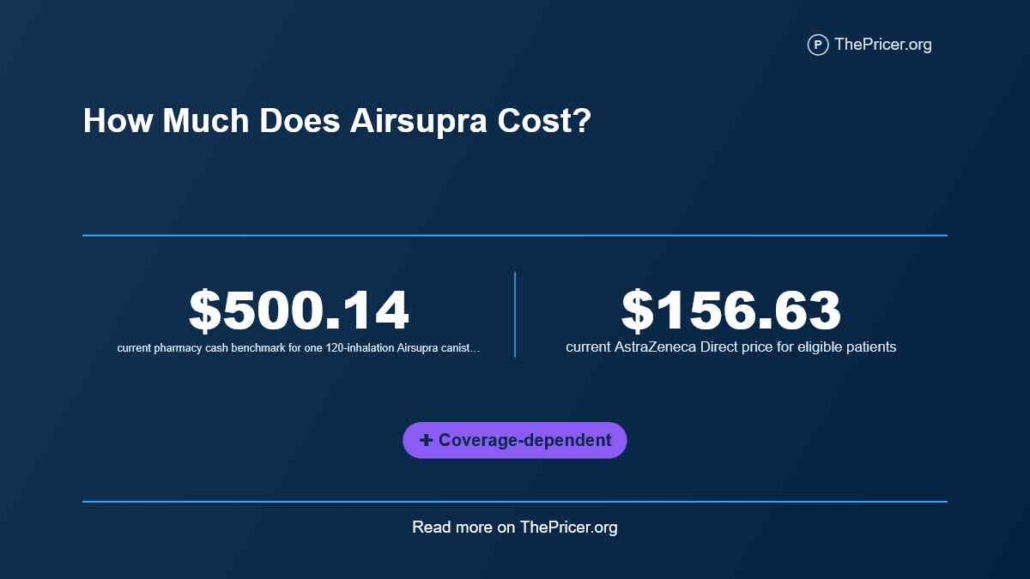
Airsupra typically costs about $500 for one 120-inhalation canister when a patient pays a pharmacy cash price, although the amount at the counter can move well above or below that figure. Drugs.com currently lists a 10.7-gram canister at about $500.14 in its current cash-price benchmark.
The amount a patient actually pays can be far lower. Insurance, manufacturer support, direct purchase, and pharmacy discount programs create separate payment routes. The lowest advertised figure is not available to every patient, so eligibility matters as much as the sticker price. Prices below refer to U.S. patients and one standard 120-inhalation canister unless another unit is stated.
Article Highlights
Jump to sections
- A current pharmacy cash benchmark for one 120-inhalation Airsupra canister is about $500.14 (at $30 per hour, earning that amount would take about 2.1 full-time workdays, before taxes).
- AstraZeneca lists a direct-purchase price of $156.63 per inhaler for eligible patients.
- The manufacturer reports average out-of-pocket spending of $67 per month with commercial insurance and $53 with Medicare Part D.
- Eligible commercial patients may pay as little as $0 or $15 per inhaler under different SUPRA Savings Card rules.
- One 120-inhalation canister contains 60 standard two-puff doses.
- No FDA-approved generic version of Airsupra is currently available.
How Much Does Airsupra Cost?
The cash price depends on the pharmacy and discount route. SingleCare listed a normal cash price of $695.81 (about 2.9 full-time workdays at $30 per hour) and a discounted price of $456.43 for one 10.7-gram, 120-inhalation canister in its September 2026 pricing data. Those figures are useful market references, not guaranteed checkout quotes. Discount-card prices can vary by pharmacy, location, and the day the prescription is filled.
There is also a manufacturer-run direct-purchase route. AstraZeneca Direct currently says Airsupra may be available to eligible patients for $156.63 per inhaler through its direct-purchase program. That is $343.51 below the $500.14 Drugs.com cash benchmark, a calculated difference of about 69%. This comparison uses two current public prices and does not imply that every patient qualifies for the direct route.
| Payment route | Current published amount | Scope |
|---|---|---|
| Pharmacy cash benchmark | $500.14 | 10.7 g, 120 inhalations, cash-paying customer |
| SingleCare discount example | $456.43 | 10.7 g, 120 inhalations, participating pharmacy discount |
| AstraZeneca Direct | $156.63 | One inhaler for eligible direct-purchase patients |
A single statement such as “Airsupra costs $500” misses the part of the bill that matters most. A patient paying cash at a retail pharmacy, a patient using a commercial plan, and a patient qualifying for manufacturer assistance can face very different prices for the same inhaler. The useful starting point is the payment route, followed by the pharmacy price and eligibility rules.
What One Inhaler Buys
Airsupra combines albuterol and budesonide in one metered-dose rescue inhaler. The current FDA prescribing information states that it is indicated for as-needed treatment or prevention of bronchoconstriction and to reduce the risk of asthma exacerbations in patients age 18 and older. Each actuation delivers 90 mcg of albuterol and 80 mcg of budesonide. One dose is two inhalations taken as needed, with a maximum of six doses, or 12 inhalations, in 24 hours.

The standard canister has 120 inhalations, so it contains 60 two-puff doses. Using the $500.14 (about 2.1 full-time workdays at $30 per hour) cash benchmark above, a fully used canister works out to about $8.34 per two-puff dose. Using the $156.63 AstraZeneca Direct figure, the same calculation comes to about $2.61 per two-puff dose. Those are cost calculations, not dosing advice, and they exclude office visits, insurance premiums, taxes, and any other medicines.
The dose count also explains why a fixed “monthly Airsupra cost” can be misleading for a cash-paying patient. Airsupra is used as needed rather than on a fixed four-times-daily schedule. Refill frequency can differ sharply from one person to another. A monthly insurance statistic can still describe claims spending, but it should not be read as a rule that every patient consumes one full inhaler every month.
Insurance Changes the Bill
AstraZeneca lists an Airsupra price of $503.93 per inhaler, based on RedBook data from January 2026. Its current affordability information also reports average out-of-pocket costs of $67 per month for people with employer or individual commercial insurance and $53 per month for people with Medicare Part D. For Medicaid, the reported range is $0.77 to $1.50 per month, with some states charging less or no copay.
Those figures come from an IQVIA Formulary Impact Analyzer audit covering the 12 months ending December 2025 and are based on a 30-day prescription supply. They are averages across covered claims, not a promise for a particular plan. A deductible, formulary tier, prior authorization rule, pharmacy network, or noncoverage decision can make one patient’s bill very different from the reported average.
Insurance also creates a comparison problem. The $67 commercial average and $53 Medicare average describe patient out-of-pocket spending, while the $503.93 figure is a list-price reference. They measure different parts of the transaction. A patient deciding how to pay should compare the actual plan copay against any eligible self-pay or assistance route rather than treating list price as the amount insurance patients normally hand over at the pharmacy.
SUPRA Savings Card Rules
The SUPRA Savings Card can cut the price much further for some commercially insured patients. Under the current savings-card terms, eligible commercially insured patients whose coverage has no listed restriction may pay as little as $0 per inhaler. If a commercial plan does not cover Airsupra or applies a managed-care restriction, an eligible patient may pay as little as $15 per inhaler, subject to the program’s savings limits and other terms.
The $15 figure is not a general uninsured price. That distinction matters because a cash-paying reader could otherwise pursue a program that does not fit the stated eligibility rules. The card excludes patients enrolled in state- or federally funded prescription insurance programs, including Medicare Part D and Medicaid. The terms also say the offer cannot be combined with another offer. Taxes may remain the patient’s responsibility where applicable.
A patient with commercial insurance should compare three numbers before paying. Those are the normal plan copay after the pharmacy processes the claim, the savings-card amount if the patient meets the terms, and any available direct or discount price. The lowest public number is useful only when the patient can lawfully use that payment route. This is why Airsupra’s true cost is better described as an eligibility problem plus a pharmacy-price problem rather than one universal retail figure.
Help Without Commercial Coverage
People without commercial insurance have a different assistance path. Airsupra appears on the AZ&Me medication list, AstraZeneca’s patient-assistance program. This is separate from the SUPRA commercial co-pay card. Patients should not assume that failing one program means they fail the other because the insurance and income rules are different.
For 2026, the AZ&Me eligibility rules place primary and specialty medicines at or below 300% of the Federal Poverty Level. In the 48 contiguous states, the published annual income limits are $47,880 for one person, $64,920 for two people, and $99,000 for four people. Applicants must also be U.S. residents, be treated by a U.S.-licensed provider, and meet the program’s insurance and other-assistance requirements. Medicare beneficiaries face extra program conditions tied to Medicare Extra Help eligibility.
For an uninsured patient who does not qualify for AZ&Me, the price comparison returns to retail discounts and direct purchase. The $156.63 AstraZeneca Direct figure can be far below a $500+ pharmacy cash benchmark when its eligibility and fulfillment rules fit the patient. A local pharmacy discount may also beat an undiscounted cash quote. Comparing those routes before the prescription is processed can prevent a several-hundred-dollar difference on a single inhaler.
Airsupra vs Cheaper Inhalers
A cheaper inhaler price does not mean the product is a direct substitute for Airsupra. Generic albuterol is a useful price reference because it is widely used as a rescue bronchodilator. Drugs.com currently lists 90 mcg albuterol inhalation aerosol from about $38.66 for 18 grams in its albuterol cash-price data. Readers comparing rescue-inhaler expenses can also see the cost of albuterol inhalers, but medication choice belongs with the prescribing clinician because Airsupra also contains inhaled budesonide.
Another common comparison is Symbicort or generic budesonide/formoterol. That comparison needs a correction from older descriptions of Airsupra. Symbicort contains budesonide and formoterol, not albuterol. Current budesonide-formoterol cash pricing starts around $194.76 for 10.2 grams at the 160 mcg/4.5 mcg strength. It is a different drug combination with different labeled uses, so comparing sticker prices alone does not establish an interchangeable treatment. Readers researching controller-inhaler costs may also find the cost of Advair useful as a separate price reference.
Airsupra also remains brand-only. Drugs.com reported in August 2026 that the FDA had not approved a generic Airsupra. That helps explain why “generic Airsupra” is not currently a valid low-cost route. Lower-priced asthma inhalers exist, but their ingredients, approved roles, dosing, and clinical fit can differ. Price research can narrow the financial options without deciding which medicine a patient should use.
The Hidden Cost Is Usage
The hidden cost in an as-needed inhaler is refill frequency. One Airsupra canister contains 60 standard two-puff doses. As an illustrative budgeting exercise, one dose per week would make 60 doses last about 60 weeks. Three doses per week would use the same canister in about 20 weeks. One dose per day would use 60 doses in about 60 days. These examples are arithmetic scenarios, not suggested use patterns. Actual use should follow the prescription and the FDA-labeled limits.
That usage difference changes the annual budget more than a simple “per month” label suggests. Consider an illustrative patient who fills three 120-inhalation canisters in one year. At the $500.14 cash benchmark, three inhalers total $1,500.42. At the current $156.63 direct-purchase figure, three total $469.89. The difference is $1,030.53 for the same assumed three-canister quantity. This example excludes medical visits, insurance premiums, taxes, and unrelated asthma medicines.
The per-dose view tells the same story at a smaller scale. A fully used $500.14 canister costs about $8.34 per two-puff dose, while a fully used $156.63 canister costs about $2.61 per two-puff dose. The financial value of a lower purchase price grows with the number of refills. Cost math should never be used to stretch doses, delay a needed refill, or change prescribed use. Its purpose is to show why checking the payment route before each fill can matter.
Choosing a Payment Route
The lowest legitimate price depends on coverage status. Commercial insurance can produce a low copay, and some commercial plans may qualify for the SUPRA card. Patients with other coverage need to compare their plan price with assistance routes that accept their insurance type. Uninsured patients can compare direct purchase, pharmacy discounts, and AZ&Me eligibility before accepting a high retail quote.
Price should stay separate from medical suitability. Airsupra is an as-needed albuterol-budesonide product for adults with asthma. A prescriber or pharmacist can address whether it fits a treatment plan, while the patient compares payment routes after the prescription is chosen. The cost of allergy testing is a separate expense for readers investigating diagnostic costs.
Makes sense if
- Your insurance claim is cheaper than the available self-pay prices.
- You meet the current SUPRA Savings Card terms.
- AstraZeneca Direct at $156.63 beats your local quote and you qualify.
- You meet AZ&Me insurance and income rules.
Does not make sense if
- A savings program excludes your insurance type.
- You assume $0, $15, or $156.63 applies before checking eligibility.
- You change inhalers solely because another cash price is lower.
- You turn a monthly average into an annual bill without checking refill frequency.
Answers to Common Questions
How much does Airsupra cost without insurance?
A current cash benchmark is about $500.14 for one 10.7-gram, 120-inhalation canister. Pharmacy discount programs and eligible direct purchase can lower that amount, so an uninsured patient may see a much lower quote than the undiscounted cash price.
Can Airsupra cost $0?
Yes. Eligible commercially insured patients can pay as little as $0 per inhaler under the current SUPRA Savings Card terms. Eligibility restrictions and savings limits apply.
Is the $15 Airsupra price for uninsured patients?
No. The current $15 per inhaler level is tied to certain eligible commercially insured patients whose plan does not cover Airsupra or applies a listed restriction. It is not a general uninsured cash price.
How many doses are in an Airsupra inhaler?
A standard canister contains 120 inhalations, equal to 60 two-puff doses. The FDA-labeled maximum is six doses, or 12 inhalations, in 24 hours. Patients should follow their prescription and clinician’s instructions.
Is there a generic Airsupra?
No FDA-approved generic Airsupra was available as of August 2026. Lower-cost asthma inhalers exist, but they are not automatically equivalent substitutes for Airsupra.
Disclosure: Educational content, not medical advice. Pricing varies by provider, location, and insurance. Confirm eligibility, coverage, and out-of-pocket costs with a licensed clinician and your insurer. See our methodology and corrections policy.