
How Much Does the Army’s CIRCM Anti-Missile System Cost?
Published on | Written by Alec Pow
This article was researched using 14 sources. See our methodology and corrections policy.
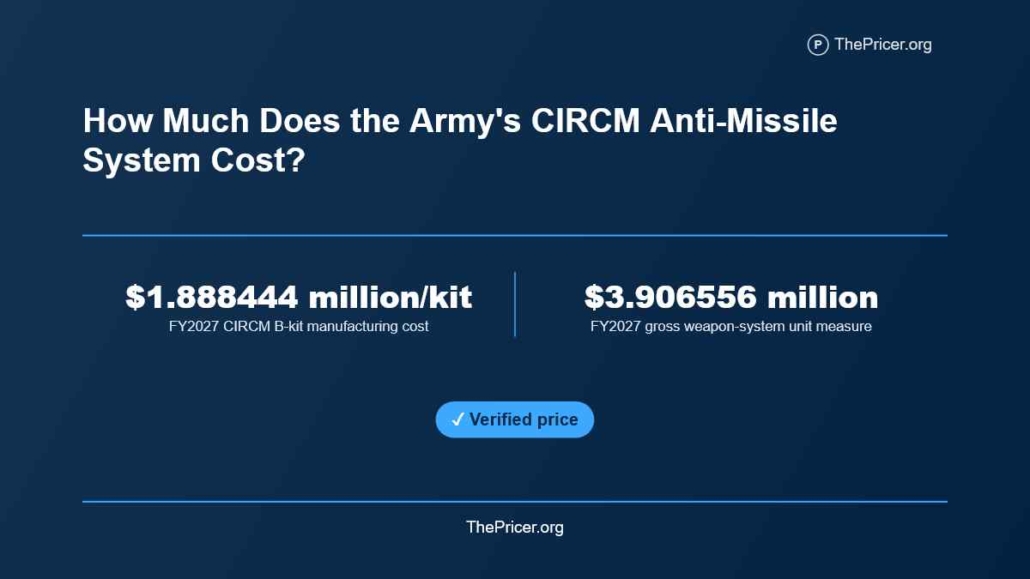
The U.S. Army’s Common Infrared Countermeasures system, known as CIRCM, has a current FY2027 B-kit manufacturing cost of $1.888444 million per kit. The same Army procurement budget shows a gross weapon-system unit cost of $3.906556 million, a total FY2027 procurement line of $140.636 million, and 172 A-kits at an average manufacturing and installation measure of $150,779 each. The annual line includes far more than one B-kit, including A-kit work, fielding, software, engineering, depot preparation, and testing.
CIRCM is an aircraft self-protection jammer for infrared-guided missiles. It does not fire an interceptor at the incoming weapon. That distinction matters for cost because the Army buys mission kits, aircraft installation hardware, integration work, software, and support across separate cost elements rather than purchasing one complete “anti-missile system” at a retail-style price.
Article Highlights
Jump to sections
- The FY2027 CIRCM B-kit manufacturing figure is $1.888444 million per kit.
- The Army’s FY2027 gross weapon-system unit measure is $3.906556 million.
- FY2027 procurement totals $140.636 million (at $30 per hour, earning that amount would take about 2.3 thousand years of full-time work, before taxes) for 36 procurement units plus broader program work.
- The A-kit manufacturing and installation line averages $150,779 across 172 kits, but aircraft type changes the real installation cost.
- The 2023 acquisition report carried a then-year program acquisition estimate of $6.5992 billion.
How Much Does the Army’s CIRCM Anti-Missile System Cost?
The cleanest current hardware figure is the B-kit manufacturing unit cost, not the gross weapon-system number. The FY2027 line buys 36 B-kits at the published manufacturing figure cited above. Multiplying 36 by $1.888444 million produces roughly $67.984 million (about 1.1 thousand years of full-time work at $30 per hour), which matches the B-kit manufacturing total after rounding in the Army cost table.
The gross unit measure answers a different accounting question. Dividing the full FY2027 procurement line of $140.636 million by the 36 procurement units gives about $3.906556 million per procurement unit. That arithmetic does not mean a single aircraft receives a box of hardware worth nearly $3.91 million. The numerator includes many activities that support the program and many A-kits whose quantity is not 36.
For a reader asking what one current CIRCM mission kit costs, the better public answer is about $1.89 million for the FY2027 B-kit manufacturing measure. For a reader asking what the Army is budgeting per procurement unit after spreading the broader annual line across 36 units, the answer is about $3.91 million. Both figures are valid within their own scope. Treating them as interchangeable would overstate the price of the B-kit itself.
What CIRCM Actually Buys
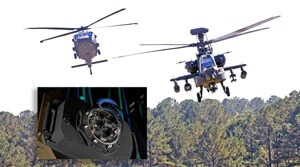
CIRCM protects Army aircraft from infrared-guided missile threats by receiving a threat handoff from the aircraft’s warning system, tracking the incoming missile, and directing modulated laser energy at the missile seeker. The Army’s aircraft survivability program page describes CIRCM as working with missile-warning systems and identifies a configuration built around two pointer trackers, two lasers, and one system processing unit. The system is designed to track the handed-off threat and jam the missile seeker with laser energy.
That hardware is the B-kit, the portable mission portion of CIRCM. The B-kit does not include every part needed to place the equipment on a specific helicopter. The host aircraft also needs an A-kit with mounting hardware, wiring assemblies, interfaces, and other platform-specific pieces. The Army can move the same B-kit concept across multiple aircraft families while changing the A-kit to fit the host.
This is why a CIRCM “unit” can mean different things in public paperwork. One document may count B-kits. Another may count A-kits. A budget line can spread software, installation, fielding, engineering, and test work across a smaller procurement denominator. Anyone comparing CIRCM prices should identify the unit before comparing dollar figures. Readers looking at the aircraft themselves can compare the broader procurement context in the Apache helicopter cost and Black Hawk helicopter cost pages.
A-Kit vs B-Kit
Using the FY2027 A-kit inputs established in the opening budget passage, 172 kits multiplied by the average $150,779 (about 2.4 years of full-time work at $30 per hour) manufacturing and installation measure produces about $25.934 million. That average is not a universal installed-aircraft price. An Army A-kit description explains that the installation kit contains the aircraft wiring and related hardware needed before the B-kit can be fitted, which makes host-aircraft configuration part of the cost question.
A practical installation model starts with two pieces. The B-kit supplies the laser jamming mission hardware. The A-kit makes the host aircraft physically and electrically prepared for the mission kit. Adding the published FY2027 averages produces an illustrative hardware-plus-A-kit figure of about $2.039223 million. That sum is useful only as a simple reference. It does not represent a quoted installed price because A-kit content changes with the host aircraft.
The platform issue matters because CIRCM is fielded across helicopters with very different airframes and mission equipment. Northrop Grumman reports more than 750 shipsets delivered and 75,000 operational flight hours across AH-64, CH-47, and UH-60 platforms. A retrofit on one type can require different brackets, wiring, access time, and pod work than another, so one blended A-kit number should not be turned into a flat installation quote.
Inside the FY2027 Bill
The FY2027 procurement request totals $140.636 million. The itemized values below come from the Army procurement budget linked in the opening passage and reconcile to that published total. The figures include recurring production, software, fielding, engineering, test support, and depot work in addition to B-kits and A-kits. The table also separates hardware-linked spending from fleet support work that does not rise one-for-one with B-kit quantity.
| FY2027 CIRCM cost element | Amount |
|---|---|
| A-kit manufacturing and installation | $25.934 million |
| B-kit manufacturing | $67.984 million |
| Other recurring production | $10.460 million |
| Depot stand-up | $10.555 million |
| Jam-code updates and software support | $1.500 million |
| Cybersecurity | $1.000 million |
| Technical publications | $0.300 million |
| Engineering change proposals | $0.325 million |
| Fielding | $8.428 million |
| System engineering | $11.150 million |
| Test and evaluation support | $3.000 million |
| Total | $140.636 million |
ThePricer’s decomposition gives another useful view of the same request. B-kit manufacturing accounts for about 48.34 percent of the line. A-kit manufacturing and installation account for about 18.44 percent. The remaining $46.718 million, or about 33.22 percent, goes to the other production and support elements shown in the table. This is the main reason the gross unit measure sits far above the B-kit manufacturing figure.
Why the Unit Price Is Rising
The FY2027 B-kit manufacturing cost is materially higher than the FY2024 figure. The FY2026 Army procurement history shows an FY2024 B-kit unit cost of $1.201328 million for 125 kits. Compare that cited historical input with the FY2027 $1.888444 million figure and 36-kit quantity established earlier. The increase is $687,116 per B-kit, or about 57.2 percent, while annual quantity falls by 89 kits, or 71.2 percent.
The Army does not attribute that increase to quantity alone. Its budget remarks say the higher B-kit cost reflects lost economies of scale from buying fewer kits and the move to the new Jupiter laser, which costs more than the legacy Solaris laser. The same remarks say annual quantities will be lower to stay within the planned funding profile.
The laser change also affects the hardware itself rather than merely the accounting denominator. A smaller production run can raise unit cost through weaker scale economics, while a more expensive laser can raise the material content at the same time. The Army budget supports both drivers, so the 57.2 percent rise should not be attributed to quantity reduction alone. The exact contribution of each driver is not separated in the public cost table.
Contracts Are Not Unit Prices
 Large CIRCM contract headlines can look like unit prices when the quantities and service content are stripped away. A January 2026 FRP2 contract record lists a potential value near $159.6 million for full-rate production and services in the first year. The accessible record does not provide a clean compatible B-kit quantity that would support dividing that ceiling into a defensible per-kit price.
The earlier production vehicle is larger. A federal contract history shows the 2021 CIRCM indefinite-delivery contract with an initial value of $959.104178 million, a later ceiling of $998.204178 million, and about $904.1 million obligated through the vehicle. Those figures cover a contract mechanism that supports multiple delivery orders and services rather than one shipment.
A contract ceiling tells readers how much purchasing authority can sit under a vehicle. It does not tell them what one B-kit, one installed helicopter, or one year’s production costs. Delivery orders can mix production hardware with engineering, field support, logistics, or schedule-specific work. A per-unit calculation is defensible only when the numerator and quantity describe the same set of deliverables.
Foreign Sales Cost Differently
Foreign Military Sales provide useful package examples, but their dollar values include buyer-specific scope. A 2026 Netherlands sale notification covers 10 CIRCM systems with $65 million in major defense equipment and $85 million in total new items.
Dividing the MDE figure by 10 gives $6.5 million of MDE per notified system. The extra $20 million covers non-MDE content in the new-item increase, so the result is an export-package normalization rather than a U.S. Army B-kit price.
Australia shows a different package ratio. Its 2026 CIRCM sale notification adds up to 33 systems, with 29 planned for installation and four as spares, and adds $140 million in major defense equipment plus $150 million in total new items. Dividing $140 million by 33 produces about $4.24 million of MDE per system.
The gap between the Netherlands and Australia normalizations does not prove one ally was charged a higher bare-system price. Package composition, spares, support, installed quantity, government services, and other equipment can differ. These examples are best used to show how export scope can move the apparent per-system figure well above the Army’s domestic B-kit manufacturing measure.
Program Cost Beyond Hardware
CIRCM spending continues outside the aircraft-procurement line. The FY2027 Army research budget requests $11.573 million for CIRCM development, integration, test activity, additional B-kit test hardware, and threat and vulnerability analysis. Adding that RDT&E amount to the $140.636 million procurement request produces a calculated FY2027 procurement-plus-RDT&E total of $152.209 million.
The broader acquisition history is much larger. The December 2023 CIRCM acquisition report carried a then-year total acquisition estimate of $6.5992 billion, a program acquisition unit cost of $3.241 million, and an average procurement unit cost of $2.773 million across a planned procurement end-item quantity of 1,988 B-kits. Those are dated lifecycle program measures, not replacements for the FY2027 manufacturing figure.
Use the B-kit number when the question is current mission-kit production. Use the gross unit measure when studying the annual procurement line. Use contract values for purchasing-vehicle scope, export notices for buyer-specific packages, and the acquisition report for historical program economics.
A ground-based interceptor system such as Patriot has a very different cost unit and mission structure, which is why the Patriot missile-system cost is a poor direct unit-price comparison even though both systems protect forces from missile threats.
Use this figure when
- Use $1.888444 million for the current FY2027 B-kit manufacturing measure.
- Use $3.906556 million for the Army’s FY2027 gross procurement-line unit measure.
- Use FMS package math only when comparing the same buyer scope and equipment class.
Do not compare directly when
- A contract ceiling contains production and services but lacks a compatible kit quantity.
- An export package contains spares, support, training, government services, or extra equipment.
- A historical lifecycle metric is being compared with one current year’s manufacturing cost.
Answers to Common Questions
How much does one Army CIRCM B-kit cost?
The FY2027 Army budget lists B-kit manufacturing at $1.888444 million per kit, or about $1.89 million.
Why does the Army also show a CIRCM cost near $3.91 million?
The $3.906556 million figure is a gross weapon-system unit measure created from the broader procurement line. It includes spending beyond one B-kit.
Does CIRCM shoot down incoming missiles?
No. CIRCM tracks an infrared-guided missile and uses modulated laser energy to disrupt its seeker so the missile misses the aircraft.
How much is a CIRCM A-kit?
The FY2027 A-kit line averages $150,779 across 172 kits, but host-aircraft configuration makes that average unsuitable as one universal installed price.
How much has the whole CIRCM program cost?
The December 2023 acquisition report carried a then-year total acquisition estimate of $6.5992 billion. That historical lifecycle estimate is a different measure from the current annual B-kit price.
Disclosure: Educational content, not financial advice. Prices reflect public information as of the dates cited and can change. Confirm current rates, fees, taxes, and terms with official sources before purchasing. See our methodology and corrections policy.