
How Much Does the Bambu Lab R1 Cost?
Published on | Written by Alec Pow
This article was researched using 11 sources. See our methodology and corrections policy.
The Bambu Lab R1 costs $2,499 in the United States before sales tax, with shipping included. In the European Union, the launch price is €2,499 including tax but excluding shipping, while UK launch pricing is £2,249. The headline price buys the standalone machine, but a more complete R1 setup can cost roughly $3,289 to $3,699+ once you add long-material handling, air purification, fire protection, or precision accessories.
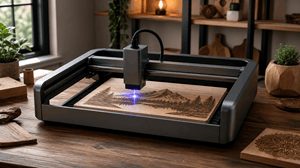
The Bambu Lab R1 is a 55W CO2 laser cutter and engraver, not a 3D printer. It is Bambu Lab’s first standalone product outside 3D printing and has a 600 × 300 mm work area, speeds up to 1,000 mm/s, automatic laser alignment, and the ability to cut materials including wood and clear acrylic. Bambu’s R1 launch announcement says pre-orders opened September 22, 2026, with shipping beginning in October.
Article Highlights
Jump to sections
- The Bambu Lab R1 has a $2,499 (at $30 per hour, earning that amount would take about 2.1 full-time workweeks, before taxes) U.S. launch price, before sales tax and with shipping included.
- EU pricing is €2,499 including tax but excluding shipping, while the UK launch price is £2,249.
- Adding the $899 E1 Pro Air Purifier brings a U.S. R1 setup to $3,398 before tax.
- The Long Material Bundle costs about $3,289, while the version adding rotary capability is about $3,499.
- The comparable 55W xTool P2S currently starts at $2,999, making the R1 about $500, or 16.7%, cheaper at the base-machine level.

How Much Does the Bambu Lab R1 Cost?
The $2,499 (about 2.1 full-time workweeks at $30 per hour) price is enough to operate the R1 if you have somewhere suitable to send the included exhaust hose. Buyers who need indoor filtration, longer-material support, or rotary engraving have a materially higher starting budget.
| R1 setup | Approx. U.S. cost | What you get |
|---|---|---|
| R1 standalone | $2,499 | 55W CO2 laser, short-focus lens, standard 600 × 300 mm work area |
| R1 + E1 Pro Air Purifier | $3,398 | Standalone R1 plus indoor smoke filtration |
| Long Material Bundle | $3,289 | R1, Riser Base, and Conveyor |
| Long Material + Rotary bundle | $3,499 | Long-material setup plus rotary processing |
| R1 + purifier + Vision Encoder + fire system | $3,696.99 | Indoor filtration plus added precision and automatic fire suppression |
The regional prices require careful comparison. Bambu charges $2,499 in the United States before tax but with shipping included. The €2,499 EU price already includes tax but not shipping. A TechRadar review of the R1 lists the UK launch price at £2,249 and confirms the same 55W CO2 specification.
At a $30 hourly wage, earning the $2,499 U.S. purchase price takes about 83.3 hours of gross work, before taxes. The $3,398 R1 plus purifier setup represents about 113.3 hours at the same wage.
What Is Included for $2,499?
The base R1 is more complete than the bare machine price may suggest. A hands-on R1 review from Tom’s Hardware reports that the unit arrives assembled and includes the cutting platform, exhaust hose, ventilation fan, tool kit, antifreeze, funnel, laser alignment sensor, calibration board, and a starter material pack with basswood plywood and clear acrylic.
A short-focus lens is also included. Bambu sells its medium- and long-focus lenses separately for buyers who need different cutting characteristics. The machine’s normal work area is 600 × 300 mm, or about 23.6 × 11.8 inches. With the Conveyor system, stock can extend to as much as 3,000 mm, or 9.8 feet.
This matters because the R1 is sometimes discussed as though it were another Bambu printer. It is a dedicated CO2 laser. If you are primarily comparing additive manufacturing equipment, our guide to 3D printer costs covers a very different market, where hobby machines can cost only a few hundred dollars. The R1 belongs closer to professional desktop laser cutters than to Bambu’s conventional printer lineup.
Accessory System
The biggest R1 cost surprise is ventilation. The included fan and exhaust hose can move fumes outdoors, so someone with a suitable window or dedicated exhaust route may genuinely be able to start at $2,499 (about 2.1 full-time workweeks at $30 per hour) plus tax. If outdoor venting is impractical, the E1 Pro Air Purifier costs about $899. That raises the hardware total to $3,398.
A detailed audit of the R1 launch listings and accessory prices found a $389 Riser Base, $499 Conveyor, $275.99 Rotary attachment, $199 Auto Fire Extinguishing System, and $99.99 Vision Encoder. Medium- and long-focus lenses were listed at $30.99 and $31.99. Guide-rail extensions for very long conveyor work were $99.99 each.
The same pricing research found a replacement laser tube assembly at $372. Bambu had not published a specific tube-life figure at launch, which makes that one of the harder long-term ownership expenses to turn into a per-hour estimate.
There is one launch discount that can reduce the filtration bill. In Bambu Lab’s official R1 pre-launch announcement, people who subscribed for R1 updates were offered 15% off a smoke purifier for 60 days after launch. That discount is for the purifier, not 15% off the R1 itself. Applied to an $899 purifier, 15% is $134.85, reducing the purifier to about $764.15 and the R1-plus-purifier combination to about $3,263.15 before tax.
Long-Material Bundles
Buying the R1, $389 Riser Base, and $499 Conveyor individually totals $3,387. The Long Material Bundle is about $3,289, which saves roughly $98.
Adding the $275.99 rotary attachment to those individual parts produces a combined price of approximately $3,662.99. The corresponding bundle is about $3,499, a savings of roughly $163.99.
Those bundles matter because some of the R1’s most visible capabilities require accessories. Furniture-length stock needs the Conveyor, and bottles, tumblers, and other cylindrical work require the Rotary attachment.
The R1 launch release confirms that the Riser Base, Conveyor, Rotary attachment, extra lenses, Vision Encoder, purifier, and automatic fire-extinguishing equipment are not part of the basic $2,499 package.
Safety Class
There is a cost issue that is easy to miss because it is not another item in the shopping cart. The standard enclosed R1 is rated as a Class 1 laser system during normal operation. Bambu says the enclosure contains the beam, so standard use does not require laser safety goggles.
Once the Riser Base or Conveyor is fitted, however, the enclosure is no longer complete. Bambu says the R1 then becomes a Class 4 laser system and is intended for trained professional use with appropriate CO2 laser eye protection. This means the $3,289 long-material configuration is not merely a larger version of the $2,499 setup. It changes the safety requirements around the machine.
Bambu’s official launch discussion also confirms the optional Vision Encoder is what keeps absolute motion accuracy within 0.1 mm across the work area. Buyers paying for very precise registration should therefore include the Encoder’s separate cost instead of assuming that level of accuracy comes with the base machine.
R1 vs Other CO2 Lasers
 The closest price comparison is the xTool P2S because both are 55W desktop CO2 machines. xTool’s current laser lineup lists the P2S from $2,999. Against the R1 at $2,499, Bambu is $500 cheaper, or about 16.7% below the P2S price.
That does not make the R1 the least expensive laser cutter on the market. Lower-powered diode machines cost much less, while larger commercial CO2 machines can cost much more. What makes the $2,499 figure interesting is the 55W output, clear-acrylic cutting capability, 600 × 300 mm bed, and automatic optical alignment at that price point.
Glowforge shows how broad the desktop laser category has become. Its current performance-laser range spans roughly $2,249 to $7,999, with 40W to 45W CO2 systems. That range is useful context, but it is not a direct specification match for the 55W R1.
Independent launch coverage from DEVELOP3D also places the R1 at $2,499 and highlights its ability to cut up to 18 mm black walnut plywood and 20 mm acrylic. Those capabilities put it well above basic hobby engraving machines even though its price remains within the desktop market.
Three Real R1 Budgets
Home workshop with outdoor exhaust: A buyer who has a safe way to route the included exhaust hose outside can stay close to the $2,499 base price, plus sales tax and material. Shipping is included in the U.S. launch price. This is the cleanest case where the advertised price closely resembles the real startup cost.
Indoor studio without easy outdoor venting: Add the $899 E1 Pro Air Purifier and the equipment bill becomes $3,398. An eligible launch subscriber using the 15% purifier offer could bring that to about $3,263.15. That one environmental constraint changes the startup budget by more than $750 even with the discount.
Small fabrication business: Start with the $2,499 R1, then add the $899 purifier, $199 fire-suppression system, and $99.99 Vision Encoder. The hardware total is approximately $3,696.99 before tax. At $30 per work hour, that represents about 123.2 hours of gross earnings.
A shop working mainly with long boards could instead start with the $3,289 Long Material Bundle, although the change to Class 4 operation means safety planning becomes part of that decision. Bambu designed the Conveyor to allow material up to 3 meters long, which is one of the R1’s clearest differences from a conventional enclosed desktop laser.
Running and Material Costs
The R1’s purchase price is only the equipment side. You still need wood, acrylic, leather, paper, engraving blanks, masking materials, replacement filters, cleaning supplies, and eventually wear parts. Unlike a filament printer, where the recurring expense is often dominated by spools, laser-project economics depend heavily on the sheet material being processed.
If you also own Bambu 3D printers, our 3D printer material cost guide provides a useful contrast. PLA and PETG are bought by the spool, while R1 projects may involve full acrylic sheets, plywood panels, leather, or specialty blanks. Waste from nesting and failed cuts can matter as much as the sticker price per sheet.
Maintenance is also more involved than on a typical hobby printer. Reflective optics, lenses, cameras, exhaust components, rails, belts, coolant, and flame sensors all need periodic attention. The CO2 tube itself is a consumable component, making the published $372 replacement assembly an important long-term number even though a reliable cost-per-operating-hour figure was not available at launch.
Is the Bambu Lab R1 Expensive?
At $2,499, the R1 sits in the premium desktop-laser category rather than the entry-level maker category. It is far more expensive than inexpensive diode engravers and more expensive than most consumer 3D printers. Bambu’s own higher-end printers show why the model name can be misleading. Our Bambu H2C cost guide covers printer configurations that can also reach several thousand dollars, but the R1 is a separate CO2 cutting platform rather than another H-series configuration.
For a more like-for-like comparison, the current $2,999 xTool P2S price makes the R1’s $2,499 base cost look relatively aggressive. Bambu is charging about 16.7% less for a machine with the same advertised 55W laser class. That advantage shrinks once an R1 buyer needs a $899 purifier or several optional systems, which is why the relevant comparison is the configuration you would actually operate rather than the cheapest product-page number.
A TechNode launch report independently confirmed the $2,499 starting price and October shipping schedule. The early pricing therefore appears consistent across Bambu’s announcement and multiple independent launch reports.
What We Verified
Launch price: Bambu Lab lists the R1 at $2,499 in the U.S. and €2,499 in the EU. Independent reviews and launch coverage match those numbers.
It is not a 3D printer: The R1 is Bambu Lab’s first dedicated standalone CO2 laser cutter and engraver. It uses a 55W CO2 source with a 600 × 300 mm standard working area.
The $2,499 figure is not the maximum realistic startup cost: Air purification, long-stock handling, rotary work, additional precision calibration, and automatic fire suppression are separate purchases.
The competitor comparison is current: xTool currently lists its 55W P2S at $2,999, placing the $2,499 R1 $500 lower before accessories.
Answers to Common Questions
How much is the Bambu Lab R1 in the U.S.?
The U.S. launch price is $2,499 before sales tax. Bambu says U.S. shipping is included in that price.
How much is the Bambu Lab R1 in Europe?
The EU launch price is €2,499 including tax, but shipping is additional. Regional checkout totals can therefore differ even though the headline number looks the same as the U.S. dollar price.
Is the Bambu Lab R1 a 3D printer?
No. The R1 is a dedicated 55W CO2 laser cutter and engraver. It can cut wood, acrylic including clear acrylic, leather, fabric, paper, and other compatible materials, and it can engrave several additional surfaces.
How much does an R1 cost with an air purifier?
The $2,499 R1 plus the $899 E1 Pro Air Purifier totals approximately $3,398 before U.S. sales tax. Eligible launch subscribers were offered 15% off the purifier, which would reduce that combination to about $3,263.15.
How much should I budget for a Bambu Lab R1?
Budget about $2,500 if you only need the base machine and can exhaust fumes outdoors. A more capable or indoor-friendly setup is closer to $3,300 to $3,700, while specialized accessories and future replacement parts can push lifetime ownership costs higher.
Bottom line: The Bambu Lab R1 starts at $2,499, but the useful budgeting range is closer to $2,499 to $3,700 depending on ventilation and accessories. Buyers who need only the enclosed machine get a 55W CO2 laser for about $500 less than the current xTool P2S. Buyers who need purification, long-material handling, rotary engraving, or added safety hardware should budget well above the headline price.
Disclosure: Educational content, not financial advice. Prices reflect public information as of the dates cited and can change. Confirm current rates, fees, taxes, and terms with official sources before purchasing. See our methodology and corrections policy.