
How Much Does the Faraday Future Futurist Humanoid Robot Cost?
Published on | Written by Alec Pow
This article was researched using 12 sources. See our methodology and corrections policy.
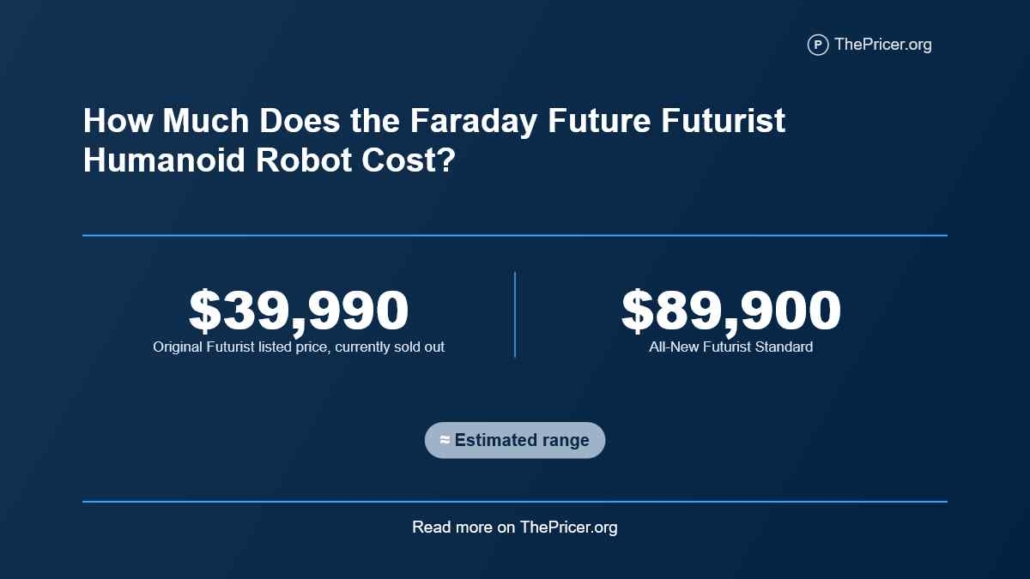
The Faraday Future Futurist humanoid robot starts at an advertised $39,990 for the original Futurist, although that configuration is currently marked sold out in the manufacturer’s store. The earlier Futurist Ultra is listed at $139,990. A newer and distinct model, the All-New Futurist, costs $89,900 for Standard or $129,900 for Ultra. These are U.S. advertised prices before applicable shipping, tax and deployment expenses.
The different generations matter. Faraday Future initially announced a $34,990 Futurist hardware price plus a $5,000 Ecosystem Skill Package in February 2026. The company subsequently introduced more capable full-size models, while changing its product catalog and package structure.
Buyers should budget for the intended application, software configuration, operator training, maintenance and delivery rather than assume the robot’s purchase price creates a fully autonomous employee.
Article Highlights
Jump to sections
- The original Futurist is listed at $39,990, but the base configuration is marked sold out.
- Futurist Ultra is advertised at $139,990 in the older product series.
- The All-New Futurist Standard costs $89,900, with Ultra priced at $129,900.
- Included manufacturer-valued skills packages differ by model and should not automatically be added again.
- Faraday Future advertises a 12-month manufacturing-defect warranty with exclusions affecting certain modifications.
- Unitree humanoids provide alternatives starting at $4,900, although equipment and capabilities differ considerably.
How Much Does the Faraday Future Futurist Humanoid Robot Cost?
Faraday Future markets multiple generations of humanoid robots under similar Futurist names. The distinction is essential because the starting prices, processors, hands and intended uses vary considerably.
The manufacturer’s original Futurist store listing advertises the earlier base model at $39,990 and Futurist Ultra at $139,990. The base model is labeled sold out.
Meanwhile, the company’s September 2026 launch presentation confirms the newer All-New Futurist Standard at $89,900 and Ultra at $129,900.
| Faraday Future humanoid | Advertised U.S. price | Distinction |
|---|---|---|
| Original FF Futurist | $39,990 | Earlier model, currently sold out |
| Original Futurist Ultra | $139,990 | Higher-end earlier configuration |
| All-New Futurist Standard | $89,900 | Newer professional humanoid |
| All-New Futurist Ultra | $129,900 | Upgraded sensing, compute and manipulation |
These are separate product offers, not a single robot whose price fluctuates between four arbitrary amounts.
The All-New Futurist Ultra costs $40,000 more than Standard, approximately a 44.5% premium. That added investment must be evaluated against the hardware differences and applications needing its advanced capabilities.
Why Earlier Prices Were Lower
Faraday Future’s February 2026 launch introduced an ecosystem-based pricing strategy. Its initial Futurist pricing announcement separated a $34,990 hardware starting price from a $5,000 Ecosystem Skill Package.
The arithmetic totals $39,990, matching the older Futurist store price.
That is important when interpreting reports saying Futurist costs under $35,000. The lower amount came from the initial hardware announcement before adding the associated skills package.
The company also introduced its FF Master humanoid and FX Aegis quadruped at lower starting prices. Those are different robots, not cheaper configurations of Futurist.
In June 2026, Faraday Future announced the All-New Futurist for $89,900, including a manufacturer-valued premium skills package. The SEC-filed June product announcement confirms that figure and the new model’s professional positioning.
The later September event established the current Standard and Ultra pricing structure. Buyers comparing articles published at different times must identify which generation each price describes.
What Buyers Receive
The newer All-New Futurist is a full-size humanoid intended for demonstrations, research, education, reception and professional deployment.
The manufacturer’s Standard configuration specifications identify a robot approximately 173 centimeters tall and weighing 54 kilograms, with 31 degrees of freedom, dual cameras, a display, microphones, communications equipment and a controller.
Its listed battery capacity is 1,152 watt-hours. Faraday Future advertises approximately six hours standing or four hours of continuous walking, with charging taking up to two hours under stated conditions.
The higher-priced All-New Futurist Ultra configuration adds dexterous hands, more advanced computing and sensing equipment, and 51 degrees of freedom.
Ultra features include NVIDIA Jetson Thor-class compute, LiDAR, RGB-D and surrounding cameras, plus positioning hardware for more advanced navigation.
Faraday Future promotes voice interaction, visitor guidance, movement demonstrations and remote operation. Not every proposed industrial or household task is a proven off-the-shelf capability.
Buyers should obtain a written list of supported functions for the selected hardware and software release rather than rely on promotional scenarios alone.
Skills Packages and Software
Faraday Future attaches manufacturer-valued skill packages to several of its robots.
The newer Standard’s $89,900 price includes a skills package described as worth $10,000. The Ultra’s $129,900 price includes a package valued at $15,000.
Those package values are not discounts that can automatically be subtracted from the retail price. Nor should they be added again when calculating the quoted bundle total.
Software development is a separate financial question. Faraday Future describes SDK and API access, over-the-air updates and optional integration into customer workflows.
A robotics laboratory may use these functions for research and custom applications. A business seeking a reception robot may need conversation design, company-data integration, network configuration and staff instruction.
The manufacturer has not established one universal public price covering all custom programming, AI services, on-site setup and future support.
A proper procurement quote should distinguish included skills from paid additional development, ongoing software services and replacement parts.
Shipping and Setup Charges
 Faraday Future’s published robot prices are hardware or configured-product offers, not guaranteed installed totals.
The manufacturer’s robot shipping and warranty policy says delivery timing varies with availability, destination and carrier conditions.
Full-size humanoid delivery may require freight planning, receiving staff, suitable storage and safe transportation inside the destination building.
The policy does not publish a universal U.S. shipping fee for every Futurist variant, so no fixed freight amount can responsibly be added to the headline price.
Professional deployment may also require a secure test area, wireless connectivity, charging access, designated operators and documented safety procedures.
Where the robot handles customers’ information or uses cameras and microphones, organizations may need privacy and cybersecurity assessment before operation.
These tasks can create labor costs even if they do not appear as separately priced accessories in the robot’s online store.
Warranty and Repair Expenses
The standard published warranty covers defects in materials and workmanship for 12 months, subject to eligibility and the applicable purchase terms.
Faraday Future’s refund and return conditions generally provide a 30-day return window for eligible purchases, subject to inspection and condition requirements.
Customer-preference returns can leave the buyer responsible for return freight, including oversized shipping charges. Original shipping charges may not be refunded.
The manufacturer’s policy excludes damage arising from misuse, unauthorized repairs and certain unsupported software or firmware changes.
That restriction matters because developer access is one of Futurist’s advertised attractions. A research institution should clarify which SDK workflows and operating-system modifications remain supported before beginning experiments.
Faraday Future has not provided a comprehensive public Futurist repair-price list for damaged joints, cameras, battery assemblies or dexterous hands.
Buyers should request written warranty coverage, spare-part availability, expected turnaround and the cost of service outside the warranty period. No reliable fixed annual repair expense can be established from the published material alone.
What a Deployed Futurist Costs
A realistic budget separates the advertised purchase from labor and other deployment expenses.
Consider an illustrative organization choosing the All-New Futurist Standard for reception demonstrations.
- All-New Futurist Standard, including its stated skills package: $89,900.
- Illustrative 8% sales tax, if fully applicable: $7,192.
- Calculated hardware-and-tax subtotal: $97,092.
- Freight, installation, training and custom development: not included because no universal published prices were identified.
The subtotal is a reproducible tax scenario, not a verified customer invoice. The organization could pay a different tax rate or qualify for an exemption.
Choosing Ultra changes the same modeled subtotal to $140,292, using its $129,900 price and the identical hypothetical 8% tax rate.
That creates a $43,200 difference at checkout under the illustrative tax assumption, before any difference in freight or deployment services.
The upgrade makes financial sense only if its additional manipulation, computing or perception capabilities are needed for the actual project.
Does a Humanoid Robot Pay for Itself?
A robot’s effective hourly cost is not its price divided by an ordinary employee’s annual hours. The robot may require supervision, task integration, maintenance and charging, and advertised motion does not establish productive autonomous work.
A bounded capital-cost calculation helps show the scale.
Spread the $89,900 Standard purchase over three years of use at an assumed 1,000 productive hours annually. Hardware allocation alone would be approximately $29.97 per productive hour.
If effective utilization were only 500 productive hours annually, the hardware allocation would rise to approximately $59.93 per productive hour.
Both figures exclude labor, electricity, repairs, freight, software and financing. They are conditional planning scenarios, not measured productivity or guaranteed service life.
The calculation demonstrates why verified task completion and utilization matter more than a robot’s apparent ability to walk and talk.
Faraday Future’s planned applications include reception, marketing events, education and industrial support. A buyer needs an operational pilot before assuming reliable labor substitution.
Cheaper Humanoid Alternatives
Faraday Future’s prices sit within a market that now includes substantially cheaper research humanoids.
Unitree’s current humanoid product catalog lists the R1 from $4,900, G1 from $13,500 and H2 from $29,900. The higher-end H2 Plus is listed at $100,000.
These figures are product starting prices. They do not make a compact entry-level model equivalent to a full-size professional Futurist Ultra.
The Unitree humanoid robot cost comparison covers developer configurations, shipping and other ownership charges that can change these advertised prices.
Faraday Future itself offers smaller humanoid alternatives. Its FF Master product listing advertises configurations starting at $22,990, while the newer Master Mini line starts at $9,990.
For a laboratory studying basic locomotion, a smaller robot may offer sufficient functionality at a much lower entry price. A business needing full-size interaction or a particular software stack may have different requirements.
Futurist vs Optimus and Atlas
Tesla Optimus is often discussed as a future lower-cost humanoid competitor, but a projected production target is not directly comparable with Futurist’s advertised online prices.
The Tesla robot pricing comparison distinguishes aspirational pricing from a confirmed consumer purchase offer.
Boston Dynamics Atlas occupies a different industrial robotics category, with enterprise deployment terms rather than a conventional public retail price.
The Atlas robot cost discussion gives context for that acquisition model and its substantial project requirements.
The comparison should focus on the robot’s actual capabilities, access to development tools, after-sales support and intended deployment.
A lower advertised hardware price cannot establish an economical replacement if the competing machine lacks the functions a buyer needs.
Latest Robotics Developments
The business supplying Futurist underwent a significant corporate change in October 2026.
According to an October 26 SEC-filed announcement, FF EAI Robotics Ecosystem completed its acquisition of Faraday Future’s robotics business on October 23.
The company said the robotics business would operate through Nasdaq-listed FFR, while Faraday Future continued trading separately as FFAI.
Management expected October robot sales and shipments to exceed 300 units and cumulative shipments to surpass 1,100 units. These are company forecasts and statements for its broader robotics business, not independently audited Futurist model sales.
Independent Los Angeles Times reporting examined Faraday Future’s shift from electric vehicles to robotics and its manufacturing plans.
The distinction matters for a long-lived equipment purchase. Customers should verify the legal contracting party, support provider and warranty responsibilities under the current corporate structure.
Who Should Buy a Futurist?
Futurist is best evaluated as professional robotics equipment rather than a finished consumer household product.
Makes sense if
- An institution has a defined humanoid research or demonstration program.
- The selected model has documented capabilities required for that program.
- The budget covers integration, supervision and maintenance beyond the robot’s price.
- Warranty, development access and technical support are confirmed in writing.
Does not make sense if
- The purchase depends on unproven claims of fully autonomous household labor.
- A smaller, lower-cost robot can perform the required educational tasks.
- The buyer cannot accommodate safe testing, operator oversight and repairs.
- The organization assumes all manufacturer-described applications are immediately production-ready.
Answers to Common Questions
How much does the FF Futurist humanoid robot cost?
The earlier Futurist is advertised at $39,990 but marked sold out. The newer All-New Futurist costs $89,900 for Standard and $129,900 for Ultra, before applicable additional charges.
Why did Faraday Future originally announce a $34,990 robot?
Its February 2026 launch separated $34,990 in hardware pricing from a $5,000 ecosystem skills package, totaling $39,990. The company subsequently expanded and revised its humanoid lineup.
Does the Futurist price include AI software?
Faraday Future lists skills packages with several models, including manufacturer-valued packages of $10,000 for All-New Futurist Standard and $15,000 for Ultra. Additional custom applications and services may be separately priced.
Does Faraday Future offer financing or leasing?
The company has discussed financing, leasing and rental arrangements, but a universally applicable public monthly payment for Futurist has not been established. Buyers should request written terms for a specific model.
Can Futurist replace an employee?
There is insufficient public evidence to guarantee that Futurist can independently perform a particular full-time job. Its financial value depends on verified capabilities, supervision requirements, uptime and total deployment costs.
Disclosure: Educational content, not financial advice. Prices reflect public information as of the dates cited and can change. Confirm current rates, fees, taxes, and terms with official sources before purchasing. See our methodology and corrections policy.