
How Much Does the iPhone 18 Pro Cost?
Published on | Written by Alec Pow
This article was researched using 14 sources. See our methodology and corrections policy.
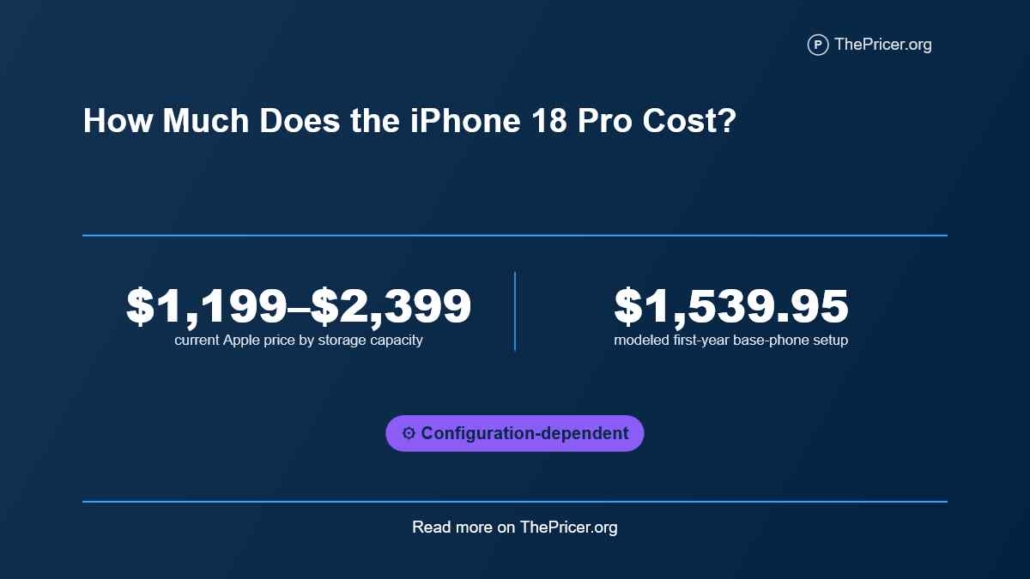
The iPhone 18 Pro costs $1,199 in the United States for 256GB, with Apple charging $1,399 for 512GB, $1,799 for 1TB, and $2,399 for 2TB. Those are current pre-tax handset prices on the current Apple store pricing.
The amount a buyer actually commits can look very different after financing, a lease, trade-in credit, carrier bill credits, protection, accessories, and sales tax. A carrier can advertise the same base phone at $0 per month while Apple still lists the hardware at $1,199, because the carrier price depends on credits and service conditions rather than a lower retail value.
Article Highlights
Jump to sections
- The 256GB iPhone 18 Pro starts at $1,199 (at $30 per hour, earning that amount would take about 5 full-time workdays, before taxes) before sales tax.
- The storage ladder tops out at $2,399 for 2TB, a $1,200 jump from the base model.
- Apple Upgrade starts at $34.99 per month for 24 months, but it is a lease rather than an owned-device installment plan.
- Carrier promotions can reach $1,200 in credits, with service and eligibility conditions attached.
- A modeled first-year setup with a case, charger, annual AppleCare coverage, and 8% hardware sales tax reaches about $1,539.95.
How Much Does the iPhone 18 Pro Cost?
Apple sells the iPhone 18 Pro in four storage capacities. The base 256GB model is $1,199 (about 5 full-time workdays at $30 per hour), followed by 512GB at $1,399, 1TB at $1,799, and 2TB at $2,399, a ladder independently matched in a current retail price guide. The jump between tiers is not uniform.
Buyers pay another $200 to move from 256GB to 512GB, another $400 to reach 1TB, then another $600 to reach 2TB. The storage tier, rather than the finish, is what changes this direct Apple price ladder. A buyer comparing colors at the same capacity is still comparing the same listed handset price.
| Storage | U.S. price | Added cost from 256GB |
|---|---|---|
| 256GB | $1,199 | $0 |
| 512GB | $1,399 | $200 |
| 1TB | $1,799 | $600 |
| 2TB | $2,399 | $1,200 |
The table is the cleanest cash-price answer, but checkout details still matter. Apple prices are shown before local sales tax in the United States. The phone can also be bought carrier-connected or connected later. That choice changes the activation and payment path even when the listed hardware price matches. For a cash buyer, storage is the configuration choice in this table that changes Apple’s listed Pro price.
What Extra Storage Costs
The 2TB iPhone 18 Pro costs almost exactly twice as much as the base 256GB model. Subtracting $1,199 (about 5 full-time workdays at $30 per hour) from $2,399 gives a $1,200 storage premium. Dividing that premium by the base price gives 100.08%, so the highest-capacity version costs about 100.1% more than the entry model. That is a useful boundary for buyers who are tempted to treat storage as a small add-on. At the top tier, storage choice alone adds slightly more money than the price of another base iPhone 18 Pro would suggest by simple dollar comparison.
The marginal price per added gigabyte becomes more favorable at the largest step. Moving from 256GB to 512GB adds 256GB for $200, or about $0.78 per added GB. Moving from 512GB to 1TB adds 512GB for $400, again about $0.78 per added GB. Moving from 1TB to 2TB adds 1,024GB for $600, or about $0.59 per added GB. The last jump is cheaper per incremental gigabyte even though it creates the largest checkout total. Buyers should judge storage by actual local-file needs, since unused capacity does not create a cash return.
Financing Versus Leasing
Apple gives buyers several ways to spread the cost, but the payment type changes what the customer owns. Apple’s current financing disclosure lists the base iPhone 18 Pro from $49.95 per month for 24 months through Apple Card Monthly Installments for qualified customers who select an eligible carrier. A financed purchase still works toward ownership of the handset. Taxes and credit approval can affect what is due and how the installment plan applies.
Apple Upgrade is different. The Apple Upgrade lease page lists iPhone 18 Pro leasing from $34.99 per month for 24 months or $49.99 per month for 12 months. At the end of a lease, Apple says eligible customers can upgrade, make a one-time purchase, or return the device and exit the program. Twenty-four payments at the lowest displayed rate total $839.76, which is $359.24 below the $1,199 cash MSRP. That gap is not a discount on an owned phone.
The monthly figure is lower because the transaction is structured differently. A shopper comparing $34.99 with $49.95 should compare end-of-lease choices and ownership rights before treating one payment as the cheaper version of the same purchase.
Trade-In and Carrier Deals
Apple’s direct trade-in program gives a different kind of discount from carrier bill credits. Its current trade-in offer gives $175 to $885 in instant credit when an eligible iPhone 13 or newer is traded in, with value depending on model, year, configuration, and condition. That credit can reduce an Apple purchase or payment without turning the phone’s retail price into a lower MSRP.
Carrier-linked promotions can reduce the effective device balance, but the largest advertised savings are commonly delivered through monthly bill credits instead of an immediate reduction in retail value. AT&T’s current product pricing lists the 256GB iPhone 18 Pro at $1,199.99, or $33.34 per month for 36 months, and says an eligible trade-in plus eligible plan can reduce the device payment to $0 per month through up to $1,200 in credits.
T-Mobile offers another illustration of why the service agreement belongs beside the phone discount. The T-Mobile promotion terms show an iPhone 18 Pro offer of up to $1,200 through bill credits, with one qualifying path requiring service at $100 or more per month with AutoPay, taxes and fees, a $35 device connection charge, and continued eligibility through the credit period. At the stated $100 service floor, 36 months equals at least $3,600 of service payments. That is three times a $1,200 phone credit, but it is not fair to call the whole $3,600 an extra phone cost because the customer needs wireless service anyway.
Verizon adds a third structure. Its Verizon launch offers describe up to $1,200 off for a qualifying new line and trade-in, and up to $1,020 for a qualifying existing-line upgrade, with credits applied over 36 months. Verizon also promotes Simplicity Pro at $80 per month after stated discounts, with an iPhone 18 Pro and annual upgrade path that requires returning the phone in good working condition. The useful comparison is not which page prints the lowest monthly handset number. It is which combination of device balance, service plan, trade-in, credit period, and return rule matches the buyer’s existing spending.
First-Year Ownership Cost
A cash buyer can spend more than the handset price without adding luxury accessories. Apple lists its iPhone 18 Pro Silicone Case with MagSafe at $49 on the Apple silicone case listing. A current 40W Dynamic Power Adapter with 60W Max costs $39 on the Apple 40W adapter listing. Apple includes a one-meter USB-C charging cable in the box, while its iPhone technical specifications do not list a power adapter among the included items. A buyer who already has compatible charging hardware can skip that $39 line.
Apple’s current Pro checkout lists AppleCare+ with Theft and Loss at $14.99 per month or $149.99 per year until cancelled on the current Pro  checkout. A worked first-year scenario can combine the base phone at $1,199, a $49 case, a $39 adapter, and annual coverage at $149.99. Hardware before tax is $1,287. Using an illustrative 8% sales tax on that hardware adds $102.96. The modeled first-year total is $1,539.95. The 8% rate is an assumption for the example, not a national tax rate. Local tax rules can change both the checkout amount and treatment of protection products.
Repair and Protection Costs
Protection changes the cost profile after purchase. AppleCare+ with Theft and Loss carries a recurring premium for the iPhone 18 Pro tier, then service fees apply when a covered incident occurs. Apple’s AppleCare service fee schedule lists a $29 service fee for covered iPhone screen or back-glass damage, $99 for other accidental damage, and $149 for a theft or loss replacement claim. Battery service has no added fee when the battery falls below Apple’s stated covered capacity threshold. Those service charges sit on top of the protection premium rather than replacing it.
The ownership question is whether the recurring premium fits the buyer’s damage and theft exposure. One year of annual iPhone 18 Pro Theft and Loss coverage costs $149.99. A covered cracked screen during that year would bring the combined annual premium and screen service fee to $178.99 before any applicable tax.
Two years of the same annual premium would total $299.98 before claims. Those calculations do not prove protection is cheaper than self-funding repairs because an uninsured repair price and the probability of a claim are separate inputs. Buyers who want current repair comparisons can use the iPhone screen repair cost analysis. The useful budget choice is to compare protection premiums, service fees, theft exposure, and the cash amount a buyer could absorb after an accident.
Price Versus iPhone 17 Pro
The iPhone 18 Pro starts $100 above the prior generation at the same 256GB capacity. A year-over-year storage comparison lists the iPhone 17 Pro at $1,099 for 256GB and $1,499 for 1TB, versus $1,199 and $1,799 for the matching iPhone 18 Pro capacities. The earlier smaller Pro stopped at 1TB, while the 2026 model adds a 2TB choice at the top of the range. That new ceiling expands the amount a buyer can spend without moving to the larger Pro Max.
The base move from $1,099 to $1,199 is a 9.1% increase. The 1TB move from $1,499 to $1,799 adds $300, or about 20%. A buyer replacing a 1TB iPhone 17 Pro with the same storage on an iPhone 18 Pro faces three times the dollar increase shown by the 256GB comparison. Storage choice can matter more than the headline $100 generation change, so the entry MSRP does not describe the full pricing shift. The difference is useful for photographers and video-heavy users who compare matching storage rather than the cheapest versions of each generation.
Which Price Should You Compare?
The right comparison starts with the transaction type. A cash buyer should compare the Apple or retailer handset price, local tax, needed accessories, and optional protection. A financing buyer should compare the same total plus the financing rules.
A carrier-promotion buyer should compare retail price, trade-in value, required service plan, credit term, and what happens if the line closes early. A lease customer should compare payments with the return requirement rather than treating the monthly amount as ownership cost. Those paths can produce very different monthly numbers for the same 256GB phone.
The adjacent Apple choices help set the price boundary. The iPhone 18 Pro Max sits above the smaller Pro, while the iPhone Duo cost analysis places Apple’s foldable at $1,999 for 256GB. A buyer who would spend $1,799 on a 1TB iPhone 18 Pro is already within $200 of the Duo’s 256GB starting price, though the products solve different needs.
The phone price makes sense when storage, ownership structure, and service commitment match the buyer’s use. It is a weak comparison when a promotional monthly payment is placed beside a full-price cash purchase without the conditions attached.
Makes sense if
- You want the Pro model and 256GB meets your storage needs.
- Your trade-in credit does not require a service plan that costs materially more than your current plan.
- You plan to keep the phone long enough for the higher purchase price to fit your upgrade cycle.
- You value AppleCare coverage relative to the repair or theft costs you could face.
Does not make sense if
- You are paying for 2TB without a clear local-storage use.
- You are comparing a lease payment with an owned-device payment as if the two transactions were identical.
- You would move to a much higher wireless plan only to obtain the maximum phone credit.
- A lower-priced current iPhone already covers the features and storage you use.
Answers to Common Questions
How much is the cheapest iPhone 18 Pro?
The 256GB iPhone 18 Pro costs $1,199 in the United States before local sales tax. Carrier promotions can reduce the device payment through credits, but they do not change Apple’s listed retail price.
How much is the 2TB iPhone 18 Pro?
The 2TB iPhone 18 Pro costs $2,399 before tax. That is $1,200 above the 256GB model and about 100.1% more than the base handset price.
Can the iPhone 18 Pro really cost $0 per month?
Yes, some carrier offers can offset the device payment with monthly credits. Eligibility, trade-in or new-line rules, service-plan requirements, and the credit period determine whether a customer receives the full advertised amount.
Does the iPhone 18 Pro include a charger?
Apple includes a USB-C charge cable with the phone, but the listed box contents do not include a power adapter. Apple’s current 40W adapter costs $39 if a buyer wants that accessory.
Disclosure: Educational content, not financial advice. Prices reflect public information as of the dates cited and can change. Confirm current rates, fees, taxes, and terms with official sources before purchasing. See our methodology and corrections policy.