
How Much Does The Kara Pod Cost?
Updated on | Researched and reviewed by Alec Pow, Founder & Pricing Investigator
Prices, claims, and calculations checked against 14 cited sources. See our research methodology and corrections policy.
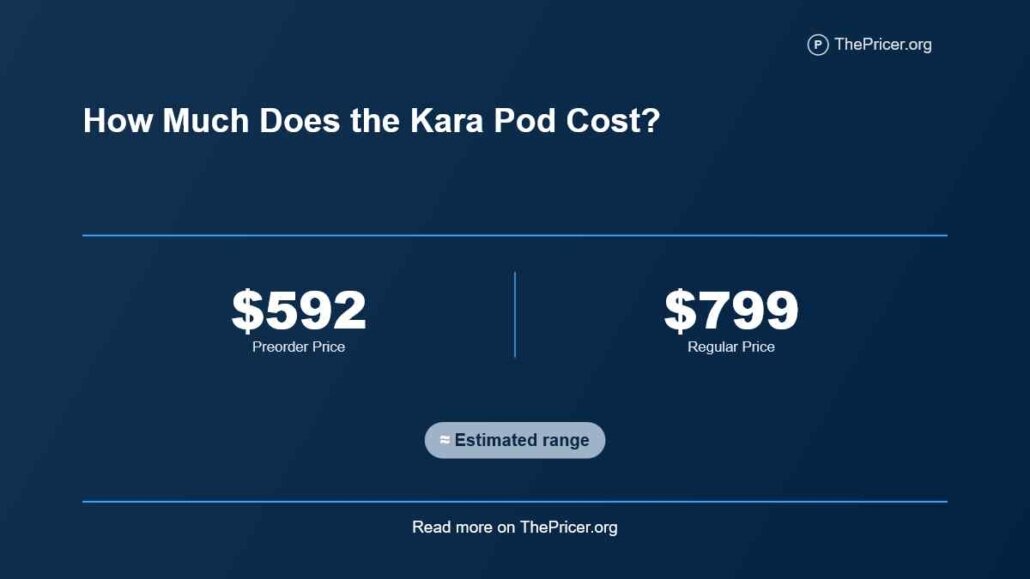
The Kara Pod costs $592 on preorder, discounted from its advertised regular price of $799. As of October 25, 2026, Kara Water still labels the air-to-water coffee maker a preorder and lists its shipping date as “TBD.” That distinction matters: the advertised price is not proof that customers can order a unit for immediate delivery.
Beyond the purchase price, Kara Water estimates replacement filters at $24.95 every three months, or $99.80 annually. Electricity is another expense. The company quotes an operating cost of $0.89 per gallon, although actual consumption depends on humidity, usage, and electricity rates.
Article Highlights
Jump to sections
- Current preorder price: $592, compared with a $799 advertised regular price.
- Availability: Preorder only on the manufacturer’s current listing, with shipping still to be determined.
- Replacement filters: $24.95 quarterly, approximately $99.80 per year.
- Maximum advertised output: 3.2 liters daily, equivalent to about 0.85 U.S. gallons.
- Electricity: Kara Water advertises $0.89 per gallon to operate, but has not published enough detail to verify the figure under different household conditions.
- Buying verdict: Interesting for its no-plumbing design, but difficult to justify purely as a money-saving replacement for tap water or inexpensive bottled water.
How Much Does the Kara Pod Cost?
The manufacturer’s current Kara Pod product listing shows the following prices and specifications.
| Cost or specification | Published figure | What it means |
|---|---|---|
| Preorder price | $592 | Current advertised promotional price |
| Regular price | $799 | Manufacturer’s comparison price |
| Promotional discount | $207 | About 25.9% below regular price |
| Financing advertisement | From $99/month | Qualification and financing terms must be checked |
| Replacement filters | $24.95/quarter | Approximately $99.80/year |
| Water output | Up to 3.2 L/day | About 0.85 U.S. gallon daily |
| Rated power | 270 W full / 190 W EcoMode | Actual energy use varies with operation |
| Shipping date | TBD | Delivery cannot be scheduled from the listing |
The separate Kara Pod preorder website still displays older information, including an estimated shipping window in 2025. Its current usefulness is primarily in the detailed product FAQs, particularly maintenance pricing and operating claims. For the purchase price and delivery status, the newer Kara Water store page is the stronger reference.
Kara Water announced in a July 2026 company press release that the Kara Pod remained in preorder as it worked toward commercial launch. That supports treating the product as an upcoming appliance, not an established retail machine with a verified delivery history.
Earlier crowdfunding prices were lower. The Kara Pod Kickstarter campaign attracted hundreds of backers in 2025, while New Atlas reported a crowdfunding entry price around $499. These were time-limited campaign offers, not prices a buyer should expect to obtain today.
What Are You Actually Buying?
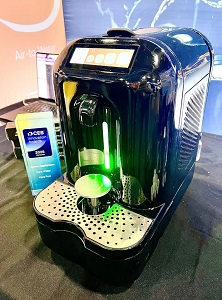 Kara Pod combines an atmospheric water generator, drinking-water dispenser, and single-serve coffee brewer. Instead of connecting to a household water line or being manually filled, it extracts moisture from surrounding air, processes the collected water, and dispenses it for drinking or coffee preparation.
It is a countertop appliance rather than a household water system. Kara Water lists a footprint of approximately 15 by 9 inches, a height near 14 inches, and a weight of about 13 pounds. It requires electricity but no direct plumbing connection.
The brewing system is designed for Nespresso Original-style capsules. That does not mean it accepts Nespresso Vertuo capsules or Keurig K-Cups. Kara also advertises its own coffee pods.
The product received recognition in the 2025 CES Innovation Awards. Earlier coverage by The Spoon described the same combination of atmospheric water generation and capsule brewing.
Neither award recognition nor launch coverage establishes how well a production unit performs over several years. Buyers should separate the published specifications from independently demonstrated reliability, water quality, and real-world operating expenses.
How Much Electricity Does It Use?
The manufacturer’s legacy FAQ says Kara Pod costs $0.89 per gallon to operate. However, its stated maximum daily water production is 3.2 liters, or about 0.845 U.S. gallon. The frequently advertised phrase “one gallon a day” is therefore a rounded description, not an exact conversion.
Applying the company’s cost estimate to the stated maximum output gives:
- Daily output: 3.2 liters, or approximately 0.845 gallon.
- Daily operating estimate: 0.845 × $0.89 = approximately $0.75.
- 30-day estimate: approximately $22.57.
- 365-day estimate: approximately $274.61.
These figures are calculations based on the manufacturer’s claimed cost per gallon. They are not measurements from a Kara Pod installed in a home. They also assume the machine achieves its maximum rated daily output every day.
A separate electrical calculation helps show why usage conditions matter. The U.S. Energy Information Administration reported an average residential electricity price of 18.16 cents per kilowatt-hour for August 2026.
If the Pod drew its rated 190 watts continuously for 24 hours, it would consume 4.56 kWh daily, costing approximately $0.83 per day or $302 annually at that national average rate. At a continuous 270 watts, the same calculation reaches approximately $1.18 per day or $429 annually.
Those are illustrative continuous-load scenarios, not predictions of actual consumption. The device may cycle between operating states. To estimate a household’s real bill, buyers need measured kilowatt-hours per liter at their expected temperature and humidity.
Filters, Pods, and Delivery
Replacement filters are easy to overlook because the Kara Pod’s main selling point is that users do not need to buy water or fill a reservoir.
Kara’s own FAQ recommends changing the mineralizing filter four times annually at $24.95 per replacement. That produces a recurring filter budget of $99.80 per year, assuming the company maintains that price and the stated replacement interval.
Do not substitute the replacement-filter price for Kara Pure or Kara Pure 2. Those are different products. A filter bundle advertised for another Kara machine is not evidence that Kara Pod owners must purchase that bundle.
Coffee capsules introduce another recurring expense. In its testing of Nespresso machines, Serious Eats found capsule costs to be a meaningful part of ownership. For a straightforward budgeting illustration, assume a compatible capsule costs $0.95:
- One capsule each day: $346.75 per year.
- Two capsules each day: $693.50 per year.
- Three capsules each day: $1,040.25 per year.
The $0.95 figure is an example price, not a universal current price for every compatible capsule. Actual costs depend on brand and package size. Ground coffee used with a different brewing system may cost less.
Shipping is also unresolved. Kara Water currently displays “Shipping TBD,” and the product page does not establish a reliable nationwide delivered price. Sales tax, shipping charges, financing interest, and possible future service requirements should not be replaced with invented flat fees.
One more hidden cost is waiting. Someone who prepays for an appliance without a confirmed shipment date may still need to purchase bottled water or use an existing brewer until the unit arrives. Before ordering, review the current seller’s cancellation terms and payment method. The Federal Trade Commission’s online-order guidance explains the protections generally available when merchandise is delayed or never delivered. Crowdfunding pledges can have different terms from ordinary retail purchases.
The First Year Costs
Consider a buyer who receives the Kara Pod at the current preorder price, runs it enough to produce the maximum stated daily amount of water, and drinks one capsule coffee daily.
| First-year expense | Illustrative amount |
|---|---|
| Kara Pod preorder purchase | $592.00 |
| Four replacement filters | $99.80 |
| Operating estimate, 365 days | $274.61 |
| 365 coffee capsules at $0.95 | $346.75 |
| Modeled first-year total | $1,313.16 |
This worked example excludes shipping, tax, financing charges, and accessories. It also treats the manufacturer’s $0.89-per-gallon figure as an operating allowance separate from filter purchases. Because Kara has not published a detailed breakdown of that allowance, the calculation could overlap with expenses already reflected in its estimate.
The coffee-capsule line should not be interpreted as a saving or penalty unique to Kara Pod. Another compatible capsule brewer also requires capsules. Removing the coffee expense leaves an illustrative first-year water-generation budget of about $966.
In later years, the same maximum-output model would cost approximately $374 annually for operation and filters, before repairs or changes in electricity prices. That is the more useful figure for comparing the Pod with other drinking-water sources.
Can Kara Pod Save Money?
Not necessarily. The answer depends heavily on what kind of bottled water you normally buy.
Consider a low-cost supermarket option. Walmart’s Great Value purified water was listed at $5.97 for forty 16.9-ounce bottles during our latest check. That package contains approximately 20 liters of water.
At Kara Pod’s maximum stated production of 3.2 liters daily, one year would yield 1,168 liters, assuming no downtime or unfavorable conditions. Replacing that amount with the Walmart water would require roughly 58.4 cases:
- Bulk bottled-water equivalent: approximately $348.65 annually.
- Kara operating estimate at maximum output: approximately $274.61 annually.
- Kara replacement filters: approximately $99.80 annually.
- Combined recurring Kara estimate: approximately $374.41 annually.
Under those assumptions, Kara Pod would cost about $26 more per year to operate and maintain than buying the low-priced bottled water, before recovering any portion of the appliance purchase price. The Pod therefore has no calculated financial payback against that particular supermarket example.
It is a different calculation for someone regularly purchasing individual convenience-store bottles. Premium single bottles can cost many times the bulk-package price per liter. Replacing them with water produced at home may eventually offset the purchase cost, provided the appliance delivers the advertised output and operates reliably.
The key question is not whether Kara Pod costs less than some bottled water. It is whether it costs less than the water you actually purchase.
For homes with safe municipal water, a pitcher is generally a cheaper alternative. The Brita Tahoe with an Elite filter is listed at $41.99, with a stated filter life of up to six months or 120 gallons. It still needs tap water, but its purchase price is hundreds of dollars below the Kara Pod.
For more extensive treatment of existing tap water, compare the purchase and maintenance costs in our guide to reverse osmosis water filtration. It solves a different problem because it treats supplied water instead of generating water from humidity.
How Much Water Can It Supply?
Kara Pod’s advertised production ceiling is 3.2 liters every 24 hours. The company’s older FAQ associates its production claim with an indoor relative humidity of 60%. It also claims operation in much drier air, but that does not mean maximum water production remains unchanged under dry conditions.
Three practical examples show the limits:
- One adult drinking 2 liters daily: At its maximum output, the Pod could theoretically cover that amount and leave approximately 1.2 liters for coffee or another person.
- Two adults each drinking 2 liters daily: Their combined 4-liter demand exceeds the stated maximum by 0.8 liter every day.
- Four adults each drinking 2 liters daily: The Pod’s 3.2 liters would cover only 40% of their combined 8-liter demand, even under ideal maximum-output assumptions.
These comparisons concern drinking water only. Cooking, guests, pets, and other household needs would increase demand.
Water quality deserves separate consideration. Kara describes filtration, heat treatment, and mineral addition, but buyers should ask for independent testing that corresponds to the production model being shipped. A claim about removing contaminants or microbes should not be treated as equivalent to an independently documented certification unless the relevant documentation is provided.
The Pod also needs sufficient ambient moisture and electrical power. It is not an emergency drinking-water solution if the electricity is unavailable. Removing moisture from indoor air may be useful in humid spaces, but buyers should not assume the machine will replace a dedicated dehumidifier.
Is It Worth Buying?
For coffee alone, the price difference is substantial. A conventional single-serve brewer costs far less because it does not have the machinery needed to extract drinking water from air. Keurig sells compact coffee makers through its U.S. store, while independent comparisons in Bon Appétit place entry-level single-serve brewers around the low hundreds of dollars, depending on the model and promotions.
Those cheaper machines must be filled with water, and Keurig’s K-Cup format is not interchangeable with the Original-style capsules Kara Pod accepts. Buyers who prefer espresso-style drinks should compare Kara Pod with an Original-compatible Nespresso machine rather than assuming every pod brewer makes the same coffee.
For a shared workplace, Kara Pod’s limited daily water output is another reason to compare alternatives carefully. A Bevi machine or FloWater refill station is designed around dispensing larger volumes, but usually requires plumbing and a commercial purchase or service arrangement. The upfront and ongoing economics are very different.
Kara Pod makes sense if:
- You strongly value generating drinking water without a plumbing connection.
- You have a suitable indoor environment and relatively modest daily water needs.
- You want the combined air-to-water and capsule-coffee functionality enough to pay a premium.
- You can tolerate an uncertain preorder delivery schedule.
It makes less sense if:
- Your main goal is saving money compared with safe tap water or inexpensive bulk bottled water.
- You need more than 3.2 liters of drinking water daily.
- You primarily want an affordable coffee maker.
- You need a proven, immediately available appliance with independently documented running costs.
For readers comparing environmental costs, our guide to bottled-water production costs explains why the price of a plastic bottle is only one part of the supply chain. Avoided packaging has potential value, but it should be considered alongside the electricity and consumables required by the Pod.
Answers to Common Questions
Is Kara Pod available to buy right now?
It can be ordered through a manufacturer preorder listing, but the current listing says shipping is TBD. It should not be described as an in-stock appliance ready for immediate delivery.
Does Kara Pod require a water connection?
No. It is designed to collect moisture from indoor air. It does require electricity and suitable ambient conditions.
How much are Kara Pod replacement filters?
The manufacturer lists $24.95 every three months, or approximately $99.80 for four replacements annually.
Can Kara Pod make enough water for a family?
Its advertised maximum of 3.2 liters per day is below the combined drinking-water needs of many households. Real-world output may be lower when conditions are unfavorable.
Does it work with Keurig K-Cups?
No compatibility with K-Cups is advertised. Kara describes compatibility with Nespresso Original-style capsules and its own compatible pods.
Is Kara Pod cheaper than buying bottled water?
It may be cheaper than frequently buying expensive individual bottles. It is not automatically cheaper than purchasing large cases of budget bottled water, and the initial $592 preorder price makes payback harder.
Disclosure: Educational content, not financial advice. Prices reflect public information as of the dates cited and can change. Confirm current rates, fees, taxes, and terms with official sources before purchasing. See our methodology and corrections policy.