
How Much Does the LOCUST Laser Weapon Cost?
Published on | Written by Alec Pow
This article was researched using 14 sources. See our methodology and corrections policy.
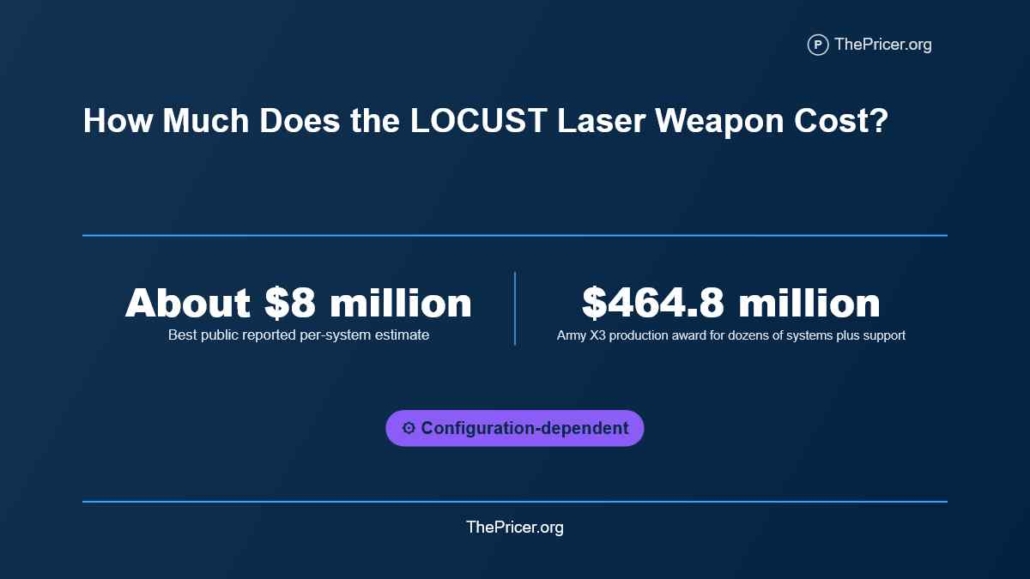
A LOCUST laser weapon system costs roughly roughly $8 million per unit, not from an official AeroVironment price sheet. The Army has since selected the newer LOCUST X3 for a $464.8 million production program covering dozens of systems plus support and training, so that large award cannot be divided into a clean X3 sticker price.
The cost story has two very different layers. LOCUST requires multimillion-dollar hardware, power, cooling, tracking, integration, maintenance, and trained operators. Once the equipment is fielded and powered, the marginal cost of a laser engagement can fall to only a few dollars. That capital-versus-shot gap is the main reason LOCUST is drawing attention for counter-drone defense.
Article Highlights
Jump to sections
- The strongest public LOCUST system estimate is about $8 million (at $30 per hour, earning that amount would take about 128 years of full-time work, before taxes) per unit.
- The Army’s LOCUST X3 production award is $464.8 million for dozens of systems plus support and training.
- AeroVironment says X3 engagements can cost below $5 per shot.
- An earlier AMP-HEL prototype agreement had a potential value of $75.9 million.
- The first international LOCUST order is worth more than $50 million, with quantity undisclosed.
How Much Does the LOCUST Laser Weapon Cost?
The clearest public unit-price signal is the CBS estimate cited in the lead. A March cost comparison independently repeated the roughly $8 million (about 128 years of full-time work at $30 per hour) base-unit figure and the below-$5 firing claim. The underlying CBS interview put the firing example near $3 in many cases. AeroVironment does not publish a catalog price that confirms every LOCUST configuration at that amount.
That distinction became more important after the March 24 release of LOCUST X3. The CBS estimate describes LOCUST at the system level, while X3 is a newer generation with upgraded power, targeting, modularity, and production configuration. The Army’s September award identifies X3 as its selected E-HEL weapon, but neither the Army nor AeroVironment has released a public price for one standard X3 package.
The best current answer is approximate. Use about $8 million to describe the public reported acquisition scale of one LOCUST system. Do not rewrite it as an exact X3 contract unit cost. A JLTV-mounted system can include vehicle integration, while a fixed or palletized setup can carry different power, mounting, sensor, and support requirements. Quantity discounts and production maturity can also affect later Army buys. The public evidence does not provide enough detail to turn those variables into a narrower official range.
What LOCUST Actually Buys
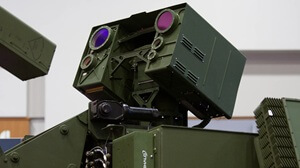
LOCUST is a high-energy laser counter-drone system built around more than the laser emitter. AeroVironment’s LOCUST X3 launch details describe a third-generation system with a 20 to 35-plus kilowatt laser, a modular beam director, and automated detection, tracking, and engagement software.
The physical package also needs electrical power and thermal management. CBS observed the beam director mounted above a base containing batteries and cooling equipment. That helps explain why the acquisition price is measured in millions even though the beam itself consumes only a small amount of energy during a short engagement.
The weapon must detect a target, hold an accurate track, direct laser energy onto a vulnerable point, manage heat, and remain usable for repeated shots.
LOCUST can also be installed in different ways. AeroVironment has demonstrated a palletized shipboard LOCUST, while the Army production program calls for tactical-vehicle and palletized configurations. Those mounting choices change the equipment and engineering around the laser even when the core weapon family is the same. A buyer comparing LOCUST prices should ask whether a quoted figure covers the laser system alone, a vehicle-mounted package, or a broader air-defense position with sensors and support.
The $464.8 Million Army Deal
Breaking Defense’s award report confirms the $464.8 million (about 7.4 thousand years of full-time work at $30 per hour) Enduring-High Energy Laser agreement and says AeroVironment will deliver dozens of 30-kilowatt LOCUST X3 systems over the next few years. The broader award also covers program support and training, as established by the manufacturer source linked in the lead.
The public quantity is only “dozens,” so an exact contract-value-per-X3 calculation is not possible. Picking 24, 36, or another number would manufacture the denominator. The only defensible arithmetic is a labeled scale comparison using the reported LOCUST estimate rather than pretending the contract reveals a unit price.
| LOCUST cost measure | Amount | Scope |
|---|---|---|
| Reported LOCUST system | About $8 million | Public unit estimate |
| Army E-HEL award | $464.8 million | Dozens of X3 systems plus support and training |
| AMP-HEL prototype ceiling | $75.9 million | Earlier prototype program |
| International LOCUST order | More than $50 million | Systems plus support, quantity private |
| Reported X3 engagement | Below $5 per shot | Marginal firing cost |
A bounded normalization can still show the contract’s scale. Divide the $464.8 million program value by the reported $8 million LOCUST estimate and the result is about 58.1 system-equivalents. That does not mean the Army ordered 58 systems. The Army award buys X3 production plus support and training, while the reported unit estimate predates X3’s public release. The calculation shows why a nearly half-billion-dollar award can be consistent with a multimillion-dollar system without proving an exact production quantity.
From Prototype to Production
LOCUST reached the production award after several Army prototype efforts. A 2023 Army agreement gave BlueHalo a $45.7 million base award with $30.2 million in options for the Army Multi-Purpose High Energy Laser program. The maximum potential value was $75.9 million. That effort centered on a 20-kilowatt-class laser integrated with an Infantry Squad Vehicle.
Comparing the prototype ceiling with the September 2026 production award shows how the spending scale changed. Divide $464.8 million by $75.9 million and the production program is about 6.12 times the maximum value of the earlier AMP-HEL agreement. The ratio does not mean one laser became 6.12 times more expensive. The contracts cover different stages, quantities, hardware generations, and support scope.
The distinction matters for historical price comparisons. Prototype contracts often pay for engineering, vehicle integration, testing, software work, and limited quantities before production economics settle. The E-HEL award funds recurring delivery of dozens of newer X3 systems plus support and training. A simple contract-to-contract ratio is useful for showing program scale, but not for measuring inflation in the price of one laser. The earlier AMP-HEL work is better read as part of the investment that made the later production award possible.
Why a Laser Shot Costs So Little
The firing-cost figure is tiny beside the system price because LOCUST does not launch a disposable interceptor. The CBS input established earlier puts a representative engagement near $3 and below $5 per shot. A GAO directed-energy review gives a broader Department of Defense estimate of roughly $1 to $10 per engagement, tied mainly to the fuel needed to generate firing power and cooling.
A calculated firing scenario makes the difference visible. Start with the reported LOCUST acquisition estimate of $8,000,000. Assume 1,000 successful engagements at $3 each. The modeled marginal engagement subtotal is $3,000, producing $8,003,000 when added to the reported system estimate. The shot subtotal equals only about 0.0375 percent of the acquisition figure.
- Reported system estimate is $8,000,000.
- Assumed 1,000 engagements at $3 each equal $3,000.
- Calculated system-plus-shot subtotal is $8,003,000.
This is a marginal-cost scenario, not a complete fielded Army bill. It excludes the host vehicle if separately priced, radar or other sensors, electrical infrastructure, battery replacement, cooling-system maintenance, soldiers, training, spare parts, repair, software support, and depot work. A cheap beam does not make the ownership cost disappear. It changes the cost of each additional suitable engagement after the capital equipment is already available.
The Iran Drone Cost Problem
The 2026 Iran conflict gives the LOCUST price question a direct inventory context. Task & Purpose’s September report says the Army selected LOCUST X3 to counter the kinds of Group 3 drones used by Iran, including Shahed-family systems. The report cites a Shahed-136 cost around $35,000 and defensive missile costs from roughly $4 million to $12 million per round.
That creates a large marginal cost mismatch when a target is suitable for a laser. Using the previously established representative LOCUST firing input of $3, the marginal shot amount is about 11,667 times smaller than a $35,000 Shahed price and about 1.33 million times smaller than a $4 million interceptor price. The comparison concerns expendable firing cost only. It does not erase the multimillion-dollar LOCUST acquisition bill or prove that every incoming drone can be defeated by a laser.
The financial advantage depends on the engagement conditions. A laser needs electrical power, cooling, accurate tracking, line of sight, and enough dwell time on the target. Weather, dust, smoke, range, target movement, and simultaneous threats can reduce the set of targets a laser can handle.
Missile systems remain part of layered defense for threats that demand different range, speed, geometry, or weather performance. The cost benefit comes from reserving costly interceptors for targets that need them.
Export and Production Costs
 LOCUST now has an international price signal, though not a foreign unit price. AeroVironment announced its first international direct commercial sale on September 8. The LOCUST export order is worth more than $50 million and covers an initial delivery of systems plus associated support. The customer, system quantity, delivery schedule, and per-system amount were not disclosed.
That missing quantity prevents meaningful division. If the order contains only a few systems, the apparent package allocation could be far above the reported domestic system estimate. If it contains a larger batch, the allocation could be much lower. Support content can also change the result. The responsible price conclusion is limited to the disclosed package value of more than $50 million.
Production capacity has its own separate price. AeroVironment announced $30 million-plus Albuquerque manufacturing investment in March 2026 to expand manufacturing operations, including facilities where LOCUST is produced. That factory spending is not part of one LOCUST’s hardware price unless contract accounting allocates it that way. It supports industrial capacity rather than one fielded weapon. Factory investment, system procurement, international sales, and per-shot energy can all involve LOCUST while measuring different economic layers.
What Changes the Real Cost
The fielded price depends on configuration. LOCUST can sit at a fixed site, ride on a tactical vehicle, or operate as a palletized system. Each option changes mounting hardware, power connections, transport needs, integration work, and possibly the sensor package. The Army’s X3 agreement includes support and training, while earlier P-HEL work also required maintenance and operator instruction. A public unit estimate cannot capture every deployment package.
Power and cooling add recurring burdens even when the marginal shot price stays low. Tracking sensors must keep the target accurately located while the beam remains on a vulnerable point. Maintenance crews must keep optics, thermal equipment, batteries, software, and vehicle interfaces working. A laser can also lose performance when atmospheric conditions weaken the beam, which changes how much defended coverage one fielded system can provide.
Use the $8 million figure when
- Describing the best public reported acquisition scale for one LOCUST system.
- Comparing LOCUST capital cost with missile-based counter-drone defenses.
- Building a labeled scenario around the reported system estimate.
Do not use it directly when
- Claiming an exact LOCUST X3 Army contract price.
- Pricing a complete vehicle-mounted or fixed-site air-defense package.
- Valuing training, maintenance, sensors, infrastructure, or long-term support.
- Dividing the international order without a disclosed system quantity.
Readers comparing other laser-defense economics can see the Iron Beam system cost. The Patriot missile system cost shows the kinetic-interceptor side of the cost-exchange problem, while the Army CIRCM cost covers a different laser application built to disrupt infrared missile seekers.
Answers to Common Questions
How much does one LOCUST laser weapon cost?
The strongest public reported estimate is roughly $8 million per system. AeroVironment has not published a standard LOCUST X3 unit price.
How much is the Army paying for LOCUST X3?
The Army’s E-HEL award is $464.8 million for dozens of X3 systems over several years plus ongoing support and training. An exact per-X3 contract price is not public.
How much does one LOCUST laser shot cost?
AeroVironment says X3 engagements can cost below $5 per shot, and the CBS interview described about $3 in many cases. Those figures are marginal firing costs rather than complete operating costs.
Why can a laser shot be cheap if the weapon costs millions?
The system requires expensive optics, tracking, power, cooling, software, integration, and support. Once fielded, it uses electrical energy instead of consuming a new missile for each suitable target.
Does the $50 million international order reveal a foreign unit price?
No. The first export order is worth more than $50 million and includes systems plus support, but AeroVironment did not disclose how many systems the customer ordered.
Disclosure: Educational content, not financial advice. Prices reflect public information as of the dates cited and can change. Confirm current rates, fees, taxes, and terms with official sources before purchasing. See our methodology and corrections policy.