
How Much Does the New U.S. Air Traffic Control System Cost?
Published on | Written by Alec Pow
This article was researched using 11 sources. See our methodology and corrections policy.
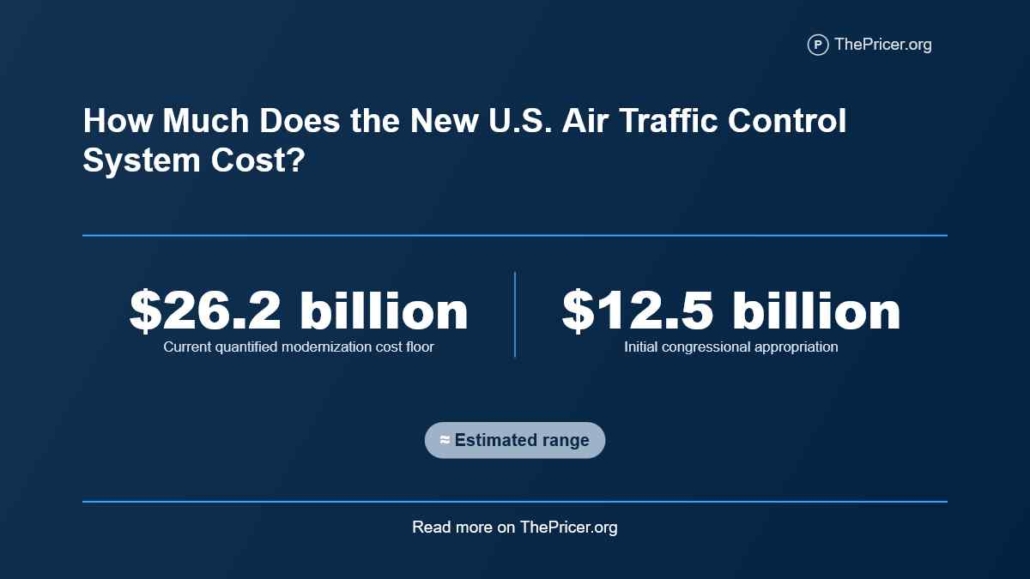
The new U.S. air traffic control modernization effort now has a current identifiable cost floor of about $26.2 billion, but that is not a final lifecycle price. FAA Administrator Bryan Bedford said on September 15, 2026 that Phase 1 will cost up to $16 billion, while the Government Accountability Office says Phase 2 systems need about $10.2 billion before Phase 2 facilities are counted.
Current FAA cost reporting puts those figures in the same modernization effort. Congress initially appropriated $12.5 billion, so the first appropriation covers less than half of the current quantified floor.
Article Highlights
Jump to sections
- The initial congressional appropriation was $12.5 billion (at $30 per hour, earning that amount would take about 200 thousand years of full-time work, before taxes), not the final program price.
- FAA now describes Phase 1 as costing up to $16 billion.
- GAO says Phase 2 systems need about $10.2 billion, excluding Phase 2 facilities.
- The current identifiable cost floor is about $26.2 billion.
- The initial $12.5 billion appropriation covers about 47.7% of that current floor.
- FAA still lacks a complete lifecycle cost estimate, so the eventual total can be higher.
How Much Does the New U.S. Air Traffic Control System Cost?
Federal sources publish several valid figures because they measure different scopes. The $12.5 billion (about 200 thousand years of full-time work at $30 per hour) figure is the initial 2025 appropriation. The $16 billion figure is Bedford’s current Phase 1 estimate. GAO says Phase 2 systems require about $10.2 billion before Phase 2 facilities. Adding those later phase estimates produces a current cost floor of about $26.2 billion.
That floor should not be described as a final project price. GAO’s September review says FAA has not developed a complete, well-documented lifecycle cost estimate for the Brand New Air Traffic Control System. GAO also says the current estimates omit government costs, most Phase 1 operating costs after implementation, all Phase 2 operating costs, and Phase 2 facility construction.
| Cost marker | Amount | Scope |
|---|---|---|
| Initial congressional appropriation | $12.5 billion | Systems and facilities funding |
| Current Phase 1 estimate | $16 billion | Broader Phase 1 program |
| Phase 2 systems need | $10.2 billion | Excludes Phase 2 facilities |
| Current quantified floor | $26.2 billion | Phase 1 plus Phase 2 systems |
| Earlier FAA funding marker | $32.5 billion | Initial funding plus stated additional need |
The initial appropriation covers about 47.7% of the current $26.2 billion floor, leaving at least $13.7 billion beyond the first appropriation. FAA’s December 2025 fact sheet called the $12.5 billion appropriation a down payment and said another $20 billion would be needed. That earlier marker implies about $32.5 billion, but it is not a finished lifecycle estimate.
What the $12.5 Billion Funds
Congress split the original $12.5 billion (about 200 thousand years of full-time work at $30 per hour) appropriation into two major buckets. GAO says $9 billion went to air traffic control systems modernization and $3.5 billion went to facilities construction. The systems money supports communications, automation, surveillance, weather tools, and training technology. The facilities money covers physical air traffic control infrastructure such as towers and control-center projects.
GAO lists $4.75 billion for telecommunications, $3 billion for radars, $500 million for runway safety and surface surveillance, $300 million for information displays, $300 million for Terminal Flight Data Manager work, $80 million for weather systems, and $100 million for training technology. The comparison table totals $9.03 billion.
The physical-facility side is already producing individual projects. FAA announced $835.8 million of facility upgrades in May 2026, including replacement work for eight towers and Terminal Radar Approach Control facilities plus improvements at 41 Federal Contract Towers. That amount is a component of the broader modernization effort, not a new amount to add on top of the current Phase 1 total.
That distinction is central to the cost question. A program appropriation, a facility award, and a supplier contract can all be accurate without being additive. Treating every contract announcement as an extra cost would double count work already financed inside the larger program.
Why Phase 1 Reached $16 Billion
GAO’s systems-only comparison shows how the Phase 1 budget expanded. The original listed appropriations total $9.03 billion. FAA’s June 2026 estimate for those Phase 1 systems totals $10.615 billion. The difference is $1.585 billion, which equals a 17.6% increase over the listed appropriations. FAA plans to cover $1.011 billion of that gap from fiscal 2026 annual appropriations, leaving a systems shortfall of $574 million.
The current $16 billion Phase 1 figure is broader than GAO’s $10.615 billion systems table because it also reflects facilities and other Phase 1 program costs. Bedford’s September testimony says FAA is supplementing the original down payment with another $1.5 billion fiscal 2027 request from the Facilities and Equipment budget to keep modernization moving.
FAA has also accelerated deployment while the cost plan is still being refined. Bedford reported that by September 1 the agency had replaced more than 64% of its copper-based telecommunications network, moved 21 towers from paper flight strips to electronic displays, installed 101 surface-awareness systems, converted more than 403 radio sites, and installed six surface-movement radars at five airports. Faster implementation can reduce years of operating obsolete equipment, but GAO warns that moving quickly without a complete lifecycle estimate and master schedule can raise the risk of cost growth and disruption.
Telecom Drives Most of the Systems Gap
Telecommunications is the largest single reason the Phase 1 systems estimate moved above the original allocation. GAO shows the telecom estimate rising from $4.75 billion to $5.91 billion, an increase of $1.16 billion. That work includes replacing aging copper infrastructure with fiber and modern network equipment, along with voice switches and radio modernization that connect air traffic facilities across the National Airspace System.
The $1.16 billion telecom increase equals about 73.2% of the net $1.585 billion difference between the listed Phase 1 systems appropriations and FAA’s latest systems estimate. The calculation is $1.16 billion divided by $1.585 billion. It is a share of the net difference, not a claim that telecom caused 73.2% of every cost increase inside BNATCS. Other programs moved in both directions.
GAO’s table shows information displays increasing by $337 million, Terminal Flight Data Manager by $384 million, weather systems by $105 million, and Alaska Automation Capability adding $198 million. Radar is $560 million below its original allocation, surface-awareness work is $31 million lower, and tower simulation is $8 million lower. Those declines offset part of the increases.
Telecommunications also carries a cost outside the headline Phase 1 systems estimate. GAO says FAA projects another $91 million for cable-loop sustainment supporting the telecom work, but classifies that spending outside the $10.6 billion estimate. That is one reason the published systems figure should not be mistaken for a full lifecycle bill.
Contracts Inside the Program
The prime integration contract is a good example of why contract ceilings and expected spending need to stay separate. Peraton’s contract has a ceiling of $1.5 billion, but GAO says FAA officials put the final negotiated price at about $876 million. That is roughly $624 million, or 41.6%, below the ceiling. FAA said negotiations shifted some radar-installation oversight to radar vendors and saved more than $150 million. The ceiling still gives FAA room to add work without exceeding the contract limit.
Radar procurement is another large component. FAA says RTX and Indra will help replace up to 612 radars by June 2028. The radar replacement program covers multiple surveillance roles and locations, so dividing one contract total by 612 would not produce a valid unit price. Reuters reports that the radar contracts total about $780 million, while Indra also has a separate $244 million digital-radio contract. FAA estimates tariffs will add around $100 million to modernization costs, mainly through radar equipment.
Software is a major cost category too. Air Space Intelligence received a $875 million, 12-year contract tied to the Flow Management Data and Services platform and SMART traffic-management tools. These component prices explain where program money is going, but they should not be stacked on top of $26.2 billion when the broader phase estimates already include related work.
Phase 2 Adds Another $10.2 Billion
 Phase 2 moves beyond replacing aging communications and surveillance hardware. GAO says FAA plans new automation systems that track aircraft, manage traffic flow, and address scheduling bottlenecks across the National Airspace System. The two large program concepts are a Common Automation Platform and Flow Management Data and Services. FAA says it needs about $10.2 billion for Phase 2 systems modernization.
That $10.2 billion does not include Phase 2 facilities. GAO says FAA had not finalized that construction estimate, received full Phase 2 funding, or established a complete timeline. The fiscal 2027 request included $860 million to begin Phase 2 systems work.
The scope helps explain why Phase 2 is expensive. Phase 1 largely accelerates existing investments and replaces worn communications, surveillance, weather, and training systems. Phase 2 requires new automation capabilities that combine flight tracking, traffic management, scheduling, and strategic planning. FAA’s FMDS and SMART description says the new tools are intended to coordinate demand, capacity, weather, airport conditions, and flight trajectories before congestion develops.
For the present cost question, the safest use of $10.2 billion is as a quantified Phase 2 systems requirement. It is not an all-in Phase 2 budget because the associated facilities and longer-run operating costs are not yet fully priced.
Costs the Estimates Leave Out
The largest uncertainty is not a hidden contractor invoice. It is the absence of a full lifecycle model. GAO says FAA’s Phase 1 estimate does not include government costs, most operations costs for Phase 1, any Phase 2 costs inside that specific estimate, or several supporting activities that FAA places outside BNATCS. The separate $91 million cable-loop sustainment amount is one documented example of work needed to support modernization that does not sit inside the $10.6 billion Phase 1 systems estimate.
Phase 2 facilities are another open category. FAA says more facility funding will be required, but GAO reports that officials had not determined the amount. Facility costs can include new or consolidated control centers, towers, TRACON infrastructure, backup systems, power, security, site preparation, and the construction work needed to keep the airspace operating while equipment is replaced.
Price changes can create further pressure. FAA’s current tariff estimate is about $100 million, while hardware, labor, construction, cybersecurity, testing, integration, and schedule changes can move future totals. Those uncertainties are why $26.2 billion is a current floor rather than a cap.
The same scope discipline applies to workforce costs. Controller hiring and training are necessary for FAA operations, but the controller workforce program is not interchangeable with the capital cost of BNATCS. Mixing normal staffing budgets into the modernization total would answer a different question.
BNATCS Differs From NextGen
BNATCS is not the first federal effort to modernize U.S. air traffic management. NextGen began more than two decades ago and moved the system toward satellite navigation, digital communications, and automation. GAO says FAA spent more than $14 billion on NextGen from fiscal 2007 through 2022, while projected combined federal and aviation-industry cost through 2030 was at least $35 billion.
Those historical figures should not be added to BNATCS. NextGen spans a longer period and includes industry spending. BNATCS is the accelerated program for communications, surveillance, facilities, and automation. The $12.5 billion figure is initial funding, $16 billion is the current Phase 1 estimate, and $26.2 billion is the current quantified floor once Phase 2 systems are included.
The same scope issue appears in complex aviation hardware. The E-3 AWACS cost breakdown separates operating rates, unit-cost references, and modernization contracts. A highway lane cost also changes when structures and utilities enter the project, while a federal helipad project shows why surrounding infrastructure can sit outside a headline construction price.
Use the $12.5 billion figure when
- Describing the original congressional appropriation.
- Explaining the first funded systems and facilities package.
Do not use the $12.5 billion figure as
- The final BNATCS price or current Phase 1 total.
Use about $26.2 billion when
- Describing the current minimum identifiable cost from Phase 1 plus quantified Phase 2 systems.
Do not describe $26.2 billion as
- A final all-in price because facilities and lifecycle costs remain incomplete.
Answers to Common Questions
Is the new U.S. air traffic control system a $12.5 billion project?
No. $12.5 billion is the initial congressional appropriation. Current evidence puts Phase 1 at up to $16 billion and identifies another $10.2 billion for Phase 2 systems.
What is the best current cost estimate?
About $26.2 billion is the current identifiable floor from Phase 1 plus the quantified Phase 2 systems requirement. It is not a final lifecycle total.
Why did Phase 1 get more expensive?
Telecommunications is the largest systems increase. Its estimate rose from $4.75 billion to $5.91 billion, while automation and weather estimates also increased and some surveillance estimates declined.
Does the $26.2 billion include every future cost?
No. Phase 2 facility construction, several operating expenses, government costs, and some supporting work are not fully included in the published estimates.
Is BNATCS the same as NextGen?
No. NextGen is the older multi-decade modernization effort. BNATCS is the newer accelerated program for aging infrastructure, communications, surveillance, facilities, and new automation systems.
Disclosure: Educational content, not financial advice. Prices reflect public information as of the dates cited and can change. Confirm current rates, fees, taxes, and terms with official sources before purchasing. See our methodology and corrections policy.