
How Much Does the Pantsir-S1 Air Defense System Cost?
Published on | Written by Alec Pow
This article was researched using 13 sources. See our methodology and corrections policy.
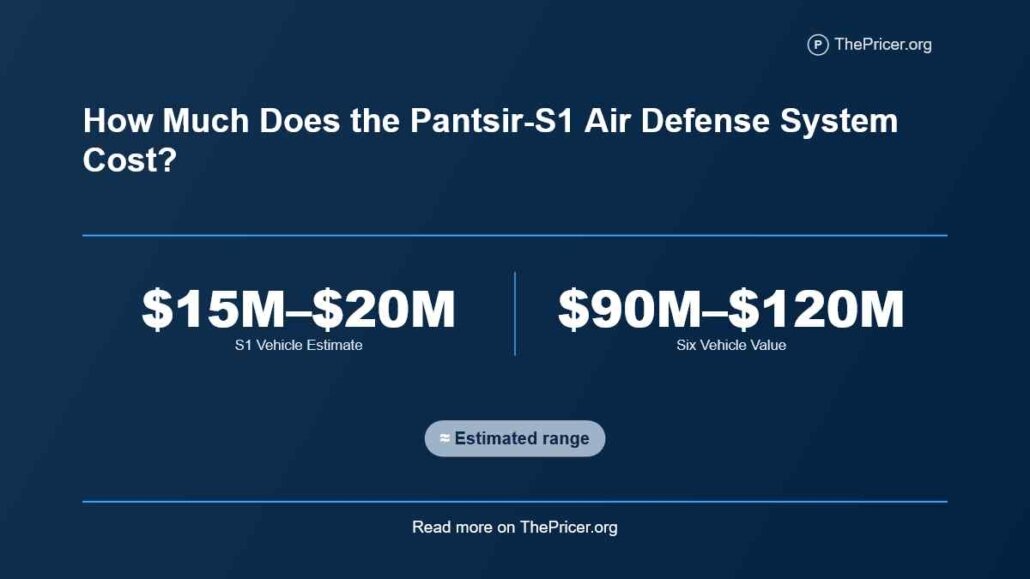
A Russian Pantsir-S1 air defense system costs an estimated $15 million to $20 million per combat vehicle in 2026. This is an open-source valuation rather than a published manufacturer price. It is supported by historical Russian export contracts, independent defense analysis, and the Ukrainian Security Service’s February 2026 estimate.
A six-vehicle Pantsir-S1 battery would therefore represent approximately $90 million to $120 million in combat-vehicle value alone. A complete procurement can cost substantially more once command posts, missiles, ammunition reserves, training, maintenance vehicles, and communications equipment are included. One documented Saudi Arabian purchase reached approximately $2.3 billion, although that contract covered an extensive Pantsir-S1M package rather than 39 standalone launchers.
Article Highlights
Jump to sections
- $15 million to $20 million is a defensible current estimate for one Pantsir-S1 combat vehicle, not an official list price.
- The UAE’s original purchase of 50 systems for $734 million averaged $14.68 million per system before accounting for development and package inclusions.
- An Algerian contract covering 38 systems for more than $500 million implies a historical average above $13.16 million.
- Saudi Arabia’s approximately $2.3 billion Pantsir-S1M contract included 39 combat vehicles, 10 command posts, missiles, and extensive support equipment.
- A hypothetical six-vehicle formation valued at $90 million to $120 million needs a separate budget for additional ammunition, personnel, and long-term support.
- Standard Pantsir-S1 launchers carry 12 ready-to-fire missiles, while certain upgraded configurations can accommodate more compact counter-drone interceptors.
How Much Does the Pantsir-S1 Air Defense System Cost?
The central pricing question is whether the quoted amount refers to one functioning combat vehicle or an entire air defense formation. A Pantsir-S1 vehicle combines a search radar, engagement sensors, missile launchers, and automatic cannons on a mobile platform. It can operate independently, although multiple vehicles are commonly linked into a coordinated defense network.
The CSIS Missile Threat profile describes a conventional Pantsir-S1 carrying 12 surface-to-air missiles and two 30 mm cannons. Its missile engagement range reaches approximately 20 kilometers against suitable aircraft targets. Actual engagement distance varies with target type, flight path, and operating conditions.
The pricing evidence falls into three groups. Older export contracts establish a historical floor for system-package averages. Defense-industry reporting provides estimates for later variants. Recent Ukrainian military statements provide replacement-value estimates, although they are not independently audited Russian production invoices.
| Purchase or estimate | Reported amount | What the figure represents |
|---|---|---|
| Pantsir-S1, 2026 estimate | $15M–$20M | Estimated value of one combat vehicle |
| UAE, original 2000 agreement | $14.68M each | $734M divided by 50 systems, including development-related scope |
| Algeria, 2006 agreement | Above $13.16M each | More than $500M divided by 38 systems |
| Pantsir-S1M, defense analysis | About $20M | Reported approximate value of an upgraded vehicle |
| Saudi S1M procurement | About $59M per combat vehicle allocation | Entire $2.3B package divided by 39 combat vehicles, not the launcher price |
These numbers should not be averaged together. They describe different variants, contract years, equipment bundles, and methods of valuation. The Saudi figure is particularly unsuitable as a direct estimate of what one Pantsir-S1 launcher costs.
Previous Export Contracts
The United Arab Emirates provides the clearest historical benchmark. Russia agreed to supply 50 Pantsir-S1 systems under a $734 million contract signed in 2000. Dividing the announced contract amount by 50 gives $14.68 million per system. In reporting on the deliveries, Gulf News quoted the manufacturer’s leadership discussing operator training and continued maintenance.
That average includes more than the value of an assembled vehicle. The contract helped fund further development of the platform. An arms-trade study by CSIS records the UAE agreement at approximately $720 million to $800 million, including development partly financed by the buyer. Using the upper reported contract value raises the implied average to $16 million per system.
Algeria supplies another comparison. In March 2010, Interfax reported a 38-system contract valued above $500 million. That creates a minimum average of approximately $13.16 million per vehicle equivalent. The actual average was higher because the reported contract value exceeded that amount.
The UAE and Algerian figures were agreed years before the current war and cover different customer requirements. They support the plausibility of the modern $15 million to $20 million estimate but cannot independently establish Russia’s 2026 manufacturing cost.
A 2024 StrategyPage assessment placed a Pantsir-S1 at approximately $15 million, an upgraded S1M at roughly one-third more, and the specialized SMD-E at about $17 million. Those are published analyst estimates, not binding export quotations.
Saudi Arabia Paid Much More
Saudi Arabia’s agreement exposes the difference between a missile launcher and a functioning national-defense purchase.
An OCCRP investigation of leaked contracts established that Saudi Arabia signed a Pantsir-S1M agreement with Russia on April 8, 2021. The reported value was approximately €2.2 billion, presented in the investigation as roughly $2.3 billion. The documents describe 39 missile-and-gun combat vehicles, 10 command-post vehicles, hundreds of missiles, and additional equipment. Investigators verified an initial payment but could not establish every subsequent transfer.
The accompanying contract-equipment investigation details nine radio command vehicles, 20 loaders, repair and recovery vehicles, fuel trucks, ammunition, simulators, and personnel training. The contract reportedly ran into 2026.
Our calculated package allocation is approximately $59 million per combat vehicle. The arithmetic is $2.3 billion ÷ 39 = $58.97 million.
It would be inaccurate to claim that Saudi Arabia paid $59 million for each launcher. That calculation allocates the expense of every command vehicle, missile, truck, and supporting service across the 39 combat vehicles. The contract does not disclose a reliable standalone price for each component.
The distinction changes the interpretation dramatically. The Saudi allocation is roughly four times the UAE’s original $14.68 million average, but that is not proof that Pantsir launcher prices quadrupled. The purchases involve different generations, contract dates, and procurement scope.
How Much Do Pantsir Missiles Cost?
A Pantsir vehicle remains useful only while it has ammunition and functioning sensors. Standard missiles are consumable assets, making replenishment a separate question from the price of the launcher.
Published estimates for individual 57E6-family missiles vary considerably. We did not establish a current, independently verifiable Russian contract price per missile. It would be misleading to attach one precise figure to every Pantsir interceptor.
The baseline vehicle carries 12 ready-to-fire missiles. Its cannons offer a shorter-range option, although gunfire is not interchangeable with missile engagement against every airborne threat.
Later Pantsir variants have been adapted for larger numbers of smaller interceptors intended for drones. A 2026 examination of the Gvozd missile describes four compact rounds occupying the space normally used by one standard missile canister. That gives a compatible 12-position launcher capacity of up to 48 compact rounds. It does not mean every older S1 can carry them without modification.
The potential savings are substantial, but only if the compact missile costs less and is suitable for the target. Its shorter engagement range means it cannot simply replace the full-size interceptor for all threats.
Consider an ammunition-planning scenario using two hypothetical prices, not verified current purchase rates.
- At $100,000 per standard missile, one 12-round reload costs $1.2 million.
- At $250,000 per standard missile, the same reload costs $3 million.
- For six vehicles, one additional full reload would cost $7.2 million to $18 million under those assumptions.
This sensitivity calculation explains why missile pricing matters even when the launch vehicle price is known. It is an ammunition budget model, not an assertion about what Russia currently pays.
The Hidden Price of a Pantsir Battery
The launcher is the most visible expense. The less obvious costs arise from making several vehicles operate as a coordinated and sustainable defense unit.
A complete formation needs secure communications, command arrangements, spare parts, maintenance capacity, electrical power, transport support, trained crews, and a reserve of missiles. Depending on contract terms, buyers may also require simulators, testing equipment, facilities, and supplier personnel.
The Royal United Services Institute’s production research identifies numerous distinct Pantsir supply-chain elements, including radar assemblies, communications modules, navigation equipment, thermal imaging systems, vehicle components, and ammunition. Replacing an immobilized launcher is therefore more complicated than buying another truck chassis.
Ukraine’s defense intelligence agency separately identified more than 50 participating enterprises associated with Pantsir-S1 combat-vehicle production in May 2026. This does not reveal production prices, but it helps explain why sanctions, damaged suppliers, and unavailable electronic components can influence replacement schedules.
Worked acquisition example
Suppose a military planner wants six Pantsir-S1 combat vehicles plus one extra missile reload for each. This is a hypothetical valuation using the current platform estimate and the ammunition assumptions above. It is not a supplier quotation.
- Six combat vehicles at $15 million to $20 million each = $90 million to $120 million.
- Six additional reloads, each containing 12 missiles = 72 missiles.
- At an assumed $100,000 to $250,000 per missile, the extra stock costs $7.2 million to $18 million.
- Modeled equipment plus additional reloads = $97.2 million to $138 million.
The missile amount is for an additional reserve, avoiding the assumption that the vehicle benchmark excludes its initial ammunition. The model still leaves command vehicles, maintenance equipment, training, and facilities unpriced. If an actual seller includes the reserve missiles in a package, that amount must not be added again.
Another useful result is the effect of procurement scope on apparent unit prices. At six vehicles, a $1 million difference in estimated vehicle value changes the formation budget by $6 million. That is before any associated difference in maintenance requirements or missile compatibility.
Pantsir vs Other Defenses
 Pantsir-S1 is a short-range defensive layer, commonly used to protect important infrastructure and longer-range missile systems. It is not a direct substitute for a strategic air defense battery.
Russia pairs short-range assets with equipment such as the S-400. The S-400 missile system’s procurement cost is substantially higher because its mission, engagement ranges, radar network, and missile inventory differ. A Pantsir can contribute close-in protection for the more expensive formation.
The same distinction applies to the American Patriot missile system. Comparing a single Pantsir truck with an entire Patriot battery produces a dramatic but largely meaningless price ratio. Patriot procurement usually includes separate launchers, radar, engagement control, and significant interceptor stocks.
At the missile level, the economics become different again. Modern U.S. APKWS guided rockets represent a lower-cost counter-drone option, but they depend on compatible launch platforms and engagement methods. The X-Bow Buckler interceptor is another example of a weapon developed around cheaper engagements. Neither product is a direct drop-in replacement for a Pantsir vehicle.
For perspective, the cost of one missile-defense interception can greatly exceed the purchase price of the threatening drone or missile. That problem affects both Russian and Western forces.
A September 2026 Reuters examination of missile inventories describes the growing demand for affordable interceptors that can be manufactured and replenished in large quantities. The relevant comparison is therefore not merely launcher against launcher. It is the cost of maintaining a usable defensive capability during repeated attacks.
What Changes the Final Price?
Two countries buying what they call Pantsir systems can receive substantially different packages. A defensible procurement comparison needs to hold the following variables constant.
- Variant. The original S1, upgraded S1M, SM, and SMD configurations can have different sensors, missile capabilities, and vehicle arrangements.
- Vehicle count. One combat vehicle is a different purchase from a coordinated six-vehicle unit with a separate command post.
- Initial ammunition. The price may include loaded missiles, an additional reserve, or a larger multiyear stockpile.
- Support vehicles. Reloaders, transport trucks, repair equipment, and recovery vehicles can be separate contract lines.
- Training and sustainment. Operator instruction, spare parts, simulators, technical assistance, and facilities can materially expand a contract.
- Contract conditions. Financing, localization proposals, sanctions, and delivery timing can affect terms without changing the physical launcher.
Current export availability also cannot be inferred from historical purchases. Russia is operating under international sanctions, and actual procurement would require government-level arrangements rather than a conventional commercial order. A published equipment valuation is not evidence that a buyer can acquire the system at that amount.
A separate issue is battlefield replacement value. Ukrainian officials have assigned approximately $15 million to Pantsir vehicles reported destroyed in particular strikes. An August 2026 report of a Pantsir loss cited that figure from Ukrainian military intelligence. Such reports indicate the value attributed to a target, not the amount of an executed arms sale or Russia’s audited replacement cost.
Answers to Common Questions
How much is one Pantsir-S1 worth in 2026?
Approximately $15 million to $20 million per combat vehicle is a defensible open-source estimate. Actual Russian domestic production costs and new export prices are not publicly established by an audited invoice.
How much does a complete Pantsir battery cost?
Six combat vehicles would have an estimated combined value of $90 million to $120 million. A purchased battery can cost more once command equipment, additional missiles, training, and support are included.
Why does the Saudi contract appear to cost nearly $59 million per system?
The figure comes from dividing an approximately $2.3 billion contract by 39 combat vehicles. The purchase also included command posts, missiles, trucks, communications, and training. It is a full-package allocation, not the documented price of an individual launcher.
How many missiles does the Pantsir-S1 carry?
The baseline vehicle carries 12 ready-to-fire surface-to-air missiles alongside two 30 mm cannons. Certain later configurations can accommodate up to 48 smaller counter-drone missiles.
Is the Pantsir-S1 cheaper than Patriot or S-400?
One Pantsir combat vehicle has a much lower estimated acquisition value than a complete Patriot or S-400 battery. Their missions and equipment packages differ, so the comparison does not establish which system provides better protection for a particular threat.
Disclosure: Educational content, not financial advice. Prices reflect public information as of the dates cited and can change. Confirm current rates, fees, taxes, and terms with official sources before purchasing. See our methodology and corrections policy.