
How Much Does the U.S. Military’s Heat Ray Cost?
Published on | Written by Alec Pow
This article was researched using 15 sources. See our methodology and corrections policy.
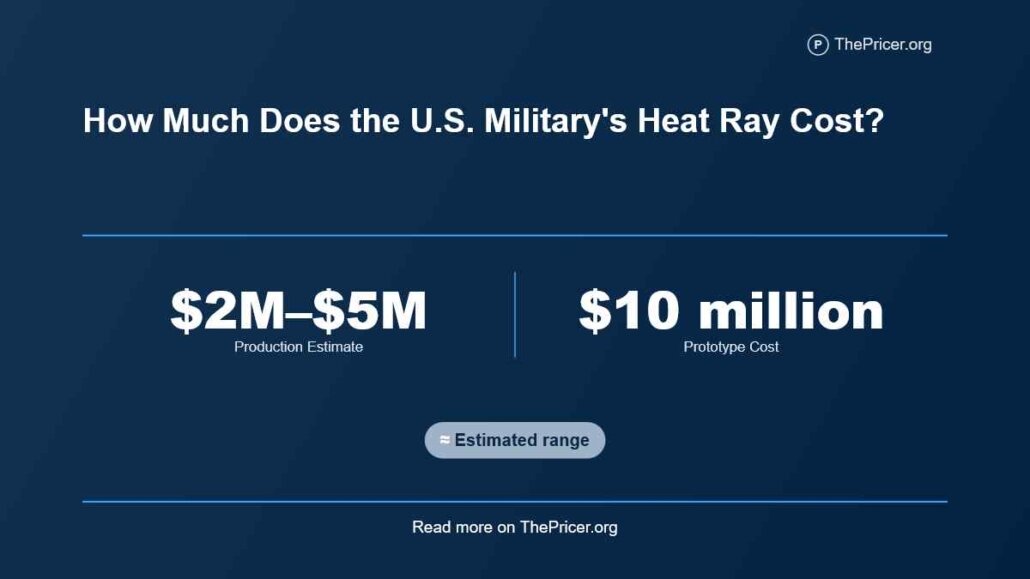
The U.S. military’s heat-ray weapon, officially the Active Denial System (ADS), was projected to cost approximately $2 million to $5 million per unit in production, according to U.S. military officials quoted in 2007. A demonstration machine reportedly cost around $10 million to build, while a proposed 2008 purchase of five vehicle-mounted systems carried a combined $25 million budget. These are historical production estimates and procurement plans, not confirmed 2026 selling prices.
The weapon has also consumed substantial research funding. The Government Accountability Office documented $55.2 million across two early development periods, while CBS later reported approximately $120 million in cumulative spending. The system is back in the news after the Pentagon approved a seven-month loan to the Department of Homeland Security for possible U.S.-Mexico border applications. That loan does not represent a new purchase.
Article Highlights
Jump to sections
- Military officials projected approximately $2 million–$5 million per production ADS unit in 2007.
- A 2008 plan for five truck-mounted systems totaled $25 million, equivalent to $5 million per vehicle.
- GAO documented $35.5 million for a demonstration program producing two prototypes, including development expenses.
- A smaller Raytheon Silent Guardian system was historically estimated around $3 million.
- Raytheon received a $7.55 million ADS 2 development contract, and a later power-system research award totaled approximately $794,000.
- The 2026 DHS arrangement involves borrowing one existing system for seven months, with no public purchase price or reimbursement total.
How Much Does the U.S. Military’s Heat Ray Cost?
There are three different ways to price the military’s Active Denial System: projected production cost, prototype development cost, and cumulative program spending.
The clearest historical unit-cost estimate appeared in The Telegraph’s November 2007 reporting on military demonstrations.
Officials said the demonstration machine cost approximately $10 million to construct, but anticipated that later production systems could cost $2 million–$5 million apiece.
The estimate was forward-looking. It depended on establishing production rather than repeatedly building research prototypes.
A second historical benchmark followed in October 2008. ABC News reported an Army plan to obtain five truck-mounted heat-ray systems for approximately $25 million.
That implied a budget of $5 million per complete vehicle-mounted system.
However, the contract was described as an expected award. It should not be presented as proof that five complete systems were delivered or purchased for that amount.
| Heat-ray cost reference | Amount | What it represents |
|---|---|---|
| Projected production ADS | $2M–$5M | 2007 official expectation per unit |
| Demonstration machine | About $10M | Reported prototype construction cost |
| Five truck-mounted systems | $25M | 2008 proposed acquisition budget |
| ADS 2 development contract | $7.55M | Design, fabrication, testing and support |
| Two-prototype program | $35.5M | Earlier demonstration and engineering budget |
| Smaller Silent Guardian | About $3M | Historical independent price estimate |
| Historical ADS program total | $120M | Reported cumulative spending by 2012 |
These figures reflect different years and scopes. The projected production estimates are more relevant to pricing a manufactured ADS unit than cumulative research expenditures, although none establishes a current replacement contract.
What Did Raytheon’s Contracts Cost?
Raytheon developed ADS equipment for the Air Force Research Laboratory and the Pentagon’s nonlethal weapons program.
The University of Bradford’s nonlethal weapons research documented a Raytheon contract valued at $7,549,715 in April 2005.
The contract covered designing, fabricating, testing, fielding and supporting an ADS 2 configuration. It was not merely a purchase order for an already-manufactured unit.
The research also records separate development efforts involving smaller systems, including a Department of Justice-funded handheld technology prototype project valued at $499,000.
These smaller contracts reveal how the Pentagon and other agencies pursued different versions rather than committing immediately to large-scale manufacturing.
The GAO’s 2009 nonlethal weapons review documented $19.7 million in early ADS research and $35.5 million in subsequent demonstration spending.
Together, those periods account for $55.2 million in documented expenditures.
GAO also identified practical weaknesses that prevented the technology from moving efficiently into routine deployment.
By the time CBS revisited the program, reported cumulative investment had reached approximately $120 million.
That larger amount reflects years of additional work, not the cost of manufacturing a single heat-ray truck.
Why Does the Heat Ray Cost Millions?
The Active Denial System is more than an antenna attached to a vehicle.
Its core is a specialized high-power millimeter-wave generator called a gyrotron. The original system also uses superconducting magnets, waveguides, refrigeration equipment, power electronics, beam-directing hardware, and control systems.
A National Defense University technical study describes a gyrotron producing approximately 100 kilowatts of electromagnetic output, with conversion efficiency exceeding 50%.
That power must be generated and managed while protecting the equipment from excess heat.
The original gyrotron’s superconducting magnet operates near 4 kelvin, requiring specialized cooling technology.
GAO reported that one ADS configuration needed approximately 16 hours to reach its operating temperature, creating a major readiness problem unless cooling equipment remained active.
These components help explain why a prototype could cost approximately $10 million, even though mass production was expected to reduce the unit price.
The equipment also creates challenges during repairs. Large antennas, specialized magnets, and waveguides are not components that ordinary vehicle mechanics can readily replace in the field.
A damaged antenna may require specialized transport and replacement rather than a routine repair.
Is There a Smaller, Cheaper Heat Ray?
Raytheon also developed a smaller version called Silent Guardian.
The reduced-range system was intended for security applications, including protecting ships, installations, and sensitive facilities.
In 2009, Wired reported an estimated $3 million price for Silent Guardian, citing an earlier financial-publication estimate.
The figure was not a manufacturer quotation. Another Wired investigation quoted Raytheon as declining to discuss sales prices before signed contracts existed.
Silent Guardian’s shorter range and lower power help explain why its estimated acquisition cost was below the original demonstration machine’s cost.
Smaller systems also create different operational tradeoffs. A unit designed to protect a facility at a few hundred meters does not provide the same coverage as a much larger long-range military configuration.
A still smaller concept received attention outside the United States.
In November 2009, Wired reported that an Israeli development team was pursuing a portable pain-beam system with an approximately $250,000 target price.
That was a development aspiration, not a proven commercial replacement for ADS.
These comparisons demonstrate that reducing size and range can change acquisition costs dramatically, but capability must be considered alongside price.
What Is the 2026 Border Test?
The Pentagon has approved a temporary loan of one existing Active Denial System to the Department of Homeland Security.
According to CNN’s October 21 investigation, the arrangement covers seven months beginning in September 2026.
The approval allows DHS to test the equipment and develop procedures for possible future use along the U.S.-Mexico border.
The memo makes DHS responsible for operating the system, rather than assigning military personnel to operate it.
That changes the cost question. The government is not purchasing a new heat-ray system; it is evaluating an asset already owned by the military.
Possible incremental expenses include equipment transportation, operator preparation, power supply, maintenance, testing personnel, and repairs.
The trial does not establish that DHS has selected a permanent operating site or approved the system for routine border use.
The Axios investigation also documents concerns about injuries and earlier consideration of ADS for border operations.
Any actual fielding decision would require evaluating safety, operational effectiveness, legal limits, and possible indirect injuries.
Operating ADS
ADS uses electricity rather than consuming an expensive missile each time its beam is activated.
However, electricity is only a small part of the operating cost.
Power generation, refrigeration, vehicle maintenance, specialized technicians, replacement assemblies, operator training, safety testing, and logistical support all affect the total.
In fact, the GAO’s 2010 urgent-needs review found that ADS 2’s size, limited mobility, and difficulty of field repair contributed to the withdrawal of operational requests.
A useful additional cost signal appeared in a later government research program.
The federal Small Business Innovation Research database lists a $793,751 award to Candent Technologies for research on power systems supporting Active Denial Technology and high-power radio-frequency equipment.
That is a component-development award, not a complete system purchase, but it demonstrates the continuing expense of solving the power and integration problem.
The hidden financial risk is equipment availability. A machine that requires extensive preparation and cannot be repaired quickly may need more personnel, spare parts, and standby support than its headline acquisition price suggests.
What Would Five ADS Units Cost?
Consider a hypothetical procurement using the historical $2 million–$5 million production range.
Suppose an agency needs five systems to support several sites, with one additional unit held as a spare.
- Five operational units at $2 million: $10 million
- One spare at $2 million: $2 million
- Six-unit low-price scenario: $12 million
- Six-unit high-price scenario at $5 million each: $30 million
The resulting acquisition scenario is $12 million–$30 million for six units, using historical estimates rather than 2026 contractor bids.
The model excludes training, site preparation, power infrastructure, repairs, and ongoing operations.
Now compare that with a six-unit arrangement using the earlier $10 million demonstration-machine cost. The hypothetical total would rise to $60 million.
The $30 million–$48 million difference illustrates how heavily the economics depend on whether ADS is manufactured as repeatable production equipment or treated as a series of specialist prototypes.
It does not mean an actual six-unit production contract would achieve the projected savings.
Heat Ray vs Laser Weapon
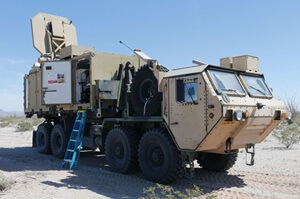 Active Denial uses electromagnetic energy to cause pain and disperse people. Military laser weapons generally have different purposes, including destroying drones or intercepting projectiles.
Nevertheless, the equipment has similar broad cost categories: high-energy components, tracking and aiming hardware, power generation, cooling, integration, and trained personnel.
ThePricer’s LOCUST laser weapon cost guide reports an approximately $8 million acquisition benchmark for the earlier counter-drone laser system.
Its marginal engagements may use only a few dollars of electricity, but that does not mean the deployed system costs only a few dollars to operate.
Likewise, the Iron Beam cost analysis examines the substantial manufacturing, support, and infrastructure spending required for military laser defense.
Those systems are not substitutes for ADS because they are designed for different targets and operational missions.
The more relevant comparison is the difference between upfront hardware costs and total operational spending.
The cost of missile-defense interception offers the opposite example: a system may have major fixed expenses and also expend expensive interceptors during each engagement.
ADS avoids the cost of consumable missiles, but its historical maintenance and readiness problems still affect the economic case.
Why Hasn’t the Military Used ADS More?
The long development history is not primarily a story about failing to build a functioning weapon.
The Pentagon successfully demonstrated the equipment. The problem was turning it into a system military commanders considered practical, supportable, and appropriate to use.
In 2005, Wired reported that the Humvee-mounted system pushed the vehicle’s electrical capacity near its limits and had to stop to direct the beam.
GAO later documented the large size of ADS 2, which weighed more than nine tons, and its demanding cooling arrangements.
That limited the system’s usefulness for rapidly changing operations.
The Pentagon also faced legal, public-perception, and safety concerns.
The equipment was shipped to Afghanistan in 2010 but returned without being used in combat.
As Congressional Research Service explained, the Army later explored smaller solid-state Active Denial technology that could reduce the size and power requirements of the original gyrotron-based system.
That work matters because it points to another possible cost trajectory: redesigning the technology around smaller electronics rather than replicating the earlier expensive vehicle-mounted prototype.
However, such systems need independent performance and safety evaluations before their costs can be compared on equivalent terms.
The historical ADS production estimate is useful for:
- Estimating the order of magnitude of a potential vehicle-mounted purchase.
- Comparing projected production cost with prototype expenditure.
- Understanding why smaller variants were pursued.
- Evaluating how multiple systems affect a government acquisition budget.
It is not sufficient for:
- Calculating the exact cost of the current DHS loan.
- Quoting a binding 2026 contractor price.
- Comparing ADS and counter-drone lasers as equivalent weapons.
- Claiming that proposed historical purchases became completed contracts.
Answers to Common Questions
How much does one military heat-ray weapon cost?
Military officials historically projected $2 million–$5 million for a production ADS unit. A demonstration machine reportedly cost around $10 million. No verified 2026 acquisition price has been published.
Did the Army plan to buy five heat-ray weapons?
Yes. Contemporary reporting described a proposed $25 million acquisition of five truck-mounted systems in 2008, equivalent to $5 million per system. That does not confirm the contract was completed.
How much did developing ADS cost?
GAO documented $55.2 million in early research and demonstration spending. CBS later reported approximately $120 million in cumulative program expenditure by 2012.
Is the smaller Silent Guardian cheaper?
A 2009 independent estimate placed Raytheon’s Silent Guardian around $3 million. It had a different size and range from the full military ADS, and the amount was not a confirmed manufacturer sales price.
How much is DHS paying for the border heat ray?
The Pentagon authorized a seven-month loan of an existing ADS in 2026. No verified purchase payment, loan reimbursement, or complete evaluation budget has been disclosed.
Disclosure: Educational content, not financial advice. Prices reflect public information as of the dates cited and can change. Confirm current rates, fees, taxes, and terms with official sources before purchasing. See our methodology and corrections policy.