
How Much Does the U.S. Pay the United Nations?
Updated on | Written by Alec Pow
This article was researched using 18 sources. See our methodology and corrections policy.
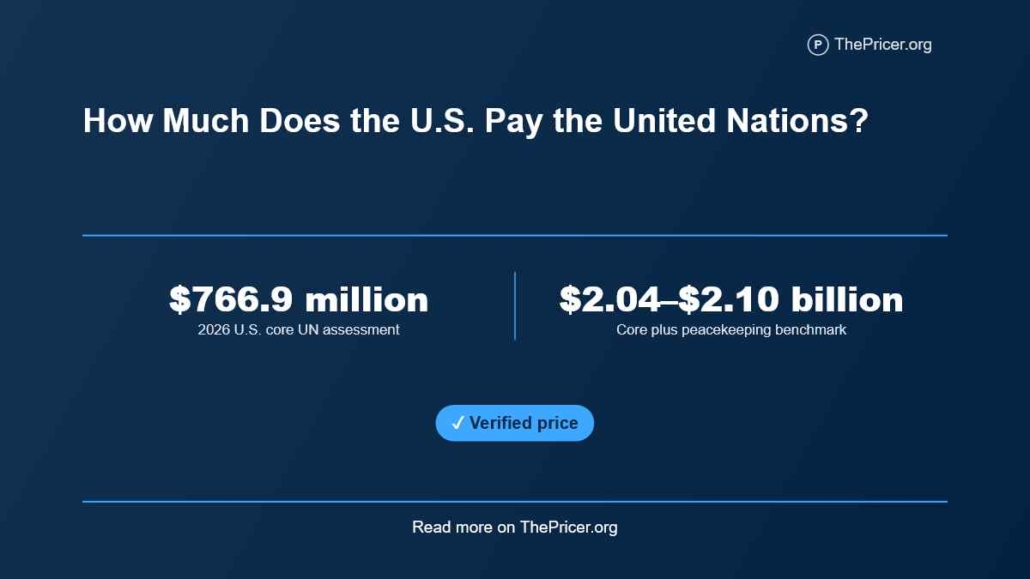
The United States’ 2026 core United Nations assessment is about $766.9 million, including $760.3 million tied to the regular budget and $6.5 million under the Peacebuilding assessment. Add a current peacekeeping benchmark and the regular-budget-plus-peacekeeping cost rises to roughly $2.04 billion to $2.10 billion, depending on whether peacekeeping is modeled at the U.S. statutory 25% payment cap or the UN’s 26.1371% assessment rate.
Those numbers are much smaller than another figure Americans may encounter: the United States supplied $14.27 billion in assessed and voluntary funding across the wider UN system in 2024, the latest complete year in the UN system-wide donor data. An OECD measure using a narrower development-assistance scope puts U.S. funding to the UN system at $10.9 billion in 2024.
The numbers are not contradictory. They measure different things. The United Nations General Assembly assesses regular dues, UN Peacekeeping sends separate assessments, and the U.S. government also chooses to direct billions toward entities such as the World Food Programme, UNHCR, and the International Organization for Migration.
The distinction became especially important in September 2026. Washington transferred $725 million toward the regular UN budget and another $102 million toward peacekeeping, or $827 million combined. After the payments, the United States still owed $1.312 billion on the regular budget alone; when outstanding peacekeeping dues are included, its remaining regular-budget and peacekeeping arrears were approximately $4.2 billion. The $827 million payment was cash against outstanding obligations, not a new $827 million annual UN charge, according to reporting on the September payment and remaining U.S. arrears.
Article Highlights
Jump to sections
- The official 2026 U.S. core UN assessment is $766.9 million (at $30 per hour, earning that amount would take about 12.3 thousand years of full-time work, before taxes), while China’s is about $641.4 million.
- The United States is assessed 22% of the regular budget, not 22% of everything spent across the UN system.
- A current regular-budget-plus-peacekeeping benchmark is about $2.04 billion to $2.10 billion, before separately assessed organizations and voluntary programs.
- The latest complete system-wide data show the U.S. supplied $14.27 billion in assessed and voluntary funding in 2024, versus about $2.5 billion from China.
- That means the U.S. core assessment is only about 20% higher than China’s, while total 2024 UN-system government funding was roughly 5.7 times as large.
- The UN assessment formula actually caps the U.S. regular-budget share at 22%; its calculated share before that ceiling was higher.
- UN spending is deliberately concentrated outside major donor countries, especially in crisis-affected states, so subtracting spending in America from U.S. contributions would not produce a meaningful “return on investment.”
Does the U.S. Pay Too Much to the UN?
There is no single accounting test that resolves whether the United States pays “too much.” Different comparisons produce materially different results.
On the regular UN budget, the case for an unusually high U.S. burden is less straightforward than the 22% headline suggests. The UN’s formula would assign the United States more than 22% before its maximum-rate rule is applied.
Compared with China’s mandatory assessments, the two countries are increasingly close. Compared with their total funding of the UN system, however, the gap becomes enormous.
| Measure | United States | China | What It Measures |
|---|---|---|---|
| 2026 regular-budget rate | 22.000% | 20.004% | Core UN assessment rate |
| 2026 core assessment | $766.9 million (about 12.3 thousand years of full-time work at $30 per hour) | $641.4 million | Current regular/PB assessment schedule |
| 2026 peacekeeping rate | 26.1371% | 23.7657% | Separate peacekeeping assessment scale |
| 2024 total UN-system government funding | $14.27 billion | about $2.5 billion | Assessed + voluntary funding across the system |
The first two rows come from the official 2026 assessment schedule. The broader donor comparison comes from the latest UN system-wide data summarized by the Congressional Research Service’s September 2026 review of U.S.-UN financing.
The resulting comparison is striking. America’s 2026 core assessment is approximately 19.6% higher than China’s. Its 2024 system-wide government funding was roughly 5.7 times China’s.
That difference between required funding and actual overall funding is more revealing than the familiar 22% statistic.
The 22% Headline Hides the Formula
The regular-budget assessment is intended to reflect countries’ capacity to pay. The methodology uses national income, debt adjustments, a low-per-capita-income adjustment, minimum rates, special limits for least-developed countries, and a maximum assessment rate of 22%.
The calculation behind the current 2025–2027 scale shows how much this matters. The United States began at 24.976% of world gross national income in the Committee on Contributions calculation. After the debt adjustment, its calculated share increased to 25.283%. It remained there until the ceiling reduced the final assessment to 22%.
China moved in the opposite direction, from a raw GNI share of 18.448% to a final assessment of 20.004%. Germany moved from 4.521% to 5.692%. India illustrates how the income adjustment can work the other way: its 3.153% raw GNI share ultimately became a 1.106% regular-budget assessment. The underlying stages can be followed in the Committee on Contributions’ machine calculation.
This produces an important distinction for the “does America pay too much?” debate. The United States pays the largest regular-budget share, but the 22% rule itself reduces rather than increases what the formula would otherwise assign to it.
Peacekeeping Adds a Second Bill
Peacekeeping is financed separately from the regular budget and operates on a July-to-June fiscal cycle. The approved 2026–2027 peacekeeping budget is roughly $5.1 billion (about 82 thousand years of full-time work at $30 per hour), according to the General Assembly Fifth Committee record approving the new budget.
Permanent members of the Security Council pay higher peacekeeping rates, while qualifying developing countries receive discounts. For 2026, the effective peacekeeping scale sets the United States at 26.1371% and China at 23.7657%. France, the United Kingdom, and Russia also pay premiums above their regular-budget rates because they are permanent Security Council members.
Using $5.1 billion simply as a benchmark, rather than as a literal U.S. invoice:
- $5.1 billion × 26.1371% = about $1.333 billion
- $5.1 billion × 25% = $1.275 billion
- Difference = about $58 million
Congress has long maintained a 25% statutory cap on U.S. peacekeeping payments even when the UN assessment rate exceeds it, a mismatch that can contribute to arrears. The history and operation of that cap are described in a review of U.S. assessed UN funding and the peacekeeping cap.
Add the current $766.9 million core assessment and the two benchmarks become approximately $2.04 billion at the U.S. 25% peacekeeping cap or $2.10 billion at the UN’s 26.1371% rate. These are comparison figures, not literal consolidated invoices, because individual peacekeeping assessments and budget periods differ.
Voluntary Funding
The biggest U.S. numbers are found outside the core membership bill.
Under the OECD’s development-assistance measure, the United States directed $10.9 billion to the UN system in 2024. Of that, $9.1 billion, or 83.8%, was earmarked for particular countries, regions, programs, themes, or purposes. The largest recipients were the World Food Programme at $3.2 billion, UNHCR at $2 billion, and the International Organization for Migration at $1.3 billion, according to the OECD breakdown of U.S. multilateral funding.
This is an important correction to the idea that Washington simply receives a $10 billion or $14 billion UN membership invoice. Much of the broader total reflects additional funding decisions, and much of that funding is earmarked rather than unrestricted.
The UN Chief Executives Board measure is broader still. It records $14.27 billion in U.S. assessed and voluntary government funding across the UN system in 2024. The $10.9 billion and $14.27 billion figures should therefore not be presented as rival estimates of precisely the same spending category.
The distinction between a formal membership obligation and additional international-program funding also matters when calculating whether leaving the WHO saves or costs the United States money. “Membership dues” and the wider financial relationship are rarely the same number.
America and China
China is the most revealing comparison because its mandatory UN burden has moved close to America’s while its broader funding remains far lower.
China was the fourth-largest government funder of the UN system in 2024 at approximately $2.5 billion, about 5% of government revenue reported in the dataset. The United States supplied about $14.3 billion, or 30.6%. A 2026 CRS analysis of China’s UN financing also found that roughly 90% of the growth in Chinese UN funding over the previous decade corresponded to increases in its mandatory regular-budget and peacekeeping assessments.
Put differently, the 2026 core assessment gap is only about $125.5 million between the United States and China, yet the latest complete broad-funding gap is roughly $11.8 billion.
China is not the only useful comparison. Germany supplied $4.78 billion to the UN system in 2024 and the United Kingdom supplied $3.08 billion. That matters because it prevents the data from being reduced to a simple U.S.-versus-China argument. Several wealthy U.S. allies also finance the broader UN system well beyond their regular-budget assessments.
Where Does the Money Go?
“What does America get back?” sounds straightforward, but the UN does not operate like an investment fund that returns spending in proportion to each country’s contribution.
The UN Chief Executives Board tracks expenses geographically according to the location of the beneficiary. That can include humanitarian assistance, development programs, peace operations, administrative activity, and other spending. It does not mean the government of the country received that amount as revenue.
The scale of redistribution is nevertheless important. In 2024, UN humanitarian and development assistance in 39 crisis-affected countries totaled about $32 billion, or approximately 48% of relevant total expenses. Humanitarian assistance across the UN development system reached $27.2 billion and development assistance $21.3 billion, according to the latest UN financing analysis.
The country-level pattern is even clearer in the detailed 2023 data: Afghanistan recorded about $3.2 billion of UN expenses, South Sudan $2.7 billion, Somalia and the Democratic Republic of the Congo about $2.4 billion each, Yemen $2.3 billion, Ukraine $2.2 billion, and Lebanon $2 billion.
Those numbers help answer the gives-versus-receives question, but they should not be turned into a fake profit-and-loss statement. A dollar spent feeding displaced people or operating a peace mission in another country is not equivalent to a dollar transferred to that country’s treasury. The same distinction matters when examining the cost of humanitarian aid to Gaza, where the destination of spending and the ultimate beneficiary are not necessarily the same entity.
What Flows Back to the United States?
There is one financial flow that can be measured cleanly: procurement.
In 2025, the UN Secretariat purchased $392.9 million in goods and services from U.S. suppliers, representing 19.88% of procurement in that dataset and making the United States the largest supplier country. About $79 million was peacekeeping-related, according to the UN’s country-by-country procurement records.
That is economically meaningful, but it is not a refund to taxpayers. American businesses supplied goods or services in exchange for the money. Subtracting $392.9 million from federal UN contributions and labeling the remainder America’s “net cost” would mix two different transactions.
U.S. Pays $827 Million and Still Owes Billions
Four terms explain most apparently contradictory UN funding headlines:
- Assessment: what the UN says a member owes under an approved scale.
- Appropriation: what Congress makes available for spending.
- Payment: cash actually transferred.
- Arrears: assessments left unpaid from the current or previous periods.
That is why the September 2026 payment can be $827 million even though the current U.S. core assessment is about $766.9 million. The payment included money toward outstanding regular-budget and peacekeeping obligations. After the transfer, the United States still owed $1.312 billion on the regular budget alone.
Arrears can also have consequences under Article 19 of the UN Charter when they reach specified thresholds. The September payment kept the United States below the level that would have endangered its General Assembly vote in 2027.
What Would the U.S. Save by Paying Less?
There is no honest single number because different funding categories behave differently.
| Funding Scenario | Approximate Amount | Important Limitation |
|---|---|---|
| 2026 core UN assessment | $766.9 million | Regular/PB schedule only, not every UN-system assessment |
| Core + peacekeeping benchmark at 25% | About $2.04 billion | Benchmark using current $5.1B peacekeeping budget |
| Core + peacekeeping benchmark at UN rate | About $2.10 billion | Uses 26.1371%; individual mission assessments differ |
| 2024 OECD UN-system funding measure | $10.9 billion | Historical ODA measure, not a 2026 spending forecast |
| 2024 CEB system-wide U.S. funding | $14.27 billion | Broader assessed + voluntary historical total |
The largest potential reductions therefore lie on the broader voluntary side, but those dollars finance specific programs rather than simply buying UN membership.
There is also a crucial difference between cutting voluntary funding and withholding an assessed contribution. Cutting a voluntary grant can eliminate future program spending. Withholding an assessment can instead leave an unpaid obligation on the UN’s books and create arrears.
The same accounting distinction is useful when looking at alternatives to traditional multilateral financing, including proposals concerning what Trump’s Board of Peace could cost participating countries.
What Changed in 2026?
 The current debate is not occurring under the same U.S. policy that produced the 2024 donor totals.
In January 2026, President Donald Trump directed federal agencies to withdraw from 66 international organizations, including 31 UN entities. For the listed UN entities, the memorandum defined withdrawal as ending participation or funding to the extent allowed by law. The administration said the changes were intended to redirect spending toward U.S. priorities. The full list and instructions appear in the January 2026 presidential memorandum.
That means the $14.27 billion 2024 figure is best treated as a historical baseline for the size of America’s UN-system financial role, not as an estimate of what the United States will contribute in 2026.
The September $827 million transfer also demonstrates why a policy of reducing or delaying UN funding does not automatically translate into zero payments. Prior assessments, congressional appropriations, statutory obligations, funding restrictions, and accumulated arrears can overlap across fiscal years.
What the Numbers Actually Show
The most useful finding is not simply that America pays the most.
On the core regular budget, the United States is protected by a 22% ceiling that holds its assessment below the UN formula’s uncapped calculation. That complicates the idea that the 22% rate itself demonstrates an unusually high burden.
On peacekeeping, the United States pays a higher rate because permanent Security Council members shoulder part of the discounts given to other countries. Congress then caps actual U.S. payments at 25%, creating a recurring mismatch between what the UN can assess and what U.S. law normally allows Washington to pay.
On broader UN-system financing, the disparity becomes much larger. The latest complete data put U.S. funding at $14.27 billion versus about $2.5 billion from China, even though their mandatory assessment rates have moved much closer together.
And on the receiving side, UN expenditure is intentionally concentrated in countries facing humanitarian, development, and security crises rather than returned proportionately to the governments that finance the system.
Those are four different financial relationships. Treating all of them as a single “UN bill” obscures the part of the debate that has the largest dollar impact: the difference between what the United States is assessed and what it has historically chosen to fund beyond those assessments.
What We Verified
- The UN’s current-assessment records identify ST/ADM/SER.B/1096 as the governing 2026 regular-budget assessment document.
- The CEB says its system-wide financial datasets are collected from UN organizations and validated against audited financial statements wherever possible.
- The peacekeeping system intentionally adjusts the regular-budget scale, with permanent Security Council members absorbing higher shares while qualifying countries receive discounts under the peacekeeping assessment methodology.
- As of September 16, 2026, the UN listed China as fully paid on its $641,361,387 regular assessment in the 2026 contribution record.
Answers to Common Questions
Does the United States pay 22% of the entire United Nations?
No. The 22% figure applies to the UN regular-budget assessment scale. Peacekeeping has a separate scale, and voluntary contributions to UN agencies and programs are additional.
How much is the U.S. assessed for the UN in 2026?
The 2026 regular-budget and Peacebuilding schedule assigns the United States about $766.9 million. A regular-budget-plus-peacekeeping benchmark is roughly $2.04 billion to $2.10 billion, depending on whether peacekeeping is modeled at the U.S. 25% payment cap or the UN’s 26.1371% assessment rate. That still does not include every separately assessed UN-system organization.
How much does China pay compared with the United States?
China’s 2026 core regular/PB assessment is about $641.4 million, compared with $766.9 million for the United States. Their mandatory contributions are therefore much closer than their overall funding: in 2024, the U.S. supplied about $14.27 billion across the UN system compared with roughly $2.5 billion from China.
Why does the United States give the UN more than its regular assessment?
A large portion of U.S. UN-system funding has historically consisted of additional contributions to humanitarian, refugee, migration, food, development, and other programs. Under the OECD’s 2024 measure, 83.8% of U.S. UN-system funding was earmarked rather than unrestricted.
Does the United States get money back from the UN?
UN money does flow into the U.S. economy, including through procurement. U.S. suppliers received about $392.9 million in UN Secretariat procurement in 2025. That should not be treated as a government refund because companies provided goods and services in exchange.
Why doesn’t the U.S. simply stop paying assessed dues?
Not making a payment does not necessarily eliminate the underlying assessment. It can instead create arrears. Large enough arrears can eventually affect a member state’s General Assembly voting rights under Article 19, although the Charter provides an exception when nonpayment results from circumstances beyond the member’s control.
Disclosure: Educational content, not financial advice. Prices reflect public information as of the dates cited and can change. Confirm current rates, fees, taxes, and terms with official sources before purchasing. See our methodology and corrections policy.