
How Much Does the US Open Pay Players?
Published on | Written by Alec Pow
This article was researched using 14 sources. See our methodology and corrections policy.
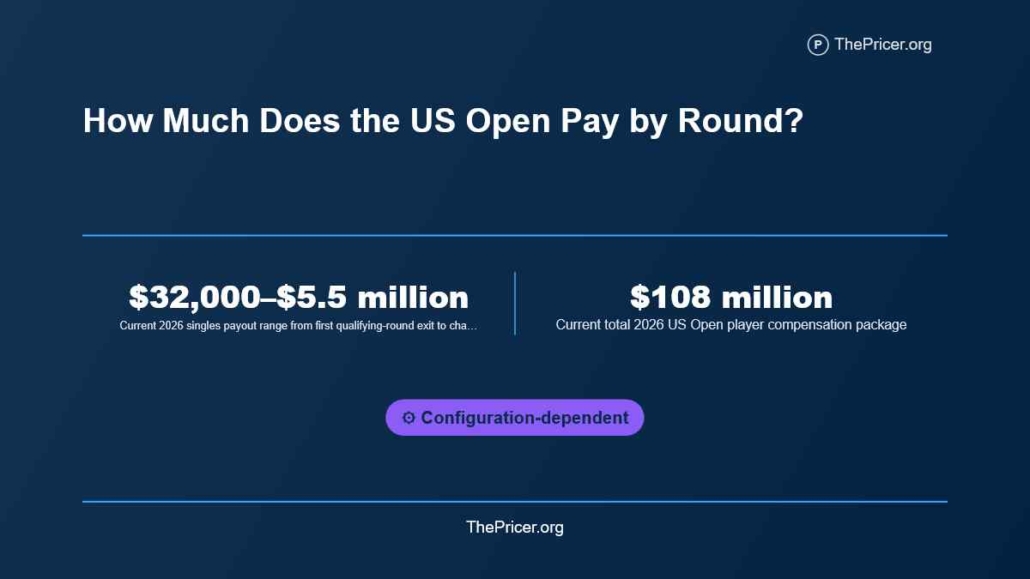
The 2026 US Open pays singles players from $32,000 for a first-round qualifying exit to $5.5 million for winning the men’s or women’s singles championship. A main-draw player who loses in the first round earns $140,000, while the runner-up receives $2.8 million. Men’s and women’s doubles champions receive $1 million per team, and the mixed-doubles champions also receive $1 million per team.
The United States Tennis Association lists the complete 2026 payout schedule in U.S. dollars for singles, qualifying, doubles, mixed doubles and wheelchair tennis. The headline figure is $108 million in total player compensation, a broader number than round-by-round prize money because it also includes player support and benefits.
Article Highlights
Jump to sections
- Each 2026 singles champion earns $5.5 million (at $30 per hour, earning that amount would take about 88 years of full-time work, before taxes).
- A main-draw first-round singles loss pays $140,000.
- Singles qualifying exits pay $32,000, $48,000 or $66,000, depending on the round reached.
- Men’s, women’s and mixed doubles champions receive $1 million per team.
- The final itself carries a $2.7 million prize-money swing between runner-up and champion.
- The published competition purses add to about $100.27 million, leaving roughly $7.73 million of the $108 million compensation package outside the listed event payouts.
How Much Does the US Open Pay by Round?
Men and women receive the same singles prize money at the US Open. The amount is based on the round where the player finishes, and the numbers are not cumulative. A champion receives $5.5 million (about 88 years of full-time work at $30 per hour) for the tournament, not $5.5 million plus every earlier-round figure.
| Singles result | 2026 payout per player |
|---|---|
| Champion | $5,500,000 |
| Runner-up | $2,800,000 |
| Semifinal | $1,450,000 |
| Quarterfinal | $780,000 |
| Round of 16 | $480,000 |
| Round of 32 | $290,000 |
| Round of 64 | $190,000 |
| First round | $140,000 |
| Final qualifying-round loss | $66,000 |
| Second qualifying-round loss | $48,000 |
| First qualifying-round loss | $32,000 |
A player who reaches the main draw and loses immediately receives $140,000. A player eliminated in qualifying receives the amount listed for that qualifying exit round rather than stacking several qualifying payments together.
Use the listed round payout when
- The player competed and finished at that stage under the normal prize-money rules.
- The amount is being discussed as gross tournament prize money before tax and private expenses.
- The table states a per-player figure, as it does for singles.
Do not treat it as take-home pay when
- The player is subject to tax withholding, fines or another permitted deduction.
- The figure is published per team rather than per player.
- A withdrawal rule changes what is payable before the player’s first match.
What Is Each Extra Win Worth?
The largest money jumps arrive late in the singles draw. Reaching the second round raises the guaranteed tournament prize from $140,000 (about 2.2 years of full-time work at $30 per hour) to $190,000, so that first main-draw win is worth another $50,000. The next win adds $100,000. Reaching the Round of 16 adds $190,000, and advancing to the quarterfinal adds another $300,000.
The value accelerates from there. Winning a quarterfinal moves the player from $780,000 to $1.45 million, an increase of $670,000. Winning a semifinal raises the prize from $1.45 million to $2.8 million, a $1.35 million jump. Winning the championship match then doubles that increment again. The champion gets $5.5 million, which is $2.7 million more than the runner-up.
- Win Round 1 adds $50,000
- Win Round 2 adds $100,000
- Win Round 3 adds $190,000
- Win Round of 16 adds $300,000
- Win quarterfinal adds $670,000
- Win semifinal adds $1.35 million
- Win final adds $2.7 million
The winner earns about 96% more than the runner-up, even though both players have already won six main-draw matches to reach the championship match. That makes the final’s incremental value much larger than the entire $140,000 first-round payment.
How Much Do US Open Qualifiers Earn?
Qualifying has its own three-step payout schedule. A first qualifying-round loss earns $32,000, a second-round loss pays $48,000, and losing in the final qualifying round pays $66,000. The 2026 Grand Slam rules state that prize money is tied to performance at the tournament, while the published US Open schedule assigns the qualifying amounts by round reached.
The biggest qualifying money swing comes in the final round. A player who loses there receives $66,000. A player who wins that match enters the main draw and is guaranteed at least the main-draw first-round prize of $140,000 if the player then competes and loses in Round 1. That makes the final qualifying victory worth at least an additional $74,000 in tournament prize money.
That $74,000 gap can matter heavily to lower-ranked players. Adding all four figures together is still wrong. A qualifier who reaches the main draw and loses in Round 1 does not receive $32,000 + $48,000 + $66,000 + $140,000. The player’s US Open result is valued at the applicable main-draw stage.
The Grand Slam rules also address lucky losers. A player replacing an on-site main-draw withdrawal receives main-draw prize money for the round or rounds actually competed in. That rule prevents the qualifying schedule from being treated as an extra set of bonuses after a player moves into the main draw.
How Much Do Doubles Players Make?
Doubles prize money uses a different unit. The official figures are paid per team, not per player. A men’s or women’s doubles championship team receives $1 million, while the runner-up team gets $500,000. If two teammates divide a $1 million championship award equally, the arithmetic is $500,000 each before taxes, private team costs and other deductions. The US Open publishes the team amount, not a guaranteed personal take-home figure.
| Result | Men’s / women’s doubles per team | Mixed doubles per team |
|---|---|---|
| Champion | $1,000,000 | $1,000,000 |
| Runner-up | $500,000 | $500,000 |
| Semifinal | $250,000 | $250,000 |
| Quarterfinal | $125,000 | $120,000 |
| Third round / first round | $80,000 | $40,000 |
| Second round / qualifying final | $50,000 | $20,000 |
| First round / first qualifying round | $35,000 | $10,000 |
The mixed-doubles structure is shorter, so the lower rows do not represent matching rounds. The championship number is easy to compare because all three doubles events pay $1 million per winning team. Calling that $1 million for each player would double the published purse and overstate what the tournament lists.
Doubles also has its own withdrawal rules. Under the 2026 Grand Slam rulebook, a qualifying on-site team withdrawal can receive 50% of first-round team prize money, with the rule describing that as 25% per player. That is separate from the ordinary amount earned by a team that plays and loses its opening match.
Why Is Total Compensation $108 Million?
The US Open describes the 2026 headline as $108 million in total player compensation. The USTA’s 2026 compensation announcement says the package is 20% above 2025 and includes a new $2 million Player Support Program. The headline includes more than round-by-round checks.
ThePricer can reconstruct about $100.27 million of published event payouts from the official schedules. The men’s and women’s singles main draws total $75.68 million. Singles qualifying adds $9.28 million. Men’s and women’s doubles add $10.12 million, mixed doubles contributes $2.88 million, and wheelchair prize money adds $2.3092 million. Those pieces sum to approximately $100.2692 million.
Subtracting that amount from $108 million leaves roughly $7.73 million outside the published competition-payout rows. Forbes reports that the headline package includes travel and accommodation support as well as the new $2 million program. The remaining difference should not be assigned to an unsupported benefit category.
This distinction also matters when comparing the money players receive with what spectators spend. The tournament’s separate US Open ticket prices range from ordinary grounds access to much more expensive stadium and resale inventory, but ticket revenue is only one part of the event’s business.
Gross Is Not Take-Home
The published prize table is gross compensation, not a promise that the same amount reaches a player’s bank account. The 2026 Grand Slam financial rules require tournaments to notify players of income tax and other tax deductions from prize money. The same rulebook allows assessed fines to be deducted from prize money, which can matter in cases covered by the separate guide to tennis player fines.
Foreign players face another layer. IRS guidance says nonresident athletes are subject to U.S. tax on U.S.-source athlete income, and 30% withholding can apply unless a lower treaty rate or another permitted arrangement changes the withholding. A Central Withholding Agreement can base withholding on expected net income instead of simply applying the standard gross withholding approach. Tax residence, treaty status and deductible expenses make one universal net-pay calculation misleading.
Private costs also sit outside the official payout schedule. Coaches, agents, physiotherapists and other professional costs depend on individual contracts. Tournament support can reduce some expenses without making every player’s cost structure identical.
There is also a lesser-known withdrawal rule. A main-draw singles player who withdraws before the first match can receive 50% of first-round prize money if the Grand Slam’s medical, timing and recent-competition conditions are satisfied. At the 2026 US Open, 50% of $140,000 equals $70,000. That amount is conditional, not an automatic payment for any player who pulls out.
Early-Round Pay Jumped in 2026
The 2026 increases were deliberately larger at the lower end of the singles draw. The 2025 payout schedule put the champion at $5 million and a first-round main-draw loser at $110,000. In 2026 those figures rose to $5.5 million and $140,000.
The champion’s check increased 10%. The first-round payment rose 27.3%. The pattern continues through the middle rounds. Runner-up pay is up 12%, semifinal money about 15.1%, quarterfinal pay about 18.2%, Round of 16 money 20%, Round of 32 about 22.4%, and Round of 64 about 23.4%. The lower the finishing round, the larger the percentage raise in this schedule.
Reuters reported that the record package arrived during continued player pressure over compensation, including calls for a larger share of Grand Slam revenue and stronger player support. The USTA also created a Grand Slam Player Advisory Council and the new $2 million Player Support Program.
The same-year 2026 revenue share cannot yet be calculated from complete public tournament revenue. Forbes reports that the 2024 US Open generated $560 million in operating revenue while that year’s player compensation was $75 million, or about 13.4%. Dividing the 2026 $108 million package by 2024 revenue would mix years and produce a misleading percentage.
How Does US Open Pay Compare?
 The US Open’s $5.5 million singles winner’s prize is the largest championship payment the USTA has offered, and the USTA describes it as the highest champion’s prize for any tennis event. The other 2026 Grand Slams use different currencies, so their raw figures should not be compared as if pounds, euros, Australian dollars and U.S. dollars have equal value.
Wimbledon paid each 2026 singles champion £3.6 million from a £64.2 million prize pool. Roland-Garros paid €2.8 million to each champion and set total prize money at €61.7 million. The Australian Open paid A$4.15 million to each singles champion from an A$111.5 million pool.
The totals also use different definitions. The US Open’s $108 million headline is total player compensation and includes support outside competition purses. That makes a direct purse-to-purse comparison less clean than simply comparing the four champion checks in their native currencies. Currency conversion can add another moving variable.
A first-round singles loser in New York receives $140,000, while the champion receives $5.5 million. Those two ends of the same schedule illustrate the USTA’s effort to increase both the headline championship prize and the money available to players who exit early.
Equal Pay Changed the US Open
The men’s and women’s prize schedules are identical in 2026, a policy that dates back more than five decades. In 1972, men’s champion Ilie Nastase received $25,000 while women’s champion Billie Jean King received $10,000. The following year, the US Open became the first Grand Slam to provide equal prize money, paying both singles champions $25,000 in 1973.
The nominal championship check has since climbed from $25,000 to $5.5 million. Dividing the modern award by the 1973 figure gives 220, so the 2026 winner’s prize is 220 times the equal championship payment introduced in 1973. That calculation is not adjusted for inflation and should not be read as a 220-fold increase in real purchasing power.
Both champions receive $5.5 million, both runners-up receive $2.8 million, and every singles round uses the same dollar amount for men and women.
- Checked the tournament structure and governing role of the four Grand Slams against the Grand Slam tournament framework.
- Confirmed the 1973 equal-pay championship checks against the US Open’s year-by-year record.
- Cross-referenced the tax discussion with the IRS explanation of Central Withholding Agreements for foreign athletes.
Answers to Common Questions
How much does the US Open winner get?
Each 2026 men’s and women’s singles champion receives $5.5 million in gross prize money.
How much does a first-round loser make at the US Open?
A singles player who competes in the 2026 main draw and loses in the first round receives $140,000 before applicable taxes and other deductions.
How much do US Open qualifying players get paid?
A qualifying exit pays $32,000 in the first qualifying round, $48,000 in the second and $66,000 in the final qualifying round.
Do doubles players each get $1 million?
No. The US Open lists $1 million as the championship prize per men’s, women’s or mixed doubles team. An equal two-player split would be $500,000 each before deductions.
Do US Open players pay tax on prize money?
Prize money can be subject to tax and withholding. Foreign players can face U.S. withholding rules, while the exact tax result depends on residence, treaty status and other individual circumstances.
Disclosure: Educational content, not financial advice. Prices reflect public information as of the dates cited and can change. Confirm current rates, fees, taxes, and terms with official sources before purchasing. See our methodology and corrections policy.