
How Much Does Thin Low-Density MDF Cost?
Updated on | Researched and reviewed by Alec Pow, Founder & Pricing Investigator
Prices, claims, and calculations checked against 11 cited sources. See our research methodology and corrections policy.
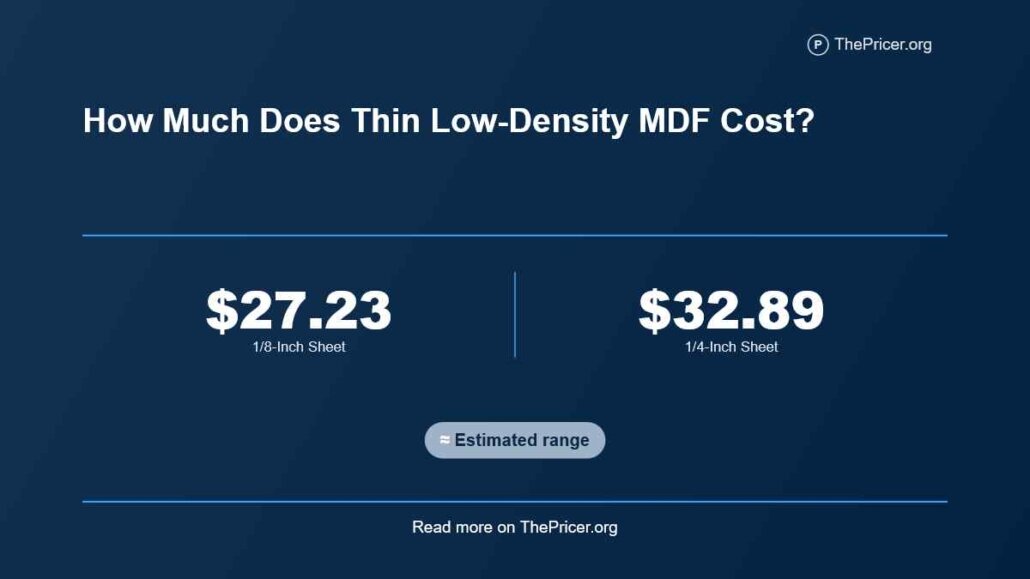
Thin MDF panels cost approximately $25 to $40 per 4-by-8-foot sheet in the reviewed U.S. supplier listings, although specialty grades, decorative surfaces, and cut-to-size orders can cost considerably more. A 1/8-inch ultralight panel was advertised for $27.23, while 1/4-inch full-sheet examples included $32.89 and $36.95. Smaller 1/4-inch project panels can cost around $16 for a 2-by-4-foot piece.
Thin MDF and low-density MDF are not interchangeable specifications. Thin describes thickness, while low-density or ultralight describes the board’s weight and physical properties. A thin sheet sold as ordinary MDF should not automatically be treated as ultralight. Buyers need to compare the actual thickness, dimensions, density grade, intended application, and delivered cost before choosing a panel.
Article Highlights
Jump to sections
- Reviewed 1/8-inch ultralight MDF costs approximately $27 per full sheet.
- Reviewed 1/4-inch full sheets cost approximately $33–$37.
- A 1/4-inch, 2-by-4-foot MDF panel costs $16.23 at Home Depot.
- Specialty 1/4-inch decorative MDF can exceed $100 per sheet.
- A full 4-by-8-foot sheet covers 32 square feet.
- Shipping, cutting, dust control, and finishing can materially increase project spending.
How Much Does Thin Low-Density MDF Cost?
Thin MDF commonly includes nominal thicknesses of 1/8 inch, 1/4 inch, and 3/8 inch. Availability varies by supplier, particularly when the customer needs a verified lightweight grade.
A Los Angeles House of Moulding listing advertised unprimed MDF/UltraLight in 4-by-8-foot sheets. Its displayed discounted prices were $27.23 for 1/8 inch and $32.89 for 1/4 inch, compared with higher crossed-out prices of $33.44 and $45.16.
Sanford and Hawley’s online inventory listed an ordinary 1/4-inch, 4-by-8-foot MDF sheet for $36.95. It separately advertised Trupan Ultralight in thicker sizes, including 1/2-inch sheets at $53.54 and 3/4-inch sheets at $79.17.
| Panel example | Listed price | Price per sq. ft. |
|---|---|---|
| 1/8-inch ultralight, 4×8 | $27.23 | $0.85 |
| 1/4-inch ultralight, 4×8 | $32.89 | $1.03 |
| 1/4-inch standard MDF, 4×8 | $36.95 | $1.15 |
| 1/4-inch standard MDF, 2×4 | $16.23 | $2.03 |
| 1/2-inch Trupan Ultralight, 4×8 | $53.54 | $1.67 |
The 1/2-inch panel is included for comparison, not classified as thin MDF for every application. The figures represent particular retailer listings checked in October 2026, not statistically representative U.S. averages.
These examples also show why the original article’s universal $10–$15 full-sheet estimate for thin MDF is unreliable. Current local supplier prices can be substantially higher.
Thin Versus Low-Density MDF
MDF is an engineered panel manufactured from wood fibers bonded with resin and compressed into sheets. Standard MDF provides smooth, relatively uniform faces and is widely used in furniture, cabinets, displays, and interior trim.
Thin MDF refers to a panel’s thickness. Low-density and ultralight describe a product engineered to weigh less than another MDF grade of comparable size.
At Cherokee Wood Products, regular MDF is available in 1/8-inch, 1/4-inch, and 3/8-inch full sheets, while the company’s separately listed ultralight full-sheet range starts at 1/2 inch.
However, Cherokee’s cut-to-size MDF offering identifies its available thin stock as ultralight. This demonstrates that density and thickness combinations vary between product lines, even within one supplier.
Buyers should ask for actual panel density, thickness tolerance, surface grade, and technical specifications where weight or machining performance matters.
Lower density does not automatically mean a lower selling price. Specialty production, availability, machining performance, freight, and supplier margins can outweigh savings in raw material consumption.
What Smaller MDF Panels Cost
Buying a small project panel can reduce immediate spending when only a few pieces are required. The trade-off is often a higher price per square foot.
Home Depot’s MDF project catalog listed a 1/4-inch, 2-by-4-foot MDF panel at $16.23. That panel contains eight square feet of material.
The same catalog displayed a smaller 1/4-inch, 12-by-18-inch panel at $4.82. Its area is only 1.5 square feet, giving an effective material rate of approximately $3.21 per square foot.
By comparison, Sanford and Hawley’s $36.95 full sheet works out to approximately $1.15 per square foot.
The smallest project panel therefore costs nearly 2.8 times as much per square foot as that particular full sheet. However, purchasing a large sheet solely to make a few small decorations could still waste money and create transportation difficulties.
A smaller panel is a sensible purchase when it provides enough material for the cut list without requiring special transport or leaving most of a full sheet unused.
Specialty MDF and Finishes
Decorative or specialty MDF products can cost several times as much as plain unfinished panels.
Sanford and Hawley’s inventory included a 1/4-inch, 4-by-8-foot Nantucket beadboard MDF panel at $104.61. Its higher price reflects the product’s profiled finish and intended decorative use rather than its thickness alone.
Other specialty products are manufactured for moisture resistance, enhanced machining, or reduced formaldehyde emissions.
Roseburg’s Arreis Ultra is a high-density, moisture-resistant MDF product. The manufacturer identifies it as a no-added-formaldehyde product suitable for demanding machining and furniture applications.
Roseburg also produces Arreis standard industrial MDF, with several panel widths and thicknesses starting at 1/4 inch.
These products do not have one published consumer retail price. Buyers should request a quote for the actual grade, thickness, dimensions, and quantity rather than use an ordinary MDF price as a substitute.
For visible interior surfaces, paint-grade MDF may be economical. When a factory-applied decorative surface is required, a finished panel could reduce later finishing labor, but that saving depends on the job.
Shipping and Cutting Costs
A full 4-by-8-foot MDF sheet is awkward to transport. Freight or delivery can change the total substantially, particularly for small orders.
Cherokee Wood Products offers sheet cutting for shipping and notes that oversized orders may require freight transportation. It requests separate shipping quotations for certain destinations and large orders.
Another specialty retailer, Smokey Hill Designs, publishes a $50 oversize charge for custom-cut pieces exceeding its specified shipping dimensions. Its product page also identifies a 1/4-inch saw kerf for cutting orders.
That charge is supplier-specific. It should not be presented as a standard U.S. freight fee for all MDF purchases.
Cutting services also reduce the usable amount of material because each saw cut removes a narrow strip. The width of the saw kerf matters when many parts must fit onto one sheet.
For repeat work, asking a supplier to quote a cutting schedule can be more useful than comparing raw sheet prices alone.
The Hidden Cost of Sheet Waste
A full MDF sheet provides 32 square feet before cutting losses. The number of sheets required depends on individual part dimensions, not solely on total surface area.
Suppose a project needs twelve cabinet backing panels measuring 18 by 24 inches. Each finished piece covers three square feet, giving a total finished area of 36 square feet.
Dividing 36 by 32 suggests a minimum of two full sheets. In a practical cutting layout, two sheets can accommodate the twelve rectangles when placed appropriately, with allowance for a typical saw kerf.
Two Sanford and Hawley 1/4-inch sheets would cost $73.90 before transport, cutting, and supplies.
However, buying twelve Home Depot 2-by-4-foot panels at $16.23 each would cost $194.76. Each small sheet is large enough for one 18-by-24-inch piece, assuming the part fits the actual usable dimensions.
The difference is $120.86. Full sheets would save about 62% in raw panel spending for this specific project, provided the cutting layout works and delivery does not erase the savings.
This illustrates why small boards suit small jobs, while repeated components often favor full-sheet purchasing.
A Complete MDF Project Budget
Consider a craft project using two full 1/4-inch MDF sheets at the reviewed $36.95 price. The builder plans to cut multiple panels, prime them, and apply a painted finish.
Use clearly labeled allowances of $20 for primer, $25 for paint, $12 for adhesive and consumables, and $15 for wear on cutting supplies. Assume the sheets are picked up without a delivery charge.
- Two full MDF sheets: $73.90.
- Primer allowance: $20.00.
- Paint allowance: $25.00.
- Adhesives and consumables: $12.00.
- Cutting supply allowance: $15.00.
- Illustrative project total: $145.90.
The MDF itself represents approximately 50.7% of the modeled cost. The other half covers materials needed to transform unfinished panels into painted components.
These allowances are planning assumptions, not published national prices for those supplies. Sales tax, new power tools, ventilation equipment, professional labor, and delivery are excluded.
A contractor providing fabrication and finishing could charge substantially more because labor would become a major expense.
MDF Safety and Material Standards
Thin MDF is commonly used indoors, but material selection and cutting practices need attention.
The EPA’s composite wood guidance identifies MDF and thin MDF as regulated categories under TSCA Title VI.
The federal emissions limits include 0.11 parts per million for MDF and 0.13 parts per million for thin MDF. Those figures are product-emissions standards, not measurements of the air quality in a particular room.
Buy panels with appropriate emissions compliance documentation. A low-density designation alone does not prove that a product uses a specific resin or qualifies for an emissions exemption.
Sawing, sanding, and routing MDF generate fine dust. The OSHA woodworking guidance identifies local exhaust ventilation as a principal means of controlling airborne wood dust near cutting and sanding equipment.
Use suitable dust collection, respiratory protection as required by the exposure conditions, eye protection, and safe machine-guarding practices.
Painting does not make every MDF product automatically safe for every environment. Coatings can reduce surface exposure, but compliance, workplace controls, and the manufacturer’s intended use remain important.
MDF Versus Other Panels
MDF is often selected because its smooth faces suit painted interior projects. It should not be treated as a universal replacement for plywood, hardboard, particleboard, or structural sheathing.
For thin interior backing, Luan plywood prices provide a useful alternative. Current 1/8-inch and 1/4-inch full-sheet Luan examples are approximately $15 to $30, although core quality, bond classification, and intended use differ.
Broader plywood pricing includes structural sheathing and cabinet-grade panels. Plywood can provide different screw-holding and structural properties depending on its construction.
For wet environments, marine plywood prices are much higher because these products involve different manufacturing and performance specifications.
Tempered hardboard is another alternative for backing and light-duty surfaces. Home Depot’s thin panel listings showed 1/8-inch, 2-by-4-foot tempered hardboard around $7.68.
Hardboard and MDF are different engineered wood products. A low price for tempered hardboard cannot establish a current price for genuine ultralight MDF.
Makes sense if
- The project needs a smooth, paintable interior panel.
- Weight and machining requirements match the specified MDF grade.
- A full sheet provides economical cutting yield.
- The manufacturer supplies suitable emissions and product information.
Does not make sense if
- Structural load capacity is required without an approved design.
- The panel will face moisture outside its rated conditions.
- A low-density label is assumed to guarantee a lower price.
- Shipping and offcuts cost more than buying suitable smaller panels.

Answers to Common Questions
How much does a 4-by-8 sheet of thin MDF cost?
Reviewed U.S. listings included $27.23 for 1/8-inch ultralight and $32.89–$36.95 for 1/4-inch panels. The exact density grade, supplier, and location affect the price.
Is thin MDF the same as low-density MDF?
No. Thickness and density describe different characteristics. A board can be thin without being designated low-density or ultralight.
Can thin MDF be used for shelves?
Thin MDF is usually better suited to backing, decorative faces, and supported components. Shelf thickness and support spacing must be selected according to the expected load and material properties.
Can MDF be used as flooring?
Ordinary thin MDF should not be substituted for structural flooring or approved underlayment without a matching product specification. Moisture and load exposure can cause premature failure.
Disclosure: Educational content, not financial advice. Prices reflect public information as of the dates cited and can change. Confirm current rates, fees, taxes, and terms with official sources before purchasing. See our methodology and corrections policy.