
How Much Does Travel Insurance Cost?
Published on | Written by Alec Pow
This article was researched using 12 sources. See our methodology and corrections policy.
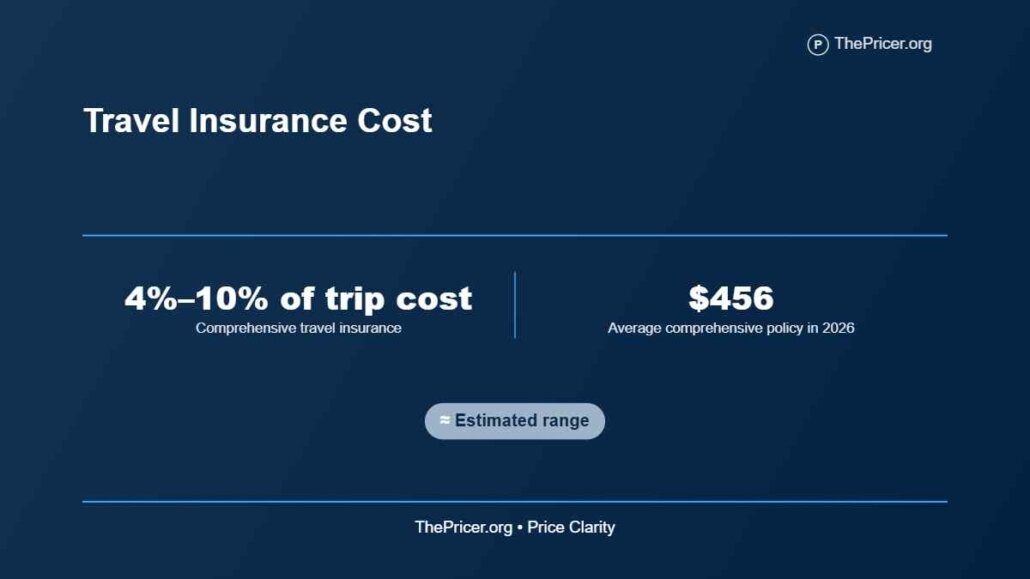
Travel insurance typically costs 4% to 10% of prepaid, nonrefundable trip expenses for a comprehensive policy.
Insuring a $3,000 vacation may cost $120 to $300, while protecting a $5,000 trip may cost $200 to $500. Standalone travel medical insurance is usually cheaper because it does not reimburse the cost of canceling a vacation.
Actual 2026 sales data shows substantial differences between policies. Squaremouth reports an average of $87 for medical-only coverage, $456 for comprehensive coverage, and $314 across its combined policy sales. These are marketplace purchase averages for different groups of travelers, not interchangeable quotes.
The amount you pay also depends on age, trip duration, destination, medical benefits, cancellation protection, and optional upgrades. The most useful comparison starts with the losses you want insured, rather than the cheapest premium advertised.
Article Highlights
Jump to sections
- Comprehensive coverage generally costs 4% to 10% of eligible insured trip expenses.
- Squaremouth’s October 2026 data puts medical-only policies at $87 on average and comprehensive coverage at $456.
- InsureMyTrip reports approximately $184 per person for international coverage in its 2026 analysis.
- Cancel For Any Reason coverage can increase premiums by roughly 50%, while usually reimbursing only 50% to 75% of eligible losses.
- Age, insured trip value, medical limits, and the number of covered travelers can change the price considerably.
- Refundable bookings, duplicate credit-card benefits, and optional upgrades can create unnecessary insurance spending.
How Much Does Travel Insurance Cost?
Travel insurance is not one standardized product. Some policies cover emergency medical expenses and medical evacuation. Comprehensive plans also cover specified trip cancellation and interruption events, plus selected travel disruptions.
Squaremouth’s October 2026 insurance cost report analyzed purchases over the preceding 12 months. The results distinguish the price of medical coverage from more extensive trip protection.
| Coverage or trip scenario | Price | Measurement |
|---|---|---|
| Medical-only insurance | $87 | Squaremouth average policy |
| Comprehensive insurance | $456 | Squaremouth average policy |
| All insurance types combined | $314 | Squaremouth average policy |
| International insurance | $184 | InsureMyTrip average per person |
| $3,000 insured trip | $120–$300 | 4%–10% planning estimate |
| $5,000 insured trip | $200–$500 | 4%–10% planning estimate |
The first four entries are reported purchase averages, whereas the last two are estimates calculated from the commonly quoted premium-percentage range. They should not be read as competing quotes for identical coverage.
InsureMyTrip’s 2026 insurance pricing analysis reports that international customers paid about 5.4% to 5.9% of insured trip value in its broader recent dataset. Individual premiums also depend on how many people are included in a policy.
Independent analysis from NerdWallet’s August 2026 comparison estimates approximately 7% of trip cost as a useful central benchmark, with prices extending beyond the usual range for certain travelers and benefits.
What the Policy Actually Covers
Comprehensive travel insurance generally combines several distinct benefits. Trip cancellation protects eligible prepaid losses when a covered event prevents departure. Trip interruption can help with expenses after a covered event cuts the journey short.
Medical coverage pays eligible emergency treatment expenses under the contract. Evacuation coverage addresses qualifying medical transportation, while baggage and travel-delay benefits have their own monetary limits and waiting periods.
The National Association of Insurance Commissioners advises consumers to examine exactly which losses a policy covers, including medical emergencies, cancellation, interruption, and baggage claims.
A policy with a higher premium may offer much larger medical or evacuation limits. Another may devote more of its cost to cancellation benefits but provide relatively modest medical protection.
Compare the benefit schedule and exclusions before comparing prices. Two policies costing the same amount may respond very differently to the same emergency.
Medical-Only Insurance Prices
Medical-only policies are often appropriate when flights and accommodation are refundable, or when the traveler already has satisfactory cancellation protection through another source.
Squaremouth’s medical insurance sales analysis reports an average of $54 for trips lasting four to seven days, $72 for eight to fourteen days, and $88 for fifteen to thirty days.
These are averages across different customers and coverage arrangements. A longer trip does not automatically cost exactly twice as much to insure.
Coverage limits affect the quote. Squaremouth’s medical-only customers paid an average of $86 for policies with $50,000 emergency medical limits, compared with $88 for $100,000 limits and $118 for $250,000 limits.
The groups are not matched individual quotes, but they suggest that increasing medical protection does not always increase the premium proportionally.
For someone traveling overseas, this can be more important than saving a small amount on the headline price.
International Travel and Evacuation
 International policies often cost more than domestic coverage because travelers may need additional medical benefits, longer protection periods, and insurance for larger prepaid expenses.
Squaremouth’s international insurance data reports average premiums of $86 for medical-only policies, $479 for comprehensive policies, and $735 for comprehensive policies with Cancel For Any Reason benefits.
Overseas health coverage needs separate attention. Medicare’s foreign travel rules explain that Original Medicare usually does not cover treatment outside the United States, apart from narrow exceptions. Some Medigap plans provide limited foreign emergency benefits.
The State Department’s overseas medical guidance places possible air-ambulance evacuation costs back to the United States at $20,000 to $200,000, depending on circumstances.
That is the potential cost of the evacuation service, not its insurance premium. Coverage may authorize transport to the nearest appropriate medical facility rather than directly home.
Before buying, determine whether the insurer coordinates evacuation, requires approval, or reimburses expenses only after payment.
How Age Changes the Premium
Older travelers often face higher premiums, especially when medical benefits are a significant part of the policy. However, higher average spending among older travelers also reflects longer vacations, different coverage choices, and larger trip values.
Squaremouth’s international dataset places average comprehensive premiums at $106 for buyers aged 22 to 34, $260 for those aged 50 to 59, $539 for ages 70 to 79, and $675 for travelers aged 80 or older.
A separate MoneyGeek 2026 rate analysis estimates approximately $201 for a 30-year-old insuring a $5,000 trip, versus $394 for a 65-year-old under its modeled comparison.
That model is more useful for isolating the effect of age than comparing unrelated customer purchases. It remains an estimate rather than a quote available to every traveler.
Older buyers should compare deductibles, medical limits, pre-existing-condition provisions, and evacuation coverage alongside the premium. A cheaper plan with inadequate medical benefits may be a poor match.
Cancel For Any Reason Costs
Standard cancellation coverage does not reimburse a traveler merely because plans change. The cancellation reason must qualify under the policy.
Cancel For Any Reason, usually called CFAR, offers broader flexibility but at a higher price. The NAIC’s CFAR consumer explanation describes reimbursement commonly ranging from 50% to 75% of eligible trip expenses, with premiums increasing by close to 50%.
CFAR frequently requires purchase within a limited period after the first trip payment, insurance of eligible prepaid expenses, and cancellation before a specified deadline.
Consider a traveler with $5,000 in nonrefundable expenses. A comprehensive policy priced at an assumed 6% costs $300. A CFAR upgrade increasing that premium by 50% produces a total of $450.
If the benefit reimburses 75% and a qualifying cancellation occurs, the claim payment could be $3,750, leaving $1,250 of the prepaid trip expense unreimbursed. The insurance premium is an additional sunk cost.
This calculation shows why CFAR is not the same as a fully refundable vacation. Confirm the exact reimbursement percentage and timing conditions before paying the upgrade.
Travel Insurance Budget
Consider two adults booking a ten-day international vacation. They have made the following prepaid, nonrefundable purchases, with the amounts chosen to illustrate the calculation rather than represent a specific booking.
- Round-trip flights for two: $1,600
- Nonrefundable accommodation: $1,400
- Prepaid tours and transfers: $500
- Total eligible trip expenses: $3,500
At a modeled comprehensive premium of 6%, the insurance costs $210. The combined insured purchases and insurance payment total $3,710.
At the broader 4% to 10% pricing range, the premium might instead be estimated at $140 to $350, depending on the selected coverage and traveler characteristics.
The modeled $210 premium protects two people under the assumed shared policy. It should not be mistaken for a verified checkout price.
If the travelers instead need only overseas medical protection, a separate medical-only quotation may cost substantially less. The resulting policy would generally not reimburse the same prepaid cancellations.
The decision is therefore not simply which policy saves the most money. It is whether the difference in premium buys benefits relevant to the possible loss.
Refundable Bookings
One easily overlooked mistake is declaring the entire vacation value when much of the accommodation or transportation is independently refundable.
Suppose a traveler expects to spend $5,000 on a vacation, but $1,500 is fully refundable lodging. The remaining $3,500 is prepaid and nonrefundable.
At a hypothetical 6% premium, insuring the full $5,000 would cost $300. Insuring only the $3,500 nonrefundable portion would cost $210 under the same proportional model.
The estimated difference is $90, equivalent to 30% of the unnecessarily enlarged modeled premium.
This is a sensitivity calculation, not a guarantee that an insurer quotes proportionally. Some optional benefits, especially pre-existing-condition waivers and CFAR, require the policyholder to insure the full eligible prepaid, nonrefundable trip value.
There is another potential duplication. The NAIC notes that some credit cards already provide trip cancellation or baggage protection. Check the card’s covered events and limits before purchasing overlapping benefits.
The cost of an actual cruise vacation can include several nonrefundable components that should be identified separately before choosing an insured amount.
Annual vs Single-Trip Insurance
Frequent travelers may prefer an annual multi-trip policy rather than buying a separate policy for every vacation. Whether it saves money depends on the coverage limits, trip lengths, and cancellation benefits.
A traveler paying an assumed $150 for each single-trip policy would spend $450 across three trips. If a comparable annual plan is quoted at $300, the annual alternative saves $150.
The example reaches a break-even point after two single-trip purchases. Beginning with the third, the modeled annual policy is cheaper, assuming the required coverage is genuinely equivalent.
Annual plans may limit trip duration, restrict individual cancellation reimbursement, or focus primarily on medical benefits. A medical-only annual plan is not directly comparable to multiple comprehensive policies.
Travel Guard publishes annual multi-trip coverage options, but actual premiums and benefit limits require a quote for the insured traveler.
For a longer international itinerary, first estimate the complete expedition travel expenses and review any operator insurance conditions. Specialized journeys can require coverage that ordinary annual plans do not provide.
Exclusions and Claim Expenses
An inexpensive premium has limited value when the likely source of loss is excluded.
Common coverage questions involve pre-existing medical conditions, high-risk activities, known weather events, pregnancy-related issues, and cancellation after circumstances were already foreseeable.
The NAIC explains that policy terms determine whether these events are eligible. Travelers must also pay attention to deductibles, per-item baggage limits, and whether advance authorization is required for certain medical services.
Independent Experian travel insurance analysis emphasizes comparing benefits and expenses across plans rather than judging by premium percentage alone.
A claim also requires appropriate evidence. Travelers should retain booking confirmations, cancellation terms, medical records, receipts, and reports supplied by airlines or other providers.
Insurance generally addresses covered losses rather than dissatisfaction with a vacation. A flight change, trip delay, or medical issue will not automatically generate the maximum advertised reimbursement.
When Paying for Coverage Makes Sense
Travel insurance is most useful when the possible covered financial loss would be difficult to absorb without assistance. The right policy depends on what the traveler could lose and which existing benefits are already available.
Makes sense if
- You have substantial prepaid, nonrefundable expenses.
- Your ordinary health insurance offers limited overseas coverage.
- You are visiting a remote area where medical evacuation may be necessary.
- You need meaningful trip interruption or emergency assistance benefits.
Does not make sense if
- Nearly all bookings are refundable and existing medical protection is adequate.
- The policy duplicates satisfactory credit-card benefits.
- You expect standard coverage to reimburse an ordinary change of plans.
- Its exclusions remove the main activity or risk you want insured.
Compare the premium with the actual exposure, not just the total vacation spending. A traveler arranging several flights, hotels, and activities should calculate the eligible losses individually before purchasing coverage.
Other required travel expenses, including U.S. passport renewal fees, belong in the overall vacation budget but are not automatically eligible insured cancellation expenses.
Answers to Common Questions
How much does travel insurance cost for a $5,000 trip?
A comprehensive policy commonly costs approximately $200 to $500 using the 4% to 10% planning benchmark. Actual quotes depend on age, destination, trip duration, insured expenses, and coverage.
How much is travel medical insurance?
Squaremouth’s 2026 medical-only policies averaged $87, with substantial differences by age, trip length, and medical limits. Short, basic policies can cost less.
Is Cancel For Any Reason insurance worth the extra cost?
It can be useful when flexibility is important, but it raises the premium and usually reimburses only part of eligible prepaid losses. Review purchase deadlines and cancellation conditions.
Does travel insurance cover pre-existing medical conditions?
Some policies provide qualifying waivers or coverage under defined terms. Others exclude related claims. Purchase timing and eligibility can determine whether a waiver applies.
Should I buy travel insurance for a refundable trip?
You may not need substantial trip cancellation coverage, but medical and evacuation protection can still matter, especially overseas. Check existing insurance benefits before selecting a policy.
Disclosure: Educational content, not financial advice. Insurance pricing depends on underwriting, coverage limits, deductibles, and region. Confirm quotes and policy terms with a licensed insurer. See our methodology and corrections policy.