
How Much Does Vehicle Registration Cost by State?
Published on | Written by Alec Pow
This article was researched using 14 sources. See our methodology and corrections policy.
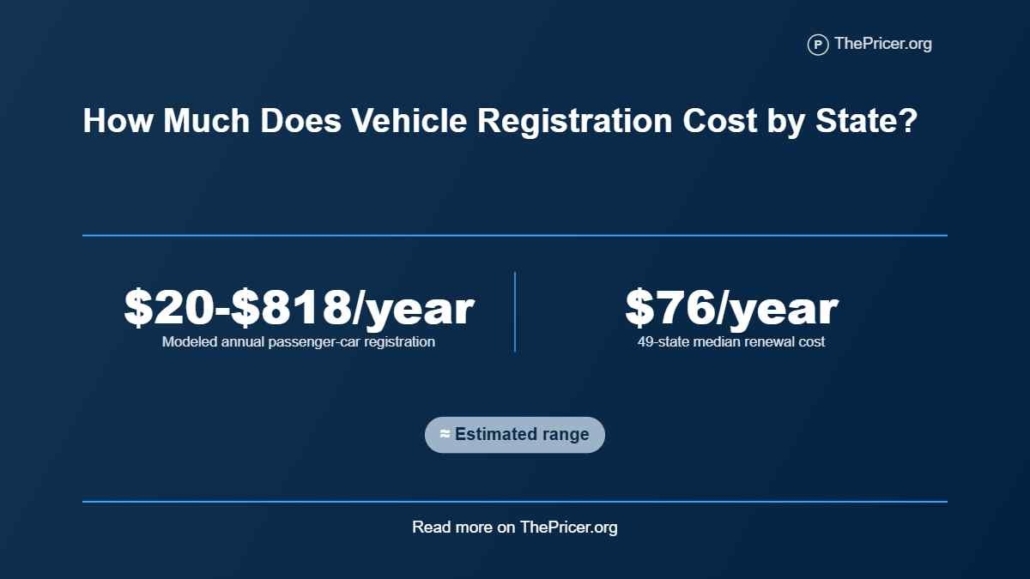
Vehicle registration for a standard passenger car can cost from $20 to more than $800 a year under the same reference-vehicle method, with a calculated 49-state median of $76. For a consistent $32,000 new passenger car, a dataset of modeled annual renewal costs runs from $20 in South Carolina to $818 in Massachusetts. Nine of those 49 states exceed $500 a year. These figures compare recurring registration, not every tax or transaction charge that can appear on a DMV bill.
Vehicle registration fees are set by state motor vehicle agencies and can depend on passenger-car value, weight, model year, county, fuel type, and registration term. The Federal Highway Administration describes registration formulas tied to vehicle value, weight, age, horsepower, and cylinder count. A renewal can combine a base registration fee with a vehicle license or ownership tax, local charge, EV surcharge, or processing fee, while title fees, purchase taxes, new-resident charges, and specialty license plates can apply in separate transactions.
Article Highlights
Jump to sections
- The modeled 49-state median renewal is $76 (at $30 per hour, earning that amount would take about 2.5 hours of work, before taxes) for the same $32,000 passenger car.
- The comparable modeled range is $20 to $818 per year.
- Nine of 49 modeled states exceed $500 in annual renewal cost.
- Alaska charges a $100 two-year state registration fee for a noncommercial passenger vehicle before location-based motor vehicle registration tax.
- Title, purchase tax, local charges, EV fees, and specialty plates can sit outside a quoted registration number.
Vehicle Registration Cost by State
The table annualizes the recurring registration result for the reference-car method. Forty-nine rows come from the same normalized dataset cited in the introduction. Alaska is outside those 49 rows, so its entry uses the official state base of $100 (about 3.3 hours of work at $30 per hour) for 24 months, equal to $50 per year before local motor vehicle registration tax. The official 2026 registration schedule shows the state fee and location-based tax schedules.
The resulting table should not be read as a cheapest-state ranking for every driver. A value-based state can become cheaper as a vehicle ages, and a county charge can move a low state figure upward. The 49-state distribution is still useful because it keeps the reference vehicle fixed. Its middle value is $76, while the first and third quartile values are $40 and $217. The nine modeled states above $500 are Arizona, Colorado, Maine, Massachusetts, Minnesota, Nebraska, Nevada, New Hampshire, and Wyoming.
| State | Annual renewal benchmark | Scope |
|---|---|---|
| Alabama | $23 | StateCalc reference car |
| Alaska | $50 | Annualized state base only |
| Arizona | $546 | StateCalc reference car |
| Arkansas | $25 | StateCalc reference car |
| California | $410 | StateCalc reference car |
| Colorado | $663 | StateCalc reference car |
| Connecticut | $169 | StateCalc reference car |
| Delaware | $40 | StateCalc reference car |
| Florida | $34 | StateCalc reference car |
| Georgia | $21 | StateCalc reference car |
| Hawaii | $392 | StateCalc reference car |
| Idaho | $69 | StateCalc reference car |
| Illinois | $151 | StateCalc reference car |
| Indiana | $36 | StateCalc reference car |
| Iowa | $364 | StateCalc reference car |
| Kansas | $30 | StateCalc reference car |
| Kentucky | $21 | StateCalc reference car |
| Louisiana | $32 | StateCalc reference car |
| Maine | $803 | StateCalc reference car |
| Maryland | $121 | StateCalc reference car |
| Massachusetts | $818 | StateCalc reference car |
| Michigan | $198 | StateCalc reference car |
| Minnesota | $522 | StateCalc reference car |
| Mississippi | $28 | StateCalc reference car |
| Missouri | $33 | StateCalc reference car |
| Montana | $217 | StateCalc reference car |
| Nebraska | $577 | StateCalc reference car |
| Nevada | $593 | StateCalc reference car |
| New Hampshire | $624 | StateCalc reference car |
| New Jersey | $59 | StateCalc reference car |
| New Mexico | $76 | StateCalc reference car |
| New York | $57 | StateCalc reference car |
| North Carolina | $60 | StateCalc reference car |
| North Dakota | $93 | StateCalc reference car |
| Ohio | $44 | StateCalc reference car |
| Oklahoma | $96 | StateCalc reference car |
| Oregon | $68 | StateCalc reference car |
| Pennsylvania | $48 | StateCalc reference car |
| Rhode Island | $50 | StateCalc reference car |
| South Carolina | $20 | StateCalc reference car |
| South Dakota | $76 | StateCalc reference car |
| Tennessee | $29 | StateCalc reference car |
| Texas | $78 | StateCalc reference car |
| Utah | $205 | StateCalc reference car |
| Vermont | $89 | StateCalc reference car |
| Virginia | $51 | StateCalc reference car |
| Washington | $65 | StateCalc reference car |
| West Virginia | $50 | StateCalc reference car |
| Wisconsin | $85 | StateCalc reference car |
| Wyoming | $660 | StateCalc reference car |
How Registration Pricing Works
Vehicle registration is the recurring state authorization that keeps a passenger vehicle registered for road use. It is separate from the title, which records ownership, and it can also be separate from sales or use tax, a plate charge, inspection expense, county tax, or specialty-plate surcharge. Those different fee structures make a raw list of base fees a poor national comparison because two states can use the same label for charges calculated in very different ways.
A fairer state comparison holds the vehicle constant and then applies each state’s formula. That is the role of the reference-car table below. It is still a planning benchmark, not a DMV quote. A driver’s payable amount can move after the state applies local taxes, a different vehicle value, a model-year adjustment, weight brackets, fuel-specific charges, or a multi-year registration cycle. Registration also does not replace required insurance or inspection rules. Treat the table as a common measuring stick, then use the state agency calculator or fee schedule for the vehicle actually being registered.
Flat, Weight, and Value Fees
Flat-fee states make the base charge easy to identify. Georgia lists the passenger registration fee at $20 for a regular passenger car or light pickup. New Mexico uses a different rule. It bases passenger registration on weight and model year, with one-year registration ranging from $27 to $62. A heavier or newer vehicle can land in a different bracket even when both owners live in the same state.
California adds several layers. California lists the registration fee at $76 for an original registration or renewal, then adds the California Highway Patrol fee, a vehicle license fee based on value, a Transportation Improvement Fee tied to vehicle value, and county or district charges where applicable. The current TIF alone is $132 for a vehicle valued from $25,000 to $34,999. That structure explains why a modeled California renewal can be far above the published base registration line. For the reference car, the $132 TIF is already about 1.74 times the $76 base fee before the vehicle license and CHP charges are added.
New Registration vs. Renewal
The first registration bill can be much larger than the annual renewal because ownership-transfer costs and purchase taxes enter the transaction. Georgia shows the distinction cleanly. Its standard title application costs $18, while the ordinary passenger registration line is $20. Most vehicles purchased on or after March 1, 2013 are also subject to Title Ad Valorem Tax. The state sets the TAVT rate at 7 percent of fair market value for most covered transfers.
That means a low renewal fee does not imply a low first-year ownership-transfer bill. On an illustrative vehicle with a fair market value of $32,000, 7 percent equals $2,240 before the separate title and registration lines. The same owner does not pay that 7 percent charge every annual renewal under the standard TAVT structure.
Adding only Georgia’s three documented lines in this assumed transfer gives $2,278 from TAVT, title, and registration before any other applicable charge. New York separates original-registration fees from renewal and lists a $25 plate fee and $50 title certificate fee for original registration, on top of registration and applicable tax.
County and Local Charges
 Local charges can alter a statewide figure enough to change a household budget. Oregon registration for a 20 to 39 MPG passenger vehicle is $136 for two years. Oregon’s county registration fee schedule adds $112 for a vehicle that lives in Multnomah County, while Washington or Clackamas County adds $60. The Multnomah line alone equals 82.4 percent of the state two-year registration charge. That ratio comes from $112 divided by $136. State registration plus the Multnomah fee is $248 for two years, or an annualized $124, before title or plate charges.
Texas uses a similar state-plus-local structure. A car or light truck at 6,000 pounds or less has a base registration fee of $50.75. Texas allows local registration fees from $0 to $31.50 depending on county, and its example renewal notice also includes a processing and handling line of $4.75. Alaska goes further because its biennial motor vehicle registration tax depends on residence location and model year. A statewide base can be useful for comparison, but the address often determines the payable local layer.
EV and Hybrid Surcharges
Fuel type now changes registration cost in much of the country. The National Conference of State Legislatures reports that at least 42 states require a special registration fee for battery electric vehicles. Some states also charge plug-in hybrids or other alternative-fuel vehicles. These fees sit on top of ordinary registration rather than replacing it, so an EV owner should not compare only the state’s standard passenger-car line.
Texas provides a clear scale comparison. Its standard passenger-car base is $50.75, while a qualifying fully electric vehicle carries an additional $200 annual fee. The EV line is about 3.94 times the standard base because $200 divided by $50.75 equals 3.94.
New fully electric vehicles issued two years of registration can be assessed $400 for that EV component. Readers pricing optional custom tags should keep those separate as well, since personalized plate fees are commonly added to normal registration rather than substituted for it. That fuel-type difference can dominate a recurring registration comparison. That gap matters for budgeting. Fuel-type rules can also change through new statutes, as seen in 2026 vehicle fee changes.
Three Worked Cost Examples
An Oregon first-registration scenario shows how separate charges combine. Assume a privately owned passenger car rated at 20 to 39 MPG, newly titled in Oregon, issued standard plates, and kept in Multnomah County. The official inputs are a $106 title fee, $136 two-year registration fee, $26 plate fee, and $112 county fee. The calculated total is $380. This scenario excludes purchase-related taxes, optional plates, lien charges, and any transaction item that does not apply to the assumed owner.
Two other cases show why the same word, registration, can describe very different bills. A Georgia owner renewing a standard passenger car can face the $20 registration line, while a qualifying ownership transfer of a $32,000 vehicle can create $2,240 of TAVT before title and registration. In Texas, a standard light passenger vehicle starts from a $50.75 base, while a qualifying EV adds $200 each year. Those two selected Texas lines total $250.75 before local and processing charges. Scope changes the result. These are documented fee structures applied to explicit scenarios, not claims about what every owner in those states pays.
Which Number Should You Budget?
Use the annual benchmark when the goal is comparing recurring registration burden across states on one common vehicle. It is most useful before a move, for a high-level ownership budget, or when a published base fee hides value-based charges. For an actual renewal, the state agency’s calculator or renewal notice is the better endpoint because it can use the vehicle’s VIN-linked attributes, county, plate type, expiration date, and exemptions.
Budget a different figure when the transaction involves a purchase, ownership transfer, move from another state, EV surcharge, local tax, specialty plate, or late renewal. A quoted base registration fee can be legally accurate and still be far below the amount due at the counter. That difference is the main source of misleading comparisons across state lists.
Use the statewide figure when
- You are comparing the same passenger-car profile across states.
- You want a recurring renewal benchmark rather than a purchase total.
- Your state uses a flat fee with few local additions.
- You have already separated optional plate costs.
Expect a different bill when
- Your state taxes vehicle value, age, or weight.
- Your county or city adds a registration or ownership charge.
- The vehicle is electric, plug-in hybrid, commercial, or unusually heavy.
- You are titling a newly purchased vehicle or registering after a move.
- The registration is late or requires replacement documents.
Answers to Common Questions
Which state has the cheapest vehicle registration in this comparison?
South Carolina is lowest in the 49-state reference-car dataset at a modeled $20 annual renewal. That does not mean every South Carolina owner has the lowest total vehicle taxes or first-year costs.
Which state has the highest vehicle registration cost in this comparison?
Massachusetts is highest in the same 49-state model at $818 for annual renewal on the reference vehicle. The figure is model-specific and should not be treated as a universal Massachusetts registration bill.
Is a title fee part of vehicle registration?
It can appear in the same transaction, but it is a separate charge. Title fees are most relevant when ownership is first recorded or transferred, while registration is renewed on a recurring schedule.
Why is my DMV bill higher than the state fee shown online?
The quoted number may be only the base registration line. Vehicle value, county charges, ownership taxes, EV fees, plate choices, processing charges, and late penalties can add separate amounts.
Disclosure: Educational content, not financial advice. Prices reflect public information as of the dates cited and can change. Confirm current rates, fees, taxes, and terms with official sources before purchasing. See our methodology and corrections policy.