
How Much Does Weight Watchers Cost?
Updated on | Written by Alec Pow
This article was researched using 12 sources. See our methodology and corrections policy.
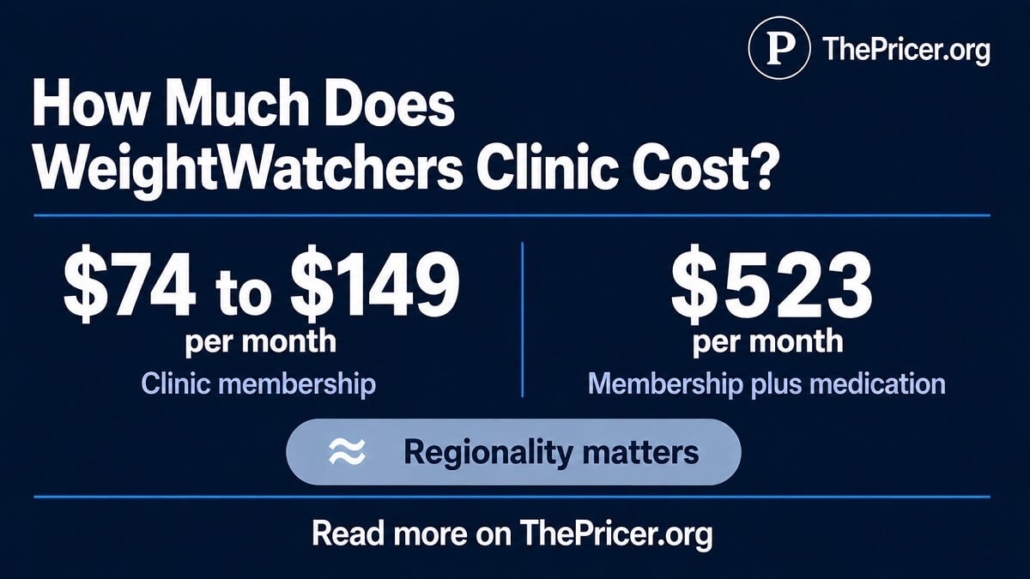
WeightWatchers Clinic is WeightWatchers’ telehealth medical-weight-management program, linking licensed clinicians, the WeightWatchers app, nutrition coaching, GLP-1 prescribing, insurers, pharmacy benefit managers, and retail or mail-order pharmacies. Members may be evaluated for Wegovy from Novo Nordisk, Zepbound from Eli Lilly, or another medication when clinically appropriate. The membership itself runs from $74 per month with a 12-month commitment to $149 per month on a flexible monthly plan under published May 2026 rates.
The clinic fee does not include a guaranteed prescription or a supply of medication. A member’s real bill can combine the recurring subscription, an insurance copay or self-pay pharmacy charge, applicable taxes, and any amount owed under the selected renewal or cancellation terms. Drug coverage, dose, refill schedule, and manufacturer-program eligibility can move the monthly total far above the membership rate.
WeightWatchers Clinic is billed per member and per billing period. The largest price changes come from the commitment length, insurance authorization, prescribed drug, dose, pharmacy channel, and savings-program rules.
TLDR: Budget $74 to $149 per month for WeightWatchers Clinic, then add the separate pharmacy expense for Wegovy, Zepbound, or another prescribed drug.
How Much Does WeightWatchers Clinic Cost?
Jump to sections
- Entry $74 (at $30 per hour, earning that amount would take about 2.5 hours of work, before taxes) per month with a year-long commitment reported in May 2026.
- Flexible plan Up to $149 per month for month-to-month enrollment.
- Wegovy self-pay Manufacturer programs list amounts from $149 to $349 per month, depending on formulation, dose, timing, and eligibility.
- Zepbound self-pay Published 2026 offers start at $299 per 28-day supply and can reach $449 under the refill-based program.
- Possible combined bill A $74 membership plus a $449 prescription equals $523 for one month.
A worked monthly total
Take a member who selects the 12-month commitment price and receives a prescription for a higher-dose Zepbound product through Lilly’s self-pay program. The clinic portion is $74 (about 2.5 hours of work at $30 per hour) per month under published May 2026 membership rates. Lilly lists eligible 7.5 mg through 15 mg refills at $449 per 28-day supply when the program’s refill requirements are met.
- WeightWatchers Clinic membership $74
- Zepbound self-pay prescription $449
- Combined monthly outlay before taxes or other charges $523
The arithmetic is $74 + $449 = $523. Across 12 billing months, the clinic portion alone is $888, since $74 multiplied by 12 equals $888. Twelve medication fills at $449 would add $5,388, producing a theoretical combined total of $6,276. That annual figure assumes the prescription, dose, program eligibility, and refill timing stay unchanged. It is a planning calculation, not a treatment forecast.
What you’re actually buying
WeightWatchers Clinic is a telehealth medical-weight-management service connected to the WeightWatchers app, food system, activity tracking, coaching features, and member community. A member completes a health intake and can communicate with licensed clinical staff. A clinician may prescribe medication when the person meets medical criteria and the clinician decides that a drug fits the care plan.
The subscription does not buy a guaranteed GLP-1 prescription. It does not guarantee that an insurer will cover the drug, that a pharmacy will have it in stock, or that a manufacturer savings offer will apply. WeightWatchers described the service as combining clinical care and nutrition tools with coaching and community support in one account.
This setup differs from a standard WeightWatchers membership, which centers on food tracking and behavioral support without the same prescribing relationship. It also differs from a primary-care visit because the recurring fee supports continued access to the clinic platform and WeightWatchers program rather than a single office appointment.
Membership tiers and billing
The published membership span is $74 to $149 (about 2.5 to 5 hours of work at $30 per hour) per month as of May 2026. The lower figure is tied to a 12-month commitment. The upper figure applies to a month-to-month option. Promotional enrollment charges may reduce the first payment, but the recurring rate and commitment language matter more when estimating the full cost of joining.
A person paying $74 per month for 12 months spends $888 on membership. A person staying on a $149 flexible plan for the same 12-month period spends $1,788. The difference is $900 per year, calculated as $1,788 minus $888. The flexible plan costs more because the member avoids the same long commitment.
Company financial reports provide a check on advertised rates without replacing consumer checkout pricing. Weight Watchers reported monthly clinical subscription revenue per subscriber of $79.23 for the first quarter of 2026. That company metric blends subscribers across offers and billing arrangements, so it should not be treated as the price quoted to every new member.
Insurance vs self-pay
 Insurance can make the medication line much smaller than the clinic charge, but approval is controlled by the health plan and its pharmacy-benefit rules. A plan may require prior authorization, proof that eligibility standards are met, a deductible payment, or use of a preferred drug. WeightWatchers can submit clinical information, yet it cannot promise approval.
A covered member may owe a copay or coinsurance amount at the pharmacy. A denied member may face the manufacturer’s self-pay amount or choose not to fill the prescription. An independent September 2025 review states that medication charges sit outside membership, which is the main billing distinction buyers need to track.
Cash buyers should compare the pharmacy expense with current manufacturer programs rather than relying on an old list price. Related figures appear in the pricing coverage for Zepbound medication costs and Hers weight-loss membership. Those services use different membership and medication structures, so the advertised starting figure does not create an equal comparison by itself.
Dosage and refill choices
Wegovy and Zepbound do not have one cash amount that applies to every dose and patient. Novo Nordisk lists Wegovy self-pay options that vary by formulation and dose. Its July 2026 materials show certain Wegovy pill doses at $149 per month, with a $199 amount for the 4 mg dose after the stated promotional date. Separate injection offers have listed introductory fills at $199 per month, followed by $349 per month, subject to the stated eligibility and program terms.
Lilly’s 2026 Zepbound program lists $299 for 2.5 mg, $399 for 5 mg, and $449 for eligible 7.5 mg through 15 mg refills. Participants must complete the next purchase within 45 days to retain the $449 higher-dose refill offer. Missing that window can expose the buyer to regular prices ranging from $499 to $699 for those doses.
Dose changes are medical decisions. A lower starter-dose price should not be treated as the long-run monthly amount, since the clinician may change the dose based on approved labeling, response, and tolerability.
Extra charges, renewal terms
The clinic agreement permits recurring membership charges and says taxes may be added where required. It also allows certain consultation charges when disclosed during enrollment or use of the service. Medication purchases remain separate, so stopping a prescription does not by itself cancel the WeightWatchers Clinic account.
Hidden-cost range The avoidable exposure can run from one extra $74 to $149 membership payment after a missed cancellation point to several remaining monthly charges under a commitment plan.
Under the February 2026 renewal and cancellation provisions, commitment plans can require payment through the agreed period, subject to the stated refund rules. The agreement also separates access to the service from medication availability. A shortage, pharmacy delay, denied claim, or clinician decision not to prescribe does not automatically erase the subscription obligation.
Members should save the checkout page, commitment length, renewal date, and cancellation confirmation. Those records establish which offer applied. They also help distinguish the clinic bill from a pharmacy charge, since the two may appear under different merchant or insurance records.
What people may pay in real use
| Member case | Clinic charge | Medication charge | Illustrative total |
|---|---|---|---|
| Insured member with a plan-set pharmacy copay | $74 | Varies by plan | $74 plus copay |
| Self-pay Zepbound starter dose | $74 | $299 | $373 per month |
| Flexible membership without a filled prescription | $149 | $0 | $149 per month |
Insured case. A member on the commitment plan would pay the $74 clinic charge plus the copay, coinsurance, or deductible amount assigned by the health plan. That pharmacy amount cannot be stated as one universal figure because each insurer and pharmacy benefit manager applies its own formulary and authorization rules.
Self-pay case. A member paying $74 for Clinic and $299 for a Zepbound 2.5 mg supply would spend $373. The starting dose is not labeled as a maintenance dose, so later spending can change.
No-fill case. A person on the $149 monthly plan may still owe the membership charge if no prescription is issued, insurance refuses coverage, or the member elects not to buy the drug. That person retains the contracted clinical and WeightWatchers program access. The three cases show why the subscription price alone does not describe the amount paid in use.
Who this cost makes sense for
WeightWatchers Clinic may fit a person who wants prescribing access connected to food tracking, behavior tools, registered-dietitian resources, and an established member program. It may also suit someone who wants support with insurer paperwork and recurring clinical contact rather than arranging separate nutrition and telehealth services.
Makes sense if
- You plan to use both the clinical team and the WeightWatchers food tools.
- You need a prescriber to handle monitoring and prior-authorization paperwork.
- You accept a separate pharmacy bill that may change with coverage or dose.
- You are comfortable with the selected commitment and renewal rules.
Doesn’t make sense if
- Your primary-care clinician already prescribes and monitors the same drug.
- You want medication included in one fixed subscription amount.
- Your health plan excludes weight-loss drugs and self-pay rates exceed your limit.
- You are unlikely to use the app, coaching, recipes, or nutrition support.
Competitors such as Ro, Hers, and Mochi use different fees, care models, and medication arrangements. A June 2026 comparison of membership fees and clinical access helps separate subscription charges from drug costs. The related overview of weight-loss injection prices supplies broader drug-cost context. FDA guidance also matters when a provider promotes compounded products, since the agency says compounded drugs are not FDA-approved and has reported labeling and dosing concerns.
What we verified
- Checked recent clinical subscriber and revenue figures in the company’s full-year results.
- Confirmed independent membership and medication figures in a June 2026 provider comparison.
- Cross-referenced the regulatory status of compounded GLP-1 promotions in the FDA’s March 2026 telehealth warning.
Article Highlights
- WeightWatchers Clinic membership runs from about $74 to $149 per month under published May 2026 offers.
- The prescription is separate from the membership and may cost more than the clinic service.
- A commitment plan can cut the monthly membership amount but increases cancellation exposure.
- Insurance approval, dose, formulation, and refill timing control much of the final bill.
- A self-pay combined total can reach $523 per month using a $74 membership and $449 medication fill.
- Enrollment does not promise a prescription, insurance coverage, or pharmacy stock.
Answers to Common Questions
Does the WeightWatchers Clinic fee include medication?
No. The membership pays for clinic and program access. Prescription charges are paid through insurance, a pharmacy, or a manufacturer self-pay channel.
Can insurance pay the WeightWatchers membership fee?
Coverage varies by employer and health plan. Some plans may offer wellness benefits, but pharmacy coverage for a GLP-1 does not mean the separate Clinic membership will be reimbursed.
Can I cancel WeightWatchers Clinic at any time?
A month-to-month plan offers more flexibility. A commitment plan may keep the member responsible for charges through the agreed term, subject to the contract’s cancellation provisions.
What happens if the clinician does not prescribe a GLP-1?
The membership charge may still apply because the subscription covers clinical access and WeightWatchers program features rather than a guaranteed prescription.
Is compounded semaglutide included?
Current offerings and legal availability can change. Members should verify the exact product, dispensing pharmacy, and approval status before paying, especially because compounded drugs are not FDA-approved.
Disclosure: Educational content, not medical advice. Pricing varies by provider, location, and insurance. Confirm eligibility, coverage, and out-of-pocket costs with a licensed clinician and your insurer. See our methodology and corrections policy.