
How Much Does Workers’ Compensation Insurance Cost?
Published on | Written by Alec Pow
This article was researched using 14 sources. See our methodology and corrections policy.
Workers’ compensation insurance for a small U.S. business often costs tens to hundreds of dollars per month, but the premium depends on payroll, employee job classifications, state rules, claims history, experience modification, and carrier pricing.
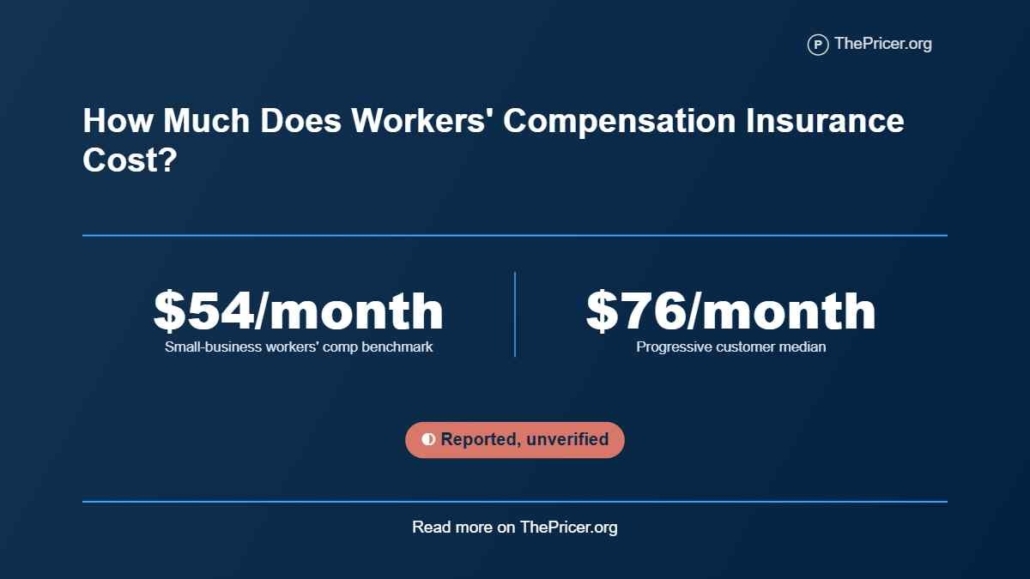
Insureon’s small-business dataset places the headline cost at $54 per month and annual premiums from about $300 to more than $5,000, although its page calls the figure an average while its methodology says the analysis uses median policy costs. That distinction matters when using its small-business pricing dataset to set an employer budget.
For employers, workers’ compensation cost is driven by payroll exposure rather than employee count alone. A low-risk office and a roofing contractor can have similar headcounts yet different class codes, rates per $100 of payroll, experience modifiers, state assessments, and audit results. The useful budget is the expected annual premium plus any applicable state charges, measured against the same payroll and classification assumptions used in the quote.
Article Highlights
Jump to sections
- Published small-business figures currently range from $54 (at $30 per hour, earning that amount would take about 1.8 hours of work, before taxes) per month in one broker dataset to a $121 monthly average in one carrier book.
- Progressive’s 2025 customer data shows a $76 monthly median, which is lower than its average and illustrates how large policies can pull an average upward.
- Texas rates are commonly expressed per $100 of payroll, then adjusted by classification and carrier factors.
- A mixed-payroll Texas scenario developed below produces a simplified base of $10,261.50 before other adjustments.
- Oregon’s 2026 Workers’ Benefit Fund assessment is 1.8 cents per hour worked, separate from the insurance premium.
How Much Does Workers’ Compensation Insurance Cost?
Current published figures differ because each company measures a different book of business. The table keeps each dataset in its own scope instead of blending several customer populations into one national average. That distinction matters because a median describes the middle policy in an ordered customer set, while an average can be pulled upward by larger or higher-risk policies.
| Source and scope | Published figure | How to read it |
|---|---|---|
| Progressive Commercial reports 2025 workers’ comp pricing | $76 (about 2.5 hours of work at $30 per hour) median and $121 average per month | Observed Progressive Commercial customer book |
| ERGO NEXT reports May 2026 customer data | Starts at $14 per month, with 49 percent below $75 per month | ERGO NEXT customer distribution |
The gap between Progressive’s median and average is useful evidence by itself. Most owners should not treat the larger average as a default quote, and the lower median is not a guaranteed target. ERGO NEXT adds another scope warning because its starting price and customer distribution describe its own insured population. Insureon’s lead figure above comes from yet another broker dataset. The safer comparison is provider by provider, with each number attached to its date and measurement method.
A small employer can use these published figures as a reasonableness check after a quote arrives, not as a substitute for rating inputs. A quote that sits far above a carrier-book median may still be sound if the business has hazardous work, large payroll, adverse loss history, or a costly state rating environment. A low figure may reflect limited payroll or lower-risk classifications.
What the Premium Buys
Workers’ compensation is an employer insurance cost tied to workplace injury and occupational illness exposure. California’s insurance guide describes a no-fault compensation system that provides benefits after job-related injury or illness and explains the separate employers’ liability part of the policy. The premium is what the employer pays for insurance protection. It is not the same thing as the value of a claim, a payroll tax, or the employee’s health insurance premium.
The policy also sits beside other business policies rather than replacing them. A customer injury or damaged client property may fall under business liability insurance, while damage to owned business property belongs in a different coverage category. Keeping those budgets separate prevents a workers’ comp quote from being mistaken for an all-purpose business insurance package.
Price comparisons need the same unit. A monthly carrier-book figure describes what a set of customers paid, while a state index rate may express dollars per $100 (about 3.3 hours of work at $30 per hour) of payroll. Neither is automatically wrong, but they answer different questions. The employer’s actual quote is the figure that connects its own payroll and work classifications to a carrier’s filed pricing and state rules.
How Payroll Becomes Premium
Payroll is a rating base, not the whole quote. The Texas Department of Insurance explains that an employer’s payroll is assigned to the applicable job classifications, then each classification’s payroll is multiplied by the insurer’s rate for that class. Those class premiums are added to form a basic premium. Under the state’s current rating method, the July 1, 2026 advisory loss cost for roofing code 5551 is 1.946. Using the state’s illustrative carrier multiplier of 1.50 produces a rate of $2.919 per $100 of payroll.
That published example also shows why an advisory loss cost is not a finished customer quote. The carrier multiplier reflects carrier expenses and other pricing components. Experience modification can change the result based on past loss history. Schedule rating can add a debit or credit for business traits not captured by the base rate, and eligible employers may encounter deductible or retrospective rating plans.
The key budgeting move is to ask for the rate basis behind the premium rather than treating the monthly installment as the rate itself. A monthly bill can change because payroll changed, the classification changed, or the insurer adjusted rating factors. The underlying exposure is still tied to the employer’s operations and reported payroll.
Job Class Changes the Bill
Job classification can create a much larger price difference than headcount alone. Texas’s July 2026 advisory table lists code 5551 at 1.946 and code 8810 at 0.020. These are advisory loss costs rather than final insurer rates, a distinction documented in the July 2026 advisory table. The gap shows why two employees with the same wage can contribute very different amounts to premium when their work falls into different legitimate classifications.
Classification is not a budgeting trick. The scenario is useful only when payroll truly belongs in the stated classes. The useful question is whether payroll records separate employees and work that belong in different classes under the applicable rules. If they do, a blended estimate based on one high-risk rate can overstate the expected base. If the records do not support a split, an assumed allocation is a weak budgeting input.
This issue also explains why industry averages can miss the mark. A contractor with field crews and office staff has several exposure types inside one company. A professional office with nearly all payroll in a low-hazard class has a different mix. Headcount can be identical while the payroll assigned to higher-risk work is not.
State Rules
Location changes both the insurance market and the rating framework. Oregon’s national comparison ranks all 50 states and Washington, D.C. Its 2024 table places Hawaii at an index rate of $2.52 per $100 of payroll, Oregon at $0.89, and North Dakota at $0.50. The listed rate effective dates run through January 1, 2024, so the state’s premium ranking is not a 2026 employer quote sheet.
Fresh state actions can move the rating environment after a national comparison is published. California’s insurance commissioner adopted an advisory pure premium rate of $1.65 per $100 of payroll in July 2026, up 6.6 percent from the 2025 approved rate. Carriers are not bound to charge that figure, which the July 2026 rate filing describes as advisory.
State rules also change whether a private-carrier quote is the relevant purchasing path. Texas says most private employers may choose whether to carry workers’ compensation, while its governmental entities must have coverage under the state’s employer rules. A national cost benchmark cannot replace the rule that applies where the employer operates and the employee works.
Audits and Extra Charges
 A policy can begin with an estimated premium and end with a different final premium after payroll and operations are reconciled. Travelers says in its premium audit guidance that an audit compares original estimates with actual payroll and business operations and may adjust the premium up or down. A business that budgets only from the first invoice may miss the final annual cost.
State charges can create another line outside the base premium. Oregon’s 2026 Workers’ Benefit Fund rate is 1.8 cents per hour worked, and the state assessment booklet says the employer normally retains half from the employee and pays the other half. Paying this assessment does not itself provide workers’ compensation insurance.
For a planning case with ten employees working 2,080 hours each, the full assessment base is 20,800 hours. Multiplying 20,800 by $0.018 per hour gives $374.40 for the total assessment flow. Under the standard half-and-half split, the employer portion before pay-period rounding would be about $187.20. That amount is small beside many annual premiums, yet it proves that the insurer’s premium line is not always the full workers’ comp-related cash flow.
Three Cost Scenarios
The first scenario uses the cited Texas inputs to show mixed payroll. Assume $350,000 of annual payroll is legitimately assigned to roofing code 5551 and $150,000 to code 8810. Apply the same illustrative 1.50 carrier multiplier used in the Texas guide.
- Roofing payroll at $2.919 per $100 produces $10,216.50.
- Code 8810 payroll at $0.030 per $100 produces $45.00.
- Simplified base premium is $10,261.50.
- Excluded items are schedule rating, deductibles, assessments, minimum premiums, and other carrier adjustments.
If the full $500,000 were hypothetically priced at the roofing rate, the base would be $14,595. The mixed-class scenario is $4,333.50 lower, a 29.7 percent difference. This is a calculated scenario, not a Texas quote. It assumes the classifications are valid, uses a 1.00 experience modifier, and excludes schedule rating, deductibles, assessments, minimum premiums, and other carrier adjustments.
The second scenario isolates claims-history sensitivity. Start with the same $10,261.50 simplified base and choose 0.75 and 1.25 only as illustrative modifiers. Multiplying the base by 0.75 gives $7,696.13. Multiplying it by 1.25 gives $12,826.88. The spread is $5,130.75. The chosen modifiers are sensitivity points, not predictions of a real employer’s experience rating.
The third scenario is the Oregon hourly assessment case above. It changes the cost through location and hours rather than job class or loss history. Taken together, the three cases show why payroll, classification, state charges, and claims experience should be modeled separately before they are combined into one annual budget.
How to Compare Quotes
Put competing quotes on the same payroll and classification assumptions before comparing price. Check whether each quote uses the same policy period, states, employee groups, payroll totals, class codes, experience modifier, and requested coverage. A cheaper installment can reflect a different exposure estimate rather than a cheaper rate. The same discipline helps when comparing workers’ comp with separate commercial property insurance or cyber liability insurance budgets.
Ask what can change after binding. Review the audit language and any state-specific assessment terms. The quote should identify any minimum premium, deposit requirement, installment charge, deductible arrangement, or schedule credit that actually applies. Do not assume a charge exists when it is absent from the quote.
Budget for coverage when
- Your state requires workers’ compensation for the employees or business structure involved.
- Your contracts require proof of workers’ compensation even when a state exception might otherwise apply.
- Your payroll contains field, shop, driving, or other work that carries a higher class rate than office work.
- Your staffing or payroll can change enough during the policy year to create a material audit adjustment.
Verify your state rule when
- You are the only owner and have no employees.
- Your workers are spread across several states.
- You use contractors or subcontractors whose status or coverage can affect an audit.
- Your state uses a state fund, special purchasing rule, or employer exemption that changes the normal private-carrier path.
Answers to Common Questions
How much is workers’ compensation insurance per month?
Current small-business publications show figures such as $54 per month, a $76 monthly median, and a $121 monthly average, but each comes from a different customer population. Your quote can be much lower or higher.
How is workers’ comp premium calculated?
A common method assigns payroll to job classifications, applies a rate per $100 of payroll, then applies insurer and employer-specific rating adjustments. State systems can use different mechanics.
Can a premium audit increase the cost?
Yes. If actual payroll, operations, classifications, or other auditable exposure differs from the estimate used at policy inception, the final premium can move up or down under the policy rules.
Is the lowest monthly quote always the cheapest policy?
No. Compare annual premium, payroll assumptions, class codes, rating factors, audit treatment, state charges, and any applicable fees. A smaller monthly installment can reflect billing structure rather than a lower annual insurance cost.
Disclosure: Educational content, not financial advice. Prices reflect public information as of the dates cited and can change. Confirm current rates, fees, taxes, and terms with official sources before purchasing. See our methodology and corrections policy.