
How Much Is a Hurricane Insurance Deductible?
Published on | Written by Alec Pow
This article was researched using 11 sources. See our methodology and corrections policy.
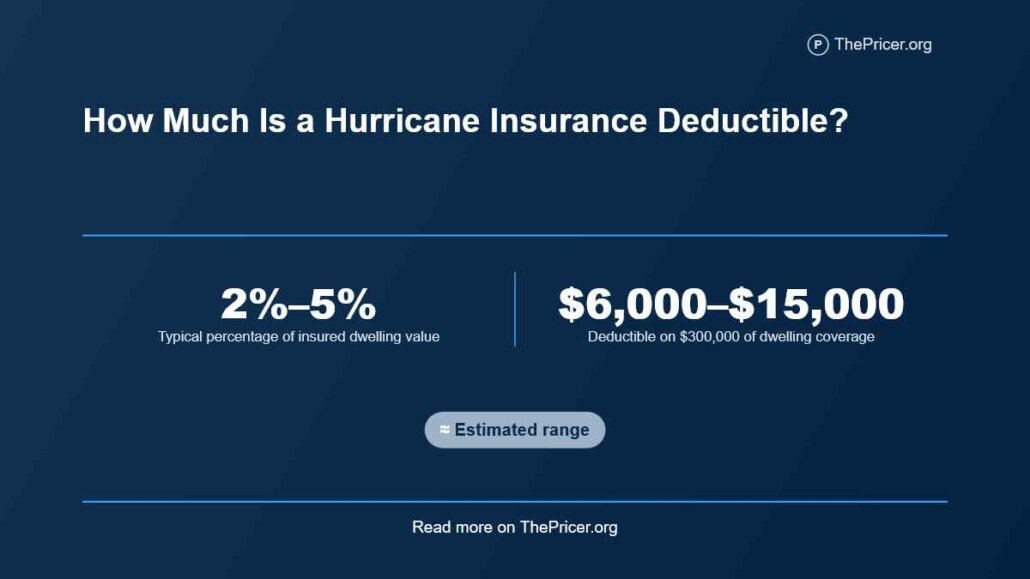
A hurricane insurance deductible is typically 2% to 5% of a home’s insured dwelling value, which means $6,000 to $15,000 for a house insured for $300,000. Some policies carry a 1% deductible, while others can reach 10% or more. The deductible is the portion of a covered hurricane loss that the homeowner must absorb before insurance pays its share.
Unlike an ordinary homeowners insurance deductible of $1,000 or $2,500, a percentage-based hurricane deductible can create a five-figure expense. The percentage usually applies to the dwelling coverage limit, not the size of the repair bill, the home’s purchase price or its mortgage balance.
The National Association of Insurance Commissioners (NAIC) reports that hurricane and named-storm deductibles can range from 1% to 15%, depending on the policy and jurisdiction. Florida and Louisiana regulators identify 2% to 5% as common levels, although higher options exist.
Article Highlights
Jump to sections
- Common hurricane deductibles are 2% to 5% of the insured dwelling amount.
- A 2% deductible on $400,000 in dwelling coverage equals $8,000; a 5% deductible equals $20,000.
- Florida insurers generally offer 2%, 5% and 10% hurricane deductible options, subject to statutory exceptions.
- A hurricane deductible is usually separate from the ordinary homeowners deductible and is not necessarily charged on every claim.
- Wind damage and flood damage have different coverage rules. Flooding generally requires separate insurance.
- Raising a deductible from 2% to 5% on $400,000 of coverage increases potential out-of-pocket exposure by $12,000.
Hurricane Deductible Amounts
Most percentage-based deductibles are calculated by multiplying the dwelling insurance limit, commonly called Coverage A, by the deductible percentage. Florida’s insurance consumer guidance identifies 2% to 5% as typical and notes that some policies use fixed-dollar deductibles.
The following table shows the dollar amounts at different insured dwelling limits. These are calculations, not insurance quotes.
| Dwelling coverage | 1% deductible | 2% deductible | 5% deductible | 10% deductible |
|---|---|---|---|---|
| $200,000 | $2,000 | $4,000 | $10,000 | $20,000 |
| $300,000 | $3,000 | $6,000 | $15,000 | $30,000 |
| $400,000 | $4,000 | $8,000 | $20,000 | $40,000 |
| $500,000 | $5,000 | $10,000 | $25,000 | $50,000 |
| $750,000 | $7,500 | $15,000 | $37,500 | $75,000 |
A homeowner with $500,000 in dwelling coverage and a 5% hurricane deductible is responsible for the first $25,000 of an otherwise covered hurricane loss. The insurer does not automatically pay anything merely because the storm was declared a hurricane. Covered damage must exceed the applicable deductible before a positive claim payment is due.
The percentage is generally applied to the insurance limit, not the property’s market value. A house that could sell for $650,000 might have $450,000 in dwelling coverage because the land is not being insured for reconstruction. At 5%, the deductible would be $22,500, not $32,500.
How Hurricane Claims Are Paid
Insurers ordinarily subtract the applicable deductible from the covered loss rather than requiring homeowners to send a separate deductible payment to the insurance company. The homeowner remains responsible for that amount when paying for repairs.
Consider a Florida home insured for $400,000 with a 5% hurricane deductible. Assume a hurricane causes $65,000 in covered wind damage, and the claim is otherwise payable at the full covered repair amount.
| Claim calculation | Amount |
|---|---|
| Covered wind repairs | $65,000 |
| Dwelling insurance limit | $400,000 |
| Hurricane deductible, 5% | $20,000 |
| Illustrative insurer payment | $45,000 |
| Homeowner’s deductible share | $20,000 |
The arithmetic is $65,000 minus $20,000, leaving $45,000. Actual claim settlements can also be affected by depreciation, replacement-cost conditions, coverage limits, exclusions and other policy terms.
Now suppose the same home sustains only $12,000 in covered hurricane wind damage. Because that amount is below the $20,000 deductible, the insurer’s payment would ordinarily be $0. The damage may still count toward an annual hurricane deductible where state law and the policy provide for that treatment.
This distinction matters when budgeting for hurricane evacuation expenses and subsequent home repairs. Insurance reimbursement does not necessarily provide immediate cash for every storm-related expense.
Hurricane Deductibles by State
Hurricane deductible rules are not uniform across the country. Some states regulate available percentages, disclosure and how often the deductible can apply. Others permit insurer-specific terms within broader insurance regulations.
Florida, Louisiana and coastal Texas provide useful illustrations of how different the arrangements can be.
Florida: The Florida Department of Financial Services identifies $500, 2%, 5% and 10% hurricane deductible options, with exceptions depending on the dwelling limit and policy. Insurers are not always required to offer the $500 option, particularly for higher-value homes. Special provisions apply to certain properties insured for $1 million or more.
Louisiana: The Louisiana Department of Insurance stated in July 2026 that named-storm or hurricane deductibles typically run 2% to 5% of insured property value. Its example of a $200,000 home with a 3% deductible produces a $6,000 homeowner obligation.
Coastal Texas: The Texas Windstorm Insurance Association (TWIA) operates a separate windstorm and hail insurance program for eligible coastal properties. A Texas Department of Insurance overview lists residential deductible choices including 1% and optional higher percentages from 1.5% through 5%, alongside certain fixed-dollar options. These TWIA terms should not be mistaken for the deductible choices on every private Texas homeowners policy.
The NAIC identifies hurricane or named-storm deductible arrangements in 19 states and the District of Columbia as of June 2025. That does not mean every home in those jurisdictions carries the same deductible or even has a separate hurricane deductible.
When Does the Deductible Apply?
A hurricane deductible does not automatically apply whenever a homeowner experiences strong wind or heavy rain. The policy must define the event that activates the special deductible, and state law may limit that definition.
The NAIC’s named-storm guidance distinguishes hurricane deductibles from broader named-storm deductibles. A named-storm provision can apply to qualifying tropical storms that never become hurricanes. A wind or hail deductible can apply to other wind events, depending on the contract.
Louisiana’s insurance department advisory explains why the exact trigger matters. Some policy wording is activated when a storm receives a name, while other wording requires a particular storm classification. A subtropical storm may therefore produce different deductible treatment under different policies.
In Florida, the statutory hurricane period begins when a hurricane warning is issued for any part of the state and ends 72 hours after the last hurricane watch or warning terminates. Damage and coverage conditions must still satisfy the applicable policy.
Homeowners should read the declarations page together with the hurricane, named-storm and windstorm endorsements. The declarations page identifies the deductible; the policy wording determines when it applies.
Can You Pay Twice in One Year?
 A homeowner facing two hurricanes in one year may not have to satisfy the full percentage deductible twice. Florida and Louisiana have annual application rules, although their details and policy conditions must be considered.
Florida’s hurricane deductible is generally applied on a calendar-year basis when the homeowner remains insured by the same insurer or insurer group. Once the full hurricane deductible has been satisfied, later qualifying hurricane losses during that calendar year can be subject to the ordinary all-other-perils deductible instead.
Louisiana’s published insurance regulations also address annual named-storm and hurricane deductibles for qualifying policies. A later storm can be subject to the greater of the remaining special deductible or the ordinary deductible.
Consider a simplified annual deductible scenario with a $10,000 hurricane deductible and a $2,000 ordinary deductible. The first hurricane produces $6,000 of covered damage, leaving $4,000 of the special deductible unsatisfied. A second qualifying hurricane produces $18,000 of covered damage.
Under the illustrated greater-of rule, the remaining $4,000 deductible applies to the second claim, producing a potential insurer payment of $14,000, assuming no other claim adjustments. If the first storm had fully satisfied the $10,000 special deductible, the later claim could instead be subject to the $2,000 ordinary deductible.
Changing insurers or insurer groups during the year may alter this result. Homeowners should retain settlement statements and deductible records, especially when multiple storms affect the same property.
The Hidden Cost of Higher Deductibles
A higher hurricane deductible may reduce the insurance premium, but it also transfers more storm-loss risk to the homeowner. The potential savings cannot be evaluated without knowing both the premium difference and the additional deductible exposure.
Take a $400,000 insured home. Moving from a 2% hurricane deductible to 5% increases the homeowner’s potential deductible from $8,000 to $20,000, an additional $12,000.
Assume, purely for comparison, that the insurer offers a $600 annual premium reduction for selecting the higher deductible. It would take 20 claim-free years to accumulate $12,000 in nominal premium savings. That comparison ignores investment returns, future premium changes and the possibility of claims during the period.
A second way to assess the choice is the break-even frequency. Under the same assumptions, $600 in annual savings divided by $12,000 of additional deductible exposure equals 5%. If a qualifying covered loss large enough to exhaust both deductibles occurs more frequently than once every 20 years, the higher deductible may have an unfavorable expected financial outcome under this simplified model.
Real insurance decisions are more complicated because storms vary in severity, smaller claims may not exhaust either deductible, and premiums can change. The calculation nevertheless reveals what the advertised annual savings must compensate for.
Another less visible expense arises when dwelling coverage increases. Florida’s consumer guidance explains that inflation-guard adjustments can raise the dollar value of a percentage deductible. A 5% deductible on $400,000 is $20,000; after the insured dwelling limit increases to $440,000, the same percentage becomes $22,000.
Wind Damage Versus Flood Damage
One of the most expensive hurricane insurance misunderstandings is assuming that a homeowners hurricane deductible covers every type of hurricane damage.
Standard homeowners insurance generally covers qualifying wind damage but excludes flooding, including storm surge. The Insurance Information Institute’s hurricane guidance distinguishes hurricane wind coverage from flood protection and explains why separate policies may be necessary.
Flood insurance purchased through the National Flood Insurance Program or a private insurer operates under its own limits and deductibles. The NFIP explains that building and contents coverage are generally purchased separately and have separate deductibles.
A home can therefore suffer wind damage subject to a hurricane deductible and flood damage subject to separate flood policy deductibles during the same storm.
Suppose a homeowner has a $10,000 hurricane wind deductible, a $2,000 flood building deductible and a $1,000 flood contents deductible. If all three coverages are triggered by otherwise covered losses large enough to exhaust them, the combined deductible exposure is $13,000.
This is an illustrative calculation, not a claim that every storm produces three deductibles. The actual total depends on which policies cover the damage and which deductibles apply.
Homeowners evaluating the cost of separate flood insurance should compare building and contents coverage, deductible choices and exclusions rather than assuming a homeowners policy provides complete hurricane protection.
How to Choose a Deductible
The appropriate deductible depends on the homeowner’s cash reserves, the available premium quotes, mortgage requirements and willingness to absorb a substantial loss. A lower deductible generally reduces the amount needed after a qualifying claim, but the premium may be higher.
The Insurance Information Institute’s deductible explanation recommends examining the percentage and the home’s insured value rather than focusing only on the annual premium.
Request quotes using the same dwelling limit, coverage terms and insurer whenever possible, changing only the hurricane deductible. Calculate the additional dollar exposure and compare it with the actual annual premium savings. If the insurer offers no meaningful discount for taking substantially more risk, the higher deductible may provide little financial benefit.
It is also worth asking whether windstorm coverage is included in the homeowners policy or provided through a separate insurer or state-supported windstorm program. Separate policies may create additional coverage gaps or deductible obligations.
Keep enough accessible funds for the selected deductible, particularly if the policy uses 5% or 10%. Emergency savings should also account for temporary accommodation, uncovered repairs and other disaster expenses.
After a hurricane, documenting roof damage and obtaining qualified repair estimates can help distinguish covered losses from unrelated maintenance. The cost of replacing a roof may be substantial, but the deductible and policy settlement terms determine how much of an insured repair the homeowner must finance.
What We Verified
We reviewed published guidance from the NAIC, Florida Department of Financial Services, Louisiana Department of Insurance, Texas Department of Insurance, Insurance Information Institute and National Flood Insurance Program. These sources establish common deductible percentages, state-specific provisions, deductible triggers and the distinction between wind and flood coverage.
The dollar tables, insurance settlement scenarios, annual deductible calculations and premium break-even illustrations use stated assumptions. They are not quotes from a particular insurer. Individual policy declarations, endorsements and current state requirements determine the deductible actually owed.
Answers to Common Questions
What is a normal hurricane deductible?
A common hurricane deductible is 2% to 5% of insured dwelling value. A home insured for $300,000 would have a deductible of $6,000 to $15,000 at those percentages. Some policies use different rates or fixed-dollar amounts.
How much is a 5% hurricane deductible?
It equals 5% of the applicable insured amount. For $400,000 in dwelling coverage, the deductible is $20,000.
Does the deductible apply to the entire home value?
It generally applies to the insured dwelling limit, not the home’s selling price or mortgage balance. The policy may specify a different basis, so the declarations page is controlling.
Do I have to pay the deductible before repairs begin?
The insurer generally subtracts the deductible from the covered claim payment. The homeowner is responsible for arranging payment of that share of the repairs. Contractor payment schedules are separate from the insurer’s deductible calculation.
Is a hurricane deductible charged every time?
Not necessarily. Florida and Louisiana have annual deductible rules for qualifying policies. Other jurisdictions and insurance contracts can treat successive storms differently.
Does a hurricane deductible cover flooding?
No. A hurricane deductible governs the applicable covered hurricane loss, usually wind-related damage. Flooding and storm surge generally require separate flood insurance, with separate deductible terms.
Can I lower my hurricane deductible?
Some insurers offer alternative deductible percentages in exchange for different premiums. Availability depends on state law, the property, the insurer and underwriting conditions. Changes may be restricted when a storm is approaching.
Disclosure: Educational content, not financial advice. Insurance pricing depends on underwriting, coverage limits, deductibles, and region. Confirm quotes and policy terms with a licensed insurer. See our methodology and corrections policy.