
How Much Is Iran’s Oil Worth?
Published on | Written by Alec Pow
This article was researched using 16 sources. See our methodology and corrections policy.
President Donald Trump turned a reserve-value question into a live war question on September 13, 2026. Speaking in Ireland, he said the United States would eventually leave Iran unless it decided to “stay and keep the oil” as it had in Venezuela. Two days later, Brent crude was trading around $107.05 per barrel.
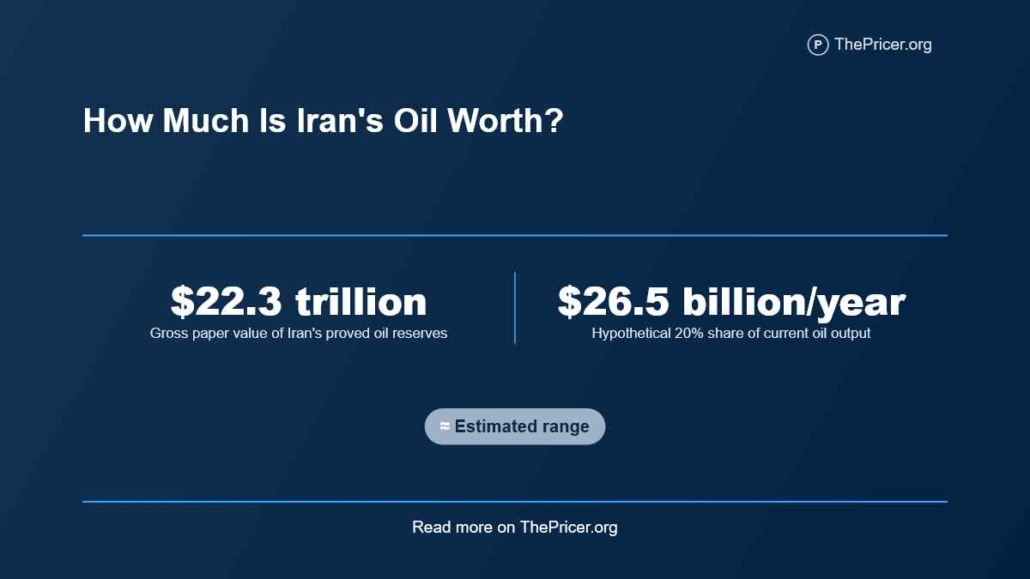
Iran has 208.6 billion barrels of proved crude reserves. Multiplying those barrels by today’s Brent price gives about $22.3 trillion. That is useful scale, not money Iran or the United States could simply collect. Trump’s Venezuela comparison creates the better question: what part of Iran’s oil could a U.S.-backed arrangement actually control, produce, buy or profit from?
Article Highlights
Jump to sections
- Iran holds 208.6 billion barrels of proved crude reserves.
- At $107.05 (at $30 per hour, earning that amount would take about 3.6 hours of work, before taxes) per barrel, their gross paper value is about $22.3 trillion.
- EIA’s 2026 Brent forecast near $91 puts the same reserves near $19.0 trillion.
- One-fifth of Iran’s reserves, matching the Venezuela deal’s approximate share, would be 41.7 billion barrels worth about $4.47 trillion at the September 15 Brent price.
- A hypothetical 20% right to Iran’s February output would equal about 678,000 barrels per day, or roughly $26.5 billion per year at the same price before costs.
Trump Changed the Question
Trump did not speak vaguely about Iran’s energy wealth. He tied a possible continued U.S. presence in Iran to oil, pointed to Venezuela as the model, said Venezuelan revenue had “paid for the war many times,” and predicted gasoline prices would fall sharply after the Iran conflict ended. That leaves three linked money questions. They concern the value of Iranian oil, what a Venezuela-like arrangement could give the United States, and whether extra supply would translate into cheaper fuel.
The first question starts with scale. The OPEC reserve table lists Iran at 208.6 billion barrels for 2025, behind Venezuela at 303.7 billion and Saudi Arabia at 267.2 billion. Those are proved reserves, not tankers waiting at a terminal for sale today. That distinction matters now.
The wording “keep the oil” also hides several possible meanings. It could refer to control of fields, equity in a producer, guaranteed purchase rights, a production share, or direct state revenue. The Venezuela arrangement Trump cited uses several of those mechanisms. It does not amount to the United States receiving the cash value of every Venezuelan barrel underground.
The $22 Trillion Number
On September 15, Brent traded near $107.05. Multiplying 208.6 billion barrels by that price gives about $22.33 trillion (about 358 million years of full-time work at $30 per hour). EIA’s September outlook puts average 2026 Brent near $91 per barrel, producing a steadier full-year reserve calculation near $18.98 trillion.
| Valuation lens | Arithmetic | Gross value | Meaning |
|---|---|---|---|
| All proved reserves at Sept. 15 Brent | 208.6B × $107.05 | $22.33 trillion | Spot-price reserve scale |
| All reserves at EIA 2026 average | 208.6B × $91 | $18.98 trillion | Annual-price reserve scale |
| One-fifth of Iranian reserves | 41.72B × $107.05 | $4.47 trillion | Venezuela-share illustration |
| One year of February output | 3.39M bpd × 365 × $107.05 | $132.46 billion | Gross production flow |
The last row is the corrective. EIA put Iranian crude production at 3.39 million barrels per day in February 2026. At that unchanged rate, producing 208.6 billion barrels would take about 169 years. Production, reserves and prices will all change long before then. A barrel expected decades from now also carries drilling, maintenance, transport, investment and time costs. The $22.3 trillion figure describes geological scale at a market price, not a collectible war prize for any government.
What “Like Venezuela” Means
The Venezuela comparison gives Trump’s remark a real economic template. The U.S.-Venezuela arrangement covers more than 65 billion barrels across 17 fields, close to one-fifth of Venezuela’s proved reserves. Interim President Delcy Rodriguez said the project lasts 25 years, targets production above 1.5 million barrels per day and preserves Venezuelan sovereignty over the resource. Under Venezuela’s assumptions, close to $19 (about 38 minutes at $30 per hour) from each produced barrel would flow to the state.
Reuters reported a layered structure rather than simple confiscation. A U.S.-linked producer would work with Venezuela’s PDVSA, the United States would hold a 35% equity interest in the corporate parent, and Washington had negotiated rights to 20% of output. Other purchase rights cover the remaining production.
If readers carry only the reserve share across, one-fifth of Iran equals 41.72 billion barrels. At $107.05, that is about $4.47 trillion of gross underground value. Trump has not proposed that Iran figure, and no Iran contract matching Venezuela’s terms exists. The calculation shows what his comparison implies at reserve scale. The existing Venezuela oil valuation reaches the same broader lesson. Control rights and future production matter more than multiplying all reserves by today’s price.
What America Could Capture
A flow-based scenario is more informative than a reserve grab. If a hypothetical Iran arrangement copied the reported Venezuelan term giving the U.S. a guaranteed 20% of output, applying it to Iran’s February production rate of 3.39 million barrels per day would yield 678,000 barrels per day.
The worked scenario is simple:
- Iran February production benchmark 3.39 million barrels per day.
- Illustrative U.S. output right 20%, or 678,000 barrels per day.
- Gross value at $107.05 about $72.6 million per day.
- Annualized gross value about $26.5 billion per year.
That $26.5 billion is not Treasury profit. It does not subtract field rehabilitation, production expenses, transport, security, insurance, corporate costs, taxes or Iran’s contractual share. It also freezes both the February production rate and September oil price for a full year. Its value is scale. A plausible production-right scenario lives in tens of billions of dollars per year, not trillions available immediately.
Even all Iranian February production valued at $107.05 comes to about $132.5 billion per year before costs. That is an enormous oil business. It still explains why the $22.3 trillion reserve number cannot be treated as revenue that could repay a war on demand.
Can the U.S. Simply Keep It?
The legal answer changes with the arrangement. A negotiated postwar production contract, an equity stake in a company and military occupation are different things. No public Iran oil agreement exists, so the United States does not currently have a disclosed contractual route resembling the Venezuela deal.
Occupation law also limits the simple idea of taking a country’s natural resources. Article 55 of the 1907 Hague Regulations treats an occupying state as the administrator and usufructuary of public real property in occupied territory and requires it to safeguard the property’s capital. That framework does not convert military control into full sovereignty over underground oil.
Oil can still raise difficult questions under occupation law, including what level of continued production is permissible and who benefits from the proceeds. A consensual agreement with an Iranian government after hostilities would sit on a different legal footing from wartime appropriation. Trump’s phrase does not tell us which path he has in mind.
Venezuela shows why the distinction matters. Caracas says it retains ownership and sovereignty while outside capital and operators receive economic rights. If an Iran proposal appears, the clauses on ownership, field rights, revenue, duration and control will matter far more than the phrase “keep the oil.”
Iran Was Already Selling Cheap
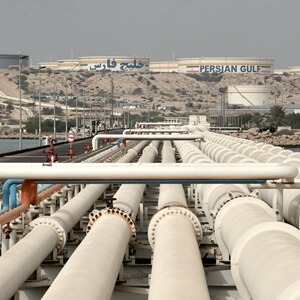 Before the blockade, sanctions had already changed what an Iranian barrel was worth to its seller. In June 2025, Iranian Light for China was offered at a $3.30 to $3.50 discount to ICE Brent for July delivery. That discount moved with market conditions, but it shows why the Brent screen price is not automatically Iran’s realized selling price.
China also dominated Iranian demand. Reuters reported that China accounted for more than 80% of Iran’s shipped oil in 2025. A later investigation described a barter-like payment system in which oil proceeds could become credits for Chinese goods and infrastructure instead of ordinary international bank transfers. Sources estimated $2 billion to $2.5 billion moved through one special-purpose vehicle over the prior year.
That is the hidden price behind a sanctioned barrel. Discounts, restricted buyers, shipping, storage, financing and unusual payment channels separate benchmark oil value from usable proceeds or liquid cash. New political control could remove some of that friction. It would not remove extraction costs, infrastructure needs or the long wait between an underground reserve and a barrel sold to a refinery.
Then the Oil Business Broke
The 2026 war changed the problem from selling cheaply to struggling to sell at all. Reuters reported that crude and condensate loadings fell from about 2 million barrels per day in March to 220,000 to 255,000 bpd in August after the U.S. reinstated its naval blockade. At $107.05, holding that August range for a year produces only about $8.6 billion to $10.0 billion of gross crude value before discounts and costs.
Kharg Island shows why controlling reserves is not the same as controlling a functioning oil business. The island has handled about 90% of Iranian shipments. Wells can keep producing for a time while storage fills and tankers wait, but eventually the export bottleneck reaches back into production.
Hormuz widens the effect. EIA says the strait carried 20.9 million barrels per day in the first half of 2025, about 20% of global petroleum liquids consumption. Disruption involving Iran can raise the price of Saudi, Iraqi, Kuwaiti and Emirati crude while reducing Iran’s own sales. That is why the cost of securing Hormuz belongs in the same economic story.
The Real Prize Is Oil Flow
The economic prize Trump is describing is better understood as control over future flow. Who develops the fields, who finances them, who operates them, where the barrels go, who gets guaranteed purchase rights and how the revenue is divided can be worth tens of billions of dollars over time without transferring ownership of all 208.6 billion barrels.
His claim that gasoline would fall sharply after the war also has limits. More Iranian crude reaching world markets could reduce oil-price pressure, especially if other Gulf exports recover. U.S. pump prices still depend on refining, inventories, crude quality and product markets. The administration has separately explored refinery expansion while plants have been running near 98% utilization.
The $22.3 trillion figure is useful for showing the size of Iran’s resource. It is misleading as a war prize. A Venezuela-like Iran structure would be priced through annual production, contract rights and net cash after costs. The U.S.-Iran war cost already runs into tens of billions of dollars. Oil might offset part of a future bill under some agreement, but that money would arrive through years of production rather than one transfer of underground wealth.
The $22 trillion figure is useful if
- it is labeled as gross reserve value at a stated oil price
- a production-based number appears beside it
It is misleading if
- it is presented as money the United States could seize or earn
- it ignores production costs, contract terms and time
Answers to Common Questions
How much is all of Iran’s oil worth?
About $22.3 trillion at roughly $107.05 per barrel, or around $19.0 trillion using EIA’s 2026 Brent forecast. Both are gross reserve calculations.
Did Trump say the U.S. should keep Iran’s oil?
Trump said on September 13 that the United States could remain in Iran and “keep the oil like Venezuela.” He did not announce detailed Iran oil terms.
What could a Venezuela-style Iran arrangement be worth?
No Iran agreement exists to price. A hypothetical 20% share of Iran’s February output would carry about $26.5 billion of annual gross crude value at the September 15 Brent price before costs.
Would Iranian oil make U.S. gasoline cheaper?
More supply could reduce crude-price pressure, but refining, inventories and fuel markets also matter. The Iran-war gasoline price shock shows how those effects reach drivers.
Disclosure: Educational content, not financial advice. Prices reflect public information as of the dates cited and can change. Confirm current rates, fees, taxes, and terms with official sources before purchasing. See our methodology and corrections policy.