
How Much Is Trump’s Russian Diesel Deal Worth?
Published on | Written by Alec Pow
This article was researched using 11 sources. See our methodology and corrections policy.
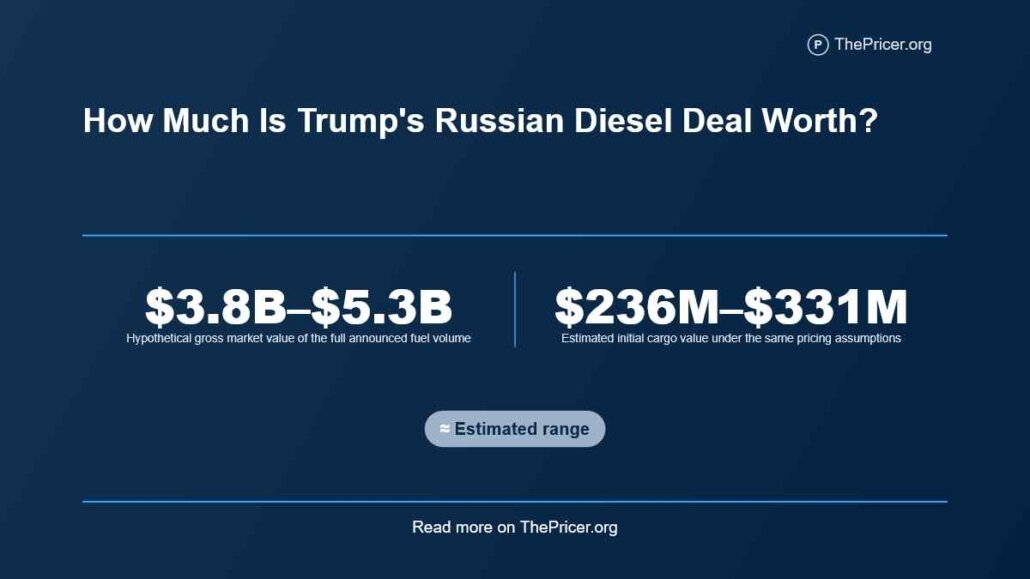
President Donald Trump’s October 9, 2026 diesel agreement with Vladimir Putin could involve fuel worth an estimated $3.8 billion to $5.3 billion if the entire announced 4.8 million metric tons are delivered and sold at an assumed $2.50 to $3.50 per gallon. But that is hypothetical gross cargo value, not a disclosed contract price, a U.S. taxpayer bill, or Russian government revenue.
One estimate reported by the Financial Times puts potential receipts for Russia’s federal budget at just $100 million over six months. Meanwhile, the first announced shipment represents less than 15 hours of recent U.S. distillate consumption. Energy analysts question whether redirecting Russian exports can meaningfully lower American pump prices at all.
The agreement combines four very different financial questions: how much diesel might be sold, what Russian exporters could earn, how much Moscow’s government might collect, and whether American drivers would save anything. So far, no publicly verified purchase price, completed shipment total or nationwide price reduction attributable to the deal establishes the final answer.
Article Highlights
Jump to sections
- Potential cargo value: approximately $3.8 billion to $5.3 billion if all 4.8 million announced metric tons are delivered at the assumed prices.
- Initial shipment: 300,000 metric tons, equivalent to about 94.5 million gallons.
- Russian government receipts: an analyst estimate of around $100 million over six months, not confirmed revenue.
- U.S. supply comparison: the initial volume is equivalent to about 0.62 day of recent American distillate demand.
- Pump price: U.S. diesel averaged $6.199 per gallon on October 5, before the agreement.
- Legal dispute: six senators from both parties challenged the sanctions relief on October 11.
- Price relief: no verified nationwide reduction has been attributed to the Russian shipments.
What Did Trump and Putin Agree To?
Trump announced the arrangement after a telephone conversation with Putin on October 9. According to Reuters reporting, the schedule begins with more than 300,000 metric tons of Russian diesel for American and global markets.
Trump also announced 500,000 tons during November, 1 million tons afterward and another 3 million tons dependent on Russia’s refinery capacity. The full announced total is approximately 4.8 million metric tons, but a substantial portion remains conditional.
| Announced stage | Diesel volume | Approximate gallons | Status |
|---|---|---|---|
| Initial release | 300,000 tons | 94.5 million | Announced for immediate supply |
| November | 500,000 tons | 157.5 million | Future delivery |
| Subsequent supply | 1 million tons | 315 million | Exact timing uncertain |
| Additional supply | 3 million tons | 945 million | Conditional on refinery capacity |
| Maximum announced | 4.8 million tons | 1.512 billion | Not verified as delivered |
The conversion assumes 7.5 barrels per metric ton and 42 U.S. gallons per barrel. Actual volume depends on diesel density. The table converts announced quantities, not verified customs entries.
The Associated Press reported that the announcement did not identify the complete payment arrangements or what concessions, if any, the United States offered. The Treasury’s subsequent sanctions authorization does not establish a government procurement contract.
How Much Is the Diesel Worth?
There is no publicly verified deal price. We can, however, estimate the gross sales value using explicit hypothetical prices.
At approximately 315 gallons per metric ton, the initial shipment represents 94.5 million gallons. The entire proposed schedule would represent 1.512 billion gallons.
| Shipment scenario | At $2.50/gallon | At $3.50/gallon |
|---|---|---|
| Initial 300,000 tons | $236 million | $331 million |
| First 1.8 million tons | $1.42 billion | $1.98 billion |
| All 4.8 million tons | $3.78 billion | $5.29 billion |
The upper-volume calculation is 1.512 billion gallons multiplied by the assumed selling price. Every $1 change in that price alters the full-volume value by $1.512 billion.
This valuation excludes any adjustment for product specifications, transportation, insurance, sanctions-related financing costs, discounts or trading fees. The assumed prices are modeling inputs, not disclosed wholesale quotations.
The table also does not reveal who receives the money. A diesel exporter, refinery, shipping company, trader, financier and government can all have different financial interests in the same cargo. Gross revenue is not the same as profit or taxes collected.
What Could Russia’s Government Earn?
This is where the billion-dollar headline becomes less straightforward.
The Financial Times reported on October 11 that analysts estimated roughly $100 million could reach Russia’s federal budget over six months from the arrangement. That is an attributed estimate, not a verified Treasury receipt or a figure derived from the full theoretical cargo value.
Compared with our hypothetical $3.78 billion to $5.29 billion in maximum gross sales, $100 million represents approximately 1.9% to 2.6%. The comparison illustrates the scale difference between possible commercial turnover and estimated government receipts. It does not imply that analysts expect all 4.8 million tons to be delivered at our assumed prices.
Russia’s fiscal benefit depends on tax rules, producer profits, actual exports and the timing of revenue recognition. Russian diesel sales can also support companies and economic activity without every dollar flowing directly to the federal budget.
Reuters separately reported on October 5 that Russia’s broader oil earnings had fallen despite higher crude prices, as production disruptions and currency movements affected government revenue. The energy-revenue report underscores why shipment value and government income should not be confused.
The $100 million estimate is useful because it offers a more specific fiscal angle than the cargo’s gross selling value. It is not evidence that Moscow will collect exactly that amount.
How Much Fuel Would America Receive?
The initial shipment sounds enormous at 300,000 metric tons. Relative to American fuel consumption, however, its scale is smaller than the headline suggests.
The Energy Information Administration’s weekly data put U.S. distillate fuel supplied at approximately 3.65 million barrels per day for the week ending October 2.
Using the same density assumption, 300,000 metric tons represent approximately 2.25 million barrels. Dividing 2.25 million by 3.65 million yields 0.62 day of U.S. distillate demand, or about 14.8 hours.
The entire conditional 4.8-million-ton schedule converts to approximately 36 million barrels, equivalent to 9.9 days of that consumption benchmark.
That does not mean Russia can supply all American diesel needs for ten days. U.S. distillate includes diesel and related products, the announcement covers global destinations, and those supplies would arrive over time rather than in one nationwide delivery.
The real question is how much additional fuel reaches markets that are short of diesel. Cargoes simply replacing shipments from other suppliers may deliver far less additional global supply than their headline volume implies.
Why Prices May Barely Move
Energy analysts have challenged the assumption that every Russian gallon released under the agreement becomes an additional gallon available worldwide.
In AP’s examination of the price effects, analysts warned that fuel redirected toward U.S. customers could leave existing Russian customers seeking replacement cargoes. That reshuffles trade routes without necessarily resolving the overall shortage.
The Guardian’s October 11 report similarly describes doubts about how much relief consumers could receive, noting supply constraints and transportation delays.
Russia also faces a complicated refinery situation. According to the Financial Times, Ukrainian attacks have damaged refining facilities, while analysts estimate Russia may still have the capacity to export approximately 1.2 million to 2 million tons of diesel per month. Those estimates describe possible capacity, not a verified future export schedule.
There is a difference between reopening a restricted export channel and creating new refinery output. The first can help particular buyers secure cargoes. The second is more directly relevant to increasing the total amount of fuel available worldwide.
A meaningful U.S. price benefit remains possible in a constrained region. It would depend on the destination, timing and delivered cost of actual shipments. No public evidence establishes a uniform nationwide discount resulting from this agreement.
What Could American Drivers Save?
U.S. on-highway diesel averaged $6.199 per gallon on October 5, according to the EIA’s national price survey. That was down from $6.529 on September 21, before Trump’s Russian-diesel announcement.
We can calculate what different hypothetical price reductions would save American fuel buyers without claiming the deal will cause any of them.
At a recent distillate supply rate of 3.65 million barrels daily, the equivalent is approximately 153.3 million gallons per day.
| Hypothetical sustained price reduction | 30-day U.S. expenditure difference |
|---|---|
| 5 cents per gallon | $230 million |
| 10 cents per gallon | $460 million |
| 25 cents per gallon | $1.15 billion |
| 50 cents per gallon | $2.30 billion |
The 10-cent example multiplies approximately 153.3 million gallons by $0.10 and 30 days, producing about $460 million. This assumes all U.S. distillate purchases experience the same sustained reduction. Actual highway-diesel savings would depend on the portion used on roads and the prices paid in each market.
For a trucker purchasing 150 gallons, a 10-cent discount saves $15. A 25-cent discount saves $37.50. For 1,000 gallons purchased over a period, the same price changes save $100 and $250 respectively.
Whether any of those savings materialize cannot be determined from the announced volumes alone. For context on actual pump-price changes and related fuel expenses, see our diesel cost per gallon analysis.
The Sanctions Dispute
The economic arrangement also required a change in how U.S. sanctions apply to Russian-origin diesel.
On October 9, the Treasury’s Office of Foreign Assets Control issued General License 135, authorizing specified transactions connected with Russian diesel sales, delivery, offloading and importation. The authorization extends through April 7, 2027, but does not remove every Russia-related restriction.
The legal dispute became more prominent on October 11. Associated Press reported that four Republican senators and two Democratic senators jointly urged the administration to reverse the decision.
The senators argued that the arrangement conflicts with restrictions enacted to limit Russian energy revenue during the war in Ukraine. Republican Senator John Barrasso, meanwhile, defended the administration’s emphasis on reducing energy costs and described the policy as potential diplomatic leverage.
Those positions reflect a genuine disagreement about sanctions authority and economic priorities. A Treasury license does not, by itself, settle questions about other statutes or establish that a particular transaction has been completed.
The extent of any legal challenge and its effect on future shipments remains uncertain.
Why Diesel Is So Expensive
Diesel prices reflect far more than the nationality of the supplier. Crude oil, refinery capacity, inventories, freight rates, fuel specifications, distribution constraints and taxes all affect the retail price.
The war involving Iran has disrupted energy flows through the Middle East, placing pressure on global petroleum markets. Russia’s own refining system has faced damage from Ukrainian attacks. Together with limited refining capacity elsewhere, these disruptions help explain why diesel availability has attracted unusually intense attention.
There are also large geographic differences within the United States. On October 5, the EIA reported diesel averaging $5.699 in the Lower Atlantic region and $8.082 in California.
A Russian shipment reaching an East Coast terminal will not automatically eliminate California’s separate tax, fuel-standard and distribution costs. Likewise, the price of shipping fuel matters. Our oil tanker charter cost analysis explores the freight expenses involved in maritime petroleum transport, although individual diesel product-tanker contracts differ from crude-tanker examples.
The distinction also matters for tax-exempt or specially taxed diesel. Our red diesel pricing guide explains why off-road and highway fuel prices can differ for reasons unrelated to international petroleum supply.
Missing Deliveries
A value assigned to fuel that has not arrived is not a realized transaction.
Under the announced schedule, the first 1.8 million tons is more clearly specified than the additional 3 million tons dependent on Russian refining capacity. Even the earlier volumes require physical loading, shipping, insurance, financing, port access and buyers willing and legally able to receive the cargo.
The timing could matter as much as the quantity. Fuel arriving after a temporary shortage eases may have a different economic effect from fuel delivered during a regional inventory squeeze.
Analysts cited by the Financial Times also question whether the announced deliveries can meaningfully change worldwide conditions, despite Russia’s remaining export capacity. The government-revenue estimate and the refinery-capacity estimates should therefore be understood as separate analyses, not evidence that every conditional shipment will occur.
To establish what the deal ultimately accomplished, the evidence should come from completed cargo records, buyer disclosures where available, changes in Russian exports, and observed wholesale and retail diesel prices measured against other market developments.
Until then, $3.8 billion to $5.3 billion remains a hypothetical maximum cargo valuation, and U.S. consumer savings remain unverified.
What We Verified
- Agreement: Reuters and AP reported Trump’s October 9 announcement and the staged diesel quantities.
- Commercial valuation: our $3.8 billion to $5.3 billion range assumes all 4.8 million tons are delivered and sold at $2.50 to $3.50 per gallon. It is not a disclosed transaction price.
- Russian fiscal receipts: the approximately $100 million six-month estimate is attributed to analysts cited by the Financial Times. It is not confirmed Russian budget revenue.
- U.S. demand: EIA distillate data provide the benchmark for the 0.62-day initial shipment comparison.
- Retail prices: the $6.199 national diesel average predates the announcement and cannot establish a deal-related discount.
- Sanctions: OFAC issued General License 135 on October 9. AP documented the bipartisan Senate objections on October 11.
- Still unknown: complete purchase terms, actual delivered quantities, proceeds received by individual sellers and any nationwide diesel-price reduction caused by the agreement.
Answers to Common Questions
How much is Trump’s Russian diesel deal worth?
The maximum proposed 4.8 million metric tons has a hypothetical gross value of approximately $3.8 billion to $5.3 billion at assumed selling prices of $2.50 to $3.50 per gallon. No public transaction price has been verified.
How much money could Putin’s government receive?
Analysts cited by the Financial Times estimate approximately $100 million could reach Russia’s federal budget over six months. That is a provisional estimate, not a confirmed payment or the same quantity as gross diesel sales.
Is the U.S. government paying Russia billions?
No publicly disclosed contract establishes such an expenditure. The arrangement concerns Russian diesel entering American and global markets, while the buyers and full commercial terms remain unclear.
Will the deal lower U.S. diesel prices?
It might ease selected regional shortages, but analysts question whether redirected Russian exports will increase overall global supply enough to lower nationwide retail prices significantly.
How much fuel is Russia initially offering?
About 300,000 metric tons, equivalent to approximately 94.5 million gallons under the stated conversion. That represents about 0.62 day of recent U.S. distillate demand.
Is importing Russian diesel legal?
OFAC’s General License 135 permits specified Russian-diesel transactions through April 7, 2027. Six senators have challenged the administration’s approach under other sanctions legislation, and the legal disagreement has not been finally resolved.
Disclosure: Educational content, not financial advice. Prices reflect public information as of the dates cited and can change. Confirm current rates, fees, taxes, and terms with official sources before purchasing. See our methodology and corrections policy.