
How Much More Does Restaurant Delivery Cost Than Pickup?
Published on | Written by Alec Pow
This article was researched using 8 sources. See our methodology and corrections policy.
Restaurant delivery can cost substantially more than pickup because the customer may encounter several added pricing layers before the order reaches the door. There is no reliable single U.S. percentage that applies to every restaurant order because restaurants can set different delivery and pickup menu prices, while platform charges can vary by merchant, distance, market, courier availability, order size, membership status, and local rules.
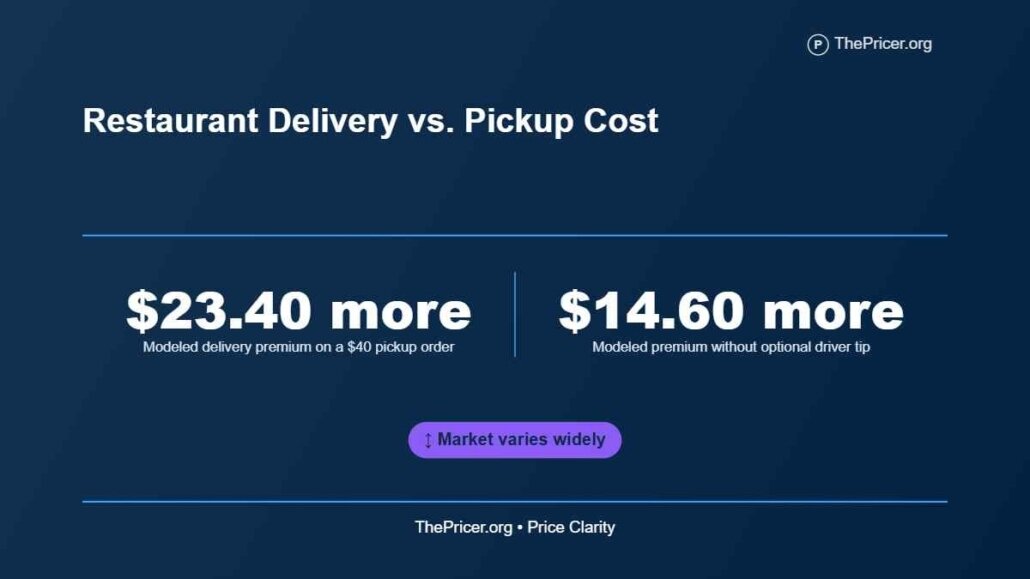
In a modeled $40 pickup order, a 10% delivery-menu markup, a documented 15% service-fee structure, an illustrative $4 delivery fee, and an illustrative 20% driver tip raise the pre-tax delivered total to $63.40. That is $23.40, or 58.5%, more than pickup under those stated assumptions.
The difference does not come from one universal “delivery fee.” Current platform rules separate the food price from service fees, delivery fees, possible distance or regulatory charges, and an optional driver tip.
Pickup removes the courier from the transaction and can eliminate several of those costs, although app-based pickup does not always match ordering directly from the restaurant. Comparing the two methods line by line shows whether the extra expense starts with a higher delivery menu, appears during checkout, or comes from the customer’s voluntary tip.
Article Highlights
Jump to sections
- Delivery can cost more before fees because restaurants may set higher menu prices for delivery than pickup.
- Current DoorDash pricing separates the delivery fee from service and other eligible delivery charges.
- A documented Uber Eats fee structure uses a service fee equal to 15% of the order subtotal, giving a useful real-world input for cost modeling.
- In ThePricer’s modeled $40 order, delivery reaches $63.40 before tax when a 10% menu markup, 15% service fee, illustrative $4 delivery fee, and 20% driver tip are included.
- Without the optional tip, that same delivery scenario costs $54.60, or $14.60 more than the $40 pickup baseline.
- A fixed delivery fee has a much larger percentage impact on a small restaurant order than on a large shared order.
How Much More Does Restaurant Delivery Cost Than Pickup?
Delivery can become more expensive before a service or delivery fee is added. Merchant pricing tools explicitly allow separate prices for delivery and pickup menu items. A comparison based only on the fee section at checkout can therefore miss part of the delivery premium already built into the food subtotal.
Published pricing guidance provides a useful illustration of how menu markup is calculated. It compares identical items across in-store and delivery menus and gives one sample set where in-store prices of $2, $10, and $12 become $3, $12, and $14 on the delivery menu. The calculated markup for that sample is 20.8%. The example demonstrates the calculation method rather than establishing a normal restaurant markup.
For a simpler ThePricer scenario, take a pickup food basket costing $40 and assume the identical delivery menu is 10% higher. The delivery food subtotal becomes $44 because $40 × 1.10 = $44. The first $4 of the delivery premium appears before the platform adds any delivery or service charge.
The percentage also changes the base for percentage-based fees. If a 15% service fee is assessed on the $44 delivery subtotal, it costs $6.60. The marked-up food and service fee together reach $50.60, which is already $10.60 above the $40 pickup food price. That is a 26.5% increase even though the two percentage inputs are 10% and 15%. The percentages compound because the service fee is calculated on the higher delivery subtotal.
Why Delivery Costs More
Pickup and delivery can begin with different food prices. Restaurants using delivery marketplaces can set prices according to fulfillment method, which means a sandwich, pizza, entree, or drink can have one listed price for pickup and another for delivery before the customer reaches checkout. A higher delivery-menu subtotal then becomes the starting point for any percentage-based charges calculated from that food price.
Delivery adds costs associated with getting the order to the customer. Current U.S. consumer guidance explains that delivery orders can carry a service fee, merchant-specific delivery fee, long-distance fee, regulatory-response fee, and other applicable charges. The exact service-fee formula can depend on the market and current pricing structure. Pickup under the structure described by the platform does not carry the same courier-related cost stack.
The competing delivery model also separates food pricing from delivery-related charges. Current consumer guidance says delivery fees can vary with location, merchant, courier availability, and membership status, while the applicable service fee appears during checkout. Restaurant delivery performed by the restaurant’s own staff can follow another fee arrangement.
A driver tip creates another difference because pickup does not involve a delivery driver. The tip is optional, but including one in a personal delivery budget can widen the gap substantially. Tax can also differ when taxable fees or a higher delivery-menu subtotal increase the taxable base under local rules. The final delivery premium can therefore contain both mandatory charges and a discretionary payment.
Fees Added at Checkout
 The delivery fee is only one possible checkout charge. A delivery order can also encounter a percentage or variable service fee, a charge tied to a farther delivery distance, a small-order charge, or a jurisdiction-specific fee. The amount visible during a particular checkout matters more than a generic advertised delivery price because the final charge can change with the restaurant, basket, delivery address, membership, and current promotion.
One published customer-fee structure states that the service fee equals 15% of the order subtotal and a $2 small-order fee applies below a $10 subtotal. The same fee structure says the delivery charge can vary by restaurant based on factors that include the customer’s location and nearby courier availability. That 15% figure is useful for a documented scenario, but it is not a universal rate for every order or market.
Other current delivery documentation describes service fees as percentage-based charges and delivery fees as amounts that can respond to distance, time, order value, basket size, and delivery conditions. A customer looking at a $3.99 or $4.99 delivery fee should not assume that figure represents the entire premium over pickup. A higher food subtotal and service charge can already have increased the order before the courier fee appears.
Pickup strips away many courier-related charges. A customer can still encounter different app menu pricing or another merchant-specific difference, so “pickup” should not automatically be equated with the restaurant’s direct ordering price. The clean comparison uses the actual pickup checkout against the actual delivery checkout for the same basket.
A $40 Order Side by Side
Consider a restaurant order costing $40 for pickup. For the delivery side, assume a 10% menu markup, making the identical food $44. Apply the documented 15% service-fee structure described above, which adds $6.60. Then assume a $4 delivery fee and a voluntary driver tip equal to 20% of the $44 delivery food subtotal, or $8.80.
| Cost component | Pickup | Delivery scenario |
|---|---|---|
| Same food at pickup price | $40.00 | $40.00 |
| Illustrative 10% delivery-menu markup | $0 | $4.00 |
| Food subtotal after markup | $40.00 | $44.00 |
| 15% documented service-fee scenario | $0 | $6.60 |
| Illustrative delivery fee | $0 | $4.00 |
| Illustrative 20% driver tip on food subtotal | $0 | $8.80 |
| Modeled total before tax | $40.00 | $63.40 |
The modeled delivery order costs $23.40 more than pickup before tax. Dividing the $23.40 premium by the $40 pickup baseline gives 58.5%. This is a calculated scenario, not an estimate of the average U.S. delivery premium. The menu markup, delivery fee, and tip assumptions can all change for a real order.
Removing the optional $8.80 tip lowers the delivery scenario to $54.60. The mandatory modeled difference is then $14.60, or 36.5% above pickup. That separation shows how much of this particular example comes from channel pricing and fees versus a customer’s voluntary driver tip.
Small Orders Take the Bigger Hit
Fixed fees make inexpensive orders especially sensitive to delivery. Assume, solely for comparison, that a delivery carries a fixed $4 charge. On a $20 food subtotal, that fee alone equals 20% of the food price. On $40, it equals 10%. On an $80 order, the same $4 represents only 5%.
| Food subtotal | Fixed delivery fee | Fee as share of food price |
|---|---|---|
| $20 | $4 | 20% |
| $40 | $4 | 10% |
| $80 | $4 | 5% |
The calculation explains why a single delivered lunch can have a much larger percentage premium than dinner for several people. A percentage service fee continues to scale with spending, but a fixed delivery charge is spread across a larger food basket as the order grows. A small-order fee can make the effect stronger when the basket falls below a platform’s threshold.
Order consolidation can change the economics without changing the platform’s stated fees. If two people would otherwise place separate $20 deliveries, each could face its own fixed delivery charge. A single $40 order may spread one fixed charge across both meals, subject to the restaurant’s and platform’s actual checkout rules. The food itself has not become cheaper; the fixed delivery component is simply divided across more spending.
This is why a broad statement such as “delivery costs 10% more” can misrepresent individual orders. A large order with a waived delivery fee may have a relatively modest premium, while a small order with menu markup, a minimum service fee, delivery charge, and tip can cost much more in percentage terms.
What Memberships Actually Remove
A delivery membership can narrow the delivery-pickup gap without necessarily eliminating it. Current membership terms describe $0 delivery fees and reduced service fees on eligible orders that meet the displayed subtotal requirement. Eligibility depends on the merchant and order, so the actual checkout remains the useful measure of savings.
A $0 delivery fee should not be read as a $0 delivery premium. A restaurant may still use a higher delivery menu, and service fees, applicable taxes, other eligible charges, and voluntary gratuity can remain. Removing one line from the checkout does not automatically make delivery equal to pickup.
Membership value depends on the orders that qualify. If a customer would otherwise pay a $4 delivery fee on an eligible order and membership removes that charge, the immediate saving is $4. A reduced service fee can add another saving, but the amount requires the actual checkout. Menu markup and voluntary driver tipping can remain.
The subscription price belongs in a longer-term affordability calculation rather than being hidden. A person ordering delivery frequently can spread a monthly membership cost across many orders, while someone ordering once may save less in fees than the subscription costs. Promotions can temporarily change that result, so a discounted first order is a poor basis for estimating the normal delivery premium.
Direct Pickup vs. App Pickup
Pickup is not one uniform price channel. A restaurant may accept orders through its own website, by phone, at the counter, and through one or more delivery marketplaces. The same meal can have different menu pricing or promotions across those channels. Comparing app delivery with direct restaurant pickup can therefore measure both a fulfillment difference and an ordering-channel difference.
Current U.S. merchant pricing helps explain why some app pickup listings may track direct restaurant prices. Published marketplace terms state that a 6% pickup commission is available to qualifying partners whose pickup menu prices match in-store prices. The same pricing structure lists delivery commissions of 15%, 25%, or 30%, depending on the merchant plan. Those merchant commissions are not customer fees and should never be added directly to a diner’s bill.
Restaurants can react to the economics of each channel through their own pricing decisions. A merchant can price delivery separately, and a higher delivery menu can help offset marketplace costs. The amount visible to the customer remains the menu price shown for that order, not the merchant’s underlying commission rate.
For the cleanest personal comparison, build the desired basket on the restaurant’s direct pickup channel and on the delivery channel before placing either order. Record the food subtotal, then compare fees, tax, and tip separately. This reveals whether the extra cost begins with the menu itself or appears only during checkout.
Three Real Price Examples
ThePricer’s existing restaurant research shows why delivery premiums need to be evaluated by order rather than assigned one national percentage. In the guide to Jimmy John’s menu prices, one documented Huntington order uses a $13.47 food subtotal, a $0.49 delivery fee, and a 15% service fee. The service fee is about $2.02, bringing those two delivery-related charges to about $2.51. Before tax and tip, that is an 18.6% increase over the food subtotal.
ThePricer’s Jersey Mike’s price guide contains a larger all-in delivery example. A $18.85 food subtotal is paired with a $3.99 delivery charge, $2.50 service fee, and $4 tip. Those additions total $10.49, producing $29.34 before any separate tax adjustment in this comparison. The added amount equals 55.6% of the original food subtotal.
A menu-price comparison can show the premium before checkout fees. ThePricer’s research into the Starbucks Unicorn Frappuccino price found one store example at $6.45 compared with $7.95 on a delivery menu. The $1.50 difference is about 23.3% of the store price before delivery fee, service fee, tax, or driver tip enters the calculation.
These examples measure different things and should not be averaged together. The Jimmy John’s example isolates listed delivery-related charges, the Jersey Mike’s example includes a tip, and the Starbucks example isolates a menu-price spread. Taken together, they show the main paths by which delivery can exceed pickup: higher food prices, mandatory platform charges, and an optional courier tip.
Makes sense if
- The time or travel avoided is worth more to the customer than the displayed delivery premium.
- A larger shared order spreads fixed delivery charges across several meals or diners.
- A qualifying membership or promotion materially reduces the actual checkout fees.
- The restaurant’s delivery menu closely matches its pickup prices.
Does not make sense if
- A small order faces a large fixed fee relative to the food subtotal.
- The delivery menu is already substantially more expensive than the pickup menu.
- The customer can collect the order easily and places little value on the time saved.
- A $0 delivery-fee promotion still leaves enough service fees and menu markup to create a large premium.
Answers to Common Questions
How much more does restaurant delivery cost than pickup?
There is no single U.S. percentage because menu markup, platform fees, distance, order size, membership, location, tax, and optional tipping vary. In ThePricer’s modeled $40 example, delivery costs $23.40, or 58.5%, more before tax when the stated 10% menu markup, 15% service fee, $4 delivery fee, and 20% driver tip are included.
Why is the food itself sometimes more expensive for delivery?
Restaurants can set separate delivery and pickup menu prices on delivery marketplaces. A higher delivery menu can help a restaurant offset costs associated with marketplace delivery, so the price difference can appear before customer-facing service and delivery fees are added.
Does a $0 delivery fee mean delivery costs the same as pickup?
No. A $0 delivery fee can still leave a higher delivery-menu price, service fee, applicable tax differences, other charges, and an optional driver tip. Compare the final pickup and delivery checkouts rather than the delivery-fee line alone.
Why does delivery cost proportionally more on small orders?
Fixed charges consume a larger share of a small food subtotal. An illustrative $4 delivery fee equals 20% of a $20 order, 10% of $40, and only 5% of $80. Minimum service fees or small-order fees can widen that difference.
Does pickup through an app always cost the same as ordering directly?
No. Pickup pricing can depend on the restaurant and ordering channel. Some platform programs encourage or require qualifying merchants to match pickup and in-store pricing, but diners should compare the actual menu and checkout when the price difference matters.
Disclosure: Educational content, not financial advice. Prices reflect public information as of the dates cited and can change. Confirm current rates, fees, taxes, and terms with official sources before purchasing. See our methodology and corrections policy.