
How Much Should You Budget for an International Trip?
Published on | Written by Alec Pow
This article was researched using 11 sources. See our methodology and corrections policy.
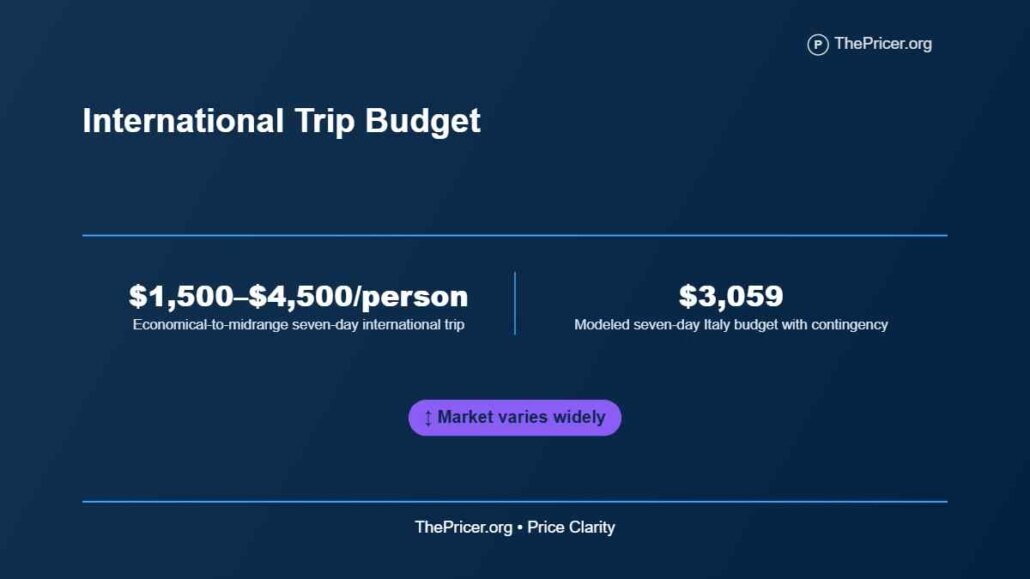
For a seven-day international vacation departing from the United States, a reasonable planning budget is $1,500 to $2,500 per person for an economical trip, $2,500 to $4,500 for a comfortable midrange vacation, and $5,000 to $10,000 or more for premium travel.
These are illustrative all-in budgets covering economy airfare, accommodation, meals, local transportation, sightseeing, and ordinary travel extras, not measured national averages.
Destination matters enormously. Seven nights in Thailand can be substantially cheaper on the ground than a week in Italy, but the airfare from your departure airport might reverse part of that savings.
The number of travelers, season, exchange rate, hotel choices, and advance bookings also change the total.
Budgeting accurately means separating the one-time cost of reaching a country from the expenses incurred each day, then allowing for entry documents, insurance, and unexpected charges.
Article Highlights
Jump to sections
- Plan approximately $1,500 to $4,500 per person for many economical-to-midrange seven-day international vacations, depending on destination and airfare.
- Reported daily traveler spending averages around $97 in Thailand, $138 in Japan, and $230 in Italy, excluding international flights.
- Comprehensive travel insurance often costs 4% to 10% of insured prepaid, nonrefundable expenses.
- A first-time adult U.S. passport book currently costs $165, including the acceptance fee.
- A 10% to 15% contingency allowance can help absorb exchange-rate changes, unexpected transport, and spending overruns.
- Extending a trip can lower the average cost per day because the international airfare is spread across more days.
How Much Should You Budget for an International Trip?
An international travel budget needs to cover transportation to the destination and daily living expenses after arrival. Airline tickets may be the largest single purchase, although lodging and activities can exceed airfare on longer vacations.
The table below presents three illustrative seven-day budgets for one U.S. traveler. Each category represents an assumed spending choice, not a quoted itinerary or national average.
| Expense | Budget trip | Midrange trip | Premium trip |
|---|---|---|---|
| Round-trip airfare | $600 | $900 | $1,800 |
| Seven nights of lodging | $350 | $840 | $2,100 |
| Food and drinks | $175 | $350 | $700 |
| Local transportation | $70 | $175 | $350 |
| Activities | $100 | $250 | $600 |
| Insurance and other extras | $75 | $150 | $300 |
| Total before contingency | $1,370 | $2,665 | $5,800 |
The budget column assumes an inexpensive destination, shared or economical accommodation, and limited paid attractions. Premium travel assumes much higher accommodation and flight spending. Taxes, destination-specific entry costs, and a separate emergency reserve may increase each total.
Real-world insurance-market data provides a different reference point. Squaremouth’s September to October 2026 travel spending data reports an average declared international trip value of $7,542 across its insured customers, with an average duration of 14 days. That is declared trip value among insurance purchasers, not an average for all international tourists or a per-person seven-day benchmark.
Destination Changes the Budget
 Daily spending varies considerably between countries, even before accounting for differences within individual cities.
Budget Your Trip’s Thailand traveler spending records estimate average daily spending around $97 per person, including a share of accommodation, local travel, food, and activities. Its budget-traveler figure is approximately $35 daily, while luxury spending is much higher.
For Japan, the same publisher’s traveler expense estimates indicate approximately $138 daily. Its Italy spending analysis puts average daily travel expenses around $230.
These figures are based on reported traveler spending, not live hotel quotes for a particular week. Accommodation is already represented in the daily amount, so adding a full hotel budget again would double count lodging.
For a seven-day stay, multiplying those daily benchmarks gives approximately $679 for Thailand, $966 for Japan, and $1,610 for Italy before international airfare.
The difference between Thailand and Italy is $931 per person over seven days at those reported daily rates. Italy could still be the more economical overall choice for a particular traveler if the airfare difference exceeds that amount in Thailand’s favor.
Those national averages hide local variation. Central Rome, Venice, and the Amalfi Coast do not necessarily cost the same as smaller Italian towns. Tokyo, Osaka, and rural Japan also create different hotel and transport budgets.
Airfare and Baggage Charges
Flight cost depends on the departure airport, travel dates, route competition, connections, and fare conditions. There is no reliable international round-trip price covering every destination.
A traveler starting from a major U.S. gateway can encounter different fares from someone who needs a domestic connecting flight. Date flexibility may matter more than simply choosing the cheapest destination on paper.
For planning, the earlier table uses assumed airfare amounts of $600, $900, and $1,800. They are not live booking offers. Replace them with an actual round-trip quote from your airport before treating the budget as ready to purchase.
The U.S. Department of Transportation explains that optional airline services can include checked baggage, seat selection, meals, and other extras. Fare bundles differ in what they include.
Under the department’s 2026 ancillary-fee regulation, airlines remain subject to fee-disclosure requirements, following the reversal of portions of the 2024 disclosure rule. Compare the baggage terms for the exact ticket, not a general assumption that international economy fares include checked bags.
Also account for travel to the U.S. airport, possible overnight connections, and arrival transfers. An inexpensive flight landing far from the destination city can lose its advantage after ground transportation.
Hotels and Everyday Expenses
Accommodation is frequently the largest controllable expense once international flights are purchased. Staying outside a city center or sharing a room can reduce the cost, though additional transport may offset part of the savings.
When comparing hotels, check the complete charge for the desired nights. Taxes, destination levies, resort fees, breakfast, and parking may be handled differently across booking sites.
A seven-night hotel costing an illustrative $120 per night produces a room charge of $840 before additional fees. Two adults sharing that room allocate $420 each to lodging, rather than $840 each.
Food budgets also require a realistic daily routine. An inexpensive breakfast and lunch can be offset by premium restaurants, alcohol, and frequent hotel dining. A person budgeting $40 per day for meals needs $280 for seven days. Raising that allowance to $70 daily adds $210 to the trip.
Local transportation should include airport transfers, public transit, trains between cities, taxis, and any rental-car costs. A rail pass is worthwhile only when its price is lower than the individual journeys a traveler would otherwise buy.
Check whether excursions include transport and admission. Purchasing an attraction ticket separately when it is already included in a tour can inflate the budget unnecessarily.
Passports and Entry Fees
Entry requirements depend on citizenship, destination, length of stay, and travel purpose. A visa-free trip may still require a passport with sufficient validity or an electronic travel authorization.
According to the U.S. Department of State’s current passport fee schedule, a first-time adult passport book costs $130 plus a $35 acceptance fee, for $165 combined. Eligible adult renewals cost $130 without the separate first-time acceptance fee.
An optional expedited application adds $60. A U.S. passport card cannot substitute for the passport book on ordinary international air journeys.
European entry requirements are also changing. The EU’s official ETIAS information lists a future application charge of €20 for most fee-paying applicants but states that the system is not yet accepting applications as of the October 2026 check. Do not add an ETIAS charge to a trip until the requirement actually applies.
Some destinations require paid visas, prearrival registration, or documentation beyond a passport. Verify the entry rules for your nationality and travel dates before purchasing nonrefundable tickets.
Travel Insurance and Medical Costs
Travel insurance can protect different expenses depending on the policy. Medical-only insurance and comprehensive cancellation coverage should not be budgeted as though they were identical products.
According to Squaremouth’s 2026 international insurance analysis, comprehensive insurance commonly costs 4% to 10% of eligible prepaid, nonrefundable trip expenses. Its international policy sales averaged approximately $86 for medical-only coverage and $479 for comprehensive coverage in the cited dataset.
For a trip with $3,000 in insured prepaid expenses, the 4% to 10% guideline suggests $120 to $300 for comprehensive protection. This is a planning estimate, not an individualized quote.
Coverage conditions matter. The comprehensive policy comparison explains that adventure activities, medical conditions, cancellations, and exclusions can affect whether a claim qualifies.
Independent coverage from Experian’s July 2026 insurance analysis also places typical comprehensive premiums around 4% to 10% of insured trip costs.
Do not assume a U.S. health insurance policy pays for overseas medical treatment. Check existing benefits and evacuation coverage before deciding what additional protection is appropriate.
Hidden Costs
Unexpected travel spending often comes from small purchases repeated across several days rather than one large surprise.
Foreign transaction fees, ATM charges, mobile data, hotel taxes, tipping customs, and additional transportation all belong in the budget when relevant.
Consider an illustrative traveler spending $1,200 abroad on a card that charges a 3% foreign transaction fee. That creates an additional $36 in card charges. Five separately charged ATM withdrawals costing $5 each add another $25, before any exchange-rate spread.
The combined $61 is small relative to the overall trip but avoidable or reducible with suitable banking arrangements. It is not a universal cost of overseas payments.
Another overlooked issue is the exchange rate used during checkout. Paying a foreign merchant in U.S. dollars may involve a merchant or payment processor conversion rate rather than your card network’s rate.
Budget for a separate emergency reserve rather than treating your full available bank balance as ordinary vacation spending. That reserve is not an expense unless used, and it should not be included in the trip’s actual cost afterward if left untouched.
A Seven-Day Italy Budget
Consider one U.S. traveler arranging seven days in Italy with economy flights and independently selected hotels, meals, transport, and activities. The following calculation is illustrative, not a current bookable itinerary.
- Round-trip economy airfare allowance: $900
- Seven nights at $110 per night: $770
- Seven days of meals at $55 per day: $385
- Local transport and airport transfers: $175
- Museums, tours, and admission: $180
- Comprehensive insurance allowance: $150
- Other travel expenses: $100
The trip subtotal is $2,660. Adding a 15% contingency of $399 creates a planning target of $3,059.
The contingency is cash set aside, not a predicted charge. If none of it is needed, the actual spend remains $2,660.
This model deliberately builds accommodation, food, and activities from separate amounts. It does not add Italy’s reported $230 daily traveler average on top, because that would count those categories twice.
The budget works as a template for different destinations. Replace the airfare with your actual quote, lodging with the complete hotel price, and daily allowances with local spending evidence.
Seven Days or Fourteen?
Longer trips cost more in total but can provide better value for the international airfare. The key calculation separates fixed travel costs from daily spending.
Using an assumed $900 round-trip flight and $140 in daily destination expenses, a seven-day trip costs $1,880 before extras. A fourteen-day trip on the same airfare and daily budget costs $2,860.
The total rises by $980, but the effective cost per day falls from about $269 to $204. The traveler receives twice as many days abroad for approximately 52% more spending.
This is a conditional calculation. It assumes the longer trip uses the same round-trip airfare and daily spending rate, with no additional intercity transport, insurance adjustment, or accommodation discounts.
The same principle helps couples compare expenses. Sharing a hotel room can reduce per-person lodging, but flights, meals, admission tickets, and some insurance premiums remain individual expenses.
When to Save or Spend More
Cutting costs is most effective when it does not undermine the purpose or reliability of the trip. A cheaper hotel in an inconvenient location may create extra transport costs, while a flexible flight can be worth more than a small fare difference.
Makes sense if
- You have flexible dates and can compare complete airfare prices.
- You choose destinations with daily expenses that fit your available budget.
- You are comfortable using public transportation and mixing inexpensive meals with selected premium experiences.
- You maintain a contingency and avoid spending money reserved for emergencies.
Does not make sense if
- The low airfare requires expensive additional travel or impractical connections.
- You cannot afford the mandatory entry documents and essential insurance or medical provisions for your situation.
- Your budget depends on an unusually favorable exchange rate or an unconfirmed accommodation offer.
- You would need expensive debt to cover ordinary discretionary vacation spending.
For destination-specific comparisons, the cost of a Dubai trip demonstrates how season and hotel choice alter totals. Longer multi-country itineraries require another approach, as shown in the around-the-world travel cost analysis.
Travelers renewing documentation can also compare U.S. passport renewal costs before deciding whether standard processing will meet the departure date.
Answers to Common Questions
Is $2,000 enough for an international trip?
It can be enough for a seven-day budget trip, particularly when airfare is reasonable and daily living costs are low. Some destinations or peak-season dates will require more.
How much spending money should I take overseas?
Separate prepaid flights and accommodation from daily meals, activities, and transportation. A daily spending allowance of $40 to $100 may work for some destinations, while expensive cities and premium activities can require much more.
How much should I save for a two-week international vacation?
An illustrative midrange planning budget is approximately $3,000 to $6,000 per person, with wide variation by destination, airfare, and accommodation. Calculate the actual trip rather than treating this as a quoted average.
Should I add an emergency fund to my vacation budget?
Yes. A separate 10% to 15% reserve is a reasonable planning choice for some trips, but the appropriate amount depends on your existing savings, insurance, health needs, and exposure to unexpected travel costs.
Are international travel packages cheaper than booking separately?
Sometimes. Compare identical flight times, baggage allowances, room categories, cancellation conditions, transfers, and taxes. A package’s advertised price may not include everything needed for the journey.
Disclosure: Educational content, not financial advice. Prices reflect public information as of the dates cited and can change. Confirm current rates, fees, taxes, and terms with official sources before purchasing. See our methodology and corrections policy.