
How Much Will Golden Dome Cost?
Published on | Written by Alec Pow
This article was researched using 13 sources. See our methodology and corrections policy.
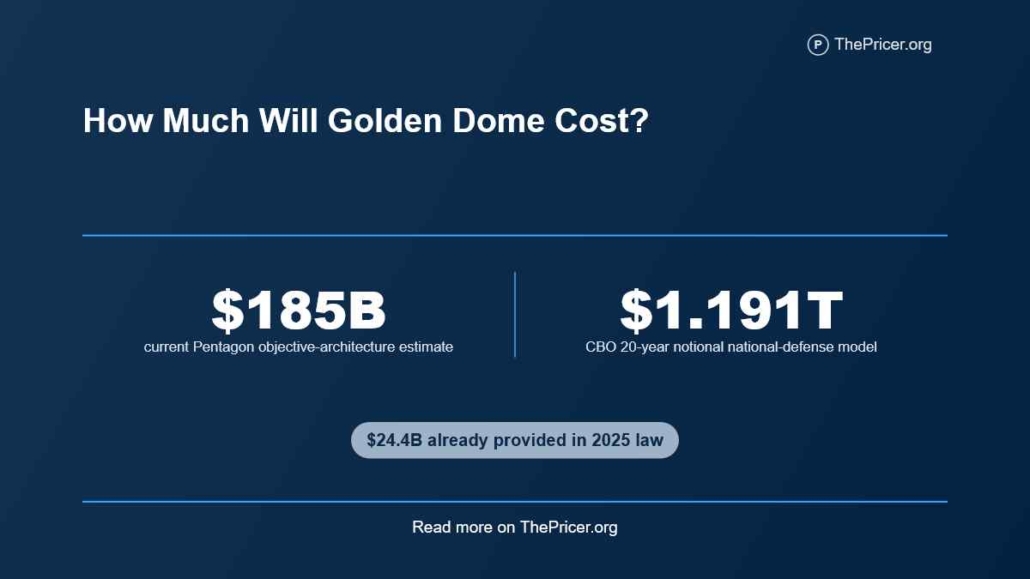
The U.S. military’s current estimate puts Golden Dome at about $185 billion to deploy its planned objective architecture through 2035. That is already $10 billion above President Donald Trump’s original $175 billion estimate. A much broader Congressional Budget Office model reaches about $1.191 trillion over 20 years, but CBO stresses that it is pricing a notional national missile-defense system based on the goals of the executive order, not the Pentagon’s still-undisclosed Golden Dome design.
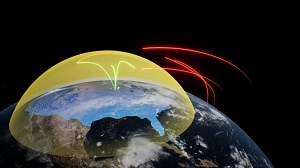
That difference is the central cost issue. Golden Dome is not one missile battery or satellite constellation. It is intended to connect existing and new land, sea and space sensors, interceptor weapons, command networks and space-based defenses into a nationwide shield against ballistic, hypersonic and cruise missiles and other aerial threats.
The eventual price depends heavily on how many threats the system is expected to engage at once, how much of the United States it protects, and how large the space-based interceptor layer becomes.
Article Highlights
Jump to sections
- The Pentagon’s current Golden Dome objective-architecture estimate is about $185 billion (at $30 per hour, earning that amount would take about 3 million years of full-time work, before taxes) through 2035.
- Trump originally announced a $175 billion price in May 2025.
- CBO’s latest notional national missile-defense model costs about $1.191 trillion over 20 years.
- CBO assigns roughly $743 billion of that total to space-based interceptors alone.
- Removing the space-based interceptor layer from CBO’s model still leaves roughly $448 billion in 20-year costs.
- Congress provided $24.4 billion for integrated air and missile defense in the 2025 reconciliation law, while the FY2027 request seeks another $17.5 billion for a Golden Dome fund.
- Some related missile-defense spending sits outside the Golden Dome fund, making the program harder to price from one budget line.
How Much Will Golden Dome Cost?
The best current Pentagon figure is $185 billion (about 3 million years of full-time work at $30 per hour). Golden Dome director Gen. Michael Guetlein said in March 2026 that the estimate had increased from $175 billion after the program was directed to accelerate several space capabilities. The revised Pentagon estimate covers the objective architecture expected to extend through 2035.
The number is not a lifetime ownership cost. It also should not be presented as a final audited program estimate while major architecture details remain classified. Trump originally described a $175 billion completed system and said an initial $25 billion would help start construction. The public schedule and accounting basis later changed as the Pentagon developed the program.
| Golden Dome cost view | Amount | Scope |
|---|---|---|
| Original presidential estimate | $175 billion | Initial 2025 estimate for the completed system |
| Current Pentagon estimate | $185 billion | Objective architecture through 2035 |
| CBO notional system | $1.191 trillion | Development, deployment and operation over 20 years |
| CBO model without space interceptors | $448 billion | 20-year model after removing its most expensive interceptor layer |
| Expanded CBO space-interceptor case | About $3 trillion | Space-interceptor constellation alone if capacity increased about fivefold |
The $1.191 trillion CBO figure is about 6.4 times the Pentagon’s $185 billion figure. That ratio is striking, but it is not proof that the Pentagon underestimated the same design by 6.4 times. The two estimates cover different architectures and different periods.
What Golden Dome Buys
Golden Dome is a system of systems rather than a single weapon. The Pentagon created a dedicated program office under Gen. Guetlein to integrate capabilities across the services and defense agencies. The program office’s stated mission covers defenses against ballistic missiles, hypersonic weapons, advanced cruise missiles and other next-generation aerial attacks.
A layered architecture can use satellites to detect launches and track maneuvering weapons, ground and sea radars to refine tracks, command systems to decide which weapon should engage, and several interceptor types to attack threats at different stages of flight. Existing systems such as Patriot and THAAD can form part of that network while new space sensors and interceptors fill gaps that today’s architecture cannot cover.
This is why Golden Dome should not be compared directly with Israel’s Iron Dome cost. Iron Dome is primarily a regional short-range rocket defense. Golden Dome’s stated mission stretches across the continental United States and includes intercontinental ballistic, hypersonic and cruise missile threats.
The architecture also needs communications, software, testing ranges, launch services, bases, trained crews, spare interceptors, satellite replenishment and years of maintenance. Those support layers make the eventual taxpayer cost larger than the price of visible launchers and satellites.
Why CBO Gets $1.191 Trillion
CBO’s September 2026 testimony provides the most detailed independent public cost stack. Because the Pentagon has not released the quantities in its objective architecture, CBO constructed a notional system broadly consistent with the capabilities requested in the 2025 executive order. CBO’s modeled architecture totals $1.191 trillion (about 19.1 million years of full-time work at $30 per hour) in 2026 dollars over 20 years.
The model contains four interceptor layers plus tracking satellites, self-defense and continuing research. Its cost components include about $743 billion for the space-based interceptor constellation, $187 billion for regional sectors, $90 billion for the tracking-satellite constellation, $46 billion for upper wide-area surface defenses, $29 billion for lower wide-area defenses, $92 billion for continuing research and integration, and about $4 billion to defend existing national missile-defense sites.
The arithmetic reveals how concentrated the bill is. Space-based interceptors alone make up about 62.4% of CBO’s entire 20-year total. Add the tracking constellation and space accounts for about $833 billion, or roughly 70% of the model.
The average spending rate also differs sharply. Spreading the Pentagon’s $185 billion deployment figure across ten years gives about $18.5 billion per year. CBO’s $1.191 trillion across 20 years averages about $59.6 billion per year. Neither program would spend money evenly each year, but the calculation shows the scale difference between the two cost concepts.
Space Is the Biggest Cost Driver
CBO’s modeled space-based interceptor layer uses 7,800 satellites in low-Earth orbit to provide enough geometry to engage a raid of 10 nearly simultaneous intercontinental ballistic missiles. Each engagement assumes two interceptor shots. CBO puts average interceptor-satellite cost at about $22 million, with large numbers of replacement spacecraft required because it assumes a five-year orbital service life.
The recurring replacement cycle is a major hidden cost. Unlike a ground interceptor that can remain stored until needed, a low-Earth-orbit constellation has to be replenished as satellites age out. CBO’s model calls for nearly 1,600 replacement space-based interceptors per year after the constellation is established.
Earlier CBO work showed how sensitive the answer is to architecture. Its 2025 space-interceptor analysis estimated 20-year constellation costs ranging from about $161 billion to $542 billion after allowing for much lower modern launch prices. Those scenarios were narrower than the national architecture CBO modeled in 2026.
Capability drives cost faster than simple missile count. CBO says multiplying space-interceptor capacity roughly fivefold in its current model could push the constellation alone toward $3 trillion over 20 years. Cutting the constellation to roughly one-fifth of its modeled size would reduce the cost by only about one-third. A smaller defense is cheaper, but costs do not fall in direct proportion to the number of threats it can handle.
The Hidden Bill Outside the Fund
Congressional budget lines create another pricing trap. The 2025 reconciliation law provided $24.4 billion for integrated air and missile defense associated with Golden Dome. The Defense Department had discussed the initial investment as approximately $25 billion.
The FY2027 budget request then sought another $17.5 billion for a Golden Dome for America Fund. If Congress approved that full amount, the two headline tranches would total about $41.9 billion. That equals roughly 22.6% of the Pentagon’s current $185 billion objective-architecture estimate.
Yet watching that fund alone will not capture every missile-defense dollar that could support the architecture. A Congressional Research Service review says the FY2027 Army request also contains $11.4 billion for THAAD and $12.2 billion for PAC-3 MSE. Those weapons can be allocated to homeland or theater missions, so those requests should not automatically be added to the Golden Dome total.
The distinction matters. The dedicated fund shows money labeled directly for Golden Dome. Existing missile-warning satellites, Patriot, THAAD interceptors, radars and other systems can sit in service budgets while still contributing to the broader homeland-defense network.
Contracts Already Show the Scale
 Golden Dome has moved beyond slide decks. In July 2026, the Space Development Agency awarded two agreements worth about $1.75 billion for 36 satellites supporting missile warning, tracking and defense. L3Harris received a potential $955 million for 18 vehicles, while Sierra Space received about $798 million for 18.
Dividing $1.75 billion by 36 gives about $48.6 million per contracted satellite-equivalent. That is not a bare satellite sticker price. The agreements cover delivery obligations and program work, so the quotient is useful only as a contract-scale indicator.
Space-based interceptors are another large development line. Space Systems Command disclosed 20 development agreements worth up to $3.2 billion across companies working on interceptor concepts. Those prototype agreements do not buy an operational 7,800-satellite constellation.
The gap between prototype funding and fleet deployment is where the largest future bills can appear. Sensor satellites measured in dozens can cost billions. A working interceptor layer could require thousands of orbital vehicles plus launch and replenishment. Ground defenses add missile inventories that are expensive on their own. Current Patriot system costs show how interceptor stocks can rival or exceed the cost of launchers, radar and fire-control equipment.
The Reagan Cost Parallel
Golden Dome has frequently been compared with President Ronald Reagan’s Strategic Defense Initiative. The comparison is useful mainly as a warning about the difference between research spending and the cost of deploying a nationwide system.
GAO reported that the Strategic Defense Initiative Organization had received $20.9 billion through fiscal year 1991 for ballistic missile-defense research and development. About $6.3 billion went to sensors, $4.9 billion to directed-energy weapons, $4.8 billion to kinetic weapons, $2.7 billion to systems analysis and battle management, with the balance going to other technologies.
Planning estimates for a deployable SDI architecture moved substantially as the design changed. In 1989, GAO documented a Phase I estimate that had fallen from as much as $145.7 billion to $69.1 billion. GAO attributed much of the reduction to fewer planned sensors and weapons, technical changes and revised cost assumptions.
That history does not establish what Golden Dome will cost. It shows how missile-defense estimates can move when designers change coverage, quantities and technology. Golden Dome has already demonstrated the same basic sensitivity. Its public estimate rose from $175 billion to $185 billion when additional space capabilities were accelerated.
What Could Move the Final Cost?
The biggest variable is defensive capacity. A system sized to defeat a small North Korean-style raid requires fewer interceptors than one intended to absorb a large attack from a peer nuclear power. CBO says its $1.191 trillion model could fully engage a regional attack or a small-scale peer attack, but it could still be overwhelmed by a full-scale attack from a peer adversary.
Coverage matters too. Defending selected command centers, missile fields and critical infrastructure is cheaper than providing a layered defense for the entire country. Removing CBO’s space-based interceptor layer cuts its 20-year total from $1.191 trillion to about $448 billion. Even that reduced model is about 2.4 times the Pentagon’s $185 billion deployment figure.
Technology can move costs in both directions. Lower launch prices make large constellations cheaper than earlier studies predicted. Better sensors, reusable launch systems, lower-cost interceptors, directed-energy weapons and automation could reduce some costs. Failed tests, redesigns, higher threat requirements, replacement launches and increased interceptor inventories can push the other way.
There is also a cost-per-shot problem. A national shield must be able to afford not just installation but repeated engagements. A defense that uses multiple expensive interceptors against every incoming weapon can consume inventories rapidly. That economic pressure is one reason directed-energy systems such as Iron Beam attract interest for cheaper threats, though lasers cannot replace every Golden Dome layer.
Answers to Common Questions
How much is Golden Dome expected to cost?
The Pentagon currently says about $185 billion to deploy its objective architecture through 2035. A broader CBO model costs about $1.191 trillion over 20 years.
Why does CBO’s number exceed the Pentagon estimate?
CBO modeled a different and more fully specified national missile-defense architecture because the Pentagon has not released enough detail for CBO to price the actual Golden Dome design. CBO’s estimate also covers 20 years of development, deployment and operation.
How much money has Congress provided for Golden Dome?
The 2025 reconciliation law provided $24.4 billion for integrated air and missile defense associated with Golden Dome. The administration is seeking another $17.5 billion for the dedicated Golden Dome fund in FY2027.
What is the most expensive part of Golden Dome?
In CBO’s notional architecture, space-based interceptors dominate the bill at about $743 billion over 20 years, roughly 62% of the modeled total.
Will Golden Dome cost $1 trillion?
That is not yet knowable for the Pentagon’s actual plan. CBO shows that a national system with capabilities broadly matching the executive order can reach about $1.2 trillion, while the Pentagon says the architecture it intends to build is different and currently estimates $185 billion.
Disclosure: Educational content, not financial advice. Prices reflect public information as of the dates cited and can change. Confirm current rates, fees, taxes, and terms with official sources before purchasing. See our methodology and corrections policy.