
How Much Will Roundup Settlement Payouts Be?
Published on | Written by Alec Pow
This article was researched using 18 sources. See our methodology and corrections policy.
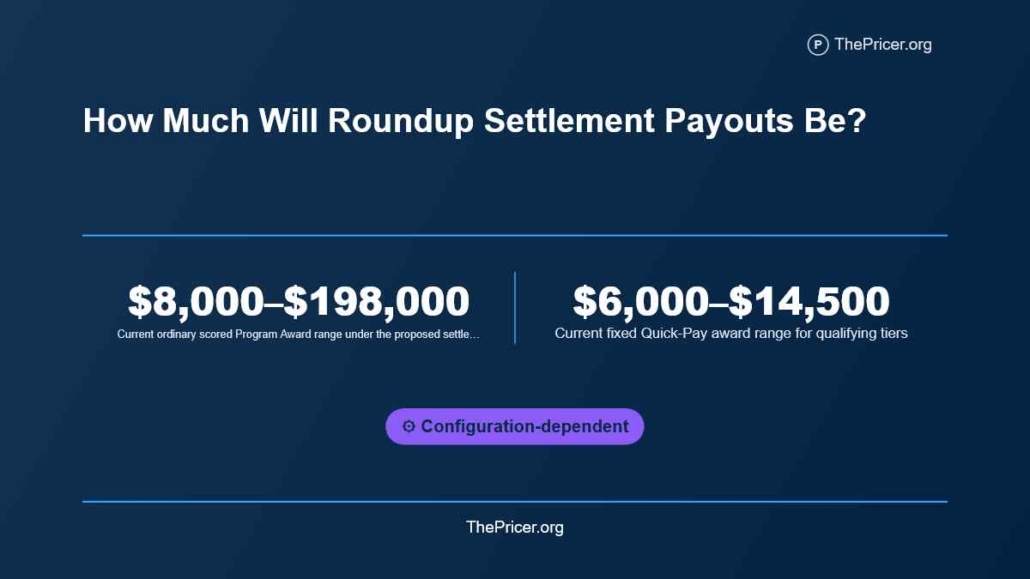
Roundup settlement payouts under Bayer and Monsanto’s proposed $7.25 billion class agreement can range from a $150 limited-proof award to ordinary scored Program Awards of about $8,000-$198,000 under the current base schedule.
Published tier averages run from $10,000 to $165,000, while certain fixed Quick-Pay awards run from $6,000 to $14,500. Extra compensation may be available in defined severe or heavy-exposure cases, so $198,000 is not a universal maximum.
The deal covers Roundup-related non-Hodgkin lymphoma claims and remains proposed rather than final. Bayer faces about 65,000 U.S. claims, and Judge Timothy Boyer is scheduled to review final approval at a September 14 fairness hearing. A ruling is not expected automatically at the hearing.
ThePricer calculations expose three money points that a simple settlement range misses. The ordinary grid reaches about $198,000 after the 120% scoring adjustment, Quick-Pay amounts sit about 25% to 55% below even the low end of the matching ordinary base bands, and dividing $7.25 billion by roughly 65,000 current claims creates a misleading $111,538 figure because the fund also covers future claims and program expenses.
Article Highlights
Jump to sections
- Current base tier averages run from $10,000 to $165,000 (at $30 per hour, earning that amount would take about 0.2 to 2.6 years of full-time work, before taxes).
- Applying the 80%-120% scoring rule produces ordinary base award bands of about $8,000-$198,000.
- Quick-Pay awards for qualifying Tiers 5-9 are fixed at $6,000-$14,500.
- A claimant who proves exposure but not the minimum exposure period can receive a $150 limited-proof award.
- The proposed settlement fund is worth up to $7.25 billion and is designed to pay current and future claims over many years.
- Medical liens and some private attorney fees can reduce the amount that reaches a claimant.
How Much Will Roundup Settlement Payouts Be?
The proposed compensation program uses nine tiers tied to exposure category, age at diagnosis and whether the qualifying non-Hodgkin lymphoma is aggressive or indolent. The court-authorized settlement notice lists the average Program Awards, the fixed Quick-Pay amounts and the 80%-120% scoring rule. It also provides a $150 (about 5 hours of work at $30 per hour) limited-proof award when some covered exposure is proved but the minimum exposure period is not. The scored bands below are ThePricer calculations using the published base averages.
| Tier | Claim profile | Average Program Award | Base scored band | Quick Pay |
|---|---|---|---|---|
| 1 | Occupational, under 60, aggressive NHL | $165,000 | $132,000-$198,000 | Not available |
| 2 | Occupational, age 60-77, aggressive NHL | $105,000 | $84,000-$126,000 | Not available |
| 3 | Occupational, under 60, indolent NHL | $85,000 | $68,000-$102,000 | Not available |
| 4 | Occupational, age 60-77, indolent NHL | $60,000 | $48,000-$72,000 | Not available |
| 5 | Residential, under 60, aggressive NHL | $40,000 | $32,000-$48,000 | $14,500 |
| 6 | Residential, age 60-77, aggressive NHL | $30,000 | $24,000-$36,000 | $11,000 |
| 7 | Residential, under 60, indolent NHL | $25,000 | $20,000-$30,000 | $10,500 |
| 8 | Residential, age 60-77, indolent NHL | $20,000 | $16,000-$24,000 | $7,700 |
| 9 | Any exposure, age 78 or older | $10,000 | $8,000-$12,000 | $6,000 |
The table explains why the often-repeated $10,000-$165,000 range is incomplete. Those numbers are tier averages, not the lowest and highest possible ordinary scored awards. Using the published base values, the standard bands extend to about $8,000 at the low end and $198,000 at the high end. Later inflation adjustments and approved special compensation can change the amount, so these figures are not lifetime guarantees.
What Sets Your Tier?
The program first separates occupational and residential claimants, then uses age at diagnosis and NHL subtype. The published occupational criteria define occupational status more narrowly than simply having used Roundup while working. The claimant needs more than 80 hours of occupational exposure and, in at least one year, must have earned either more than half of total income or more than $15,000 from the qualifying job. Documentary proof is required.
That classification moves the money sharply. A claimant under 60 with aggressive NHL has a Tier 1 average of $165,000 with qualifying occupational exposure, compared with a Tier 5 residential average of $40,000. The occupational average is 4.125 times the residential average for that matched age and NHL category. For an under-60 claimant with indolent NHL, Tier 3 averages $85,000 and Tier 7 averages $25,000, a 3.4-to-1 difference.
Age also changes the tier before scoring begins. Occupational claimants with aggressive NHL move from a $165,000 average below age 60 to $105,000 from age 60 through 77. All qualifying claimants diagnosed at 78 or older enter Tier 9, which has a $10,000 base average regardless of occupational or residential classification. These rules explain why one generic Roundup payout figure is not useful for an individual claim.
Why Awards Vary Within a Tier
Tier assignment is only the first step. Claim scoring can move an ordinary Program Award to 80% or 120% of its tier average. The scoring materials consider treatment intensity, evidence supporting exposure, exposure duration and frequency, age, disease stage, certain medical-history issues, timing between exposure and diagnosis and some preexisting litigation facts. Treatment can include chemotherapy, radiation or more intensive interventions. Readers comparing the medical side of a claim can separately review typical chemotherapy costs, though treatment cost itself is not the settlement formula.
Take Tier 3. Its published average is $85,000. Applying the program’s 80%-120% rule gives about $68,000 at the bottom of the base scoring band and $102,000 at the top. The difference inside one tier is $34,000. A table value of $85,000 cannot be read as a promised check, because two claimants in the same tier can land on opposite sides of that average.
Quick Pay Trades Money for Speed
Quick Pay is available only to qualifying Tiers 5-9 claimants who filed a lawsuit or signed a tolling agreement before February 13, 2026. A review of Quick-Pay eligibility confirms that these awards are fixed and expedited. Accepting Quick Pay prevents the claimant from receiving another award under this settlement program.
The fixed amounts are materially below the ordinary base scoring bands. Tier 5 Quick Pay is $14,500, compared with a standard base band of $32,000-$48,000. That is $17,500 below even the low end of the standard band. Tier 9 Quick Pay is $6,000, compared with a base band of $8,000-$12,000, a $2,000 gap from the low end.
Across Tiers 5-9, the fixed Quick-Pay amount is about 25% to 55% below the bottom of the corresponding ordinary base scoring band. That does not make one route legally or financially better for every claimant. Quick Pay exchanges scoring uncertainty and a longer claims path for a fixed amount and faster processing. The size of that exchange is the part a claimant can quantify from the published schedule.
Who Can Seek a Settlement Award?
The class is broader than people who already have a diagnosis, but receiving compensation is narrower than merely having used Roundup. The administrator’s current class-membership rules cover qualifying U.S. exposure before February 17, 2026 and divide members into people already diagnosed with NHL and people who may receive a qualifying diagnosis later. Compensation still requires the applicable diagnosis, proof and filing rules.
Fits the compensation path if
- The class-member and exposure requirements are satisfied.
- A qualifying NHL diagnosis and required medical proof are supplied.
- The applicable registration and claim-package deadlines are met.
Does not support a standard tiered award if
- The person has Roundup exposure but no qualifying NHL diagnosis during the claims period.
- The claimed disease falls outside the settlement’s covered NHL definitions.
- The claimant cannot meet the program’s required proof and filing conditions.
This is also why “anyone who used Roundup gets a settlement” is inaccurate. The agreement creates legal rights for a wider exposed class, including some people who could be diagnosed later, but cash compensation depends on the claims rules. Individual eligibility can turn on facts that a broad payout chart cannot resolve.
A diagnosis before 2020 creates another restriction. Under the settlement’s filing rules, a person diagnosed before 2020 who had not filed suit or entered a tolling agreement before February 13, 2026 usually cannot receive a full award unless the person can show that the applicable state deadline to sue had not expired. That claimant can remain in the class yet receive no payment if the state-law timing exception cannot be proved.
The nine-tier grid also does not control every Roundup lawsuit. The Missouri class settlement is separate from federal MDL No. 2741 in the Northern District of California, where the September 1, 2026 report still listed 3,925 pending actions. A Roundup claim that remains on that federal track is not automatically valued by this class schedule, so the claimant’s legal track must be identified before using the tier table as a payout estimate.
Special Funds Raise Some Awards
The highest ordinary current-base Program Award is about $198,000 after applying the 120% scoring ceiling to Tier 1’s $165,000 average. That is not an absolute settlement maximum. The program also creates an Extraordinary Circumstances Fund and an Extraordinary Residential Exposure Fund. A review of the special-fund rules describes separate annual pools for severe cases and unusually heavy residential exposure.
The severe-case fund can address circumstances such as death before age 78, organ transplant and certain intensive treatments. The residential fund is aimed at qualifying home exposure above 80 hours on properties totaling more than six acres. Those pools are limited portions of annual settlement funding rather than flat add-ons to every claim, and the agreement does not publish one universal individual maximum. A claimant who qualifies for extra compensation can exceed the standard grid, but no responsible payout forecast can simply add an invented surcharge to $198,000.
Fees and Liens
A gross Program Award is not always the amount that reaches the claimant. The administrator’s medical-lien and fee rules say NHL-related reimbursement claims can apply when government programs or participating private insurers paid for care. The same rules cap fees at 22% of an Award Payment for private counsel retained after February 13, 2026. Earlier signed retention agreements are not governed by that particular cap.
Separately, the six class-counsel firms requested $675 million from the settlement fund, equal to about 9.3% of the proposed $7.25 billion fund, according to reporting on the fee petition. That fund-level request should not be subtracted again from an individual’s award as though it were that person’s private lawyer bill.
A worked scenario shows the gap between gross and net. Start with an illustrative $100,000 Program Award. Assume a private lawyer retained after February 13 charges the maximum 22%, or $22,000. Then assume, only for this scenario, a resolved NHL-related medical lien of $5,000. The amount left would be $73,000. The lien figure is an assumption, not an average, and an earlier attorney contract can use different terms.
Taxes are another possible difference between gross and usable proceeds. IRS settlement-tax guidance says damages received on account of personal physical injury or physical sickness are often excluded from federal gross income, subject to rules such as prior deductions for related medical expenses. Punitive damages and settlement interest are taxable. The tax result can depend on what the payment legally represents, so a Roundup award should not be described as automatically tax-free.
Legal expenses outside a settlement can also differ sharply from this program’s structured deductions. Someone comparing a class award with separate litigation should distinguish a published compensation schedule from the broader cost of suing someone, where filing, discovery, experts and attorney arrangements can create a different financial picture.
$7.25 Billion Is Not $111,538 Each
 Dividing the settlement headline by today’s lawsuit count produces a tempting number. Using the approximately 65,000 U.S. Roundup claims cited above, $7.25 billion divided by 65,000 gives about $111,538. That arithmetic is correct, but treating the quotient as an expected claimant payment is wrong.
The denominator and numerator do not describe the same thing. The 65,000 figure is an approximate count of current U.S. claims. The fund is designed to cover current and future eligible claimants over 17 to 21 years, along with administration, taxes, approved attorneys’ fees, special awards and other program expenses. Future claim counts are unknown. Some current cases may also fall outside the class or follow different settlement paths.
The tier system gives a better way to estimate a claimant’s gross program payment than dividing one fund total by today’s lawsuit count. A Tier 6 claimant, under the current base schedule, starts with a $30,000 tier average and a scored band of $24,000-$36,000. The $111,538 quotient does not override that formula. It describes only a division of two headline numbers with incompatible scopes.
When Could Checks Be Paid?
The settlement is not final. The official case schedule lists a fairness hearing for September 14, 2026 at 9:30 a.m. Central Time in St. Louis. Judge Timothy Boyer will consider whether the settlement is fair, reasonable and adequate. A same-day final ruling is not promised, and court approval can still be followed by appeals before the settlement reaches its Effective Date. The June 4, 2026 deadline to opt out has already passed for ordinary class members.
If final approval is granted, already-diagnosed class members get 180 days to register and then 180 days after the settlement becomes final to submit a Claim Package. People diagnosed after March 4, 2026 can file within six years of diagnosis and before the 16th Annual Payment Date. Bayer’s 2026 legal-risk disclosure confirms that appeals can delay finality, so no universal payment date exists.
Limited faster paths exist. Quick-Pay and qualifying exigency awards have rules that permit payment before the entire settlement becomes fully final. Those exceptions do not create a general payment date for ordinary Program Awards. Claimants should use the administrator’s dated notices rather than an estimated month from advertising or social posts.
Jury Verdicts
Past Roundup trials produced numbers far above the settlement table. Reuters reported a $2.1 billion Georgia jury award in 2025 and a $332 million California verdict in 2023 in its analysis of opting out. Those verdicts do not establish what a claimant will receive under this class program. Trial awards can include legal theories, damages and appellate risks that are absent from a fixed settlement schedule.
The legal environment also changed in June 2026. In Monsanto v. Durnell, the U.S. Supreme Court held that federal pesticide law preempted Durnell’s state-law failure-to-warn claim because it would have required a cancer warning beyond the EPA-approved label. That ruling affects an important theory used in Roundup litigation, which helps explain why older jury results are an especially weak shortcut for estimating today’s class award.
- Checked the occupational and residential proof thresholds against a September 2026 litigation update from one of the firms serving as class counsel.
- Confirmed the current court filings and approval materials through the settlement administrator’s program documents repository.
- Cross-referenced the latest procedural posture with Reuters’ August appellate-court report, which confirms the case remained in Missouri state court ahead of the September hearing.
Answers to Common Questions
What is the average Roundup settlement payout?
There is no single published average for all claimants. The nine current base tier averages range from $10,000 to $165,000, and ordinary scored awards can move to 80%-120% of the applicable tier average.
What is the highest Roundup settlement payout?
Under the current base tier schedule, the highest ordinary scored Program Award is about $198,000. Defined special funds can add compensation in qualifying cases, so the agreement does not support treating $198,000 as an absolute maximum.
How much is the Roundup Quick-Pay settlement?
Qualifying Quick-Pay awards range from $6,000 to $14,500 for Tiers 5-9. They are fixed rather than scored and are available only under the program’s Quick-Pay eligibility rules.
When will Roundup settlement checks be paid?
There is no universal payment date. Final approval, possible appeals, registration and claim processing affect ordinary Program Awards, while some Quick-Pay and exigency awards can follow faster rules.
Are Roundup settlement payouts taxable?
Some damages tied to personal physical injury or physical sickness can be excluded from federal taxable income, while punitive damages and interest are taxable. The result depends on how the payment is characterized and the claimant’s tax history, so a Roundup award should not be assumed to be entirely tax-free.
Disclosure: Educational content, not financial advice. Prices reflect public information as of the dates cited and can change. Confirm current rates, fees, taxes, and terms with official sources before purchasing. See our methodology and corrections policy.