
How Much Will the Alaska LNG Pipeline Cost?
Published on | Written by Alec Pow
This article was researched using 10 sources. See our methodology and corrections policy.
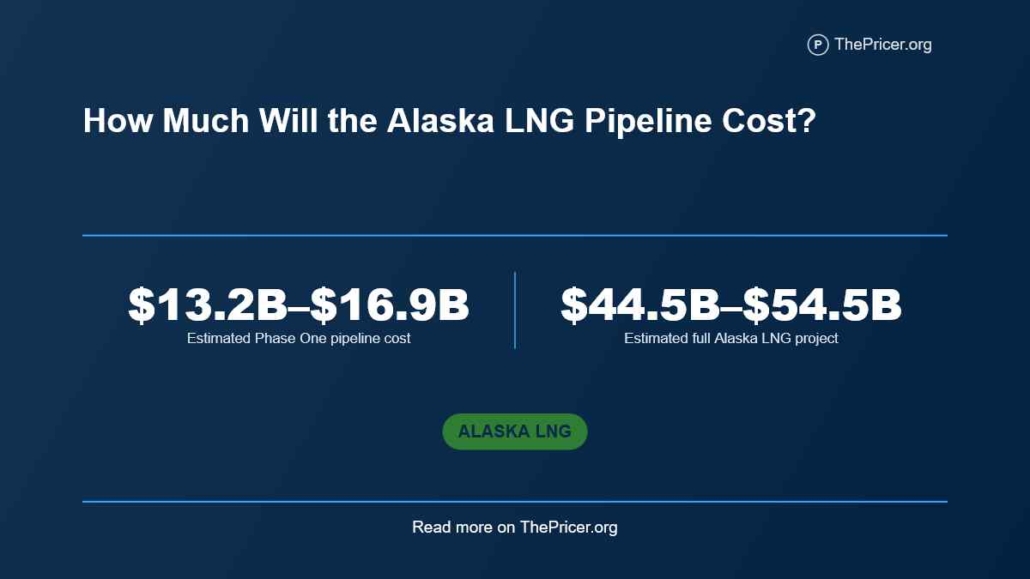
The Alaska LNG pipeline is currently estimated to cost about $13.2 billion to $16.9 billion for Phase One, according to project developer Glenfarne’s latest public 2026 estimate. The complete Alaska LNG project, including the North Slope gas treatment plant and a giant liquefied natural gas export terminal at Nikiski, is estimated at $44.5 billion to $54.5 billion.
That distinction is important. The frequently quoted “$50 billion Alaska pipeline” is not really a $50 billion pipeline. The pipeline itself accounts for roughly one-quarter to one-third of the total project. Most of the remaining money would be spent turning North Slope natural gas into exportable LNG through processing, compression, liquefaction, storage and marine facilities.
The project is also moving again. Alaska LNG has secured long-term North Slope gas supply commitments, Asian buyers have signed preliminary LNG agreements, and South Korean investment has emerged as a possible financing source. But a final investment decision has not yet converted the estimate into a fixed construction price, so the eventual bill could still move substantially.
Article Highlights
Jump to sections
- Pipeline cost: Glenfarne estimates Phase One at approximately $13.2 billion to $16.9 billion (at $30 per hour, earning that amount would take about 212 to 271 thousand years of full-time work, before taxes).
- Full Alaska LNG project: approximately $44.5 billion to $54.5 billion in current developer estimates.
- LNG terminal: estimated at approximately $23.6 billion to $28.4 billion.
- North Slope gas treatment plant: approximately $7.7 billion to $9.2 billion.
- Pipeline length: Phase One is about 739 miles of 42-inch pipeline from the North Slope toward Southcentral Alaska.
- Calculated pipeline cost per mile: roughly $17.9 million to $22.9 million per mile.
- Export capacity: the full project is designed around approximately 20 million metric tons of LNG annually.
- Biggest uncertainty: the LNG plant and gas treatment plant estimates remain less precise than the pipeline estimate.
How Much Will the Alaska LNG Pipeline Cost?
The strongest current estimate for the Alaska LNG pipeline itself is $13.2 billion to $16.9 billion (about 212 to 271 thousand years of full-time work at $30 per hour).
Glenfarne disclosed that range publicly in June 2026 while presenting updated Alaska LNG numbers to state lawmakers. Alaska Public Media reported that the developer put total Alaska LNG capital costs between $44.5 billion and $54.5 billion, with Phase One accounting for $13.2 billion to $16.9 billion.
| Alaska LNG component | 2026 estimated cost |
|---|---|
| Phase One pipeline | $13.2B-$16.9B |
| Nikiski LNG facility | $23.6B-$28.4B |
| North Slope gas treatment plant | $7.7B-$9.2B |
| Full Alaska LNG project | $44.5B-$54.5B |
Those figures were also summarized by Japan’s JOGMEC, which noted that the pipeline estimate had reached a considerably more advanced level of cost definition than the LNG and gas-treatment portions of the project.
That means the most defensible answer today is not “Alaska LNG costs $54 billion.” The answer is: the gas pipeline is expected to cost $13.2 billion to $16.9 billion, while the integrated export project could reach $44.5 billion to $54.5 billion.
Cost Per Mile
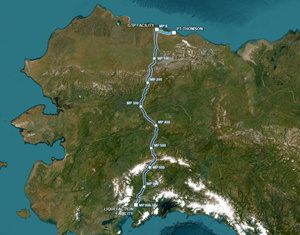
Phase One involves approximately 739 miles of 42-inch pipeline carrying North Slope natural gas south toward Alaska population centers.
The project developer confirmed the 739-mile Phase One configuration when it announced a long-term gas supply agreement with ConocoPhillips in May 2026. Glenfarne describes Phase One as a 739-mile pipeline built to deliver North Slope gas to Alaska consumers.
That gives us a useful derived cost:
$13.2 billion (about 212 thousand years of full-time work at $30 per hour) ÷ 739 miles = approximately $17.9 million per mile.
At the high end:
$16.9 billion ÷ 739 miles = approximately $22.9 million per mile.
So the pipeline currently works out to roughly $18 million to $23 million for every mile of route.
This is not comparable to laying an ordinary natural-gas distribution line. Alaska LNG crosses an Arctic and sub-Arctic environment, major rivers, mountainous terrain, permafrost zones and remote areas where roads, camps and logistics may have to be created specifically for construction.
For perspective, even the economics of an existing oil route can become enormous when flows are disrupted. Our analysis of Saudi Arabia’s East-West Pipeline shutdown shows how the value attached to major energy pipelines often extends far beyond their physical construction cost.
Why the Full Project Costs $54 Billion
The pipe itself is not even the most expensive component.
At the midpoint of Glenfarne’s current estimates:
Pipeline midpoint: $15.05 billion
LNG terminal midpoint: $26.0 billion
Gas treatment plant midpoint: $8.45 billion
That totals about $49.5 billion.
The Nikiski liquefaction complex alone therefore represents more capital than the entire 739-mile Phase One pipeline.
The LNG plant must cool natural gas to approximately -260°F so it becomes liquid, dramatically reducing its volume for marine transport. The facility also requires liquefaction trains, power generation, storage tanks, loading systems and a marine terminal capable of handling LNG carriers.
Before the gas reaches the pipeline, the North Slope treatment plant must remove carbon dioxide and other components from raw produced gas.
The federal environmental review describes Alaska LNG as an integrated system involving a gas treatment plant, more than 800 miles of pipeline, liquefaction and storage facilities and an LNG marine terminal.
Phase One Comes First
Glenfarne has broken Alaska LNG into two financially independent stages rather than attempting to finance the entire $45 billion-plus megaproject at once.
Phase One focuses primarily on moving North Slope natural gas south for Alaska consumers.
Phase Two adds the major export infrastructure, including the LNG terminal, additional compression, pipeline extension and North Slope gas-treatment facilities required for full export operations.
A Department of Energy project update explains that Phase One consists of the 739-mile, 42-inch pipeline, potentially including the Point Thomson lateral, while Phase Two adds the LNG plant and other infrastructure needed for exports.
This strategy makes the first financing decision much smaller:
$13.2B-$16.9B instead of $44.5B-$54.5B.
Even at the high end, financing the pipeline alone would require roughly 69% less capital upfront than funding the $54.5 billion high-end estimate for the entire project.
What Changed From $44 Billion?
 Earlier 2026 reporting frequently described Alaska LNG as a $44 billion project.
In March, Reuters reported that Glenfarne was seeking final investment decisions on the pipeline in 2026 and the export terminal in 2027, with LNG exports targeted for 2031. At that point the project was still commonly described as costing about $44 billion.
The June disclosure refined that headline number into a range topping out at $54.5 billion.
The difference between $44 billion and $54.5 billion is $10.5 billion.
That increase alone is equivalent to approximately 62% to 80% of the entire current Phase One pipeline estimate.
However, it would be inaccurate to say the project simply “went $10.5 billion over budget.” Construction has not yet reached that stage. The numbers are evolving pre-construction estimates with different engineering maturity, timing and assumptions.
The Old $65 Billion Estimate
Interestingly, Alaska LNG has carried even larger price estimates before.
The original project partners estimated roughly $45 billion to more than $65 billion in 2012 dollars during earlier development work.
A Department of Energy filing from the original export application describes an estimated $45 billion to $65 billion construction cost for the liquefaction plant, long-distance pipeline, gas treatment facilities and supporting infrastructure.
The fact that today’s $44.5 billion to $54.5 billion estimate is nominally below the old upper bound does not mean the project has become cheaper after inflation. Design changes, ownership, construction strategy, phasing and engineering assumptions have changed enough that the two ranges should not be treated as identical projects.
The $54 Billion Korea Angle
Financing has become one of the most important parts of the cost story.
Reuters reported on September 29, 2026 that the Trump administration was considering using roughly $54 billion from South Korea’s strategic U.S. investment package for Alaska LNG and other major American projects.
The number is striking because it is almost identical to the $54.5 billion upper end of Glenfarne’s current Alaska LNG construction estimate.
But the two should not be treated as if South Korea has simply agreed to write a $54 billion check for Alaska LNG. Reuters reported that the proposed investment structure still involves negotiations, and Alaska LNG still needs additional binding commercial commitments to support full financing.
The latest development therefore improves the financing picture without converting the entire project cost into committed capital.
Gas Supply Is Advancing
One major Phase One risk has been reduced.
In May 2026, Glenfarne and ConocoPhillips reached a 30-year gas supply agreement covering North Slope production. Reuters reported that this, alongside other supply agreements, provided sufficient gas volumes to support a Phase One final investment decision.
The project has agreements involving major North Slope producers including ConocoPhillips, ExxonMobil, Hilcorp and Great Bear Pantheon.
That matters financially because a multibillion-dollar pipeline without contracted supply is extremely difficult to finance. Securing gas does not eliminate construction risk, but it removes one major uncertainty from the revenue model.
Export Math
The complete Alaska LNG project is designed for about 20 million metric tons of LNG production per year.
Using Glenfarne’s $44.5 billion to $54.5 billion total estimate gives us another useful cost metric.
$44.5 billion ÷ 20 million tonnes = $2,225 of construction capital per annual tonne of LNG capacity.
At the high end:
$54.5 billion ÷ 20 million tonnes = $2,725 per annual tonne.
So Alaska LNG currently implies roughly $2,225 to $2,725 of project capital for each tonne of annual LNG production capacity.
This calculation is useful for comparison with competing LNG projects because it normalizes enormous construction totals against export capacity.
How Much Gas Can It Move?
The original integrated system was designed to transport up to roughly 3.3 billion cubic feet of natural gas per day.
At 3.3 Bcf per day, annual throughput would theoretically reach:
3.3 Bcf × 365 = about 1.20 trillion cubic feet per year.
Using the midpoint $15.05 billion pipeline construction estimate and dividing it by 3.3 billion cubic feet of daily capacity gives approximately:
$4.56 of construction capital per cubic foot of daily capacity.
That is an infrastructure ratio, not a transportation tariff. Customers would ultimately pay rates built around financing, operating costs, taxes, maintenance, contracted volumes and required investor returns.
Tax Costs Matter
Property taxation has become another major variable in whether the pipeline can attract financing.
Alaska’s existing structure imposes a 20-mill tax, equivalent to about 2% of assessed oil and gas property value. The governor proposed replacing that treatment for Alaska LNG with a tax based more heavily on actual gas throughput. The state described the proposal as an attempt to reduce the large front-loaded tax burden during construction and early operation.
A simple illustration shows why developers care.
Two percent of a hypothetical $15 billion assessed pipeline value equals:
$15 billion × 2% = $300 million per year.
The actual taxable value, municipal treatment and final legislation could differ considerably, so this is not a forecast of Alaska LNG’s tax bill. It shows why property-tax structure can materially change financing on a project this large.
The Alaska Department of Revenue also warned that the fiscal consequences of changing the system could vary by hundreds of millions of dollars or more per year, depending on whether the project proceeds and how the final tax structure operates.
The Hidden Cost
The biggest hidden cost may be financing rather than steel.
A $50 billion construction estimate does not mean investors need only $50 billion over the project’s economic life. Large infrastructure developments usually depend on debt and equity capital deployed over several years. Interest during construction, financing fees, contingency reserves and delays can materially raise the amount that must eventually be recovered.
Consider a deliberately simplified example. If an average $25 billion of capital were outstanding during a five-year construction period at a hypothetical 7% annual financing cost:
$25 billion × 7% × 5 years = $8.75 billion.
That is not an Alaska LNG financing forecast because actual draw schedules, capital structure and interest rates are unknown. It demonstrates why the final economic cost of a $50 billion megaproject can be considerably higher than its engineering-and-construction CAPEX estimate.
Cost overruns create the same effect. A 10% increase on Glenfarne’s $54.5 billion high estimate adds $5.45 billion. A 20% increase adds $10.9 billion, producing a hypothetical total of $65.4 billion.
That is why routing, logistics and construction delays matter so much. Similar economics can be seen in maritime transport: our analysis of rerouting an oil tanker around Africa shows how extra distance and time quickly turn into millions of dollars of additional fuel, operating and capital cost.
Could It Cost More Than $54.5 Billion?
Yes.
The published pipeline estimate has reportedly reached a more developed engineering stage, while the LNG facility and gas-treatment portions remain less precise. JOGMEC reported that Glenfarne described pipeline accuracy around -10% to +15%, while the two major Phase Two facilities still carried approximately 30% estimate accuracy.
That does not mean a 30% overrun will happen. It means there is substantially more uncertainty around billions of dollars of future Phase Two construction.
Alaska also presents unusually difficult construction conditions. Remote work camps, seasonal construction windows, permafrost, environmental restrictions, river crossings, material transport and specialized Arctic labor can all magnify schedule problems.
Commodity prices matter as well. Tens of billions of dollars of infrastructure require enormous quantities of steel, concrete, compressors, turbines, electrical equipment and skilled labor. A relatively small percentage increase in those inputs becomes a large dollar number when applied across a $50 billion project.
Why Build It?
The economic argument rests on two markets.
Phase One is intended to improve Alaska’s long-term domestic natural-gas supply as Cook Inlet production declines.
Phase Two would turn that infrastructure into a major export system aimed largely at Asian LNG buyers. Alaska’s geography creates a shorter route to several Asian markets than Gulf Coast LNG exports and avoids several global maritime chokepoints.
Shipping geography has become more valuable during periods of conflict and disruption. Consumers have already seen how energy-route risk can affect fuel prices after Middle East disruptions.
Whether those advantages justify $44.5 billion to $54.5 billion of investment ultimately depends on construction cost, financing terms, LNG sale prices, gas supply prices and how much capacity is covered by long-term contracts.
What We Verified
We checked the newest developer estimates against Alaska legislative material, Department of Energy documents, current project announcements and recent reporting rather than repeating the older $44 billion headline as though it were still the only available figure.
- Verified: Glenfarne’s June 2026 Phase One estimate is approximately $13.2 billion to $16.9 billion.
- Verified: the full Alaska LNG construction estimate is approximately $44.5 billion to $54.5 billion.
- Verified: Phase Two includes roughly $23.6 billion to $28.4 billion for the LNG facility and $7.7 billion to $9.2 billion for the North Slope gas treatment plant.
- Verified: Phase One centers on approximately 739 miles of 42-inch pipeline.
- Calculated by ThePricer: the pipeline estimate equals roughly $17.9 million to $22.9 million per mile.
- Calculated by ThePricer: the complete project costs roughly $2,225 to $2,725 for each tonne of annual LNG capacity at the planned 20 MTPA scale.
- Current financing status: major foreign investment is being discussed, but the full project has not yet reached a fully financed, fixed-price construction stage.
Answers to Common Questions
How much will the Alaska LNG pipeline cost?
The latest developer estimate puts the Phase One pipeline at approximately $13.2 billion to $16.9 billion.
How much will the entire Alaska LNG project cost?
Glenfarne’s current estimate is approximately $44.5 billion to $54.5 billion for the pipeline, Nikiski LNG facility and North Slope gas treatment plant combined.
How much does the Alaska LNG pipeline cost per mile?
Using the approximately 739-mile Phase One route, the current estimate works out to roughly $17.9 million to $22.9 million per mile.
Why is the LNG terminal more expensive than the pipeline?
Liquefying natural gas requires enormous refrigeration trains, power generation, storage tanks, compressors, loading systems and marine infrastructure. Glenfarne currently estimates the Nikiski LNG facility alone at approximately $23.6 billion to $28.4 billion.
When could Alaska LNG begin operating?
The current development strategy targets pipeline construction and domestic gas first, followed by LNG exports. Glenfarne has publicly targeted first LNG exports around 2031, although the schedule still depends on final investment decisions, financing, construction and commercial agreements.
Has South Korea committed $54 billion to Alaska LNG?
Not as a simple finalized project check. September 2026 reporting says roughly $54 billion from South Korea’s U.S. strategic investment package is being considered for Alaska LNG and other major projects. The exact investment structure and final commitments remain under negotiation.
Disclosure: Educational content, not financial advice. Prices reflect public information as of the dates cited and can change. Confirm current rates, fees, taxes, and terms with official sources before purchasing. See our methodology and corrections policy.