
How Much Will the F/A-XX Fighter Jet Cost?
Published on | Written by Alec Pow
This article was researched using 11 sources. See our methodology and corrections policy.
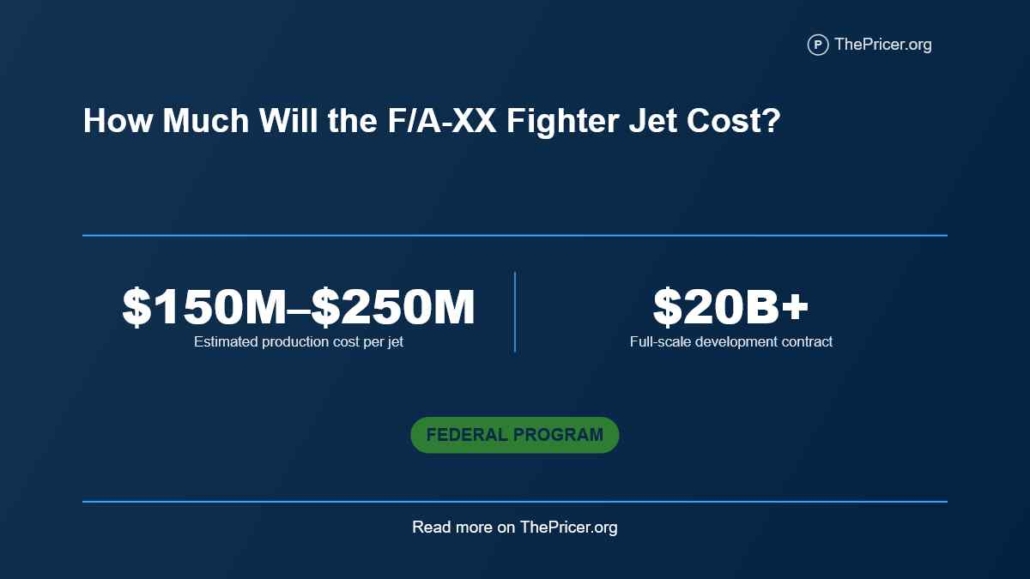
The U.S. Navy’s F/A-XX sixth-generation fighter could cost roughly $150 million to $250 million per production aircraft, based on the cost of current carrier fighters, earlier estimates for sixth-generation aircraft, and the much greater range, stealth, sensors, networking, and carrier-specific engineering expected from the new jet.
That is an estimate, not an official Navy unit price. What is now confirmed is much bigger: on September 29, 2026, the Pentagon selected Boeing for a more than $20 billion full-scale development contract covering the F/A-XX and multiple test aircraft.
The distinction matters. The $20 billion contract does not mean one F/A-XX costs billions of dollars. It pays for designing, testing, integrating, and maturing a new carrier-based combat aircraft before large-scale production begins. The eventual F/A-XX program could become a hundreds-of-billions-of-dollars effort once production, engines, weapons, spare parts, unmanned teammates, upgrades, training, and decades of operation are included.
Article Highlights
Jump to sections
- Estimated production price: about $150 million to $250 million (at $30 per hour, earning that amount would take about 2.4 to 4 thousand years of full-time work, before taxes) per F/A-XX, although the Navy has not published an official unit price.
- Development contract: Boeing received a contract worth more than $20 billion on September 29, 2026 for full-scale development and multiple test aircraft.
- Development is not production: dividing the $20 billion contract by the number of test aircraft would produce a meaningless “price per jet.”
- Program scale: reporting has described F/A-XX as potentially worth hundreds of billions of dollars over its lifetime.
- Range: the Navy has publicly targeted about 25% more operational range than its existing carrier fighters.
- Fleet timing: F/A-XX is expected to start augmenting and eventually replacing F/A-18E/F Super Hornets during the 2030s while operating alongside the F-35C.
- Hidden spending: weapons, unmanned aircraft, spare engines, carrier modifications, training, software, maintenance, and future upgrades can push the real cost far above the aircraft flyaway price.
How Much Will the F/A-XX Cost?
Until the Navy publishes a production contract or procurement budget showing both aircraft quantity and aircraft cost, there is no verified F/A-XX sticker price. A reasonable current planning range is approximately $150 million to $250 million (about 2.4 to 4 thousand years of full-time work at $30 per hour) per production aircraft.
| F/A-XX cost measure | Amount | What it means |
|---|---|---|
| Estimated production aircraft | $150M-$250M | Our current estimate, not an official Navy unit price |
| Full-scale development contract | $20B+ | Engineering, development and multiple test aircraft |
| Illustrative 200-aircraft production fleet | $30B-$50B | Aircraft production only at our estimated range |
| Illustrative 300-aircraft production fleet | $45B-$75B | Aircraft production only at our estimated range |
| Long-term program | Potentially hundreds of billions | Development, production and decades of broader program spending |
The $150 million to $250 million range reflects the aircraft’s likely position above today’s F-35C and F/A-18E/F in complexity, while acknowledging that high-rate production can spread development and fixed manufacturing costs across more aircraft.
The Pentagon’s September 29 announcement is the most important new price evidence. According to reporting on the award, the Navy selected Boeing for a contract worth more than $20 billion for the full-scale development phase. The contract includes multiple aircraft for ground testing, airworthiness work, systems evaluation, and weapons integration.
That makes F/A-XX one of the largest new combat-aircraft development efforts underway in the United States.
The $20 Billion Contract
The first mistake to avoid is treating the newly announced $20+ (about 40 minutes at $30 per hour) billion as a production order.
It is an engineering and development contract. Boeing has to turn a classified design into an aircraft that can repeatedly take off from and land on an aircraft carrier, survive demanding carrier operations, integrate new weapons and sensors, meet stealth requirements, communicate with other aircraft and unmanned systems, and pass years of flight testing.
The Pentagon says the development award will produce multiple test aircraft rather than an operational fleet. USNI News reported that extending the effective range of the carrier air wing is one of the new fighter’s principal missions.
Suppose, only as an illustration, that the Navy eventually acquired 300 production F/A-XXs. Spreading $20 billion of development across 300 aircraft would equal about $66.7 million of development spending per production aircraft before buying a single production jet.
At 200 aircraft, the same calculation rises to $100 million per aircraft.
That is not how the Pentagon will quote the jet’s flyaway price, but it demonstrates why a sixth-generation fighter can have a relatively manageable factory unit cost while still generating an enormous overall program bill.
Why $150 Million to $250 Million?
There are several useful benchmarks, but none is a perfect comparison.
The current carrier-capable F-35C is already a nine-figure aircraft. The latest pricing covered in our guide to the cost of an F-35 fighter puts an F-35C at about $110.8 million in the latest production lots.
F/A-XX is being built a generation later with greater range, very low observability, advanced sensors, open mission systems, networking with crewed and uncrewed aircraft, and the structural demands of carrier operations.
The Air Force’s corresponding sixth-generation F-47 program provides another benchmark. Boeing received that Engineering and Manufacturing Development award in March 2025. The Air Force described the award as covering design and development rather than publishing an ordinary production unit price.
Before the F-47 program was finalized, public discussion around the Air Force’s NGAD fighter frequently involved possible aircraft costs of roughly $200 million to $300 million. Those figures should not simply be transferred to F/A-XX, but they show the price territory associated with an advanced sixth-generation crewed combat aircraft.
Aviation analysts also have to account for the naval penalty. Carrier aircraft need strengthened structures, arresting equipment, corrosion protection, specialized landing gear, folding or deck-compatible design considerations, and systems capable of surviving repeated launches and recoveries at sea.
That makes a future F/A-XX costing only about as much as an F-35C difficult to assume without evidence of very aggressive cost controls or much larger production volumes.
Super Hornet Comparison
The F/A-18E/F Super Hornet offers the clearest predecessor comparison.
In March 2024, the Navy awarded Boeing a contract for the final 17 planned Super Hornets. The Naval Air Systems Command valued the deal at approximately $1.3 billion.
A simple $1.3 billion ÷ 17 calculation gives about $76.5 million per aircraft-equivalent.
That should not be called the exact price of one Super Hornet because the contract also included an important technical-data package. It does, however, give us a useful scale benchmark.
At our estimated $150 million low end, an F/A-XX would cost roughly twice that $76.5 million contract allocation. At $250 million, it would be about 3.3 times as much.
For a deeper comparison of the outgoing aircraft, our guide to F/A-18 fighter costs separates the bare aircraft price from upgrades, sustainment, and fleet-level spending.
Range Costs Money
 The Navy is not buying F/A-XX simply because the Super Hornet is old. One of the key requirements is greater reach.
In 2025, Navy officials said F/A-XX was being designed for roughly a 25% increase in operational range compared with existing Navy tactical aircraft.
That has an important cost implication. More range normally means some combination of greater fuel capacity, more efficient propulsion, aerodynamic improvements, reduced drag, lighter materials, different internal weapons arrangements, and sophisticated thermal and power management.
A 25% increase is easy to visualize. For every 100 nautical miles of equivalent reach from today’s benchmark aircraft, the target becomes about 125 nautical miles.
At 400 nautical miles, a 25% improvement would be 500. At 600, it would be 750.
Those examples are mathematical illustrations rather than disclosed F/A-XX combat-radius figures, which remain classified.
The Navy’s earlier aviation planning documents already stated that F/A-XX would need longer range, greater speed, advanced sensors, and the ability to employ longer-range weapons.
A 300-Jet Fleet
The Navy has not announced a final F/A-XX program-of-record quantity, so it would be misleading to claim that it will definitely buy 200, 300, 400, or any other specific number.
We can, however, model the financial implications.
Worked example: assume 300 production aircraft.
- 300 × $150 million = $45 billion
- 300 × $200 million = $60 billion
- 300 × $250 million = $75 billion
Add the newly disclosed $20 billion-plus development phase and those simplified totals become approximately $65 billion, $80 billion, or $95 billion.
Even these numbers are nowhere near a true lifetime program cost. They omit operating expenses, depot maintenance, spare engines, weapons, software improvements, replacement components, training, infrastructure, and any accompanying unmanned aircraft.
The Congressional Budget Office’s 2026 fighter-fleet projection provides one useful clue about the early production ramp. Under its projection, F/A-XX deliveries begin in 2038 and reach 48 aircraft in the fleet by 2040. That is a projection rather than an announced Navy production contract, and later budgets can change the schedule.
Development Funding
One of the strangest parts of the F/A-XX story is that the newly announced contract is much larger than the annual budget figures that preceded it.
Congress sharply increased funding after the Pentagon had considered slowing the program. The FY2026 defense agreement provided an additional $897.26 million above the administration’s request and directed the Navy toward a single engineering-and-manufacturing-development contractor.
Combined with other funding, roughly $1.7 billion became available for the program in FY2026.
Then the Navy’s FY2027 request contained only about $140 million for continued F/A-XX research and development, according to budget reporting.
The apparent contradiction illustrates another important defense-cost rule: contract value, annual appropriations, obligations, and cash actually paid are not the same thing.
A $20 billion contract can be funded incrementally over years. The government does not necessarily hand Boeing $20 billion on the day the contract is signed.
No Production Money Yet
The Navy made another revealing statement during its FY2027 budget briefing: there was research-and-development funding for F/A-XX in the five-year plan, but no aircraft procurement funding yet.
The Navy’s budget director said explicitly that the current Future Years Defense Program contained R&D rather than F/A-XX aircraft purchases. The FY2027 Navy budget briefing therefore gives us an important answer to the unit-price question: the government has reached the development-contract stage, not the transparent recurring-production stage where a reliable flyaway figure normally emerges.
That is why any website claiming an exact “$___ million per F/A-XX” today should identify that number as an estimate unless it can point to a future Navy procurement exhibit.
Weapons
The aircraft will also be only one part of the bill.
A combat-ready fighter requires missiles and other weapons. One current example is the AIM-120 AMRAAM. Our analysis of AMRAAM missile pricing found a recent U.S. Air Force all-up-round benchmark of about $1.17 million, with the FY2027 base-funded figure rising to roughly $1.45 million per round.
Four $1.17 million missiles represent about $4.68 million of missile inventory. Eight represent about $9.35 million.
Future F/A-XX weapons may be different, longer-ranged, and more expensive, but the example shows why an aircraft’s flyaway price never represents the total value of an armed jet ready for combat.
Internal weapons bays, launchers, weapon integration software, testing, and future missile certification can also generate development costs before the Navy purchases the weapons themselves.
Unmanned Teammates
F/A-XX is not being designed as a stand-alone fighter.
The Pentagon says it will operate in a network that includes both crewed and uncrewed aircraft. That means the relevant future combat-cost question may eventually become:
How much does one F/A-XX combat package cost?
That package might include one crewed fighter, one or more Collaborative Combat Aircraft, weapons, networking equipment, electronic warfare capabilities, and tanker support.
A $200 million crewed aircraft accompanied by two hypothetical $25 million unmanned aircraft would already represent $250 million of aircraft before weapons or support. If the unmanned aircraft cost $40 million each, the same formation rises to $280 million.
Those drone prices are examples only, not disclosed F/A-XX companion-aircraft prices. The calculation demonstrates why the cost of the future carrier air wing cannot be understood from the crewed fighter’s unit price alone.
Propulsion
Engines are another major uncertainty.
Advanced fighter propulsion programs are becoming enormously expensive because future engines must deliver thrust while also improving range, electrical generation, cooling, and thermal management for sensors and electronic systems.
GE Aerospace’s current next-generation XA102 program shows how sophisticated this technology is. In September 2026 the company said it was preparing to assemble its first XA102 adaptive-cycle test engine for the Air Force’s Next Generation Adaptive Propulsion effort.
The Navy has indicated that F/A-XX does not necessarily require the same propulsion solution as the Air Force’s F-47. Until the selected engine and its acquisition structure are public, adding a guessed engine price to the F/A-XX estimate would create false precision.
The Hidden Cost
The true F/A-XX bill will extend far beyond Boeing’s aircraft production line.
Major additional categories can include:
- spare engines and engine overhaul;
- radar and electronic warfare support;
- mission software development;
- weapons integration;
- long-range missiles;
- Collaborative Combat Aircraft;
- simulators and pilot training;
- maintainer training;
- specialized test equipment;
- spare parts inventories;
- carrier deck and maintenance equipment;
- depots and repair facilities;
- cybersecurity and communications infrastructure;
- mid-life modernization;
- stealth-material maintenance;
- decades of fuel and personnel costs.
This is why Reuters reported even before the final award that the F/A-XX competition could eventually become a program worth hundreds of billions of dollars over its lifetime.
The final program figure could therefore bear little resemblance to “$200 million multiplied by the number of aircraft.”
Cost Risks
There are several ways F/A-XX could end up above our estimated range.
First, the Navy could buy fewer aircraft than initially expected. Lower production volume spreads tooling, engineering, overhead, and supplier costs over fewer units.
Second, the aircraft could require unusually expensive low-observable materials, sensors, computing hardware, or electronic warfare equipment.
Third, carrier qualification adds requirements that land-based fighters do not face.
Fourth, schedule delays can drive engineering and labor bills higher while pushing production further into the future.
Finally, the industrial base itself matters. Boeing is simultaneously responsible for the Air Force’s F-47 program, and concerns over whether the aerospace industry could execute both next-generation fighters were one reason the F/A-XX decision took longer than originally expected.
On the other hand, F/A-XX could come in below $200 million if the Navy freezes requirements early, shares technology with other programs, achieves a strong production rate, and avoids the repeated redesigns that have inflated the costs of past weapons programs.
What We Verified
- Verified: Boeing was selected on September 29, 2026 for an F/A-XX full-scale development contract valued at more than $20 billion.
- Verified: the development award includes multiple test aircraft for ground, airworthiness, systems, and weapons-integration work. It is not a fleet production contract.
- Verified: Navy officials have described greater operational range as a core requirement, including a publicly discussed target of roughly 25% improvement.
- Verified: the Navy’s FY2027 planning contained F/A-XX research-and-development funding but no F/A-XX aircraft procurement within the published five-year budget plan.
- Estimated by ThePricer: the $150 million to $250 million production-aircraft range is an analytical estimate based on current carrier-fighter pricing, sixth-generation program benchmarks, and expected F/A-XX capabilities. It is not a Boeing or Navy quote.
Answers to Common Questions
How much will one F/A-XX fighter cost?
A reasonable current estimate is approximately $150 million to $250 million per production aircraft. The Navy has not yet published an official recurring unit price.
Does an F/A-XX cost $20 billion?
No. The more than $20 billion award announced in September 2026 covers the full-scale development phase and multiple test aircraft. It is not the price of one fighter.
How much could a fleet of F/A-XX fighters cost?
At an illustrative $150 million to $250 million each, 300 production fighters would represent about $45 billion to $75 billion in aircraft production. Adding the current $20 billion-plus development phase would bring that simplified calculation to at least $65 billion to $95 billion before weapons, sustainment, drones, infrastructure, or operating costs.
When will the Navy buy production F/A-XX fighters?
The fighter is planned for introduction in the 2030s. The Navy’s FY2027 five-year budget plan still showed research and development rather than F/A-XX aircraft procurement, so transparent production pricing remains several budget cycles away.
Will the F/A-XX replace the F-35C?
No. Current Navy plans call for F/A-XX to operate alongside the F-35C. Its primary replacement role is tied to the F/A-18E/F Super Hornet, with the new aircraft entering the carrier air wing during the 2030s.
Will F/A-XX be more expensive than an F-35C?
Probably, based on its newer technology, greater range, carrier requirements, and sixth-generation systems, but an exact comparison cannot be made until the Navy publishes a production price. The latest F-35C production benchmark is about $110.8 million, while our current F/A-XX estimate is $150 million to $250 million.
Disclosure: Educational content, not financial advice. Prices reflect public information as of the dates cited and can change. Confirm current rates, fees, taxes, and terms with official sources before purchasing. See our methodology and corrections policy.