
How Much Will the New Tesla Roadster Cost?
Updated on | Written by Alec Pow
This article was researched using 12 sources. See our methodology and corrections policy.
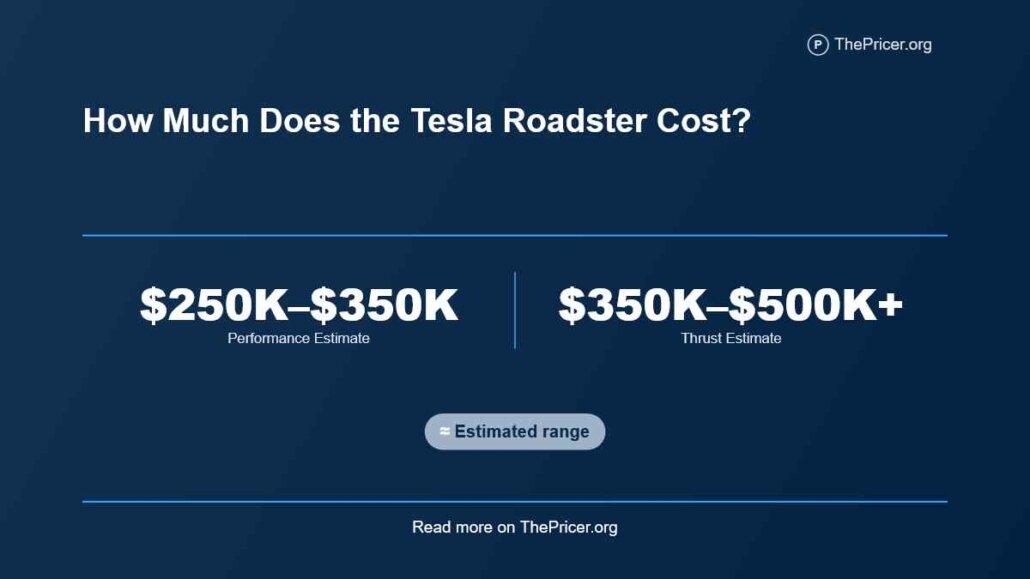
The redesigned Tesla Roadster has no confirmed retail price as of October 2026. For preliminary budgeting, a Performance model might cost approximately $250,000 to $350,000, while a Thrust configuration could reach $350,000 to $500,000 or more. These are editorial planning scenarios, not Tesla estimates or verified transaction prices. Tesla has announced reservation payments of $50,000 for Performance and $250,000 for Thrust. The invitation-only Rocket version has no published price.
The new Roadster is considerably different from the $200,000 electric supercar Tesla announced in 2017. Its redesigned engineering combines powered suction fans that can hold the vehicle upside down with compressed-gas thrusters developed alongside SpaceX engineers. Tesla demonstrated a prototype jumping over other vehicles, rotating in midair and landing. Production is targeted for 2028, but final specifications, delivery dates and purchase prices remain unconfirmed.
Article Highlights
Jump to sections
- Our independent $250,000 to $500,000+ planning range covers possible Performance and Thrust prices, not an official Tesla MSRP.
- Performance requires a $50,000 reservation, while Thrust requires $250,000.
- The Rocket configuration is invitation-only, seats one and has no announced purchase price.
- Tesla demonstrated upside-down driving and brief airborne maneuvers using suction fans and cold-gas thrusters.
- The original 2017 Roadster prices were $200,000 for the base model and $250,000 for Founders Series.
- A hypothetical $300,000 Performance purchase could reach $330,500 in first-year costs under the assumptions detailed below.
- Tesla targets 2028 production but does not guarantee when reservation holders will receive a car.
How Much Will the Tesla Roadster Cost?
Tesla introduced three configurations at its October 15 presentation: Performance, Thrust and Rocket. The company describes Thrust and Rocket as specialized enhancements to the Roadster platform, with important differences in equipment, intended use and availability.
As Reuters reported following the reveal, the company provided reservation amounts and a tentative production target but no retail price.
Our estimated $250,000 to $350,000 Performance range is a judgment-based scenario informed by the original Roadster’s $200,000 advertised starting price, the time elapsed since 2017 and the new vehicle’s more elaborate engineering. The $350,000 to $500,000+ Thrust scenario allows for additional specialized propulsion hardware.
These ranges are not calculated from a verified bill of materials, published Tesla margins or comparable transaction prices. Inflation alone cannot establish either range, and a large reservation deposit does not establish a vehicle’s eventual MSRP. Buyers should treat the estimates as hypothetical budgets rather than probable Tesla quotations. Actual prices could fall substantially outside them.
| Roadster version | Reservation | Possible price | Defining features |
|---|---|---|---|
| Performance | $50,000 | $250K–$350K scenario | Two seats, active aero, suction fans |
| Thrust | $250,000 | $350K–$500K+ scenario | Two seats, rear gas thrusters |
| Rocket | Invitation only | Undisclosed | One seat, multiple lift and rotation thrusters |
| Original 2017 Roadster | $50,000 historically | $200K originally advertised | Earlier design, superseded specifications |
Tesla’s official Roadster page identifies Performance as road-ready, Thrust as a limited-release racing configuration and Rocket as invitation-only. It also warns that certain advertised features apply only to particular enhancements and that Rocket is not approved for public-road use.
Compared with Tesla’s broader vehicle range, these sums are extraordinary. Our Tesla car price guide provides useful model-by-model context, although its older Roadster estimates should not be treated as current pricing for the October 2026 redesign.
How Does the Roadster Almost Fly?
The redesigned Roadster uses two different force-control technologies: an underbody suction system and compressed-gas propulsion.
The suction system pulls air from underneath the car. Flexible ground seals help create a low-pressure region, allowing atmospheric pressure to push the vehicle toward the surface beneath it.
Unlike traditional aerodynamic wings, which depend heavily on the vehicle moving through air, powered suction can generate downforce even when stationary.
During Tesla’s demonstration at SpaceX’s McGregor, Texas facility, the prototype climbed a curved ramp and drove upside down. It then left the ramp, rotated while airborne using thrusters and landed on its wheels.
Car and Driver’s examination of the event describes the inverted driving demonstration and Tesla’s claim that the underbody system can produce roughly two times the vehicle’s weight in suction force.
The second technology uses compressed air released from specially controlled nozzles. This produces force without burning conventional rocket propellant.
Rear-mounted thrusters can supplement forward acceleration. Thrusters positioned around the vehicle can also generate upward and rotational forces, but those capabilities are associated with the Rocket configuration rather than the standard Performance car.
Tesla demonstrated the prototype briefly lifting over a Cybercab, Cybertruck, Semi, Model Y and Model 3. TechCrunch’s event reporting details the jump, the ramp maneuver and the engineering partnership with SpaceX.
These were controlled prototype demonstrations, not certification for sustained flight, public-road airborne operation or unrestricted customer use. Tesla’s published trim descriptions do not establish that every Roadster will be capable of these maneuvers.
Performance, Thrust and Rocket
Performance is the road-focused version. Tesla describes it as having two seats, active aerodynamics and a multi-mode suction system. Its advertised acceleration is under 1.6 seconds from 0 to 60 mph.
Thrust adds rear-mounted cold-gas thrusters. These provide additional acceleration force beyond what the tires alone can transmit to the road. Tesla claims acceleration below 0.9 seconds to 60 mph. It identifies this version as a limited-release racing configuration.
Rocket adds multiple thrusters distributed around the vehicle for upward and rotational movement. It has only one seat, and Tesla claims 0-to-60 acceleration below 0.59 seconds. Tesla states that Rocket is invitation-only, is not available in every region and is not approved for public-road use.
Electrek’s detailed trim comparison confirms the distinction between the road-focused Performance, racing-oriented Thrust and airborne-capable Rocket configurations.
Tesla’s claimed range for the redesigned car is approximately 300 miles, considerably less than the 620 miles originally advertised in 2017. It also describes top speeds exceeding 230 mph. These are manufacturer claims, and the final figures may vary by configuration.
The acceleration and range claims have not been independently verified using customer-ready production vehicles.
Rocket’s flight-related systems are not approved for public-road use. Tesla has not established where customers will legally be able to operate them or what additional permissions may eventually be required. The company’s disclaimer should not be interpreted as a definitive classification of the vehicle under aviation law.
Flying Hardware
The Roadster’s thrusters require more than nozzles attached to an electric car.
Tesla describes carbon-fiber-overwrapped pressure vessels integrated throughout the vehicle, providing storage for the compressed gas used by the propulsion system.
According to Business Insider’s October 2026 reveal report, the prototype combines unusual high-pressure storage hardware with a redesigned electric chassis.
The system introduces several engineering and manufacturing challenges, including gas storage, pressure regulation, thermal management, structural protection, propulsion controls and inspection.
The suction system adds powered fans, seals, ducting, moving aerodynamic equipment and sensors.
These components help explain why the new Roadster could cost more than its original 2017 target. However, Tesla has not released supplier contracts, bill-of-materials data or option prices that would permit a defensible dollar estimate for each system.
Nor has it published a customer refill schedule, replacement-part catalog or maintenance price for the compressed-gas system.
That uncertainty is especially relevant for Rocket, whose specialized engineering could produce acquisition and ownership costs outside the normal sports-car market.
How Much Does It Cost to Reserve One?
The standard Performance reservation totals $50,000. Buyers pay $5,000 initially and the remaining $45,000 within ten days.
A current review of Tesla’s U.S. reservation selector reports that selecting Thrust changes the second payment to $245,000, resulting in a total reservation of $250,000.
The payment is a reservation deposit, not the final purchase price.
Tesla’s official Roadster reservation agreement states that the final price will be established when customers configure their vehicles.
The agreement says a reservation does not constitute a vehicle purchase, that delivery cannot be guaranteed and that the deposit can be refunded if canceled under its terms before the final vehicle purchase agreement.
Tesla does not hold reservation money in a separate escrow or trust account, and it does not pay interest.
A completed purchase can apply the reservation payment toward the vehicle price. Buyers should never add the deposit again as though it were an extra purchase fee.
The Hidden Cost of Waiting
Tesla first unveiled the second-generation Roadster in 2017 and initially expected production years earlier than the current 2028 target.
The Wall Street Journal’s Roadster coverage describes the extended development delay and the newest presentation’s emphasis on experimental engineering.
A refundable deposit still creates opportunity cost because the customer cannot use the funds elsewhere while Tesla holds them.
Suppose a Performance buyer reserves the car with $50,000 and waits two years. If that money could otherwise earn an illustrative 4% annual compounded return, it would grow to $54,080.
The modeled forgone return is $4,080.
For the larger $250,000 Thrust reservation, the same calculation produces $270,400, or $20,400 in forgone potential earnings.
Neither scenario is a guaranteed investment outcome. They demonstrate why a large refundable deposit is economically different from leaving money available until a car is ready for purchase.
Another cost is uncertainty. Older reservation holders have waited nearly nine years since the initial announcement, and the latest production target remains subject to change.
What Would a Roadster Cost All-In?
Consider a hypothetical Performance purchase at $300,000, within our independent planning range. This is not a Tesla quotation.
Assume 7% sales tax and the following illustrative additional expenses.
- Assumed vehicle price: $300,000
- Sales tax at 7%: $21,000
- Title, registration and delivery allowance: $2,000
- First-year insurance allowance: $6,000
- Home-charging installation allowance: $1,500
- Modeled first-year total: $330,500
The additional costs equal $30,500, approximately 10.2% of the assumed purchase price.
If the buyer’s $50,000 reservation is applied toward the vehicle, the remaining purchase-price balance is $250,000 before the other expenses.
Actual taxes and insurance could differ substantially. The Tesla Model 3 ownership-cost analysis illustrates how insurance and depreciation can outweigh charging expenses, though those specific Model 3 amounts should not be transferred to the Roadster.
The EV charger installation guide provides separate price evidence for home electrical work.
Tesla’s Wall Connector installation instructions also confirm that professional configuration, circuit sizing and commissioning can be necessary.
What Will Ownership Cost?
Operating a Roadster involves ordinary electric-car expenses and potentially unusual costs related to its specialized mechanical systems.
Home charging and public fast charging have different rates. ThePricer’s Tesla charging-cost guide explains how local electricity prices and charging habits change the bill.
Battery replacement is another long-term risk. Our Tesla battery replacement guide covers existing models, but the new Roadster has no published production battery-replacement price.
Its high-pressure gas vessels, seals, specialized tires and aerodynamic mechanisms also have no confirmed service price.
Insurance may become complicated for the Thrust and Rocket configurations. Wired’s regulatory examination discusses uncertainty surrounding propulsion-assisted airborne vehicles. The legal treatment of any customer vehicle will depend on its final design and intended operation.
There is no reason to assume a conventional auto policy covers deliberate aerial maneuvers. Customers will need specific insurance terms before relying on the demonstrated capabilities.
The IRS clean-vehicle credit guidance also confirms that ordinary federal clean-vehicle purchase credits are no longer available for vehicles acquired after September 30, 2025.
A future Roadster buyer should therefore not subtract an assumed federal vehicle credit from the purchase price.
Is the Roadster Worth More Than Plaid?
Tesla already sells extremely quick production vehicles at much lower prices than our Roadster scenarios.
The Tesla Plaid pricing guide provides a documented benchmark for its high-performance Model S and Model X variants.
Using that guide’s approximately $101,630 Model S Plaid price and an assumed $300,000 Roadster purchase price, the Roadster costs about 2.95 times as much, or $198,370 more.
The additional expense would buy a very different vehicle, with limited-production engineering and features not found on Plaid. The comparison remains hypothetical until Tesla publishes a Roadster MSRP.
Other Tesla products show how the company prices specialized vehicles. Its Tesla Semi cost guide covers a commercial electric truck whose costs depend on batteries and heavy-duty equipment. The Tesla Cybercab cost guide covers another vehicle with unresolved pricing and production assumptions.
Neither is a direct Roadster competitor, but both illustrate why Tesla’s preliminary price targets and production announcements should be distinguished from confirmed transaction prices.
Makes sense if
- You want a rare engineering-focused performance car and can afford substantial uncertainty.
- You understand which version offers suction fans, rear thrusters or airborne capability.
- You can leave a large refundable deposit outstanding without financial strain.
- You are willing to review future safety, insurance and use restrictions before purchase.
Does not make sense if
- You need a guaranteed vehicle delivery date or firm purchase price.
- You expect every Roadster to perform the Rocket version’s airborne demonstrations.
- You assume the 2017 $200,000 advertised price remains binding.
- You require predictable maintenance costs or confirmed road legality for specialized propulsion.
Answers to Common Questions
How much will the new Tesla Roadster cost?
Our independent planning scenarios range from approximately $250,000 to $500,000+ for Performance and Thrust. These are not verified Tesla prices. Tesla has not announced an official MSRP, and the Rocket configuration cannot yet be priced reliably.
Can the Tesla Roadster actually fly?
During controlled demonstrations, Tesla showed a prototype driving upside down with powered suction fans and performing brief airborne maneuvers using cold-gas thrusters. Tesla attributes the airborne capability to the Rocket configuration, which is not approved for public-road use.
How much is the Roadster deposit?
Performance requires $50,000, paid in two installments. Thrust requires $250,000. Rocket is invitation-only.
What is the difference between Thrust and Rocket?
Thrust adds rear-mounted cold-gas propulsion for acceleration. Rocket adds multiple thrusters around the vehicle for upward and rotational movement, has one seat and is not approved for public-road use.
When will Tesla deliver the Roadster?
Tesla targets production in 2028. The company has not guaranteed customer delivery dates, final specifications or prices.
Disclosure: Educational content, not financial advice. Prices reflect public information as of the dates cited and can change. Confirm current rates, fees, taxes, and terms with official sources before purchasing. See our methodology and corrections policy.