
How Much Will the Pentagon’s FORTRESS America Program Cost?
Published on | Written by Alec Pow
This article was researched using 13 sources. See our methodology and corrections policy.
The Pentagon’s FORTRESS America program could require tens of billions of dollars to make U.S. military installations more resistant to blackouts, drone attacks, sabotage, cyberattacks, and supply disruptions. Based on published military construction costs and a 2026 Congressional Budget Office estimate, ThePricer calculates a $72.9 billion ten-year scenario for equipping 500 installations with layered counter-drone defenses and a benchmark microgrid project at each site.
That figure is an illustrative cost model, not a Pentagon budget or an official forecast. It covers two major resilience investments and ten years of counter-drone operating costs. It does not include new water systems, fuel reserves, expanded cybersecurity, strategic stockpiles, industrial conversion contracts, or nuclear microreactors. A fully implemented FORTRESS America program could cost considerably more, depending on what each installation needs.
The Pentagon has not announced a program-wide price. Officials are assessing requirements across approximately 500 installations in the continental United States, while a senior official has indicated that full implementation could take decades.
How Much Will FORTRESS America Cost?
Jump to sections
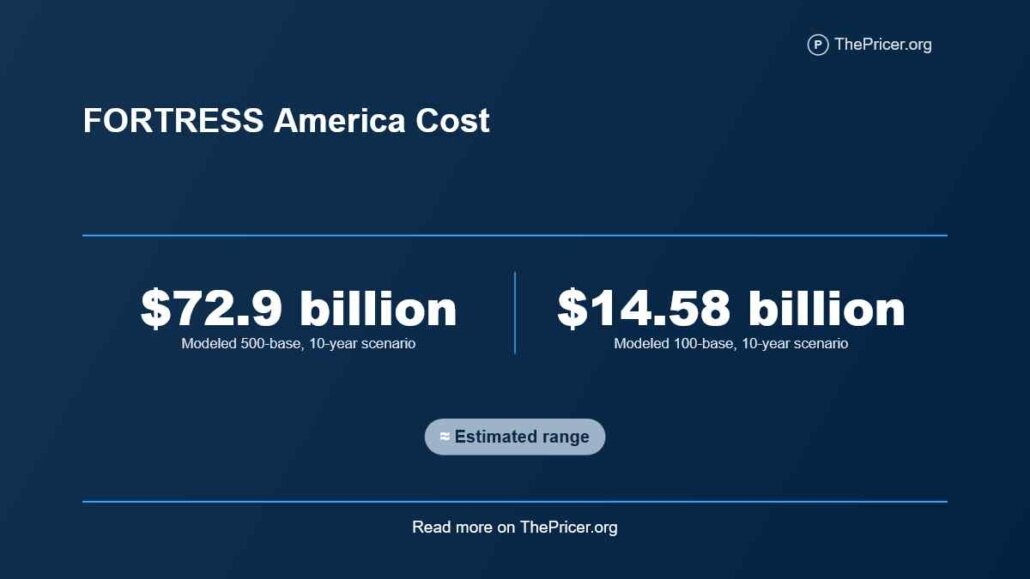
Our modeled cost is $14.58 billion for 100 installations or $72.9 billion for 500 installations over ten years. These figures assume that each installation receives a layered counter-drone system and one microgrid project comparable in cost to an existing Army installation. They also include ten years of counter-drone operating expenses.
The calculation uses two independently documented prices:
- $74 million per installation for a layered counter-small-drone defense, according to the Congressional Budget Office’s July 2026 analysis.
- At least $5 million per installation annually to support that defense, according to the same CBO analysis.
- $21.8 million per installation as an energy-system construction benchmark, based on the completed Fort Hunter Liggett microgrid.
Using those prices, the 500-installation scenario breaks down as follows.
| Cost component | Calculation | Modeled cost |
|---|---|---|
| Layered counter-drone systems | 500 × $74 million | $37 billion |
| Microgrid construction | 500 × $21.8 million | $10.9 billion |
| Counter-drone support | 500 × $5 million × 10 years | $25 billion |
| Ten-year modeled total | Three components combined | $72.9 billion |
The CBO explicitly estimates that protecting 100 representative installations would cost approximately $7.4 billion upfront and $500 million annually. Extending its per-site figures to 500 installations is ThePricer’s calculation, not a projection made by the CBO.
Our model also assumes every site needs the same level of drone protection and a similarly priced microgrid. Real bases vary enormously in size, electrical demand, threat exposure, existing infrastructure, and mission. Some would cost less, while large installations requiring substantial new generation or water independence could cost much more.
What Would the First 100 Bases Cost?
A smaller deployment illustrates how quickly individual projects accumulate. Equipping 100 installations with the modeled counter-drone systems and microgrids would cost approximately $9.58 billion upfront. Ten years of counter-drone support would add at least $5 billion, producing a $14.58 billion ten-year total.
Water independence would increase that amount. The Air Force has documented a $100 million water-treatment and supply project at Mountain Home Air Force Base in Idaho, involving a new treatment plant, pump station, and pipeline. The Air Force project description provides a real example of the price of securing a major installation’s water supply.
If 20 of those first 100 installations required water projects costing $100 million each, the added construction bill would be $2 billion. That would raise the illustrative ten-year portfolio to $16.58 billion, before other infrastructure and operating expenses.
This is a scenario, not a claim that the Pentagon has selected 100 bases or ordered 20 water plants. Its purpose is to show the financial consequences of applying known construction prices to a defined group of installations.
What Is FORTRESS America Supposed to Build?
FORTRESS America is a Pentagon initiative intended to make military installations and essential defense operations less dependent on vulnerable civilian systems. The program was announced in September 2026, and an October 6 implementation memorandum initiated the establishment of a dedicated program office. The program-office directive brought together officials responsible for installations, industrial capacity, information systems, and spending.
The Army’s program announcement describes five broad areas of work:
- Energy independence. Make installations capable of sustaining essential missions when external electricity supplies fail.
- Industrial and supply-chain resilience. Reduce dependence on disrupted suppliers and expand the capacity to produce critical defense goods.
- Strategic reserves. Improve access to supplies and materials needed during prolonged emergencies.
- Installation and cyber resilience. Protect bases and essential systems from physical and digital threats.
- Space and spectrum resilience. Protect the communications and technical capabilities on which military operations depend.
Reporting in October also described a goal of allowing major bases to operate independently for at least 90 days. The reported 90-day requirement should be distinguished from a published, priced construction specification. The costs of supplying electricity, water, fuel, communications, and essential materials for that period will depend heavily on each base’s mission.
How Much Do Military Microgrids Cost?
Electricity is one of the easiest FORTRESS expenses to benchmark because the military has already completed resilience projects at several installations. Their prices demonstrate why no single national per-base figure can describe every energy requirement.
At the lower end, Fort McCoy completed a $1.4 million microgrid to support its main gate. The Fort McCoy project announcement concerns a localized mission, not the electrical needs of the entire installation.
At White Sands Missile Range, the Army completed a $10.9 million microgrid associated with its water infrastructure. The White Sands project shows the cost of supporting a particularly important base function.
Fort Hunter Liggett’s renewable-energy microgrid cost $21.8 million. Aberdeen Proving Ground unveiled a separate $25 million microgrid project with approximately 9.2 megawatts of capacity, documented in the Aberdeen project announcement.
These completed projects supply a documented construction-price range of approximately $1.4 million to $25 million, but they do not provide equivalent service. A gate-level microgrid, a water-system microgrid, and a larger installation energy project have different capacities and missions.
The $21.8 million figure in our national scenario is a benchmark for a mid-sized project, not evidence that it could supply every base for 90 days. A major air base may need far greater generating capacity, additional fuel storage, multiple independent systems, or technology that existing projects do not provide.
Readers comparing civilian backup electricity investments can see how generator costs change with capacity in our guide to data center backup generators.
Nuclear Microreactors
The Army is exploring small nuclear reactors to provide dependable electricity for military installations, including when civilian grids fail.
Under its Janus initiative, the Army announced agreements involving five initial installations and potential government milestone payments totaling up to $2.2 billion over fiscal years 2027 through 2031. The Army’s microreactor announcement describes a development and deployment effort, not a standard purchase price for one finished reactor.
Dividing the $2.2 billion ceiling by five produces $440 million per installation as a simple arithmetic comparison. It should not be interpreted as the contracted cost of each reactor. Payments, scope, ownership, construction risks, and eventual operating arrangements may differ.
Five installations also represent a tiny fraction of the approximately 500 being assessed. Widespread use of nuclear generation would change FORTRESS costs substantially, but it would be misleading to multiply the Janus ceiling across the country as though every base had selected identical reactors.
Our $72.9 billion scenario excludes nuclear microreactors entirely. Where microreactors replace conventional microgrid investments, their costs should be substituted rather than automatically added to avoid double counting.
Water and Base Defenses
Electricity and counter-drone defenses are only part of the infrastructure bill. Bases also need dependable water, wastewater treatment, communications, physical security, and protected control systems.
Fort Hunter Liggett is pursuing an estimated $165 million modernization of its aging water infrastructure. The Army Reserve’s project description includes replacement piping, storage capacity, a well, and wastewater-system improvements.
These examples put substantial water projects in a documented range of roughly $100 million to $165 million. They are not the average cost of making an installation water-independent. Some bases may need limited improvements, while others face unusual supply, treatment, or geographic challenges.
Counter-drone protection presents a different expense. The CBO’s $74 million benchmark includes equipment for detecting and engaging multiple small drones, along with supporting infrastructure. Its annual support estimate starts at $5 million and could rise if additional military personnel or frequent replacement systems are required.
Physical fortification against sabotage, protection against larger weapons, cybersecurity improvements, and replacement of vulnerable utility networks would generate additional costs. Some of those expenditures may fall under existing defense programs. Without a published FORTRESS project list, adding every related military contract to the program total would risk counting the same investment twice.
For context on the costs of defending installations against more substantial threats, see our separate analysis of U.S. base defense spending in the Middle East. Those expenditures should not be treated as FORTRESS America funding.
What Could Push the Final Cost Higher?
The largest uncertainty is not the price of a single microgrid or defense system. It is the combination of work required at each installation and the number of years over which that work must be funded.
Our $72.9 billion calculation covers 500 installations, one benchmark microgrid each, layered counter-drone protection at each site, and ten years of counter-drone support. It does not price the entire five-pillar initiative.
The main upward cost pressures are:
- Larger energy systems. Airfields, maintenance depots, and major logistics hubs may need more electricity than the benchmark microgrid can provide.
- Water and fuel independence. Storage, treatment, pipelines, and reserves can require major construction projects.
- Long operating periods. An initiative taking decades to complete will involve maintenance, replacements, staffing, and technology upgrades beyond a ten-year window.
- Industrial readiness. Preparing civilian manufacturers to produce military goods during emergencies may require equipment, contracts, inventories, and periodic readiness testing.
- Threat-specific fortification. Bases near sensitive facilities or with higher exposure may need substantially more protection.
Costs could also be lower than our scenario if many bases already have suitable systems, if smaller installations do not need comprehensive counter-drone coverage, or if projects are financed through arrangements that reduce immediate federal construction spending.
A senior defense official’s October comments confirmed that the Pentagon was still assessing energy requirements and costs. Air & Space Forces Magazine characterized the potential national undertaking as costing scores of billions, possibly hundreds of billions of dollars. That broad assessment is consistent with the scale of our calculations, but it is not an official Pentagon estimate.
FORTRESS America should also be kept separate from the proposed Golden Dome missile defense system. Both concern homeland defense, but they have different missions and spending requirements. Combining their projected prices would misrepresent the cost of either program.
Before Spending Is Approved
The first important document will be a project-level spending plan that identifies installations, expected capabilities, construction costs, financing arrangements, and annual operating commitments. It will allow the public to distinguish new spending from work already authorized under existing military construction and resilience programs.
Three questions will determine whether early budget figures are meaningful:
- How many bases receive which upgrades? A count of 500 installations does not establish that each needs the same systems.
- What does each project actually deliver? A microgrid protecting one mission-critical building is different from a base-wide independent energy system.
- Are operating and replacement costs included? A construction-only budget can substantially understate the ten- or twenty-year cost.
The Government Accountability Office’s installation oversight work underscores the importance of tracking infrastructure costs and resilience outcomes consistently. For a program spanning hundreds of sites, a transparent inventory of existing assets and new requirements will be essential to credible cost reporting.
Our assessment: A $72.9 billion ten-year portfolio is a defensible illustration of what just two major FORTRESS-related capabilities could cost across 500 installations. It is neither a minimum program price nor a prediction of congressional appropriations. The actual nationwide program could cost less for those two capabilities, substantially more when additional requirements are included, or unfold across a much longer period.
Answers to Common Questions
Has Congress approved $72.9 billion for FORTRESS America?
No. The $72.9 billion figure is ThePricer’s modeled scenario using published CBO and military construction benchmarks. It is not an authorization, appropriation, or Pentagon request.
Will every U.S. military base get a nuclear reactor?
No such nationwide deployment has been announced. The Army’s Janus initiative concerns five initial installations, and the eventual power systems selected under FORTRESS America may vary by site.
Does the ten-year estimate include every FORTRESS America expense?
No. It includes modeled counter-drone equipment, benchmark microgrid construction, and counter-drone support. Water projects, cyber defenses, fuel reserves, industrial preparedness, strategic stockpiles, and other requirements are excluded.
When will the Pentagon publish a final cost?
There is no confirmed date for a comprehensive program-wide estimate. Defense officials were still evaluating requirements in October 2026, and complete implementation could extend over decades.
What We Verified
Disclosure: Educational content, not financial advice. Prices reflect public information as of the dates cited and can change. Confirm current rates, fees, taxes, and terms with official sources before purchasing. See our methodology and corrections policy.