
How Much Does HVAC Duct Replacement Cost?
Updated on | Written by Alec Pow
This article was researched using 10 sources. See our methodology and corrections policy.
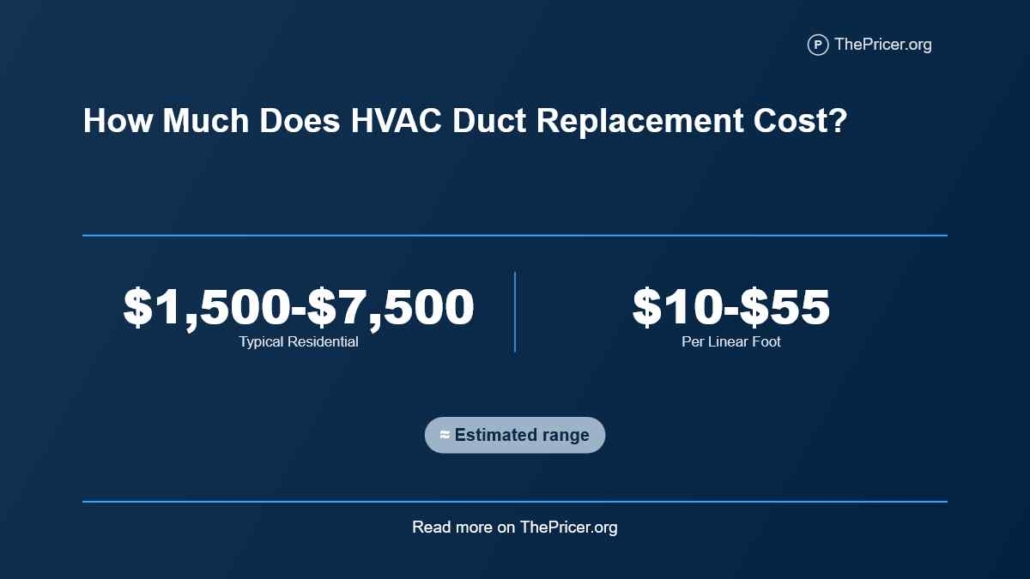
Replacing HVAC ductwork typically costs about $1,500 to $7,500 for a residential system, although a small accessible job can fall below that range and a large house with ducts hidden behind finished walls can exceed $10,000.
Current 2026 pricing sources show why homeowners encounter very different estimates. Angi reports roughly $10 to $25 per linear foot, This Old House estimates about $16 to $19 per foot, and HomeGuide gives a broader replacement range of approximately $25 to $55 per foot. Those figures are not necessarily contradictory because contractors may include different amounts of removal, insulation, fittings, registers, access work, and labor in the quoted price.
The most important question is therefore not simply “What does ductwork cost per foot?” It is what exactly is included in the replacement quote.
Article Highlights
Jump to sections
- A typical residential duct replacement can cost roughly $1,500 to $7,500 (at $30 per hour, earning that amount would take about 1.3 to 6.3 full-time workweeks, before taxes), with large or difficult projects reaching $10,000 or more.
- Current published replacement rates range from approximately $10 to $55 per linear foot depending on scope and methodology.
- This Old House estimates about $3,100 to $3,700 for 200 feet of replacement ductwork.
- HomeGuide puts full residential replacement around $1,400 to $5,600 for many homes.
- Repairing localized duct problems can cost only $200 to $1,000, making full replacement unnecessary in many cases.
- Sheet metal normally costs more than flexible duct, not less as the previous version stated.
- Age alone does not mean ductwork needs replacement. Condition, leakage, design, insulation, corrosion, contamination, and airflow matter more.
- The federal 25C Energy Efficient Home Improvement Credit ended for property placed in service after December 31, 2025, although state, utility, and Home Energy Rebate programs may still help with qualifying efficiency projects.
How Much Does HVAC Duct Replacement Cost?
For most homeowners, a useful planning range is approximately $1,500 to $7,500 (about 1.3 to 6.3 full-time workweeks at $30 per hour) for replacing substantial portions or all of a conventional residential duct system.
| Project | Typical 2026 cost |
|---|---|
| Minor duct repairs | $200-$1,000 |
| Replace one damaged section | $400-$1,500 |
| Small/simple duct replacement | $1,500-$3,000 |
| Typical whole-home replacement | $3,000-$7,500 |
| Large or difficult system | $7,500-$10,000+ |
| Professional duct sealing | $500-$4,000 |
The ranges overlap because a contractor may define “replacement” differently. Replacing accessible flex-duct branches in an attic is not comparable with removing sheet-metal trunks above finished ceilings, cutting drywall, rebuilding plenums, insulating new ducts, and repairing the finished surfaces afterward.
Current This Old House duct-replacement data estimates approximately $16 to $19 per linear foot. Its examples work out to about $1,600-$1,900 for 100 feet, $3,100-$3,700 for 200 feet, and $7,800-$9,300 for 500 feet.
By comparison, HomeGuide’s current replacement estimates put many projects at $1,400-$5,600 and roughly $25-$55 per linear foot. Angi’s 2026 project data gives a lower $10-$25-per-foot replacement range.
For that reason, use linear-foot pricing for an early budget, not as a substitute for an itemized contractor quote.
Cost by Home Size
Square footage is not a direct measure of duct length, but larger houses generally contain more supply branches, returns, fittings, and registers.
HomeGuide currently estimates approximately:
| Home size | Estimated duct replacement |
|---|---|
| 1,000-1,500 sq. ft. | $1,400-$3,400 (about 1.2 to 2.8 full-time workweeks at $30 per hour) |
| 1,500-2,000 sq. ft. | $2,100-$4,500 |
| 2,000-2,500 sq. ft. | $2,800-$5,600 |
| 2,500-3,000 sq. ft. | $3,500-$6,700 |
| 3,000-4,000 sq. ft. | $4,200-$9,000 |
A compact two-story house can still cost more than a larger ranch if the installer must open walls and ceilings to reach the ducts.
Material Costs
The previous version had the material hierarchy backward. Sheet metal is generally more expensive than flexible duct.
Current material-only estimates published by This Old House are approximately:
| Duct material | Material cost per foot |
|---|---|
| Non-insulated flexible duct | $1-$3 |
| Insulated flexible duct | $2-$4 |
| Fiberboard | $4-$7 |
| Sheet metal | $7-$15 |
These are material prices rather than fully installed prices.
Flexible duct is inexpensive and useful for short branches and locations where rigid duct is difficult to route. Poorly installed flex duct can sag, compress, kink, or create excess resistance, however. ACCA’s Manual D residential duct standard specifically addresses the airflow effects of excessive flex-duct length, sag, and compression.
Sheet metal costs more but is durable and works well for trunks and straight runs. Many systems combine rigid metal trunks with shorter flexible branches rather than using one material everywhere.
Labor and Access
Labor can become more important than the duct material itself.
An open basement ceiling provides technicians with direct access. Ducts buried above drywall, inside soffits, beneath floors, or in low crawl spaces can require considerably more labor.
Typical cost drivers include:
- Attic or crawlspace access
- Removing the old duct system
- Opening ceilings or walls
- Repairing drywall afterward
- Adding or replacing insulation
- Building new plenums and transitions
- Changing return-air pathways
- Adding registers or returns
- Permits and inspections
- Testing and balancing
The 2024 International Residential Code requires duct joints, seams, and connections to be properly fastened and sealed using approved methods. The IRC duct-system requirements also address insulation, supports, factory-made ducts, and installations in garages and other special locations.
Design Matters
Replacing damaged ducts with new ducts of exactly the same incorrect dimensions can preserve the original problem.
Residential duct design should account for room airflow requirements, blower performance, static pressure, fittings, duct length, material, and system geometry.
ACCA’s Manual D is the ANSI-recognized residential duct-design procedure. It matches duct-system resistance with blower performance so that the system can deliver appropriate airflow to each space.
This is worth asking about when obtaining estimates, particularly if the old system already has rooms that are consistently too hot or too cold.
A contractor who proposes a full replacement should be able to explain whether the existing duct sizes and return system are being verified rather than simply copied.
Repair or Replace?
Full replacement is not automatically the correct solution when a duct system leaks.
Current duct-repair pricing puts many repairs at approximately $200 to $1,000. Sealing an individual leak may cost $150-$500, while replacing a damaged section can run about $400-$1,500.
Repair usually makes more financial sense when the problem is limited to a few accessible sections, loose connections, damaged insulation, or localized leaks.
Replacement becomes more compelling when:
- Damage or leakage occurs throughout the system.
- Flexible ducts are crushed, torn, or badly deteriorated.
- Metal ducts have extensive corrosion.
- Wet or mold-contaminated insulated duct material cannot be salvaged.
- The original system was poorly sized or designed.
- Large sections have failed insulation.
- Repeated repairs are becoming expensive.
The EPA specifically states that wet or moldy insulated duct material should be removed and replaced because it cannot be effectively cleaned.
Sealing Instead
If the ducts themselves remain structurally sound, sealing can sometimes solve the expensive part of the problem without replacing them.
ENERGY STAR reports that a typical home’s duct system can lose approximately 20% to 30% of the air moving through it because of leaks, holes, and poor connections. Proper sealing and insulation can improve HVAC efficiency and comfort.
That does not mean replacement automatically reduces the entire utility bill by 20% to 30%.
Current professional sealing estimates run roughly $500 to $4,000, with Angi placing the current average near $2,250. Compare that with replacement before approving a complete tear-out when leakage is the main problem.
You can read ENERGY STAR’s explanation of duct leakage and sealing for the efficiency side of the decision.
A 200-Foot Example
Consider a house requiring approximately 200 linear feet of replacement ductwork.
This Old House’s current $16-$19-per-foot benchmark produces:
200 × $16 = $3,200
and:
200 × $19 = $3,800
Now assume the project also requires these illustrative extras:
| Line item | Example cost |
|---|---|
| 200 feet of replacement | $3,200-$3,800 |
| Old-duct removal/disposal | $500 |
| Permit/inspection allowance | $250 |
| Drywall/access repair | $800 |
| Illustrative project total | $4,750-$5,350 |
The extra amounts are examples rather than national fixed rates, but the calculation demonstrates why a homeowner can receive a $5,000 quote even though an online duct-price calculator initially suggests $3,500.
The Hidden Price
The biggest hidden expense is often not the duct itself. It is gaining access to it.
If replacing $1,500 worth of ducts requires removing finished ceilings, relocating wiring, repairing insulation, and restoring drywall and paint, the building work can materially increase the final invoice.
Asbestos is another potential cost in older buildings. Do not disturb suspect duct insulation or tape until it has been properly evaluated.
Mold or water damage can also turn a duct replacement into a moisture-remediation project. Replacing contaminated material without correcting the source of water allows the problem to return.
Return-air deficiencies are easy to miss. A contractor may discover that a new HVAC system needs larger returns or other airflow changes rather than a straightforward one-for-one duct replacement.
If the HVAC equipment itself is aging, compare the duct job with the cost of related work such as furnace replacement or an AC evaporator coil replacement. Coordinating the work can sometimes prevent paying twice to open the same area.
Cleaning Is Different
 Cleaning, sealing, repairing, and replacing ducts solve different problems.
Duct cleaning removes contamination from serviceable surfaces. It does not repair crushed flex duct, replace failed insulation, redesign an undersized return, or reconnect a collapsed branch.
The EPA does not recommend routine duct cleaning merely because ducts contain ordinary household dust. It suggests considering cleaning when there is substantial visible mold on appropriate hard surfaces, vermin infestation, or heavy debris being released into the home.
If contamination rather than structural failure is the issue, compare replacement with our current guide to air duct cleaning costs.
Rebates in 2026
Be careful with older articles recommending the federal Energy Efficient Home Improvement Credit.
The IRS confirms that the Section 25C credit is not available for property placed in service after December 31, 2025. That makes old advice about claiming a 2026 federal ductwork tax credit outdated.
Other help may still exist. The Department of Energy’s Home Energy Rebates can support qualifying whole-home efficiency projects in participating states, and DOE specifically lists duct sealing among potential HOMES improvements.
Program availability and eligibility vary by state, so check the state energy office and local utility before assuming a rebate applies to a replacement project.
What We Verified
We compared current 2026 replacement and repair pricing from multiple cost databases, checked ENERGY STAR and EPA guidance, reviewed the current residential duct-design standard from ACCA, checked the 2024 International Residential Code’s duct installation requirements, and verified the current federal incentive situation with the IRS and Department of Energy.
That research produced several corrections to the previous article:
- Sheet metal is generally more expensive than flexible duct, not cheaper.
- A 20%-30% duct leakage figure does not mean replacement automatically cuts household energy bills by 20%-30%.
- Ductwork should not automatically be replaced because it reaches a particular birthday.
- Localized failures may justify repair or sealing instead of replacement.
- The federal 25C credit ended for improvements placed in service after December 31, 2025.
- Commercial ductwork should not be assigned a generic $8,000-$25,000 national range without project specifications.
Commercial Projects
Commercial duct replacement should usually be estimated from plans and specifications rather than a residential cost-per-foot table.
A commercial system may involve higher pressure classes, much larger duct dimensions, fire and smoke dampers, rooftop equipment, cranes or lifts, occupied-building work, testing and balancing, controls, and code requirements that do not appear in a typical residential replacement.
The Sheet Metal and Air Conditioning Contractors’ National Association publishes HVAC duct construction standards covering metal, flexible, commercial, and institutional systems.
For that reason, a commercial building needs a project-specific mechanical estimate rather than the old article’s unsupported blanket range.
Getting Quotes
Get at least three detailed estimates when the project is large enough to justify full replacement.
Ask each contractor to state:
- How many linear feet or duct runs are being replaced
- Which materials and insulation levels are included
- Whether old-duct removal is included
- Whether drywall or ceiling repairs are included
- Whether permits are included
- Whether the system will be redesigned or copied
- How duct sizing was determined
- Whether leakage testing or balancing is included
- What labor and material warranties apply
Comparing those line items is more useful than comparing only the bottom-line price.
Answers to Common Questions
How much does it cost to replace HVAC ductwork?
Many residential projects fall between about $1,500 and $7,500, while larger or difficult replacements can exceed $10,000. Current published per-foot estimates range from roughly $10 to $55 depending on what the estimate includes.
How much does 200 feet of duct replacement cost?
This Old House currently estimates approximately $3,100-$3,700 for a 200-foot replacement. Removal, insulation, difficult access, permits, drywall repairs, and redesign can raise the finished project total.
Should 20-year-old ductwork automatically be replaced?
No. Age is one factor, but condition matters more. Well-installed sheet-metal ducts can remain useful for decades. Inspect for leakage, corrosion, insulation failure, contamination, physical damage, and airflow problems before replacing an otherwise functional system.
Is it cheaper to seal ducts than replace them?
Often, yes, if the existing ducts are structurally sound. Professional sealing currently costs roughly $500-$4,000, while localized repairs can cost a few hundred dollars. Extensive deterioration or poor system design may make replacement the better investment.
Can I replace HVAC ductwork myself?
Minor sealing of accessible joints can be a DIY project for some homeowners, but complete replacement requires airflow design, correct sizing, supports, sealing, insulation, and compliance with local codes. Poorly installed ducts can reduce airflow and HVAC performance even when they appear physically intact.
Does replacing ductwork improve indoor air quality?
It can when the existing system has contamination, moisture-damaged insulation, pest damage, or leaks that pull contaminants from attics or crawl spaces. Replacement is not automatically an indoor-air-quality upgrade if the old duct system is clean, dry, sealed, and structurally sound.
Disclosure: Educational content, not financial advice. Prices reflect public information as of the dates cited and can change. Confirm current rates, fees, taxes, and terms with official sources before purchasing. See our methodology and corrections policy.