
How Much Does a McLaren Senna Cost?
Updated on | Researched and reviewed by Alec Pow, Founder & Pricing Investigator
Prices, claims, and calculations checked against 11 cited sources. See our research methodology and corrections policy.
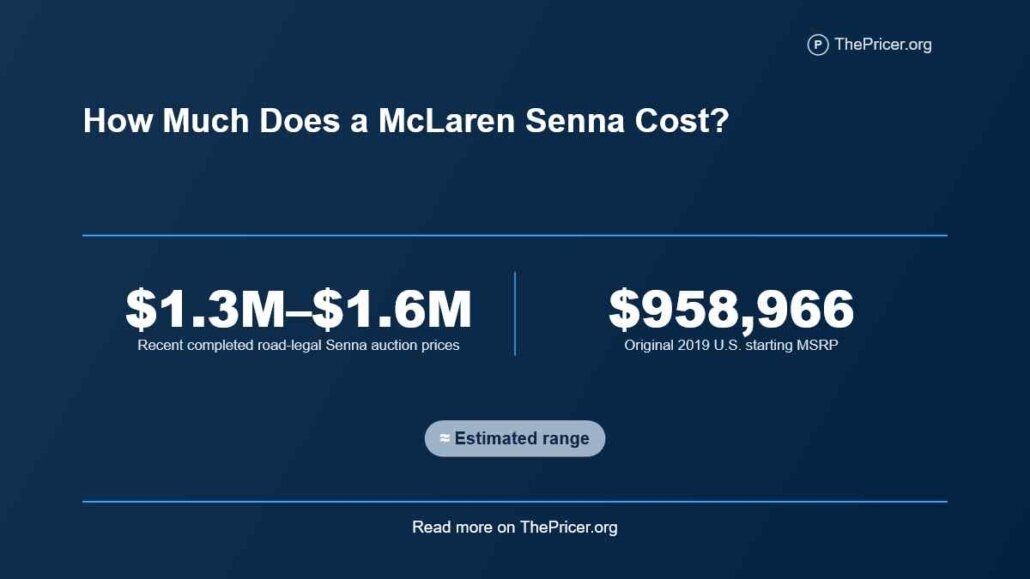
A McLaren Senna can cost approximately $1.3 million to $1.6 million based on several documented 2025–2026 U.S. auction transactions, although exceptional low-mileage examples carry dealer asking prices above $2 million. Recent listings have approached $3 million, but advertised prices do not establish what buyers ultimately pay.
The original Senna had a U.S. starting MSRP of $958,966 when introduced for the 2019 model year. Only 500 examples of the road-legal Senna were built. Today, mileage, accident history, McLaren Special Operations customization and documented maintenance can create large differences between otherwise similar cars.
Buying one also involves sales taxes, insurance, inspections and specialist maintenance. Those expenses require individual quotations rather than assuming every owner spends six figures annually.
Article Highlights
Jump to sections
- The original 2019 McLaren Senna MSRP was $958,966.
- A Senna sold on Bring a Trailer for $1,360,000 in February 2026.
- Another sold for $1,506,500 in May 2026, while an August 2025 example achieved $1,470,000.
- Selected dealer asking prices in October 2026 exceed $2.2 million, with some approaching $3 million.
- Classic.com publishes a base Senna market benchmark of approximately $1.33 million.
- One detailed owner report disclosed $2,200 for annual servicing and $4,400 for tires, with additional repair and track expenses.
How Much Does a McLaren Senna Cost?
The distinction between completed sales and advertisements is essential in this market. Sellers can ask substantially more than buyers have recently paid, especially for highly customized cars with unusually low mileage.
Classic.com’s base Senna market benchmark stood at approximately $1,325,051 in October 2026. The figure is a proprietary market estimate, not the price of a particular transaction.
| McLaren Senna price evidence | Amount | Price type |
|---|---|---|
| Original 2019 MSRP | $958,966 | Historical new-car base price |
| August 2025 Senna | $1,470,000 | Completed auction sale |
| February 2026 Senna | $1,360,000 | Completed auction sale |
| May 2026 Senna | $1,506,500 | Completed auction sale |
| Classic.com base benchmark | $1,325,051 | Modeled market valuation |
| Selected October 2026 listings | $2.25M–$3M | Dealer asking prices |
These examples cover several distinct cars and sale circumstances. They are not a representative national sampling of all privately negotiated Senna transactions.
Classic.com’s overall Senna market listings include a McLaren Charlotte example offered at $2,249,996 in October 2026 and another advertised at $2,799,996. An MSO example at Ferrari of San Diego was listed at $2,999,999 in September.
Those sellers may accept lower offers, retain their cars or remove advertisements without disclosing a sale. Treat advertised figures as evidence of seller expectations, not realized market values.
What Have Sennas Actually Sold For?
Recent Bring a Trailer transactions provide transparent prices and individual vehicle histories.
On August 15, 2025, a Racing Green Senna auction closed at $1,470,000. Chassis 88 of 500 had approximately 2,600 miles and a distinctive transparent finish.
On February 19, 2026, a Papaya Spark MSO Senna sold for $1,360,000. It had approximately 8,000 miles and an original window sticker totaling $1,123,219, including substantial bespoke options.
On May 4, 2026, a Stealth Cosmos Black Senna sold for $1,506,500, also with approximately 8,000 miles.
The arithmetic average of these three deliberately selected transactions is $1,445,500. This is a three-sale comparison, not a national average, and the cars differ in configuration and condition.
It establishes that standard-road-car auction outcomes cannot automatically be described as $2 million to $3 million sales simply because current dealers advertise at those levels.
McLaren Senna values remain highly sensitive to individual chassis characteristics. A buyer should use recent completed transactions as a starting point and adjust for documentation, damage, mileage and unusual factory specifications.
Original Price and Performance
The McLaren Senna was developed as a road-legal, track-focused member of the company’s Ultimate Series and named after three-time Formula One world champion Ayrton Senna.
MotorTrend’s original 2019 Senna specifications reported the $958,966 base MSRP and confirmed that all 500 production allocations had been sold.
Later test vehicles could have different published base-price figures and substantial option charges. Car and Driver’s instrumented 2019 road test listed a $964,966 base price and $982,816 as tested.
The Senna uses a twin-turbocharged 4.0-liter V8 producing 789 horsepower and 590 pound-feet of torque, connected to a seven-speed dual-clutch transmission.
In that test, the car accelerated from zero to 60 mph in 2.8 seconds and completed the quarter-mile in 10.1 seconds.
Carbon-fiber construction, active aerodynamics, carbon-ceramic brakes and specialized suspension distinguish the Senna from more comfort-oriented supercars.
Its original price bought a production road car with exceptional track capability, not unlimited track support, lifetime maintenance or guaranteed future appreciation.
How Customization Affects Value
McLaren Special Operations, commonly called MSO, supplied bespoke paint, exposed carbon-fiber finishes, cabin trim and other personalization options.
Such equipment can materially increase a car’s original invoice. It does not follow that every dollar spent on customization returns an additional dollar at resale.
The February 2026 auction provides a concrete comparison. Chassis 224 reportedly had approximately $129,000 in MSO bespoke options and an original suggested retail total of $1,123,219.
Its $1,360,000 sale represents an increase of approximately $236,781, or 21.1%, over that specific vehicle’s original sticker price, before transaction costs, maintenance and inflation.
That result is more informative than comparing a heavily customized car directly with the original base MSRP.
McLaren’s personalization program can also create designs with a narrower group of interested buyers. A distinctive color or exposed-carbon package might attract a premium from one collector and receive less enthusiasm from another.
Buyers should obtain the original specification, option list and documentation showing whether unusual components were factory-installed or modified afterward.
The Hidden Cost of Buying a Senna
A successful auction bid is not the same as the amount needed to take ownership. Sales taxes, registration, transport, inspections and buyer charges can increase the total.
Consider the actual May 2026 auction result of $1,506,500. The sale price is documented, while the following additional expenses are illustrative assumptions for an eligible hypothetical purchase.
- McLaren Senna purchase price: $1,506,500
- Sales or use tax, assumed at 6%: $90,390
- Enclosed vehicle transport, assumed: $5,000
- Pre-purchase inspection and specialist checks, assumed: $3,000
- Illustrative acquisition total: $1,604,890
This calculation assumes all listed expenses are separately payable and that the 6% tax applies to the transaction. Actual taxes depend on jurisdiction and registration circumstances. Auction-platform buyer charges, if applicable, must also be checked and are excluded here.
The extra $98,390 is equivalent to approximately 6.5% of the winning bid. This is a useful reminder that negotiating a lower price is not the only consideration when budgeting for a seven-figure car.
Title history deserves particular attention. A Senna’s carbon-fiber construction and specialized components can make previous accident repairs costly and consequential for resale.
Annual Maintenance and Repair Costs
McLaren Senna ownership expenses cannot responsibly be represented by a single universal maintenance figure. Storage-only cars, occasional road cars and frequently tracked vehicles have dramatically different costs.
A detailed Senna owner’s annual expense report describes a year involving regular maintenance and significant additional component work.
The owner reported $2,200 for annual service, $7,900 for windscreen replacement, $4,400 for tires, $4,200 for front brake pads, $1,400 for pre- and post-track inspections, and $1,200 for a door and strut issue.
These expenses total $21,300. They represent one reported ownership experience, not an annual average for all Sennas.
The difference between the $2,200 scheduled service and the larger combined bill highlights the financial exposure created by occasional replacement parts.
The specialist FF Performance service information publishes routine pricing for several McLaren models but requests individual quotations for Ultimate Series vehicles, including the Senna.
Consequently, a shop’s standard 720S service schedule should not be presented as a guaranteed Senna maintenance price.
Before purchase, request maintenance records and a current inspection estimate from an authorized dealer or specialist familiar with the Senna.
Insurance, Storage and Track Use
Insurance is one of the least transparent expenses for a seven-figure hypercar. The premium depends on agreed insured value, driver history, location, annual mileage, security, deductibles and permitted use.
Hagerty’s collector insurance guidelines distinguish ordinary covered use from competition and discuss separate arrangements for certain motorsport activities.
The original article claimed that Senna insurance commonly costs more than $100,000 annually. No sufficiently representative insurer quotation supports treating that amount as a normal premium.
A specialist insurer should provide a written quotation using the actual car’s value, ownership structure and intended use. Track driving may require separate coverage or be excluded entirely.
Hagerty’s agreed-value insurance explanation describes how a predetermined covered value can help protect a collectible car against disagreement over ordinary market valuation after a total loss.
Storage also depends on circumstances. A suitable privately owned garage may avoid a recurring commercial storage fee, while climate-controlled specialist facilities can charge substantially more.
Track use introduces tire wear, brake wear, transportation, inspections and possible damage exposure. The owner report above shows that such individual expenses can collectively exceed the annual routine service charge.
What Changes the Resale Price?
The Senna’s limited production provides scarcity, but scarcity alone does not establish a guaranteed investment return.
Five factors deserve particular attention when comparing two examples.
- Mileage: A low odometer reading may appeal to collectors, although limited use does not eliminate maintenance needs.
- Accident history: Structural repairs, replacement body panels and inconsistent records can affect valuation.
- Original specification: Factory MSO finishes and well-documented options can influence buyer demand.
- Service documentation: Continuous records make it easier to evaluate the car’s mechanical and storage history.
- Sale venue: Auction results and dealer advertisements reflect different selling mechanisms and negotiated outcomes.
There is also a distinction between a Senna bought to drive and one bought primarily to collect. Track mileage can impose measurable operating costs, while preserving an unused car requires storage and ongoing care.
Collectors comparing other high-value vehicles can review the Bugatti Veyron cost and the Aston Martin DB9 market. Both involve very different production histories and ownership economics.
Senna GTR and Other Variants

The road-legal Senna should not be confused with the track-only Senna GTR or rarer LM and GTR LM variants.
The Senna GTR auction database reports seven completed sales ranging from $973,000 to $1,435,000, with a median of $1,239,500 and recent transactions through August 2026.
Those results contradict the original article’s unsupported claim that ordinary GTR examples now routinely exceed $4 million at auction.
Classic.com’s broader Senna market separates the GTR, LM, XP, Can-Am and GTR LM models because their supply, purpose and collector demand differ.
A GTR is not automatically worth more than a road-legal Senna. Track-only status can limit how an owner uses the vehicle, even when it offers greater circuit-focused capabilities.
The GTR LM is a separate, much rarer derivative and should not be included in a general Senna GTR price comparison.
Buying a Senna Through a Dealer or Auction
Buyers generally encounter Sennas through specialist exotic-car dealers, collector auctions and private brokerage arrangements.
Each route has different inspection opportunities and transaction terms. An auction may establish a transparent winning price but offer limited post-sale recourse. A dealer may provide more time for inspection and negotiation, although the asking price may be higher.
Before committing, verify the chassis number, title, factory specification, mileage, maintenance history and any reported repairs. Obtain an independent inspection familiar with McLaren carbon-fiber structures and Ultimate Series mechanical systems.
Makes sense if
- The car has an independently reviewed history and specialist inspection.
- The buyer can comfortably fund acquisition expenses beyond the advertised price.
- The intended driving and storage arrangements match the insurance terms.
- The price is justified against completed sales and the individual car’s condition.
Does not make sense if
- The purchase relies on guaranteed future appreciation.
- The seller refuses meaningful inspection or documentation review.
- The financial plan excludes maintenance, insurance and potential major repairs.
- The buyer treats an exceptional dealer advertisement as proof of ordinary resale value.
Alternatives such as leasing a Lamborghini create different recurring commitments, but they do not provide the same ownership exposure or collector-market characteristics as acquiring a Senna.
What We Verified
- Compared original MSRP references from automotive publications and vehicle pricing databases.
- Reviewed three completed 2025–2026 Bring a Trailer Senna transactions.
- Separated current dealer asking prices from completed auction sales and market benchmarks.
- Examined an owner-reported maintenance breakdown without treating it as a national average.
- Checked specialist insurance guidance and tracked Senna GTR sales.
- Did not establish a representative annual Senna insurance premium or a guaranteed appreciation rate.
Answers to Common Questions
How much is a McLaren Senna worth in 2026?
Recent completed auctions support approximately $1.3 million to $1.6 million for several road-legal examples. Selected current dealer asking prices exceed $2 million, depending on specification and condition.
How much was the McLaren Senna when new?
The original U.S. starting MSRP was $958,966 for the 2019 model year. Individual cars could have substantially higher original window stickers because of factory options and MSO customization.
How much is a McLaren Senna GTR?
Tracked Senna GTR auction transactions range from approximately $973,000 to $1,435,000, with a reported median of $1,239,500. Rare special derivatives should be valued separately.
Is the McLaren Senna a good investment?
Its limited production and motorsport connection support collector interest, but future appreciation is uncertain. Insurance, maintenance, taxes, selling fees and potential repair costs can offset any resale gain.
How much does a McLaren Senna cost to maintain?
One detailed owner report documented $2,200 for annual service and much larger additional expenses for tires, glass, brake components and repairs. Owners need individual quotes because driving frequency and component condition substantially affect costs.
Disclosure: Educational content, not financial advice. Prices reflect public information as of the dates cited and can change. Confirm current rates, fees, taxes, and terms with official sources before purchasing. See our methodology and corrections policy.