
How Much Does a Miniature Pinscher Cost?
Updated on | Written by Alec Pow
This article was researched using 14 sources. See our methodology and corrections policy.
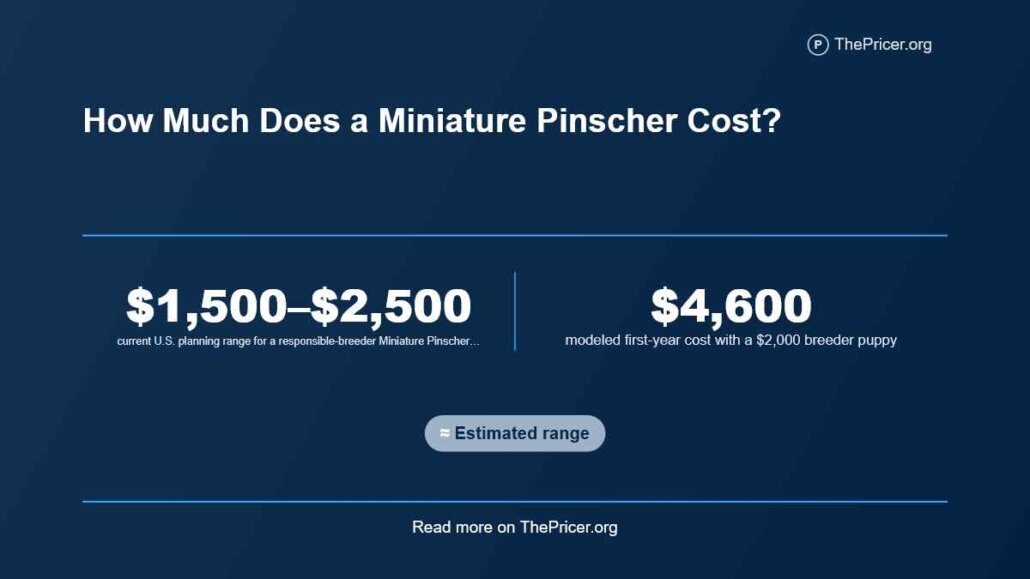
A Miniature Pinscher puppy from a responsible U.S. breeder currently costs about $1,500 to $2,500 based on current national breeder pricing. Individual breeder listings can extend above that band before taxes and platform fees. Breed-rescue adoption can cost much less, but Miniature Pinscher rescue fees are often tied to veterinary work rather than one fixed national price.
The Min Pin is inexpensive to feed and groom compared with many larger or long-coated dogs, but the puppy, veterinary care, training, parasite prevention, insurance, and a secure home setup can make the first year expensive. A modeled breeder-puppy first year below comes to about $4,600 before any remaining vaccine charges, dental treatment, boarding, or emergency care.
Article Highlights
Jump to sections
- Current national responsible-breeder pricing is about $1,500 to $2,500.
- One current breeder payment schedule reaches $2,000 to $3,000 before taxes and fees.
- Breed-specific rescue pricing can be case-specific because veterinary and travel expenses may be reimbursed.
- A modeled breeder-puppy first year comes to about $4,600.
- A current retail food example for a 10-pound adult works out to roughly $162 per year before treats.
- Patella screening matters because kneecap problems are a recognized Miniature Pinscher concern.
How Much Does a Miniature Pinscher Cost?
The current planning range is tighter than the old $600 to $1,500 headline because live responsible-breeder listings cluster higher. A low private-ad price can still exist, but it should not be treated as the normal responsible-breeder floor without knowing the parents’ health testing, registration status, contract terms, and what veterinary work is included with the puppy.
RisingStar Miniature Pinschers currently lists $1,500 to $2,500 in current RisingStar puppy pricing before taxes and fees. Davilg Miniature Pinschers lists $2,000 to $3,000 on its current Davilg payment schedule, while its breeder note quotes $2,000 for red puppies and $2,500 for black-and-rust puppies.
The table combines the national planning range cited in the opening with the two direct breeder listings cited above. It separates the broader buyer benchmark from seller-specific payment schedules rather than blending them into one invented average.
| Current purchase route | Published price | Scope |
|---|---|---|
| National responsible-breeder market | $1,500 to $2,500 | Good Dog buyer guide |
| RisingStar breeder example | $1,500 to $2,500 | Deposit plus final payment |
| Davilg breeder payment schedule | $2,000 to $3,000 | Before taxes and fees |
Breeder vs Rescue Pricing
Miniature Pinscher adoption does not have one dependable national breed-rescue price. Internet Miniature Pinscher Service says adopters reimburse necessary veterinary and possible travel costs, and the organization requests a donation. The amount is agreed before placement. Its senior program waives the adoption donation for dogs age 10 and older and pays half of routine medical bills for those adopted seniors.
That structure explains why a simple $150 to $600 rescue range can be misleading. A dog that has already been sterilized, microchipped, vaccinated, tested, and treated for a medical issue may carry a different placement expense from a healthy dog needing little work. A local shelter can also use its own fee schedule rather than the breed-rescue model.
The price comparison needs matched scope. A breeder puppy offers a known age, documented breeding program, and stated contract terms. A rescued adult can arrive with veterinary work already completed and a known adult size and behavior profile. The rescue route can cut acquisition spending sharply, but the exact savings depend on the dog and what medical work is included before placement.
What a Breeder Price Should Buy
A higher puppy price has value only when the breeder can show what sits behind it. Current American Kennel Club guidance lists a patella evaluation for Miniature Pinschers as the recommended health test from the national breed club. Buyers can ask for the registered names of both parents and documentation of the completed screening rather than relying on a broad statement that the parents are healthy.
Contract terms matter too. Ask whether the listed puppy price includes registration paperwork, a microchip, age-appropriate vaccines, deworming, and a written health guarantee, and whether a spay or neuter agreement limits breeding rights. Those items can change early out-of-pocket spending even when two puppies carry the same sticker price. Put each included service into the first-year budget only once.
Price alone cannot identify a responsible breeder. A less expensive puppy with clear screening records and a strong contract can be a better-documented purchase than a more expensive puppy sold mainly on color or pedigree language. The useful comparison is the complete acquisition package, the parents’ health records, and the obligations written into the contract.
First-Year Min Pin Budget
A first-year model shows how quickly care can overtake the sticker price. Rover’s 2026 dog-cost data puts puppy veterinary visits at $145 to $305, preventatives at $295 to $355, training at $235 to $385, puppy insurance at $175 to $880, and puppy food at $575 to $4,775 across dog sizes and feeding choices. Essential supplies start around $260. Small dogs tend to sit toward the lower side of several size-sensitive categories. The same 2026 research places lifetime care for a small-breed dog from about $19,840, before individual health and household choices move the total higher.
Use the already established $2,000 current red-puppy example. Add $455 for a female spay using the current U.S. spay benchmark, $225 for puppy vet visits, $325 for preventatives, $260 for essential supplies, $575 for food, $235 for training, and $527.50 for insurance using the midpoint of Rover’s puppy range.
The result is $2,000 + $455 + $225 + $325 + $260 + $575 + $235 + $527.50 = $4,602.50, rounded to about $4,600. The puppy is about 43% of the modeled total. The other selected costs add $2,602.50. Remaining vaccine charges are excluded because the breeder example already includes age-appropriate vaccinations, and adding a full vaccine-series estimate could count some care twice.
Food and Everyday Costs
Food is one place where the Min Pin’s small body can save real money. A typical adult weighs about 8 to 11 pounds, so a 10-pound example is useful for testing a retail feeding plan. One current 10-pound bag of small-breed Canidae is $39.88. Its label lists 540 calories per cup, 1,616 calories per pound, and a feeding guide of one-third cup daily for a 10-pound adult.
Those inputs imply about 0.111 pound of food per day, or roughly 40.7 pounds per year. That is a little over four 10-pound bags, producing an annual dry-food cost near $162 at the current one-time purchase price. Treats, shipping, price changes, waste, mixed feeding, and veterinary diets are outside that calculation. The selected product is a pricing example, not a breed diet recommendation.
This calculation also shows why the old $30 to $60+ monthly food line was too blunt. A small dog can land well below that amount on some dry-food plans, while wet food or premium specialty diets can cost much more. The feeding label and the dog’s body condition matter more than assigning every Miniature Pinscher the same monthly food bill.
Health and Insurance Costs
Patellar luxation deserves more attention than generic statements about breed health. PetMD says $1,000 to $3,000 per affected knee is possible when surgical treatment is needed. Mild cases may be managed without surgery, while more severe cases can require surgical correction. That potential bill explains why parent screening is financially relevant even though screening cannot remove every future medical risk.
Insurance can shift part of the unexpected-risk burden, but the premium is not fixed by breed name. NerdWallet’s current summary of NAPHIA’s 2026 industry data puts the 2025 U.S. average accident-and-illness premium for dogs at $836 per year. Accident-only coverage averaged $190 per year. Those are market benchmarks across many dogs, ages, ZIP codes, deductibles, and policy designs, not quotes for a Miniature Pinscher puppy.
A buyer comparing policies should check orthopedic exclusions, waiting periods, deductibles, reimbursement percentages, annual limits, dental illness language, and pre-existing-condition rules. A cheap policy can leave more of a knee or emergency bill with the owner. An emergency fund remains useful even when insurance is carried because reimbursement timing and excluded charges can still create an immediate cash need.
Training and Grooming
Miniature Pinschers are small, but their training needs should not be priced like an optional luxury. PetMD describes the breed as energetic, intelligent, and prone to slipping through fences or darting through doors. The same Miniature Pinscher care profile puts adult weight around 8 to 11 pounds, gives a 12-to-16-year life expectancy, and describes grooming as minimal. Secure gates, a well-fitted collar or secure walking gear, recall work, and early household training can matter far more than salon appointments.
The first-year model already reserves money for structured training. Owners comparing formats can also review current dog training costs for group and private options. Professional help is not required every year, but an early course can be a sensible first-year expense for a quick, independent toy breed.

Grooming is comparatively cheap. The short coat usually needs simple home brushing, nail care, bathing as needed, ear checks, and dental care rather than repeated clipping. Readers comparing small companion breeds can see how that differs from Coton de Tulear costs and Papillon dog costs, where coat care has a different role in the budget.
Choosing the Right Budget
The strongest Miniature Pinscher budget separates acquisition from ownership. A breeder puppy can absorb a large share of the opening budget before routine care begins, while the worked scenario shows that the selected care costs can exceed the purchase price within the first year. The puppy is the expensive part of acquisition. It is not the whole expense.
Small size works in the owner’s favor for food, some medications, equipment, and grooming. Long-lived dog ownership works in the opposite direction because routine costs repeat for many years. A specific Miniature Pinscher can land far above the first-year model after years of veterinary care, insurance, food, dental work, travel, and replacement supplies. The first-year total is a starting budget, not a lifetime projection.
Makes sense if
- You can pay the puppy price without spending the money reserved for veterinary care.
- You want a tiny, active dog with low coat-maintenance costs.
- You can provide secure doors, gates, fencing, and consistent training.
- You will verify parent health screening and contract terms before paying a deposit.
Does not make sense if
- Your budget covers the puppy but leaves little room for first-year medical care.
- You expect the breed’s small size to make every ownership category cheap.
- You want a dog that needs little training or supervision around exits.
- You are paying a premium mainly for color without stronger health documentation.
Answers to Common Questions
How much does a Miniature Pinscher puppy cost?
Current national responsible-breeder pricing is about $1,500 to $2,500. Individual current breeder payment schedules can reach about $3,000 before taxes and fees.
How much should I budget for the first year?
The worked breeder-puppy scenario comes to about $4,600 before remaining vaccine charges, dental treatment, boarding, or emergency care.
How much does a Miniature Pinscher cost to feed?
Food depends on calorie density and the dog’s weight. One current 10-pound-dog retail example works out to about $162 per year for dry food before treats, shipping, or price changes.
Are Miniature Pinschers expensive to groom?
No regular clipping schedule is needed for the short coat. Home brushing, nails, bathing, ear care, and dental hygiene make grooming relatively inexpensive for many owners.
What health test should I ask a breeder for?
The current national breed-club recommendation listed by the AKC includes a patella evaluation. Ask for the parents’ registered identities and the actual screening records.
Disclosure: Educational content, not medical advice. Pricing varies by provider, location, and insurance. Confirm eligibility, coverage, and out-of-pocket costs with a licensed clinician and your insurer. See our methodology and corrections policy.