
How Much Does a Quantiferon TB Gold Test Cost?
Updated on | Written by Alec Pow
This article was researched using 14 sources. See our methodology and corrections policy.
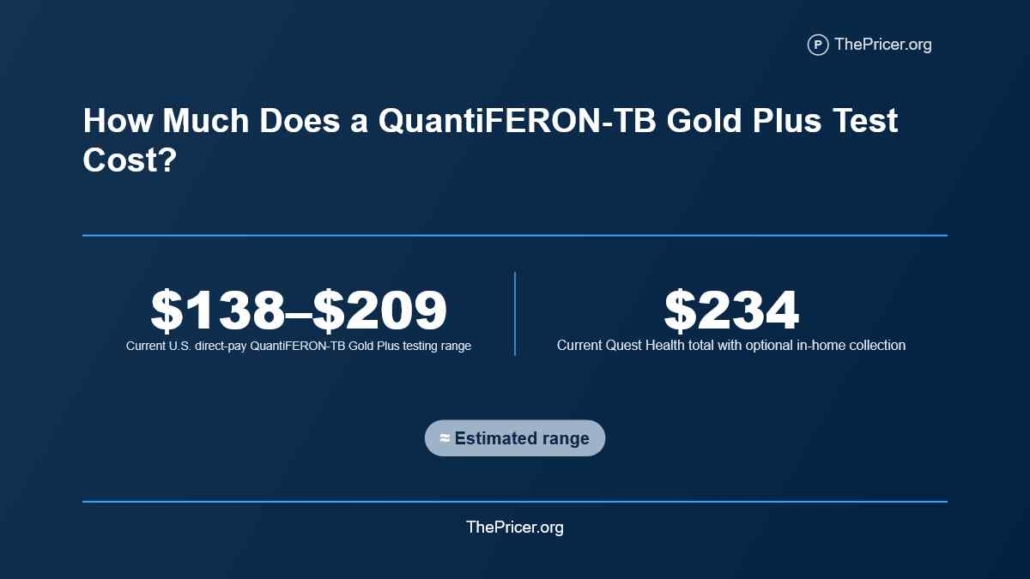
A QuantiFERON-TB Gold Plus test currently costs about $138 to $209 through the direct-pay U.S. offers reviewed for this update. Jason Health TB testing lists $138, while one Request A Test option is $205 before its disclosed service fee policy of $4, bringing that route to $209. That spread makes checkout structure part of the cost question. The test is also called QFT-Plus or an IGRA tuberculosis blood test. It measures an immune response to Mycobacterium tuberculosis. CDC’s TB diagnostic guidance says a positive blood test needs further evaluation because the screening test alone does not distinguish inactive infection from active TB disease.
Article Highlights
Jump to sections
- Direct-pay offers reviewed here run from $138 to $209 (at $30 per hour, earning that amount would take about 4.6 to 7 hours of work, before taxes).
- Labcorp OnDemand lists the test at $149.
- Quest Health lists $149 plus a $6 physician service fee, for $155.
- Request A Test lists two laboratory options that reach $149 and $209 after its disclosed service fee.
- A positive result can lead to a separate clinical evaluation, chest imaging, and other testing.
- Routine annual TB testing is not recommended for most U.S. healthcare personnel after baseline screening unless there is exposure or ongoing transmission.
How Much Does a QuantiFERON-TB Gold Plus Test Cost?
The cash prices below come from current direct-pay sellers rather than hospital chargemasters or insurance claims. The Labcorp OnDemand TB test is $149 (about 5 hours of work at $30 per hour). The Quest tuberculosis blood test costs $149 plus a $6 physician service fee. Request A Test currently shows laboratory choices at $145 and $205, with the disclosed $4 service fee added once per order.
| Direct-pay option | Published test price | Known added fee | Direct charge and timing |
|---|---|---|---|
| Jason Health | $138 | None identified on the cited listing | $138 |
| Labcorp OnDemand | $149 | None listed on the test page | $149, results listed at 2 to 5 days |
| Quest Health | $149 | $6 physician service fee, optional home collection $79 | $155, results listed at 2 to 3 business days |
| Request A Test, Lab 1 | $145 | $4 service fee | $149 |
| Request A Test, Lab 2 | $205 | $4 service fee | $209 |
The gap from the lowest reviewed direct charge of $138 to the highest of $209 is $71. Choosing the lower published route instead of the highest reviewed route reduces the cash bill by about 34%. That is a provider-choice calculation from this sample, not a national market average.
What the Price Buys
QuantiFERON-TB Gold Plus is the current QuantiFERON blood test used in the United States. CDC’s current IGRA guidance lists QFT-Plus alongside T-SPOT.TB as the two FDA-approved TB blood tests. An IGRA measures how the immune system responds after blood is exposed to TB-specific proteins rather than looking directly for tuberculosis bacteria in the bloodstream.
QFT-Plus measures interferon-gamma response to TB antigens and uses control material to help interpret that response. CDC lists positive, negative, and indeterminate as possible QFT-Plus results. The old article’s idea of a cheap “basic QuantiFERON” and a pricier “Plus” upgrade is no longer a useful buying comparison. QFT-Plus is the current product name in the CDC guidance, not an optional premium tier added to a current basic QuantiFERON test.
The posted direct-pay price usually buys the laboratory order, collection at the seller’s partner network, analysis, and a result report within that seller’s stated scope. It does not buy treatment for tuberculosis. A positive result also does not tell a patient whether the infection is inactive or active disease. Those questions belong to a separate clinical workup.
The test is widely used for employment, school, exposure, and risk-based screening. A person who needs only documentation for an institution may be shopping for a fixed-price screening service, while a person with symptoms or a recent exposure may need medical care rather than a stand-alone consumer lab purchase.
Direct Pay vs Doctor-Ordered Testing
Direct-pay testing can remove the need to schedule a routine office visit just to obtain the order. The current consumer offers in the price table arrange the laboratory order within their purchase process, though their eligibility rules and state availability differ.
The patient then visits the specified collection network and receives the report through the seller or laboratory portal. This route has a different billing path from a test ordered during medical care. Direct-pay prices should be treated as cash purchase options, while a clinician-ordered test may be processed through medical insurance when coverage rules are met. A person comparing the two paths should ask the health plan for the expected patient responsibility rather than assuming the consumer cash price will be reimbursed.
The worked direct-pay example is straightforward. Quest’s published test is $149 (about 5 hours of work at $30 per hour), and its physician service fee is $6, making the basic direct charge $155. The same Quest listing offers optional in-home collection for another $79. A buyer choosing that convenience would have an itemized total of $234 before any unrelated medical care. The extra $79 raises the direct testing bill by about 51% compared with the $155 collection-center route.
That optional home-draw example shows why the advertised lab price and the amount paid can differ without any hidden medical procedure. The key question is whether the posted price includes the order, collection method, and report the buyer needs.
When Follow-Up Costs Appear
A positive QuantiFERON result can create a second layer of spending because the blood test cannot determine whether a person has inactive TB infection or active TB disease. CDC’s TB testing overview says positive results require other tests to make that distinction, which can include a chest X-ray and sputum testing. The price of a chest X-ray is separate from the IGRA bill.
An indeterminate result can lead a clinician or institution to request another test. If a cash-paying patient repeated the same direct-pay route from this sample, two tests would create a modeled laboratory spend of $276 to $418. That range is simply two times the reviewed $138 to $209 direct charges. It does not estimate how often repeats occur.
A negative result can still lead to clinical evaluation when symptoms, immune suppression, or recent exposure make tuberculosis a concern. The blood test is one part of a screening and diagnostic pathway. This distinction matters for budgeting. Someone who needs clearance paperwork after a negative result may finish with one direct-pay charge, while a positive, indeterminate, or clinically concerning result may lead to imaging, clinician visits, or other tests after the original laboratory purchase.
Insurance and Workplace Screening
Insurance coverage depends on why the test is being performed and how it is ordered. The U.S. Preventive Services Task Force gives risk-based LTBI screening a Grade B recommendation for asymptomatic adults at increased risk. A health plan may still apply its own network, ordering, and billing rules to the laboratory service.
That does not make every QuantiFERON purchase a $0 test. Employment, school, immigration, or convenience testing can follow different benefit rules, and direct-pay consumer purchases may sit outside ordinary insurance billing. Ask the insurer for the in-network laboratory and expected patient responsibility before paying cash.
Healthcare workers also need updated frequency guidance. CDC says healthcare personnel screening should occur at baseline, but routine annual testing is not recommended after baseline unless there is a known exposure or ongoing transmission. State and local requirements can differ. This correction matters because the old article could make a reader budget for yearly blood testing that federal guidance no longer recommends for most healthcare personnel.
If an employer or school requires documentation, ask whether it pays directly, reimburses employees, accepts either IGRA or skin testing, or requires a named test. Those policy details can matter more than the laboratory list price.
Results and Collection Timing
Consumer turnaround is usually measured in days, not a guaranteed next-day result. The current listings in the price table show Labcorp at two to five days after the sample reaches its laboratory and Quest at two to three business days. Those are seller estimates rather than guarantees, and the collection appointment can add time before laboratory processing begins.
QuantiFERON collection is time-sensitive, so some sites limit when these samples are drawn or shipped. A buyer with a school or work deadline should confirm that the chosen location performs QFT-Plus collections on the planned day and should leave room for the seller’s stated processing window.
The fastest-looking price is not always the fastest completed test. A nearby collection site, a suitable draw time, and a report that satisfies the institution can be worth more than saving a few dollars on a route that adds scheduling friction. A slightly cheaper test can be a poor match if its collection network or processing schedule does not fit the deadline. Price, location, documentation format, and expected result date belong in the same comparison.

QuantiFERON vs the TB Skin Test
QuantiFERON-TB Gold Plus and the tuberculin skin test both screen for TB infection, but they create different visit patterns. CDC’s TB blood test guidance says an IGRA requires one patient visit and is preferred for people who received the BCG vaccine. The blood test is not affected by BCG vaccination, which can complicate interpretation of a skin test.
The skin test requires placement and a return visit 48 to 72 hours later so a trained person can read the reaction. That second visit can matter for work schedules, transportation, and missed appointments even when the skin test’s cash price is lower. The broader TB testing cost comparison should match both price and visit requirements rather than comparing one laboratory fee with an incomplete skin-test quote.
Blood testing is not automatically the right choice for every person. CDC says a TB skin test remains an acceptable alternative when blood testing is unavailable, too costly, or too burdensome. Current CDC guidance also still prefers the skin test for children younger than 5, while noting that some experts use blood tests in younger children.
The practical price advantage changes with the reason for screening. Someone with a BCG history or difficulty returning for a skin-test reading may value one-visit blood testing more. Someone with easy access to a low-cost clinic and no BCG issue may find the skin test less expensive.
How to Compare Testing Options
Start with the price that reaches the result, not the number printed beside the test name. For the current offers reviewed here, that means adding a disclosed order or physician service fee when one applies. It also means checking whether the collection site is available nearby and whether the report meets the employer, school, or clinical requirement.
People who cannot comfortably pay a private cash price can ask local public or community clinics whether QFT-Plus or another accepted TB test is available. Prices and test types vary by site. Students comparing several clearance requirements may also need a separate titer test for vaccine-immunity documentation.
Makes sense if
- You need a one-visit TB blood test for accepted work or school documentation.
- You have confirmed the final direct-pay charge, including order fees.
- You received BCG vaccination and an IGRA fits the screening requirement.
- The chosen collection site can meet your deadline.
Does not make sense if
- You are paying cash before checking whether qualifying risk-based screening is covered by your plan.
- You have TB symptoms and are using a consumer screening purchase in place of medical evaluation.
- Your institution requires a different test or its own paperwork.
- You are repeating annual healthcare-worker testing only because an outdated general rule says it is required.
Answers to Common Questions
How much does a QuantiFERON-TB Gold Plus test cost without insurance?
The current direct-pay offers reviewed here run from $138 to $209, with several options around $149 to $155.
Is QuantiFERON-TB Gold Plus a different premium test?
No. QFT-Plus is the current QuantiFERON TB blood test sold in the United States. Older QuantiFERON generations should not be treated as cheaper current tiers.
How long do QuantiFERON results take?
Current consumer sellers commonly quote several business days. The examples reviewed here range from about two to five days depending on the laboratory and seller.
Does a positive QuantiFERON result mean active tuberculosis?
No. A positive result supports TB infection, but further medical evaluation is needed to determine whether the infection is inactive or active disease.
Do healthcare workers need a QuantiFERON test every year?
CDC does not recommend routine annual TB testing for most U.S. healthcare personnel after baseline screening unless there is known exposure or ongoing transmission. State and local requirements can differ.
Disclosure: Educational content, not medical advice. Pricing varies by provider, location, and insurance. Confirm eligibility, coverage, and out-of-pocket costs with a licensed clinician and your insurer. See our methodology and corrections policy.