
How Much Does a Russian Blue Cat Cost?
Updated on | Written by Alec Pow
This article was researched using 14 sources. See our methodology and corrections policy.
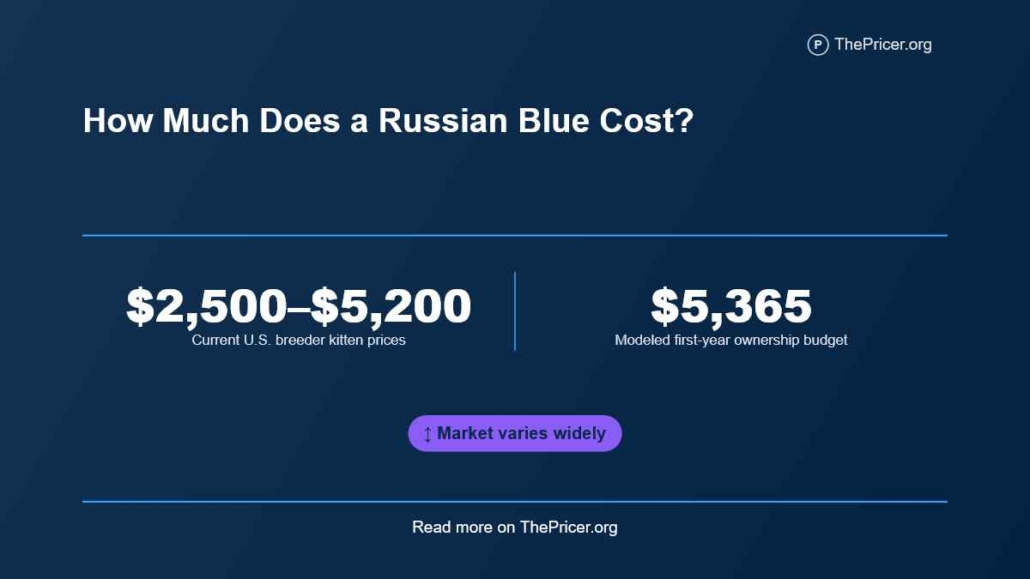
A purebred Russian Blue kitten currently costs about $2,500 to $5,200 in the direct U.S. breeder examples reviewed for this update. That is an observed 2026 breeder-market band, not a national average. Current offers include $2,500, $3,500, and $5,200 base prices, with deposits and optional selection fees changing the cash needed before pickup.
The first-year bill is higher than the kitten price because food, litter, insurance, gear, and later veterinary care continue after the breeder handoff. Buyers also need to compare what each breeder has already paid for, such as vaccinations, microchipping, sterilization, health records, a carrier, or temporary insurance, so those costs are not counted twice.
Article Highlights
Jump to sections
- Current direct breeder examples reviewed run from $2,500 to $5,200 (at $30 per hour, earning that amount would take about 2.1 to 4.3 full-time workweeks, before taxes) for a Russian Blue kitten.
- Current reservation deposits in the reviewed offers range from $250 to $500 in the examples used for deposit analysis.
- One breeder’s optional pick-of-litter fee raises a $5,200 kitten to $6,125 before tax or transport.
- A calculated first-year scenario using a $3,500 kitten comes to about $5,365 with selected 2026 care assumptions.
- Russian Blues are not hypoallergenic, so allergy-treatment savings should not be built into the ownership budget.
- The breed’s short double coat is low-maintenance, which can keep routine grooming spending modest.
How Much Does a Russian Blue Cost?
The current breeder market is well above the old $500 to $1,500 (about 0.4 to 1.3 full-time workweeks at $30 per hour) headline. RBPBlues in Missouri currently lists $2,500 Russian Blue kittens with a $500 deposit applied to the purchase. The package includes age-appropriate vaccines, deworming, rabies vaccination, a veterinary health exam, a carrier, TICA registration paperwork, and a food sample.
WhimsyPixie in New Jersey posts $3,500 pet-kitten pricing. That puts the middle direct example $1,000 above the Missouri offer before reaching the highest-priced breeder in the current sample. The difference should be read beside the contract and included veterinary work rather than as a quality ranking.
| Current direct breeder example | Published kitten price | Reservation terms |
|---|---|---|
| RBPBlues, Missouri | $2,500 | $500 deposit applied to total |
| WhimsyPixie, New Jersey | $3,500 | $500 non-refundable deposit |
| ArchangelCat, Idaho | $5,200 | $250 non-refundable reservation deposit |
ArchangelCat’s published pricing is a $250 reservation plus a $4,950 remaining balance, producing a $5,200 base total before tax where applicable. The three prices are a small current sample of direct breeder offers, not evidence that every U.S. breeder sits inside this range.
Why Russian Blue Prices Vary
Russian Blue pricing changes because breeder programs sell different packages and use different contracts. The $2,500 (about 2.1 full-time workweeks at $30 per hour) RBPBlues offer includes a carrier, registration paperwork, vaccinations, rabies vaccination, deworming, and a veterinary exam.
WhimsyPixie includes age-appropriate vaccines, spay or neuter surgery, a microchip, deworming, one month of insurance, TICA papers, toys, and a health guarantee in its $3,500 price. Those inclusions have real value and should be separated from the pedigree premium itself.
Reservation timing can change the practical comparison too. A breeder may place families on a waitlist before a litter is born, while another may price a kitten only after availability is known. The buyer should separate the total kitten price from the amount due today, the amount due at selection, and any charge that is optional. Those stages change cash flow even when the final base price stays the same.
The widest price gap in the current sample is $2,700, from $2,500 to $5,200. The higher base price is about 108% above the lower one. That comparison is useful only as a market spread because the packages, breeder programs, contract terms, and locations differ. A buyer should compare the actual services and documents included rather than treating price as a quality score.
What the Breeder Price Should Include
A breeder quote should be read like a package. Russianbluezz, an active TICA-listed cattery, states that its kitten price includes paperwork, a medical book, microchip, vaccinations, rabies vaccination, deworming, FeLV and FIV tests, and spay or neuter surgery. That kind of itemization helps the buyer avoid setting aside money twice for services that are already completed.
Other breeders leave some work to the new owner. ArchangelCat says its base package includes a veterinary exam, microchip, age-appropriate medical care, registration access, a carrier, and 30 days of pet insurance, but spay or neuter can involve an additional veterinary charge when it is performed before departure. The contract should identify who pays, when the service must happen, and whether registration or pedigree documents depend on completion.
Health claims need the same precision. A statement such as “genetically tested” does not tell the buyer which diseases were tested or what result applies to the kitten. Ask for the parents’ registered names, copies or registry references for test results, the kitten’s medical record, vaccination dates, and the written health guarantee. The lower-priced kitten can still be the more complete package if those items are included and verifiable.
First-Year Russian Blue Cost
A first-year calculation should add only costs that remain after the breeder package. Rover’s 2026 U.S. cat-cost research places annual food at $225 to $1,920, litter at $125 to $580, toys at $20 to $350, pet insurance at $120 to $1,140, routine annual exams at $80 to $200, and general gear at $20 to $330. Those are broad U.S. cat ranges rather than Russian Blue-only figures.
One itemized scenario starts with WhimsyPixie’s $3,500 kitten because the breeder already includes sterilization, microchipping, vaccines, deworming, one month of insurance, registration paperwork, and some toys. Choose $600 for food, $300 for litter, $250 for home gear, $100 for later toy replacement, $120 for a later annual exam, and $495 for the remaining 11 months of insurance at an assumed $45 per month.
The resulting ThePricer first-year scenario is $3,500 + $600 + $300 + $250 + $100 + $120 + $495 = $5,365. It excludes transportation, boarding, pet rent, emergency treatment, dental work, and any optional premium furniture. The non-purchase values are chosen assumptions inside Rover’s published ranges, so $5,365 is a reproducible scenario rather than an average.
Deposits and Optional Charges
Deposits change the timing of the purchase even when they are credited toward the final price. WhimsyPixie’s current purchasing terms use a $500 non-refundable holding fee for pet kittens. The same page says the fee is returned or transferred if the breeder cannot provide the kitten for a breeder-side reason. A buyer who cancels has different exposure from a breeder who cannot complete the placement.
ArchangelCat uses a different structure. Its current reservation form lists a $250 non-refundable deposit for one kitten and an optional $925 pick-of-litter fee due later. Pair that with the already established $5,200 base acquisition price and the optional selection raises the kitten to $6,125 before tax, transport, or any separate sterilization charge. The optional feature adds about 18% to the base price.
These terms show why “deposit” and “price” should not be merged into one number without reading the contract. A deposit may be applied to the purchase yet still be non-refundable if the buyer changes plans. Optional selection fees can raise the total without changing routine veterinary care. Travel can add another bill when pickup is not practical, so transport should be priced separately for the buyer’s route.
Annual Ownership

After the purchase year, the recurring budget is driven less by breed and more by feeding choices, insurance, litter, veterinary care, and the household’s use of paid services. Using the Rover ranges cited in the first-year section, food alone can run $225 to $1,920 per year, while litter can add $125 to $580. Those two essentials combine to $350 to $2,500 per year before insurance, veterinary care, toys, or replacement gear.
Converted to a monthly planning figure, that food-and-litter combination is about $29 to $208 per month. Add insurance using Rover’s already cited $120 to $1,140 annual range and the three categories together become $470 to $3,640 per year, or roughly $39 to $303 per month. This is not a complete ownership total because exams, dental care, emergencies, boarding, and gear remain outside it.
The pet insurance cost guide explains why age, ZIP code, deductible, reimbursement rate, and annual limit can move premiums. Readers comparing other pedigree cats can also use the Tonkinese cat cost, Himalayan cat cost, and Norwegian Forest Cat cost as adjacent ownership-budget references.
Not Hypoallergenic
The old claim that a Russian Blue can save hundreds or thousands of dollars in human allergy treatment should be removed. The American College of Allergy, Asthma & Immunology says all cats produce allergens and studies have not shown that cats can be hypoallergenic. Hair length is not a reliable measure of allergen levels.
The Russian Blue Breed Council goes further and states directly that Russian Blues are not hypoallergenic. That makes allergy-treatment savings an unsuitable part of a Russian Blue cost estimate. A household with known cat allergy should make the adoption decision around medical advice and individual exposure, not a breed marketing claim.
This correction changes the economics too. A Russian Blue should not be purchased with an assumed future saving on antihistamines, specialist appointments, cleaning, or other allergy-related expenses. Those costs vary by person and cannot be responsibly offset against the kitten price. The breed’s low-maintenance coat may reduce grooming work, but grooming convenience and human allergen exposure are separate questions. Coat color, short hair, and dense fur should not be treated as financial proxies for lower allergy risk.
Health Costs
The Cat Fanciers’ Association describes the Russian Blue as a healthy natural breed and says it is not known for specific genetic problems, while also noting that the relatively small gene pool may warrant care in breeding programs. CFA flags large appetites and obesity risk, which makes measured feeding and routine weight monitoring relevant to the long-term care budget rather than a special breed medication allowance.
TICA lists a 10-to-20-year life expectancy and describes the dense short coat as easy to maintain with brushing or combing once or twice a week. That combination matters financially. A long lifespan can mean many years of food, litter, insurance, dental care, and veterinary exams, while routine coat care can often stay at home rather than requiring scheduled professional grooming.
No healthy-kitten price can remove later medical uncertainty. Insurance can soften some covered accident or illness bills, but deductibles, exclusions, reimbursement limits, and pre-existing-condition rules still leave owner-paid costs. A cash reserve should stay separate from the purchase deposit. The purchase is short. Ownership is not.
Makes sense if
- You can pay the breeder without using the money reserved for veterinary care.
- You can verify registration, medical records, parent information, and contract terms.
- You are prepared for a waitlist rather than choosing an unverified seller for speed.
- You can support years of food, litter, insurance, enrichment, and veterinary care.
Does not make sense if
- Your budget depends on finding a pedigreed kitten near the old $500 price floor.
- You are counting on the breed being hypoallergenic.
- A non-refundable deposit would consume your emergency reserve.
- You are comparing sellers by price without checking what each package includes.
Answers to Common Questions
How much does a Russian Blue kitten cost?
The current direct U.S. breeder examples reviewed for this update range from $2,500 to $5,200. That is an observed sample, not a national average.
Why are Russian Blue kittens expensive?
Breeder packages can include veterinary care, registration, microchipping, sterilization, testing, insurance, carriers, or other items. Availability and waitlists can also affect how quickly a buyer finds a kitten.
How much can the first year cost?
The itemized scenario above totals about $5,365 using a $3,500 kitten and selected 2026 care assumptions. Transport, emergencies, boarding, pet rent, and dental treatment are excluded.
Are Russian Blue cats hypoallergenic?
No. Allergy specialists state that all cats produce allergens, and the Russian Blue Breed Council also says the breed is not hypoallergenic.
What should a Russian Blue breeder include?
Ask for a written contract, registration information, medical records, vaccination history, parent information, health-test documentation when testing is claimed, and a precise list of what the purchase price covers.
Disclosure: Educational content, not medical advice. Pricing varies by provider, location, and insurance. Confirm eligibility, coverage, and out-of-pocket costs with a licensed clinician and your insurer. See our methodology and corrections policy.