
How Much Does Spoiler Installation Cost?
Updated on | Written by Alec Pow
This article was researched using 9 sources. See our methodology and corrections policy.
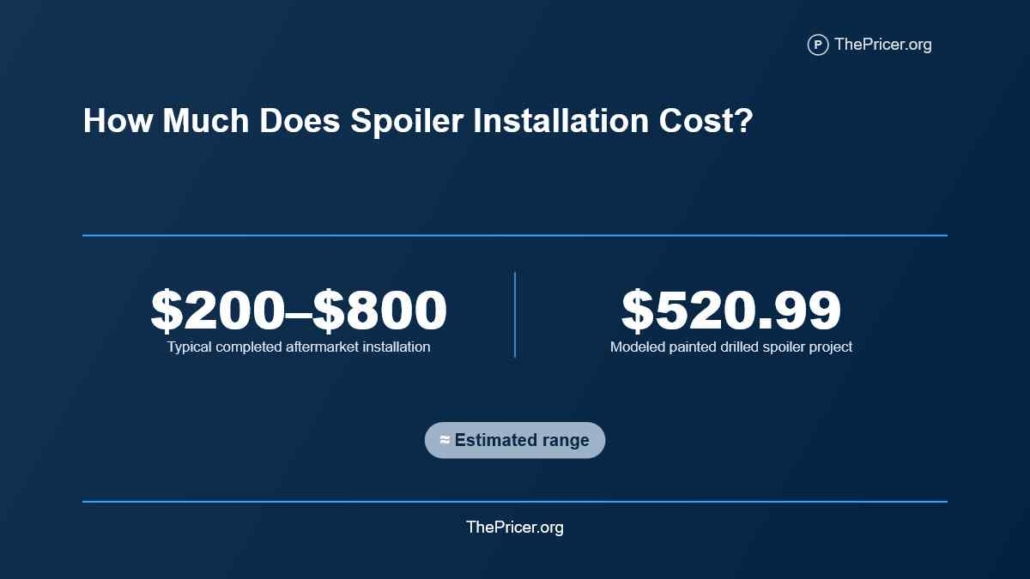
A practical budget for adding a rear spoiler to a car is about $200 to $800 for many ordinary aftermarket installations, including the spoiler and professional fitting. A cheap ABS lip spoiler that is already finished can stay near the lower end, while an unpainted spoiler that needs body-shop preparation, color matching, and drilling can easily reach $450 to $900+.
OEM and performance parts cost more. Current factory-style spoilers from Ford and Chevrolet run roughly $549 to $1,195 before installation, while carbon-fiber spoilers commonly cost around $800 to $1,700. Serious track-style rear wings can cost $2,800 to $3,000+ for the part alone.
The installation method matters almost as much as the spoiler itself. Some low-profile spoilers attach with automotive adhesive and can be fitted quickly. Others require trunk trim removal, precise templates, drilling several holes through the decklid, corrosion protection, sealing, and sometimes repair of holes left by the factory spoiler.
Article Highlights
Jump to sections
- A common aftermarket spoiler installation can cost roughly $200 to $800 (at $30 per hour, earning that amount would take about 0.8 to 3.3 full-time workdays, before taxes) total.
- Budget ABS spoilers currently start around $60 to $100.
- Professional painting of a prepared spoiler commonly adds roughly $150 to $300.
- Current OEM and Ford Performance spoilers range from about $549 to $1,195 before installation.
- Carbon-fiber rear spoilers currently run roughly $800 to $1,700, while large performance wings can cost $2,800 to $3,000+.
- Adhesive-mounted spoilers can require less than an hour of installation work, while drilled installations commonly take about 1 to 2 hours before any bodywork complications.
- ThePricer math shows how a $95.99 spoiler can become a $520.99 project once paint and installation are included.
How Much Does Spoiler Installation Cost?
| Spoiler project | Part price | Typical completed budget |
|---|---|---|
| Simple finished ABS lip spoiler | $60-$150 (about 2 to 5 hours of work at $30 per hour) | About $150-$350 |
| Unpainted ABS spoiler | $90-$250 | About $400-$700 |
| Fiberglass aftermarket spoiler | $150-$450 | About $450-$900+ |
| Pre-painted OEM-style spoiler | $500-$700 | About $600-$1,000 |
| Premium OEM/performance spoiler | $700-$1,200 | About $850-$1,500+ |
| Carbon-fiber spoiler | $800-$1,700 | About $950-$2,200+ |
| Large carbon/performance wing | $2,800-$3,100+ | About $3,000-$4,000+ |
These completed totals are planning ranges rather than national flat-rate prices. Body-shop labor rates, installation method, paint, vehicle design, existing holes, and spoiler fitment can move the final bill considerably.
At the inexpensive end, Ikon Motorsports currently sells a Mustang ABS trunk spoiler for $95.99. The important detail is that the manufacturer says drilling is required and warns that the new spoiler may not use the holes from the factory spoiler.
That small sentence can matter more to the final price than the $95.99 sticker.
A $96 Spoiler Becomes a $521 Job
A cheap unpainted spoiler does not necessarily produce a cheap finished modification.
Take the current $95.99 (about 3.2 hours of work at $30 per hour) Ikon Mustang spoiler as an example. Assume it needs a body-color finish and a drilled installation.
Use a planning budget of:
- Spoiler: $95.99
- Professional paint and preparation: $200
- 1.5 hours of installation at a hypothetical $150 per hour: $225
Total:
$95.99 + $200 + $225 = $520.99
The physical spoiler represents only:
$95.99 ÷ $520.99 = about 18.4%
That means approximately 81.6% of this modeled finished project is paint and labor rather than the spoiler itself.
This is why shopping only by the online part price can be misleading. A $100 unpainted spoiler can realistically turn into a roughly $500 modification.
Current body-shop pricing references put professional painting of a prepared spoiler at roughly $150 to $300 for a basic single-color finish. More surface repair, multi-stage pearl colors, metallic matching, and poor fiberglass finish can push the paint bill higher.
Pre-Painted OEM
A more expensive spoiler can sometimes be the better value once preparation and installation are included.
Chevrolet currently sells a Corvette Low Profile Spoiler for $549. It comes already painted in Carbon Flash Metallic and uses a no-drill installation with UHB tape and urethane. Chevrolet also includes the installation materials.
Compare that with our $520.99 modeled budget for the $95.99 unpainted Mustang spoiler.
Suppose the Corvette spoiler takes 30 minutes to one hour at the same hypothetical $150-per-hour shop rate:
$549 + $75 = $624
or:
$549 + $150 = $699
The expensive-looking $549 OEM accessory ends up only:
$624 – $520.99 = $103.01
to:
$699 – $520.99 = $178.01
more than our modeled $96 aftermarket project.
Worked example: a buyer sees a $100 unpainted aftermarket spoiler and a $550 pre-painted OEM accessory. The OEM piece appears to cost $450 more at checkout. Once the aftermarket spoiler needs $200 of paint and $225 of drilled installation, the completed-price gap can shrink to just over $100.
That is a much better comparison than part price alone.
Drilling vs. Adhesive Installation
The biggest installation divide is between spoilers that attach to existing mounting points or adhesive and spoilers that require new holes in the body.
Tesla’s current service procedure for several rear spoilers illustrates the adhesive approach. The technician cleans the surface, aligns the spoiler with a jig, removes the adhesive backing, positions the part, and applies controlled pressure along the spoiler. Tesla lists a flat-rate time of only 0.18 hour for one current Model Y spoiler retrofit procedure.
See the current Tesla adhesive spoiler procedure.
Drilled spoilers require more work and carry more risk. An AmericanMuscle installation guide for an Anderson Composites carbon spoiler estimates about 1 hour and requires a drill, multiple bits, templates, panel removal, bolts, washers, foam gaskets, and careful alignment.
Other drilled spoiler procedures from the same retailer are rated at roughly 2 hours. See the current carbon spoiler installation guide.
Drilling introduces three costs that an adhesive install avoids:
- More labor for measuring and disassembly
- Risk of a misaligned hole or damaged paint
- Need to protect exposed metal against corrosion and seal mounting holes against water
If an existing spoiler is being removed, another problem appears: the old holes may not line up with the new part.
Old Spoiler Holes
A replacement spoiler is cheapest when it uses the factory mounting holes already in the trunk.
If it does not, the installer may have to drill new holes while leaving some old holes unused. Those holes cannot simply be ignored if they remain visible or permit water into the decklid.
The body shop may need to weld, fill, sand, prime, and repaint part or all of the trunk lid. That can turn what looked like a simple $200 to $500 spoiler project into a bodywork job costing hundreds more.
The current Ikon Mustang spoiler mentioned earlier specifically says it may not use holes from the factory spoiler. That is exactly the kind of fitment note to check before buying.
If your car already has a spoiler, ask the seller for the mounting-hole pattern or installation instructions and compare them with the factory part before ordering.
Carbon-Fiber Spoilers

Carbon fiber moves the project into a much higher price category.
Anderson Composites currently lists several carbon-fiber rear spoilers for the 2024-2026 Mustang at:
- Type-GR rear spoiler: $1,199
- STG-type rear spoiler: $1,699
- Dark Horse Type-AC spoiler with Gurney flap: $1,699
- GT5 carbon-fiber rear wing: $2,999
The current Anderson Composites spoiler catalog demonstrates how quickly a genuine carbon component can move beyond the price of ordinary ABS or fiberglass.
Carbon fiber is light and stiff and can be appropriate for a performance-oriented part, but paying for carbon does not automatically mean the spoiler has been aerodynamically developed for your exact vehicle.
OEM Performance Spoilers
Factory performance parts also show how wide the price range can become.
Ford Performance currently lists:
- 2015-2023 Mustang Track Pack rear spoiler: $565
- 2015-2023 Mustang PP1 rear spoiler: $585
- Mustang rear spoiler with Gurney flap: $700
- 2024-2026 Performance Pack spoiler with Gurney flap: $1,195
- FP350S rear wing kit: $2,820
The current Ford FP350S wing costs $2,820 before installation.
Compare it with Ford’s $700 spoiler:
$2,820 – $700 = $2,120 more
Ratio:
$2,820 ÷ $700 = 4.03
The track-oriented wing therefore costs just over 4 times as much as the $700 performance spoiler before either is installed.
Spoiler vs. Wing vs. Splitter
A spoiler, wing, splitter, air dam, and diffuser are not interchangeable terms.
Rear spoiler: normally attaches directly to the trunk, hatch, or rear roof edge and alters airflow leaving the rear of the vehicle. A properly engineered spoiler can reduce rear lift and may also affect drag.
Rear wing: usually sits above the body on supports so airflow can act on both sides of an airfoil-shaped element. Performance wings are often designed to generate downforce, normally with a drag penalty.
Front splitter: projects forward near the bottom of the front bumper and helps manage pressure and airflow around and underneath the front of the car.
Air dam: reduces the amount of high-energy airflow reaching the underside of the vehicle from the front.
Rear diffuser: manages airflow as it exits underneath the rear of the vehicle.
The idea that a rear spoiler simply exists to “stop air getting under the car” is therefore incorrect.
SAE research on passenger cars notes that rear aerodynamic aids can reduce rear lift, improve high-speed stability, and in some designs reduce drag. Those effects depend on the geometry of the spoiler and vehicle rather than the presence of a spoiler alone.
What Are Spoilers Made From?
ABS plastic is common on affordable aftermarket and factory-style spoilers. It is inexpensive, relatively light, and can be molded into complex shapes. Current Ikon ABS spoilers start below $100.
Polyurethane is another flexible polymer used for exterior body parts. It should not be confused with silicone, which is not the normal structural material implied by many older spoiler descriptions.
Fiberglass or FRP allows manufacturers to create larger or more complex shapes at a relatively low material cost. The downside is that inexpensive fiberglass parts can require significant sanding, filling, and fitting before paint.
Carbon fiber is lightweight, rigid, visually distinctive, and expensive. Current name-brand carbon spoilers easily reach $1,000 to $1,700, while large carbon wings can approach or exceed $3,000.
Material affects price, but fitment quality can have a larger effect on the completed installation bill. A well-fitting ABS spoiler requiring little preparation may cost less to finish than a cheap fiberglass part that arrives wavy or poorly molded.
Does a Spoiler Improve Performance?
A correctly engineered spoiler can alter lift, drag, stability, and crosswind response. It does not follow that every aftermarket spoiler will improve those characteristics.
Position, height, width, angle, vehicle shape, underbody airflow, front aero balance, suspension, and driving speed all affect the result.
For a street car, many spoilers are purchased primarily for appearance. That is not a problem as long as the buyer does not assume the part creates verified downforce simply because it looks similar to a racing component.
OEM and serious motorsport parts are more likely to have engineering data behind them. Ford, for example, describes its current Mustang Performance Pack spoiler as designed to add downforce as well as style.
Other performance upgrades can dwarf the price of a spoiler. Compare our guides to supercharger installation costs, Flowmaster exhaust system prices, and twin-turbo installation costs.
What We Verified
- Checked: current inexpensive ABS rear spoilers can be bought for roughly $60 to $100, including a current $95.99 Ikon Mustang example.
- Confirmed: Chevrolet currently prices its painted no-drill Corvette Low Profile Spoiler at $549.
- Cross-referenced: current Ford Performance rear spoilers run from roughly $565 to $1,195, while the FP350S rear wing costs $2,820.
- Verified: current Anderson carbon-fiber Mustang spoilers cost roughly $1,199 to $1,699, with a larger carbon rear wing at $2,999.
- Checked: real installation procedures range from adhesive-mounted spoiler work measured in fractions of an hour to drilled installations commonly estimated around 1 to 2 hours.
- Confirmed: rear spoilers can reduce rear lift when correctly designed, rather than simply preventing air from going underneath the car.
Answers to Common Questions
How much does it cost to install a spoiler?
A practical completed budget is about $200 to $800 for many ordinary aftermarket spoilers. An unpainted drilled spoiler can cost $450 to $900+ once bodywork and installation are included, while premium carbon or performance parts can push the project past $2,000 to $3,000.
How much does a spoiler cost without installation?
Budget ABS spoilers currently start around $60 to $100. OEM-style parts often cost $500 to $700, premium factory performance spoilers can reach $1,200, and carbon-fiber spoilers commonly cost around $800 to $1,700+.
How much does it cost to paint a spoiler?
A prepared spoiler with a straightforward single-color finish commonly costs roughly $150 to $300 to paint professionally. Poor surface quality, fiberglass repair, pearl or tri-coat colors, and difficult color matching can increase the price.
Do all spoilers require drilling?
No. Some spoilers attach with high-strength automotive adhesive or existing factory holes. Others require new holes through the trunk or hatch. Check the installation instructions before buying because drilling can add labor and create extra bodywork if the new mounting pattern does not match existing holes.
Does adding a spoiler make a car faster?
Not automatically. A properly engineered spoiler can reduce lift and sometimes drag, but other designs trade additional drag for more downforce. Cosmetic aftermarket spoilers may have little measurable aerodynamic benefit.
Disclosure: Educational content, not financial advice. Prices reflect public information as of the dates cited and can change. Confirm current rates, fees, taxes, and terms with official sources before purchasing. See our methodology and corrections policy.