
How Much Does a Camel Cost?
Updated on | Written by Alec Pow
This article was researched using 13 sources. See our methodology and corrections policy.
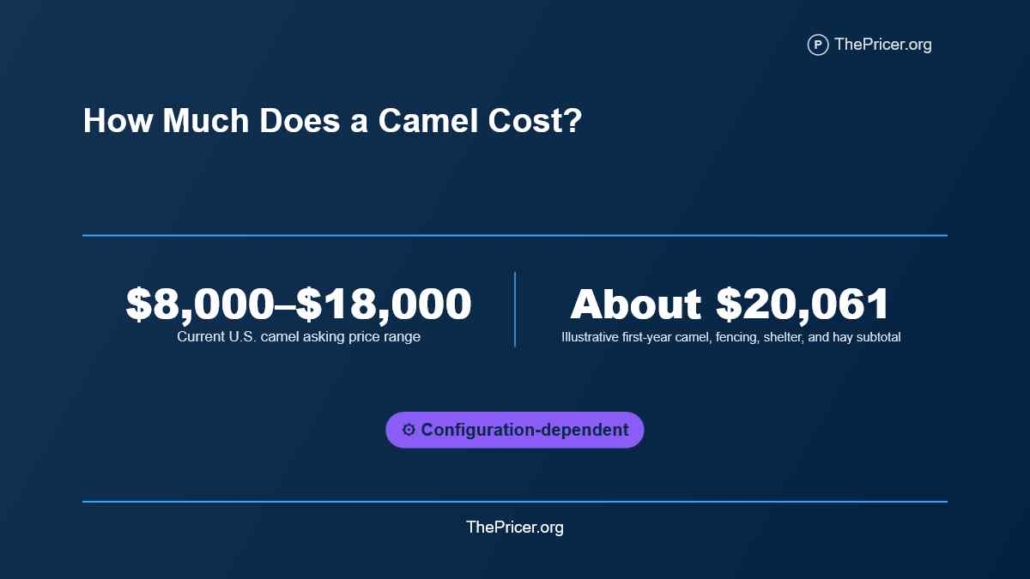
A camel currently costs about $8,000 to $18,000 in the recent U.S. public listings reviewed for this update. Ordinary individual listings cluster closer to $8,000 to $13,000, while Bactrian calves, hybrids, breeding stock, unusual color, and highly trained animals can move above that band. A camel buyer also has to budget for secure fencing, shelter, forage, veterinary care, transport, and decades of upkeep.
The purchase price varies sharply because “camel” covers dromedaries, domestic Bactrians, and crosses between the two. Age, sex, breeding history, bottle raising, handling, saddle training, color, and location all affect the seller’s asking price. A low livestock price can become expensive once a property has to be rebuilt around a 1,000-pound-plus animal.
Article Highlights
Jump to sections
- Recent U.S. camel listings reviewed here range from about $8,000 to $18,000 (at $30 per hour, earning that amount would take about 1.5 to 3.5 months of full-time work, before taxes).
- A 2026 two-week-old bottle-fed male was listed at $8,000, while a nine-year-old trained gelding was listed at $13,000.
- A 2026 F2 Bactrian-dromedary female was advertised for $18,000.
- A modeled 200-by-200-foot camel paddock needs 800 linear feet of perimeter fencing before gates and handling pens are added.
- Using current retail hay and a 9-kilogram daily hay benchmark produces a high-side forage budget of about $3,901 per year.
- A first-year example built around a $12,500 dromedary female reaches about $20,061 before posts, gates, labor, transport, veterinary work, and land.
How Much Does a Camel Cost?
Current public U.S. asking prices show a thin market rather than one dependable national average. Exotic Animals for Sale currently shows a camel listing page with a nine-year-old gelding at $13,000 (about 10.8 full-time workweeks at $30 per hour) and an eight-year-old female dromedary at $12,500. The gelding has basic handling and has started saddle work, while the female includes an older saddle that needs repair.
A separate April 2026 listing offered a bottle-fed male camel at $8,000. That price was for a two-week-old animal, so it cannot be compared directly with a mature trained camel. A young camel can carry a lower purchase price while creating more bottle-feeding, training, time, and long-term management work for the buyer.
| Recent U.S. listing | Asking price | Why the comparison differs |
|---|---|---|
| Two-week-old bottle-fed male | $8,000 | Very young animal requiring continued raising and training |
| Eight-year-old female dromedary | $12,500 | Mature female with an older saddle included |
| Nine-year-old gelding | $13,000 | Basic handling plus early saddle work |
| F2 Bactrian-dromedary female | $18,000 | One-month-old hybrid female |
The useful headline is about $8,000 to $18,000 for the recent public U.S. sample, with many ordinary individual offers nearer $8,000 to $13,000. These are advertised prices, not completed-sale records. A buyer should compare age, species, training, health records, reproductive value, and delivered cost before deciding that one camel is cheaper than another.
Species and Breeding Value
Dromedaries have one hump, domestic Bactrian camels have two, and hybrids combine traits from both lines. The old article treated the domestic Bactrian and the critically endangered wild camel as though they were the same animal. They are not. The unusual ability to tolerate extremely saline water is documented in wild Camelus ferus, not as a normal husbandry trait of every domestic two-humped camel.
Current pricing also shows how genetics can affect the market. A one-month-old F2 hybrid female was listed in Texas at $18,000 (about 3.5 months of full-time work at $30 per hour) in June 2026. A 2025 New Mexico offer for white Bactrian bull calves ranged from $12,000 to $18,000. Those figures should be read as specialty asking prices rather than a fixed Bactrian rate.

Training and reproductive history matter too. A camel that leads, loads, kneels on cue, stands for care, accepts tack, or has a proven breeding record can save years of handling work. Color and pedigree can raise asking prices in a small market, but they should not replace a health exam, behavior assessment, species verification, and facility check. Breeding plans also change the value of females, proven sires, and unrelated pairs.
The Hidden Price of Housing
Camel fencing has to resist a large animal leaning, rubbing, pushing, or colliding with it. Government husbandry guidance recommends fencing at least 1.9 meters, about six feet, for camels and warns against barbed wire in a domestic setting. The same camelid housing guidance calls for secure construction, suitable ground, shade, shelter, and regular fence inspection.
A 100-foot non-climb fence roll currently costs $369.99. A modeled 200-by-200-foot square paddock has 800 feet of perimeter, so eight rolls alone cost $2,959.92. Posts, corners, braces, fasteners, gates, machinery, labor, a catch pen, and repairs are still missing. The model is a cost illustration, not a universal acreage recommendation. A handling alley or catch pen may need stronger construction than the main pasture fence.
Shelter adds another layer. A current 12-by-20-foot run-in livestock shelter costs $699.99. Climate and species change what is adequate. A Bactrian camel has a very different coat and cold tolerance from a dromedary. The retail shelter price is only a hardware benchmark, not a camel welfare minimum. Buyers in wet, cold, or very hot regions may need stronger structures, drainage, bedding, shade, wind protection, and freeze-proof water systems.
What Feeding Can Cost
Camels are adapted to fibrous forage, but that does not mean feed is almost free. Modern camel-farming research reports dry-matter intake near 1% of body weight for maintenance and close to 2% for a lactating 620-kilogram dromedary. Other managed-camel rations commonly use roughly 8 to 10 kilograms of hay or comparable roughage each day, with additional feed adjusted to body condition, work, growth, pregnancy, or milk production.
A 50-pound orchard-grass bale currently costs $26.99. Using 9 kilograms, about 19.8 pounds, of hay per day as a transparent retail-cost model is equivalent to about 145 of those 50-pound bales per year. That works out to roughly $10.69 per day and $3,901.13 per year.
This is a high-side small-bale retail model, not a prescribed diet. Owners with productive pasture or access to farm-scale hay can spend less per pound. Owners in drought, winter, or poor-pasture areas can spend more. Feed quality also matters because camel nutrition research links intake needs to maintenance, lactation, and production level. Mineral supplements and concentrates should be chosen for camels rather than copied from cattle feed without veterinary advice.
Vet, Training, and Transport
Veterinary care is difficult to reduce to one national camel fee. The buyer needs a large-animal or exotic-livestock veterinarian willing to work with camels, plus a safe place for examination and restraint. Routine work can include health examinations, parasite control, vaccination decisions, dental care, reproductive work, blood tests, and treatment of injuries. Emergency care can involve farm-call distance, extra staff, sedation, or transport to a facility.
Training can add value before the sale or become a separate expense afterward. A camel that loads into a trailer, accepts a halter, kneels on cue, and stands for routine care is easier and safer to manage than an unhandled adult. The current $13,000 gelding listing is $5,000 above the $8,000 bottle-baby listing, a 62.5% price gap. Age and sex differ too, so that gap cannot be assigned to training alone, but it shows why buyers should not compare price tags without comparing handling history.
Transport can be another major bill because a camel requires a suitable trailer, experienced handlers, route planning, and destination paperwork. Commercial animal carriers that take custody of regulated animals fall under federal transport standards, according to USDA transport guidance. Interstate entry rules can add health certificates, testing, identification, or permits set by the destination state.
A First-Year Camel Budget
A buyer starting without camel infrastructure can cross $20,000 quickly. Take the current $12,500 female dromedary listing, then add the modeled eight rolls of six-foot fencing at $2,959.92, the $699.99 run-in shelter, and the retail hay model of $3,901.13. The subtotal is $20,061.04.
The arithmetic is $12,500 + $2,959.92 + $699.99 + $3,901.13 = $20,061.04. It is deliberately incomplete. Fence posts, gates, braces, installation, land, water equipment, transport, veterinary care, training, insurance, manure management, bedding, supplements, and emergency repairs are excluded. A professionally built paddock can raise the infrastructure bill far beyond the wire-only figure.
The same model also shows how misleading the purchase price can be. The camel represents about 62% of the visible subtotal. Housing wire, shelter, and one year of retail hay account for the other 38% before many unavoidable property costs appear. An owner who already has suitable pasture, fencing, shelter, and livestock equipment can spend far less during year one than a buyer starting with an empty field.
Why Saudi Prices Reach Millions
Saudi camel prices belong to a separate market from an ordinary U.S. farm or pet purchase. Racing bloodlines, breeding reputation, beauty competition results, prestige, and festival awards can create values that have little connection to the cost of a routine riding or companion camel. Mixing those figures into a normal U.S. price range makes the everyday market look far more expensive than it is.
Real multimillion-dollar transactions exist. In January 2023, a Saudi businessman completed a $32 million camel deal for 12 animals that had placed first at the King Abdulaziz Camel Festival. That works out to about $2.67 million per camel if the package price is divided evenly, though the reported deal did not assign an individual value to each animal.
That verified transaction is useful as an extreme specialty-market case. Festival winners can carry breeding, prestige, and competition value that an ordinary livestock camel does not. It does not support claims that an ordinary Saudi riding camel costs millions, and it does not validate unsourced internet stories about a $200 million individual camel. Those claims should be kept out unless a traceable sale record supports them.
Is Camel Ownership Practical?
Camels can live for decades and are social animals, so the purchase should be treated as a long livestock commitment rather than an unusual one-time acquisition. They need space, secure containment, appropriate companionship, experienced handling, veterinary access, reliable forage, and a transport plan. A tame youngster can still mature into a very large animal, and intact males can become much harder to manage during breeding periods.
Readers comparing large livestock can look at the cost of a llama, an alpaca, or an Akhal-Teke horse. Those animals differ in size and husbandry, but each shows why infrastructure, feed, health care, and training can matter as much as the purchase price.
Makes sense if
- You already have suitable land or can fund secure camel-height fencing and shelter.
- You have located a veterinarian and transporter who will work with camels.
- You understand the animal’s species, sex, training history, and social needs.
- You can carry a multi-decade feed, repair, and emergency-care budget.
Does not make sense if
- Your budget stops at the $8,000 to $18,000 purchase price.
- You plan to use weak fencing or an improvised shelter.
- You are buying a bottle baby without a feeding and training plan.
- You are choosing a distant animal only because its asking price looks lower.
Answers to Common Questions
How much does a camel cost in the United States?
Recent public U.S. listings reviewed for this update range from about $8,000 to $18,000. Many ordinary individual listings sit closer to $8,000 to $13,000.
How much does a dromedary camel cost?
Current dromedary and general camel listings include an eight-year-old female at $12,500 and a bottle-fed young male at $8,000. Training, age, sex, and breeding value can move the price.
How much does it cost to feed a camel?
A retail-hay model using 9 kilograms per day and a current $26.99 50-pound bale works out to about $3,901 per year. Pasture and farm-scale hay can lower the cash bill.
Do camel humps store water?
No. Camel humps store fat. Their ability to cope with scarce water comes from other physiological adaptations rather than a tank of water inside the hump.
How long does a camel live?
Dromedary camels can live about 40 to 50 years in managed care, making fencing, food, health care, and property planning long-term expenses.
Disclosure: Educational content, not medical advice. Pricing varies by provider, location, and insurance. Confirm eligibility, coverage, and out-of-pocket costs with a licensed clinician and your insurer. See our methodology and corrections policy.