
How Much Does a Hospital Bed Cost for Home Use?
Updated on | Written by Alec Pow
This article was researched using 13 sources. See our methodology and corrections policy.
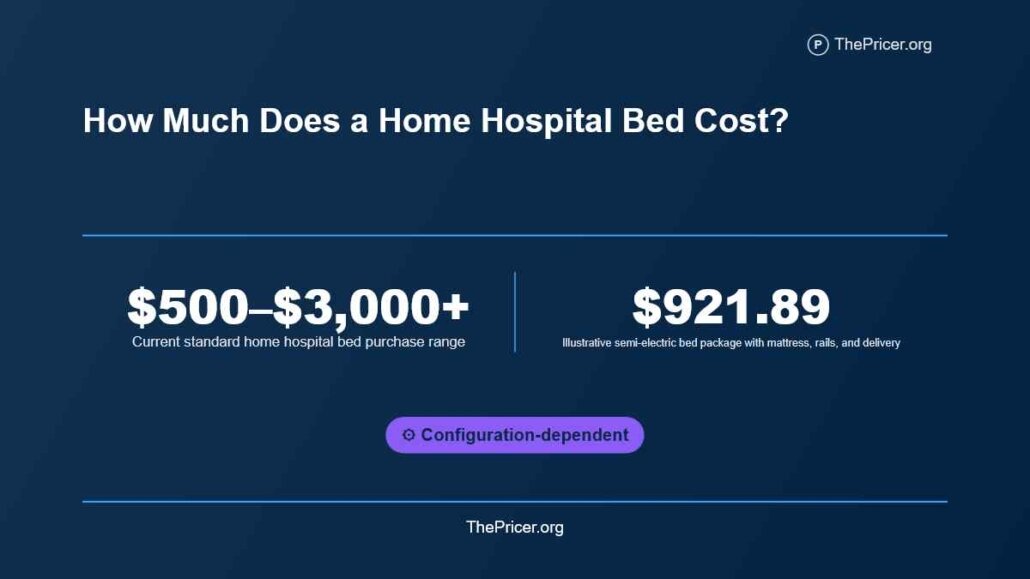
A home hospital bed usually costs about $500 to $3,000+ for a standard manual, semi-electric, or full-electric model, while bariatric beds can run about $1,500 to $6,000+ and premium residential models can reach $4,000 to $13,000+. The sticker price is only part of the bill because mattresses, rails, delivery, setup, weight capacity, and rental terms can change the amount paid.
This price guide focuses on hospital beds purchased or rented for use at home. Acute-care and ICU beds bought by hospitals belong to a different procurement market that can include service contracts, electronics, accessories, and institutional support. Mixing those prices with home-care beds makes the consumer answer look far more expensive than it is.
Article Highlights
Jump to sections
- Standard home hospital beds commonly fall around $500 to $3,000+, depending on controls and package contents.
- A current manual Drive homecare bed is listed at about $669.
- Current semi-electric listings range from about $510 to $1,663.
- Current standard full-electric models can start below $700, with many higher-feature models above $1,000.
- Bariatric models can range from about $1,681 for a 600-pound model to more than $4,000 for wider 1,000-pound capacity beds.
- Medicare may cover qualifying home hospital beds, but it does not cover total-electric beds when powered height adjustment is only a convenience feature.
How Much Does a Home Hospital Bed Cost?
A current Drive manual homecare bed is listed at $668.94. Current semi-electric home bed listings include models from about $510 to $1,663, depending on configuration and package contents.
Full-electric prices overlap with semi-electric prices more than many older articles suggest. Current full-electric home bed listings include basic frames around $628 to $675, Invacare models around $1,125 to $1,610, and higher-spec models that can approach $3,000. A low advertised figure may be frame-only, while another price may include a mattress or other equipment.
| Home hospital bed type | Current published example or range | What the price represents |
|---|---|---|
| Manual | About $668.94 | Drive Delta Pro manual homecare bed listing |
| Semi-electric | About $510 to $1,663 | Current home-care listings with different packages and brands |
| Full-electric | About $628 to $2,939 | Current standard and low-bed listings before premium residential models |
| Bariatric | About $1,681 to $4,397 | Drive bariatric homecare models |
| Premium residential | About $3,999 to $12,999+ | Premium residential price examples |
The table shows published examples, not a national average. Packages differ. The useful comparison is the delivered system that meets the same positioning, width, transfer, and caregiver requirements.
What the Purchase Price Includes
A hospital bed listing may describe a complete package or only the frame. Mattress choice, rails, delivery, and installation can add hundreds of dollars. A current Medline semi-electric package lists the frame at $486.50, a required basic mattress at $148.58, half-length assist rails at $136.81, and residential lift-gate curbside delivery at $150.
Using those published components, an illustrative home order totals $921.89 before tax or any in-room assembly. The arithmetic is $486.50 + $148.58 + $136.81 + $150 = $921.89. The frame by itself is only about 53% of that scenario total. That changes the math. A buyer who compares only frame prices can miss nearly half of the payable amount.
Mattress upgrades can raise the total further. The same listing prices a premium foam mattress at $194.63 instead of $148.58, while full-length rail options run above the basic half-rail price. Delivery can also change by address and service level. A warehouse or facility with a receiving dock may qualify for a different freight option than a private residence.
Sheets, overbed tables, trapeze equipment, IV poles, battery backup, pressure-relief surfaces, and wider extension kits can become separate purchases. They should be added only when they match the care plan and the bed manufacturer approves the combination.
Manual, Semi-Electric, or Full-Electric?
A manual hospital bed uses hand cranks for its adjustable functions. It can be a lower-cost option when position changes are infrequent and a caregiver can operate the cranks safely. Semi-electric beds power the head and knee sections but use a manual crank for bed height. Full-electric models power the head, knee, and bed height, reducing manual adjustment during transfers and daily care.
The current price overlap means the control system should not be chosen from sticker price alone. A semi-electric package with mattress and rails can cost more than a frame-only full-electric listing. Compare equivalent packages. Check whether the user can operate the pendant, whether a caregiver needs frequent height changes, and what happens during a power outage.
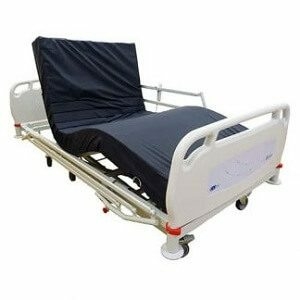 A standard home-care sleep surface is often around 36 inches wide by 80 inches long. The current Medline package above uses that size, and many common home beds use a similar footprint. Room dimensions still matter because the frame, headboard, footboard, rails, caregiver clearance, and transfer equipment need more space than the mattress itself.
If the person also uses mobility equipment, bed height and transfer clearance should be checked against the chair or transfer method. The cost of a wheelchair can become part of the same home-care equipment budget.
Bariatric and Premium Bed Prices
Bariatric home hospital beds cost more because width, frame strength, deck design, motors, and safe working load change. The current Drive bariatric prices in the table list a 42-inch-wide 600-pound model at $1,680.90, a 48-inch 750-pound model at $3,566.34, and a 54-inch 1,000-pound model at $4,010.87 before optional rails.
Moving from the listed 600-pound model to the 1,000-pound model adds $2,329.97. That is about a 139% increase in price for a configuration that also becomes 12 inches wider and supports 400 additional pounds. The added cost reflects a different bed class, not a small upgrade. Buyers should match capacity to the person, mattress, accessories, and manufacturer rules rather than adding a large safety margin without checking room and transfer requirements.
The current premium-home pricing source in the table also places standard manual beds around $500 to $1,000, semi-electric beds around $500 to $1,500, standard full-electric beds around $800 to $3,000+, and premium residential models from about $3,999 to more than $12,999 for wider or split configurations.
Premium beds may add lower deck heights, broader positioning, residential finishes, in-room service options, or wider sleeping surfaces. Those features can matter for long-term use, but they should not be mixed into the price range for basic DME-style beds.
Rent or Buy?
Renting can make sense when the bed is needed for a short recovery period, the care plan may change, or the supplier includes maintenance and replacement service. Current 2026 rental examples place many hospital-bed rentals around $195 to $400 per month, with delivery and setup commonly adding about $100 to $300. Local quotes vary by bed type and service area.
At $275 per month, six months of rental payments equal $1,650 before a delivery or pickup charge. That is already above the purchase price of many standard home full-electric packages. A rental may still be the better financial choice when maintenance is included, the expected need is brief, or the user may require a different bed soon.
Buying becomes easier to justify as the expected use period grows. Ownership gives the household control over the mattress and accessories, but the owner takes responsibility for repairs, moving, and resale or disposal.
Compare like with like. A $225 monthly semi-electric rental should not be compared with an $8,000 premium residential purchase as though they provide the same equipment and service. Ask for the model, mattress, rails, delivery, setup, maintenance, replacement policy, pickup fee, and minimum rental period in writing.
What Medicare Covers
Medicare Part B can cover a hospital bed as durable medical equipment when it is medically necessary, ordered for home use, and supplied through the required Medicare channels. CMS says a fixed-height bed can qualify when positioning cannot be achieved in an ordinary bed, when positioning is needed to relieve pain, when the head must be elevated more than 30 degrees for specified conditions, or when required traction can attach only to a hospital bed.
CMS also states that a semi-electric hospital bed may be covered when the fixed-height criteria are met and frequent or immediate body-position changes are required. Total-electric beds are not covered under this rule because powered height adjustment is treated as a convenience feature. CMS separately defines heavy-duty extra-wide coverage for patients over 350 pounds through 600 pounds and extra-heavy-duty coverage above 600 pounds when the basic hospital-bed criteria are met.
The patient’s share is not the retail sticker price. Medicare DME coverage states that after the Part B deductible, the beneficiary usually pays 20% of the Medicare-approved amount when the supplier accepts assignment. Hospital beds are also part of the capped-rental DME system. CMS states that capped-rental items such as hospital beds can be paid for over a continuous period of up to 13 months before title transfers under the applicable rules.
Private insurance and Medicaid use their own authorization, network, and supplier rules. Households needing constant support may also need to budget for 24/7 in-home care, which can cost far more than the bed itself.
Mattress, Rails, and Home Safety
Side rails should not be described as devices that guarantee a person will not fall. FDA guidance warns that rails can create entrapment, strangulation, injury, and fall hazards, including injuries when someone climbs over a rail. The FDA bed-rail safety guide recommends patient assessment, monitoring, low bed positions, locked wheels, appropriate transfer aids, and careful rail use rather than routine reliance on rails.
Mattress compatibility is part of the same safety decision. The mattress, frame, and rails can create hazardous gaps if dimensions or compression characteristics do not match. Soft surfaces and overlays can change those gaps as the mattress compresses. A pressure-relief mattress can be medically useful, but it still has to work safely with the bed system.
Used hospital beds deserve the same review. Check the exact model, recall history, motor and pendant function, casters, brakes, frame damage, compatible mattress size, approved rails, replacement-part availability, and cleaning history before use. A bargain frame can become expensive if the correct mattress, rails, or control parts are missing.
The bed also has to fit the room and transfer plan. Leave room for caregivers, wheelchairs, walkers, lifts, oxygen equipment, and emergency access. If the home setup is becoming more complex than one bed can solve, comparing assisted living costs can provide useful financial context for a broader care decision.
Choosing the Right Bed
The lowest-priced bed is not automatically the lowest-cost choice. Manual height adjustment can create extra work for a caregiver. A narrow bed may not meet the user’s weight or transfer needs. A premium bed can waste money if the expected use lasts only a few weeks. The strongest purchase decision matches the person’s positioning needs, transfer method, expected duration of use, caregiver ability, room size, and payment coverage.
Makes sense if
- The bed type matches the positioning and transfer needs documented by the care team.
- The quote identifies the frame, mattress, rails, delivery, setup, and warranty.
- The weight capacity and sleep-surface width fit the user and approved accessories.
- The expected use period supports the rent-versus-buy choice.
Does not make sense if
- You compare a frame-only price with a complete delivered package.
- You buy full-length rails solely because they appear safer without a patient-specific assessment.
- You choose a manual bed only because it is cheaper when frequent height changes are required.
- You use an ICU or hospital-procurement price as the benchmark for a home-care bed.
A useful final quote separates the bed system from optional equipment and ongoing care. Those costs solve different needs and should be budgeted separately.
Answers to Common Questions
How much is a basic hospital bed for home use?
A basic home-care bed can start around $500 to $700, while better-equipped standard models often reach $1,000 to $3,000+. Mattress, rails, and delivery may be separate.
How much does it cost to rent a hospital bed?
Current rental examples place many home hospital beds around $195 to $400 per month, with delivery and setup often billed separately.
Does Medicare pay for a full-electric hospital bed?
CMS does not cover a total-electric hospital bed under its standard hospital-bed policy when powered height adjustment is treated as a convenience feature. Semi-electric and other qualifying bed types may be covered when medical-necessity rules are met.
Does a hospital bed come with a mattress?
Sometimes. Some listings are bed-frame only, while others require the buyer to select a mattress as part of the package. Verify the exact mattress, size, and pressure-support needs before ordering.
Are hospital bed rails always safer?
No. Rails can assist some users, but FDA guidance also identifies entrapment and fall hazards. The rail, mattress, bed frame, and individual user’s needs should be evaluated together.
Disclosure: Educational content, not medical advice. Pricing varies by provider, location, and insurance. Confirm eligibility, coverage, and out-of-pocket costs with a licensed clinician and your insurer. See our methodology and corrections policy.