
How Much Does Apoquel Cost?
Updated on | Written by Alec Pow
This article was researched using 11 sources. See our methodology and corrections policy.
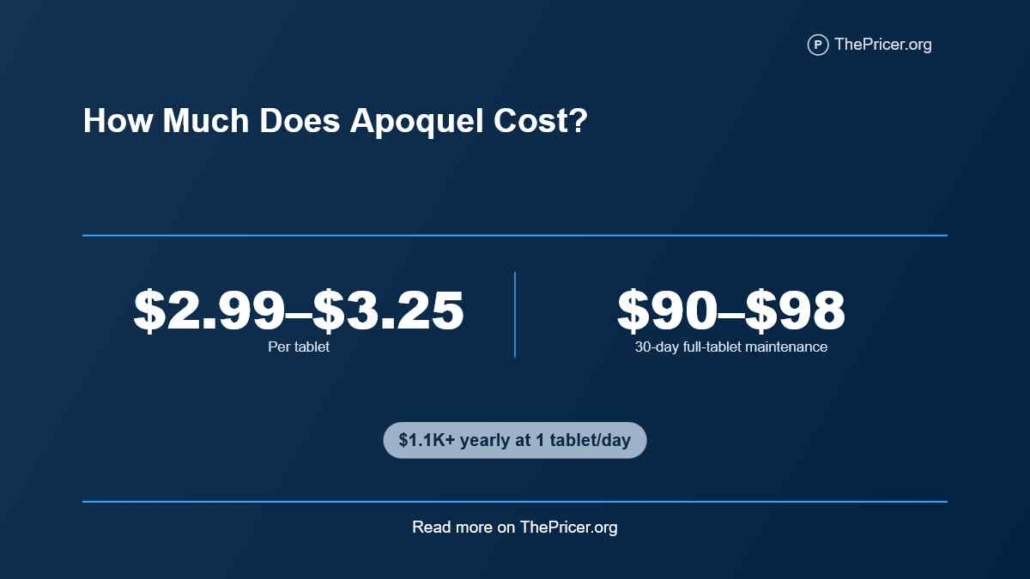
Apoquel currently costs about $2.99 to $3.25 per tablet at major U.S. online pet pharmacies before introductory discounts or autoship savings. That puts a 30-tablet supply around $90 to $95 and a 100-tablet supply around $299 to $316 at current retail prices.
The actual monthly cost depends heavily on your dog’s prescribed dose. Apoquel comes in 3.6 mg, 5.4 mg, and 16 mg strengths, and the FDA-approved dosing chart uses whole or half tablets based on body weight. Treatment is generally given twice daily for up to 14 days and then once daily for maintenance, so the long-term cost is usually lower than simply multiplying a twice-daily dose by 365 days.
Article Highlights
Jump to sections
- Current retail price: approximately $2.99 to $3.25 per tablet before promotions.
- 30 tablets: roughly $90 to $95 (at $30 per hour, earning that amount would take about 3 to 3.2 hours of work, before taxes) at current major U.S. online pharmacies.
- 100 tablets: approximately $299 to $316 in current listings.
- Dosing: generally twice daily for up to 14 days, followed by once-daily maintenance.
- Generic: there is no FDA-approved generic Apoquel currently available in the United States.
How Much Does Apoquel Cost?
Current retail pricing is considerably higher than the $1.71 to $2.50 per-tablet figures found in some older Apoquel cost guides.
Chewy currently lists 30 Apoquel Chewable tablets at $89.70, or about $2.99 each.
Petco currently lists 30 Apoquel 16-mg tablets at $94.86, or about $3.16 per tablet before promotional discounts.
Its current 100-count 5.4-mg bottle costs $316.23 (about 1.3 full-time workdays at $30 per hour), while a 100-count Apoquel Chewable package is currently around $299.
Valley Vet also currently lists regular Apoquel starting around $94.86 and Apoquel Chewable starting around $89.70.
A useful current planning range is therefore:
| Quantity | Approximate Current Retail Price |
|---|---|
| 1 tablet | $2.99–$3.25 |
| 30 tablets | $89.70–$95 |
| 100 tablets | $299–$316 |
| 365 full tablets | About $1,090–$1,186 |
Those totals represent medication only. Veterinary examinations, allergy workups, treatment of secondary skin or ear infections, and other care are separate expenses.
How Dosing Changes the Price
Apoquel should not be budgeted as though every dog takes one tablet twice a day forever.
The official Zoetis prescribing information gives a dose of 0.4 to 0.6 mg of oclacitinib per kilogram of body weight, administered twice daily for up to 14 days and then once daily for maintenance.
The FDA-approved weight chart is:
| Dog Weight | Amount Per Dose |
|---|---|
| 6.6–9.9 lb | ½ of a 3.6-mg tablet |
| 10–14.9 lb | ½ of a 5.4-mg tablet |
| 15–19.9 lb | 1 × 3.6-mg tablet |
| 20–29.9 lb | 1 × 5.4-mg tablet |
| 30–44.9 lb | ½ of a 16-mg tablet |
| 45–59.9 lb | 2 × 5.4-mg tablets |
| 60–89.9 lb | 1 × 16-mg tablet |
| 90–129.9 lb | 1½ × 16-mg tablets |
| 130–175.9 lb | 2 × 16-mg tablets |
Both the regular tablets and Apoquel Chewable are scored, and the FDA-approved dosing chart itself calls for half tablets in several weight ranges.
Always follow the dose prescribed by the veterinarian rather than changing tablet strength purely to reduce cost.
Monthly Cost Examples
Because the three tablet strengths are currently priced fairly similarly per tablet, the number of tablets used often matters more than the milligram number printed on the bottle.
For a dog prescribed one full tablet once daily for maintenance:
- 30 days at $2.99 per tablet = $89.70 (about 3 hours of work at $30 per hour)
- 30 days at $3.25 per tablet = $97.50
- 365 days = approximately $1,091 to $1,186
If that dog begins treatment with the full labeled 14-day twice-daily phase, the first year would use approximately 379 tablet-equivalent doses instead of 365.
At current prices, that produces a first-year medication cost of roughly $1,133 to $1,232 for a dog whose dose is one whole tablet each time.
A dog using half a tablet per maintenance dose would cost approximately half as much. A dog requiring two tablets per dose could cost roughly twice as much.
A 30-Pound Dog
One particularly misleading cost example found in older articles uses a 30-pound dog taking one 5.4-mg tablet twice daily indefinitely.
That is not the FDA-approved maintenance schedule.
According to the current dosing chart, a dog weighing 30 to 44.9 pounds receives ½ of a 16-mg tablet per dose.
After the initial twice-daily period of no more than 14 days, maintenance dosing is generally once daily.
At $2.99 per full tablet, half of one tablet per day has a medication-equivalent cost of about:
$1.495 × 30 = $44.85 per month
That is dramatically different from budgeting 60 full tablets every month.
The actual prescribed dose and treatment duration remain veterinary decisions.
Apoquel Tablet vs Apoquel Chewable
Apoquel is currently available in both traditional tablets and pork-liver-flavored chewable tablets.
The FDA lists the original Apoquel tablet under NADA 141-345 and Apoquel Chewable under NADA 141-555.
Both forms are available in:
- 3.6 mg
- 5.4 mg
- 16 mg
Current online pricing is very similar. In some listings, the chewable version is actually a little cheaper.
That means owners choosing between them should generally focus on what the dog will reliably take and what the veterinarian prescribes rather than assuming chewables always carry a large price premium.
How Fast Does Apoquel Work?
Apoquel’s fast onset is one reason veterinarians use it for allergic itching.
Zoetis says Apoquel starts relieving allergic itch within approximately 4 hours and provides significant itch control within about 24 hours.
Current manufacturer information supports both short-term seasonal use and longer-term treatment when appropriate.
The drug is a Janus kinase inhibitor rather than a corticosteroid or antihistamine.
Apoquel is FDA-approved for control of itching associated with allergic dermatitis and control of atopic dermatitis in dogs at least 12 months old.
Safety and Side Effects
Apoquel is a prescription immunomodulating medication, so its safety discussion deserves more than saying serious effects are merely theoretical.
Zoetis states that Apoquel and Apoquel Chewable should not be used in dogs younger than 12 months or dogs with serious infections.
The prescribing information also warns that treatment can increase susceptibility to serious infections and may worsen existing parasitic skin infestations or pre-existing cancers.
New benign and malignant neoplastic conditions have been observed during clinical studies and after approval.
The manufacturer advises weighing risks and benefits in dogs with a history of recurrent serious infection, recurrent demodicosis, or neoplasia.
The most commonly reported side effects include vomiting and diarrhea.
Apoquel should also not be used in breeding, pregnant, or lactating dogs.
Veterinary follow-up should be based on the individual dog’s health and treatment course. There is no basis for telling every owner that a universal six-month laboratory schedule is mandatory.
Treating the Cause of the Itch
Apoquel can control itching, but buying the tablets may not be the only expense.
A veterinarian may need to investigate why the dog is itchy in the first place. Possible contributors include fleas, environmental allergies, food-responsive disease, bacterial skin infections, yeast infections, ear disease, or other dermatologic problems.
Those problems can require additional examination, skin or ear testing, prescription shampoos, antibiotics or antifungals, diet trials, and follow-up appointments.
A cheaper Apoquel bottle therefore does not necessarily equal a cheaper total allergy-care plan.
Likewise, if a secondary skin infection is present, simply suppressing the itch without appropriately addressing the infection would not be an adequate treatment strategy.
Is There a Generic Apoquel?
As of September 2026, there is still no FDA-approved generic Apoquel available in the United States.
The active ingredient is oclacitinib, but seeing the generic drug name does not mean a lower-cost generic product is actually approved and marketed.
Current FDA labeling records list the Zoetis Apoquel tablet and Apoquel Chewable products, while current veterinary drug references continue to state that no generic version is available.
Because generic approval depends on regulatory applications and intellectual-property issues, it is not responsible to promise that generic oclacitinib will appear on a specific date or immediately cut prices by 20%, 30%, or 40%.
Until an FDA-approved competitor is actually available, owners should budget using real current Apoquel prices.
Apoquel Has a New Competitor
A generic is not the same thing as a competing drug.
Another prescription JAK inhibitor, Zenrelia (ilunocitinib), is now available for allergic itching in dogs.
Current Chewy pricing shows some 30-tablet Zenrelia strengths at approximately $61.79 to $85.07, depending on strength.
That can be cheaper than current Apoquel retail pricing, but the medications are not interchangeable merely because both target itch pathways.
They have different active ingredients, FDA labels, dosing instructions, warnings, and veterinary considerations.
Owners interested primarily in cost should ask their veterinarian whether a different prescription therapy is medically appropriate rather than substituting products themselves.
Can You Split Apoquel Tablets?
Yes, when the prescribed dose calls for it.
The official prescribing information states that regular Apoquel tablets are scored, and the FDA-approved dosing table specifically uses half tablets in several weight ranges.
Apoquel Chewable tablets are also scored on both sides.
That means splitting can be part of normal labeled dosing.
However, splitting should follow the prescribed dose. Buying a stronger tablet solely because its price per milligram looks lower and creating a different dose without veterinary direction is not an appropriate cost-saving strategy.
Buying Apoquel From Overseas
Older cost guides sometimes say U.S. owners may legally import a small personal supply from Canada, India, or another country simply by having a veterinary prescription.
That is an oversimplification.
The FDA’s current personal-importation guidance says that in most circumstances it is illegal for individuals to import drugs into the United States for personal use when those foreign products do not comply with U.S. approval requirements.
FDA personnel can consider enforcement discretion under limited circumstances, including certain serious conditions and small personal-use quantities, but that is not equivalent to a blanket legal right to order cheaper foreign pet medication.
The FDA specifically says the same framework applies to animal drugs and recommends obtaining medication from legal U.S. sources.
For Apoquel, the safer cost comparison is therefore between licensed U.S. veterinary clinics and legitimate U.S. prescription pharmacies.
Ways to Spend Less
The simplest current savings method is comparing legitimate U.S. pharmacy prices.
Chewy currently discounts recurring Autoship purchases by 5%, while Petco also advertises a 5% recurring Autoship discount on Apoquel.
New-customer promotions can temporarily reduce the first prescription order further, but they should not be used to calculate long-term cost because those discounts generally apply only once.
Zoetis also operates Apoquel Petcare Rewards. The current standard program awards points based on tablet count and membership level, with rewards redeemable toward veterinary products or services.
Current published rewards can reach up to $90 on qualifying purchases, depending on purchase size and reward status.
That is more defensible than assuming every owner can automatically save $150 to $250 per year.
Ask the veterinarian for a written prescription if you want to compare legitimate pharmacy prices, but verify that any online seller requires veterinary authorization.
Apoquel vs Cytopoint
Apoquel and Cytopoint are commonly discussed together because both are used for allergic itching, but their cost structure is different.
Apoquel is an oral prescription medication taken at home.
Cytopoint is an injectable monoclonal antibody administered through veterinary care and generally provides approximately 4 to 8 weeks of itch relief, according to current Zoetis information.
The cheaper option depends on dog weight, how frequently Cytopoint needs to be repeated, the Apoquel dose, and whether treatment is seasonal or year-round.
It is therefore misleading to declare that Cytopoint always costs $70 to $135 or is automatically cheaper over a year.
See our full guide to Cytopoint injection costs for the current price structure.
You might also like our guides to DHPP/DHLPP vaccine costs and dog vaccination costs.

What We Verified
We checked current Apoquel prices at Chewy, Petco, and Valley Vet. Major online prices are now generally around $2.99 to $3.25 per tablet, substantially above older $1.71 to $2.50 estimates.
We verified the dosing directly against the FDA-approved prescribing information. Apoquel is generally administered twice daily for no more than 14 days and then once daily for maintenance, and the dosing chart uses different whole- and half-tablet combinations according to weight.
We also verified that there is still no FDA-approved generic Apoquel currently available in the U.S., so predictions about an imminent generic price collapse should not be presented as fact.
Finally, we corrected the overseas-purchase section using FDA importation guidance. A veterinary prescription does not create a blanket legal right to import cheaper foreign Apoquel into the United States.
Answers to Common Questions
How much does Apoquel cost per month?
For a dog using one full tablet once daily for maintenance, current major online prices work out to roughly $90 to $98 per month. A dog prescribed half a tablet daily can cost about half that amount, while dogs requiring multiple tablets per dose can cost considerably more.
Is there a generic version of Apoquel?
No FDA-approved generic Apoquel is currently available in the United States as of September 2026. Oclacitinib is the drug’s generic ingredient name, but that is not the same as having an approved generic product for sale.
Can Apoquel tablets be cut in half?
Yes when the prescribed dose requires it. Apoquel tablets are scored, and the FDA-approved dosing chart specifically calls for half-tablet doses in several dog-weight ranges.
How quickly does Apoquel work?
Zoetis reports that Apoquel begins relieving allergic itching within about 4 hours and provides significant itch control within approximately 24 hours. The drug should still be used according to the veterinarian’s diagnosis and dosing instructions.
Disclosure: Educational content, not medical advice. Pricing varies by provider, location, and insurance. Confirm eligibility, coverage, and out-of-pocket costs with a licensed clinician and your insurer. See our methodology and corrections policy.