
How Much Does Salmon Cost?
Updated on | Written by Alec Pow
This article was researched using 9 sources. See our methodology and corrections policy.
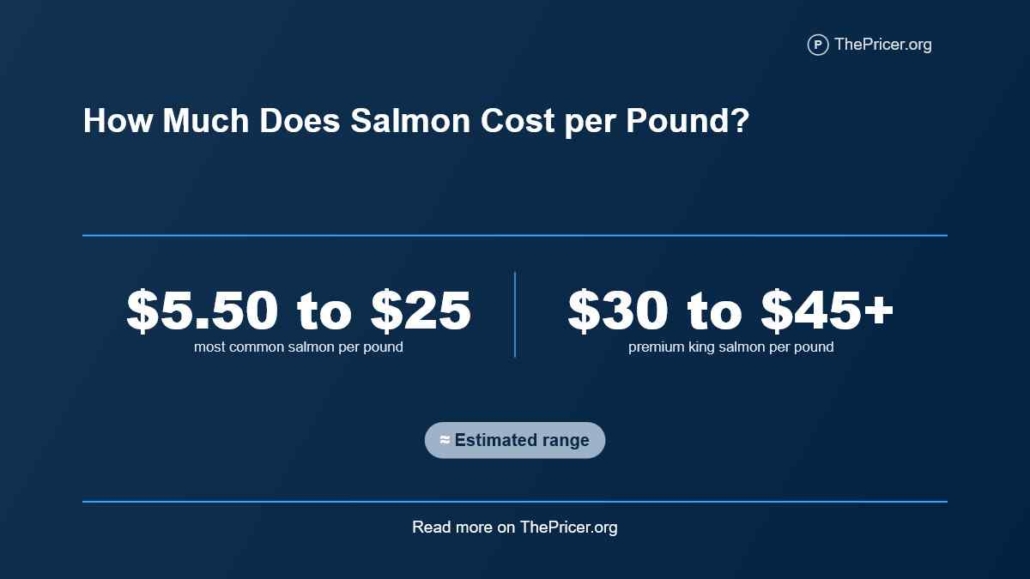
Salmon currently costs about $5.50 to $15 per pound for lower-cost frozen pink salmon and mainstream farmed Atlantic products, around $15 to $25 per pound for many wild sockeye and premium fresh options, and roughly $30 to $45+ per pound for premium king salmon. Specialty Copper River king, direct-shipped fish, smoked salmon, and limited seasonal catches can cost considerably more.
The biggest mistake when comparing salmon prices is treating “fresh salmon” and “frozen salmon” as two uniform products. Species, wild versus farmed production, cut, retailer, season, package size, and processing can affect the price more than freezing itself. A current fresh Atlantic fillet can cost only a few percentage points more per pound than comparable frozen Atlantic salmon, while one wild salmon species can cost almost three times as much as another.
Article Highlights
Jump to sections
- Current fresh Atlantic salmon examples run around $9 to $15 (at $30 per hour, earning that amount would take about 18 to 30 minutes, before taxes) per pound.
- Frozen Atlantic salmon currently costs roughly $10 to $12.50 per pound in the examples we checked.
- Budget frozen wild pink salmon can cost about $5.50 to $7 per pound.
- Current wild sockeye commonly falls around $15 to $25 per pound, although premium direct-to-consumer prices can be higher.
- Wild Alaskan king salmon currently reaches about $42.50 per pound at one premium seafood retailer.
- At Walmart, a current fresh Atlantic example costs only about 6.6% more per pound than its 2-pound frozen Atlantic product.
- At the same retailer, current wild sockeye costs about 2.8 times as much per pound as frozen wild pink salmon.
- At Whole Foods, current Alaskan sockeye carries about a 47% per-pound premium over Atlantic salmon.
- Canned pink salmon remains one of the lowest-cost forms, with one current example equivalent to about $5.08 per pound.
How Much Does Salmon Cost per Pound?
| Salmon product | Current price example |
|---|---|
| Frozen wild pink salmon | $5.73 per pound |
| Fresh skin-on Atlantic salmon | $8.97 per pound |
| Fresh skinless Atlantic salmon | $10.64 (about 21 minutes at $30 per hour) per pound |
| Frozen Atlantic salmon, 2-lb package | $9.99 per pound |
| Frozen Atlantic salmon, 1-lb package | $12.48 per pound |
| Wild Alaska sockeye portions | $15.98 per pound |
| Whole Foods Atlantic salmon | $14.99 per pound |
| Whole Foods Alaskan sockeye | $21.99 per pound |
| Premium wild Alaskan king fillet | $42.50 per pound |
| Canned wild pink salmon | $4.68 per 14.75 oz, about $5.08/lb |
Current Walmart salmon listings illustrate how wide the market is. Fresh skinless Atlantic salmon is currently about $10.64 per pound, fresh skin-on Atlantic is around $8.97 per pound, wild Alaska sockeye portions are about $15.98 per pound, and value frozen pink salmon is roughly $5.73 per pound.
At Whole Foods, current listings put Atlantic salmon at $14.99 per pound and Alaskan sockeye at $21.99 per pound.
Premium wild king salmon is a different price tier. Seattle’s Pure Food Fish Market currently lists wild Alaskan king salmon fillet starting at $42.50 per pound, with a 2-pound minimum.
Why Salmon Prices Vary So Much
Species is one of the largest price drivers. Pink and chum salmon generally occupy the value end of the wild-salmon market, while sockeye commands more and king or Chinook salmon can be considerably more expensive.
Wild versus farmed production matters too. Most inexpensive fresh salmon found year-round in U.S. supermarkets is farmed Atlantic salmon. Wild Pacific species are harvested seasonally and can command premiums based on catch, origin, and demand.
Cut and processing affect what you pay. A boneless trimmed portion requires more processing than a whole fish. Smoked salmon includes curing, smoking, packaging, and additional labor.
Package size can create its own discount. A current 2-pound Walmart frozen Atlantic package costs $19.97 (about 40 minutes at $30 per hour), or just under $10 per pound, while the same retailer’s 1-pound frozen Atlantic package is currently $12.48 per pound.
Season and origin are especially important for wild salmon. Copper River, Bristol Bay, and other named fisheries can command very different prices even when the fish are the same species.
There is also an important terminology distinction. Sockeye, coho, king, pink, and chum describe salmon species. “Alaskan salmon” describes origin. A sockeye or coho can itself be an Alaskan salmon.
ThePricer Math
It’s easy to assume that fresh salmon costs dramatically more than frozen salmon. A current same-retailer Atlantic comparison shows otherwise.
Current fresh skinless Atlantic salmon:
$10.64 per pound
Current frozen Atlantic salmon:
$19.97 ÷ 2 pounds = $9.985 per pound
Difference:
$10.64 – $9.985 = $0.655 per pound
Percentage premium:
$0.655 ÷ $9.985 = 6.6%
So in this current Walmart comparison, fresh Atlantic salmon costs only about 6.6% more per pound than the comparable 2-pound frozen Atlantic package.
That is very different from comparing a $28 premium fresh wild fillet with $7 frozen pink salmon and concluding that freezing reduces salmon prices by 75%. Those are different species and products.
For shoppers, the more useful rule is: compare species with species and cut with cut before comparing fresh with frozen.
Species Matters More Than Freezing
Now compare two current wild salmon products at the same retailer.
Frozen wild pink salmon:
$5.73 per pound
Wild Alaska sockeye:
$15.98 per pound
Price ratio:
$15.98 ÷ $5.73 = 2.79
The current sockeye example therefore costs about 2.8 times as much per pound as the wild pink salmon.
The percentage premium is:
($15.98 – $5.73) ÷ $5.73 = 178.9%
So species creates an approximately 179% premium in this comparison.
Whole Foods provides another same-retailer example:
Atlantic salmon: $14.99/lb
Alaskan sockeye: $21.99/lb
Difference:
$21.99 – $14.99 = $7.00
Premium:
$7 ÷ $14.99 = 46.7%
The wild sockeye currently costs about 47% more than Atlantic salmon in that comparison.
If you’re comparing other premium fish, our guides to Yellowfin tuna prices and Bluefin tuna costs show how species and cut can create even larger seafood price differences.
2026 Wild Salmon Season Prices
Fresh wild salmon can change price substantially during the commercial season, and 2026 provides good real-world examples.
On June 17, 2026, National Fisherman reported fresh Copper River sockeye selling from $14.99 to $34.99 per pound across Pacific Northwest retail markets. Anchorage Costco was selling Copper River fillets for $14.99 per pound, while other retailers were considerably higher.
By early July, current wild Alaska sockeye prices still varied sharply by seller. National Fisherman’s July 6 market report found sockeye around $15.99 per pound at Anchorage Fred Meyer, $16.99 to $18.99 at King Soopers, $20.99 at Carrs-Safeway, and roughly $23 to $29.99 through some direct-to-consumer sellers.
This is why there is no single meaningful “Copper River salmon price.” Even during the same harvest period, location, retailer, shipping method, cut, and whether the seller is a supermarket or specialty seafood business can move the price by more than $10 per pound.
Whole Fish, Fillets, Smoking
A lower per-pound sticker price does not always mean a lower cost for the amount you actually eat.
Whole salmon includes the head, backbone, fins, and other parts that may not become boneless portions. For example, Pure Food Fish Market currently lists whole Alaskan king salmon at about $32.50 per pound while its wild king fillet starts at $42.50 per pound. The whole fish has the cheaper sticker price, but the two products cannot be compared pound for pound as equivalent edible fillet.
Fillets and steaks are different cuts. A fillet is cut lengthwise from the side of the fish. A salmon steak is normally a cross-section through the body and often contains bone. They should not be treated as interchangeable names.
Smoked salmon carries a processing premium. Current Pure Food Fish Market listings put several smoked salmon products around $46.50 per pound. That reflects more than raw-fish cost because curing, smoking, handling, and packaging are built into the price.
Online shipping can materially increase a seafood order. Fresh and frozen fish may require insulated packaging, ice or refrigerant, and expedited delivery. Some retailers impose minimum order quantities or separate vacuum-sealing charges.
For example, the premium wild Alaskan king fillet cited above has a 2-pound minimum. At $42.50 per pound, the fish itself starts at:
2 × $42.50 = $85
before any optional packaging or delivery charges.
Canned Salmon Can Be the Cheapest
Fresh and frozen fillets are not the only way to buy salmon.
Walmart currently sells Chicken of the Sea wild-caught pink salmon for $4.68 per 14.75-ounce can.
Normalized to a pound:
$4.68 ÷ 14.75 × 16 = $5.08 per pound
That puts the canned product near the very bottom of the current salmon price spectrum.
Canned salmon isn’t interchangeable with a fresh fillet for every recipe, but for salmon patties, salads, spreads, pasta, and casseroles, the price difference can be substantial.
At $5.08 per pound, the current canned example costs only about:
$5.08 ÷ $15.98 = 31.8%
as much per pound as the current $15.98 wild sockeye example.
For another lower-cost fish comparison, see our guide to the cost of tilapia.
Atlantic vs Pacific Salmon
Salmon is a common name applied to several fish species in the Salmonidae family, which also includes trout.
For U.S. shoppers, salmon can broadly be divided into Atlantic salmon and several Pacific salmon species.
Atlantic salmon, Salmo salar: NOAA states that commercial and recreational fishing for Atlantic salmon is prohibited in the United States and only farm-raised Atlantic salmon appears in U.S. seafood markets. The remaining wild U.S. populations are found in a few Maine rivers, and the Gulf of Maine population is listed as endangered.
King or Chinook: Generally one of the richest and most expensive Pacific species. Current premium wild Alaskan fillets can exceed $40 per pound.
Sockeye: Known for its deep red flesh and firmer texture. Current retail examples commonly fall around $15 to $25 per pound, although premium seasonal sellers can charge more.
Coho or silver: A medium-rich Pacific salmon. Current retail pricing can overlap both Atlantic and sockeye depending on whether it is fresh, frozen, wild, or farmed.
Pink: Generally smaller and leaner, and commonly used for canned and lower-cost frozen salmon. It is often one of the least expensive wild salmon options.
Chum or keta: Another Pacific species commonly used fresh, frozen, smoked, or for roe. Its price is usually below premium king salmon.
Nutrition, Freshness, and Safe Storage

Nutrition varies by salmon species and whether the fish is wild, farmed, raw, or cooked, so one nutrition number should not be applied to every salmon product.
NOAA currently lists a 100-gram serving of raw farmed Atlantic salmon at approximately 142 calories, 19.84 grams of protein, and 6.34 grams of total fat. Salmon also supplies omega-3 fatty acids, vitamin B12, selenium, and other nutrients.
When buying fresh fish, the FDA says fish should smell fresh and mild rather than strongly fishy, sour, or ammonia-like. Fresh fillets should have firm flesh without drying or dark discoloration around the edges.
The FDA recommends cooking most seafood to an internal temperature of 145°F.
Frozen salmon can also be a high-quality product. Avoid packages that are torn or damaged, and watch for excessive frost or ice crystals that may indicate prolonged storage or thawing and refreezing.
The idea that salmon from a fish market is automatically fresher or better tasting than supermarket salmon is too broad. Quality depends on harvest, cold-chain handling, turnover, processing, and personal taste. Likewise, wild salmon is not universally “better” than farmed salmon. The two can differ in fat content, texture, availability, flavor, and price.
Salmon Budget Examples
Case 1: Four inexpensive salmon dinners
A shopper buys a 2-pound bag of frozen wild pink salmon for $11.46.
If the bag makes four 8-ounce portions:
$11.46 ÷ 4 = $2.87 per 8-ounce portion
That is before seasonings and side dishes, but it shows why pink salmon works well for a lower-cost salmon meal.
Case 2: Four fresh Atlantic portions
At $10.64 per pound, two pounds of fresh Atlantic salmon cost:
2 × $10.64 = $21.28
Four 8-ounce portions therefore cost about:
$21.28 ÷ 4 = $5.32 each
The fresh Atlantic example costs roughly $2.45 more per 8-ounce serving than the frozen pink example, largely because these are different salmon products rather than simply fresh versus frozen versions of the same fish.
Case 3: Premium wild king dinner
At $42.50 per pound, four 8-ounce king-salmon portions require two pounds:
2 × $42.50 = $85
That equals:
$85 ÷ 4 = $21.25 worth of salmon per 8-ounce portion
before shipping, sides, or preparation.
To save money, compare prices per pound rather than package price, look at frozen pink or coho when premium species are unnecessary, check wild sockeye prices during the main harvest season, and buy larger frozen packages when the unit-price discount is meaningful.
Canned salmon is often the lowest-cost choice for dishes where fillet presentation does not matter. Buying premium king salmon makes more financial sense when its flavor, richness, or presentation is specifically what you want rather than when salmon is simply an ingredient.
Answers to Common Questions
How much does salmon cost per pound?
Current salmon prices range from about $5.50 per pound for inexpensive frozen pink salmon to $40 to $45+ per pound for premium wild king fillets. Mainstream Atlantic salmon commonly falls around $9 to $15 per pound, while wild sockeye often costs around $15 to $25 per pound.
How much does fresh salmon cost?
Current fresh Atlantic examples are around $9 to $15 per pound. Fresh wild sockeye commonly costs more, while premium fresh king salmon can exceed $40 per pound.
How much does frozen salmon cost?
Frozen salmon can range from approximately $5.50 to $7 per pound for value wild pink salmon to around $10 to $12.50 for current Atlantic examples. Premium frozen wild species can cost more.
Is fresh salmon more expensive than frozen?
Not always by much. In one current same-retailer Atlantic comparison, fresh salmon at $10.64 per pound was only about 6.6% more expensive than a 2-pound frozen Atlantic package costing about $9.99 per pound.
Why is sockeye salmon more expensive?
Wild sockeye has a distinct color, texture, seasonal harvest, and limited supply compared with year-round farmed Atlantic salmon. Current same-retailer examples show sockeye carrying premiums of roughly 47% over Atlantic salmon and much more over inexpensive pink salmon.
Why is king salmon so expensive?
King or Chinook salmon is prized for its rich, high-fat flesh and is produced in smaller quantities than some other Pacific salmon species. Premium wild Alaskan king fillets currently reach around $42.50 per pound in one specialty-market example.
Is canned salmon cheaper than fresh salmon?
Usually. One current 14.75-ounce canned pink salmon example costs $4.68, equivalent to about $5.08 per pound. That is less than half the price of many fresh Atlantic products and about one-third of the current $15.98 wild sockeye example.
Is all Atlantic salmon farmed?
In U.S. seafood markets, yes. NOAA says commercial and recreational fishing for Atlantic salmon is prohibited in the United States, so Atlantic salmon sold in U.S. markets is farm-raised.
Disclosure: Educational content, not financial advice. Prices reflect public information as of the dates cited and can change. Confirm current rates, fees, taxes, and terms with official sources before purchasing. See our methodology and corrections policy.