
How Much Do Scrubs Cost?
Updated on | Written by Alec Pow
This article was researched using 11 sources. See our methodology and corrections policy.
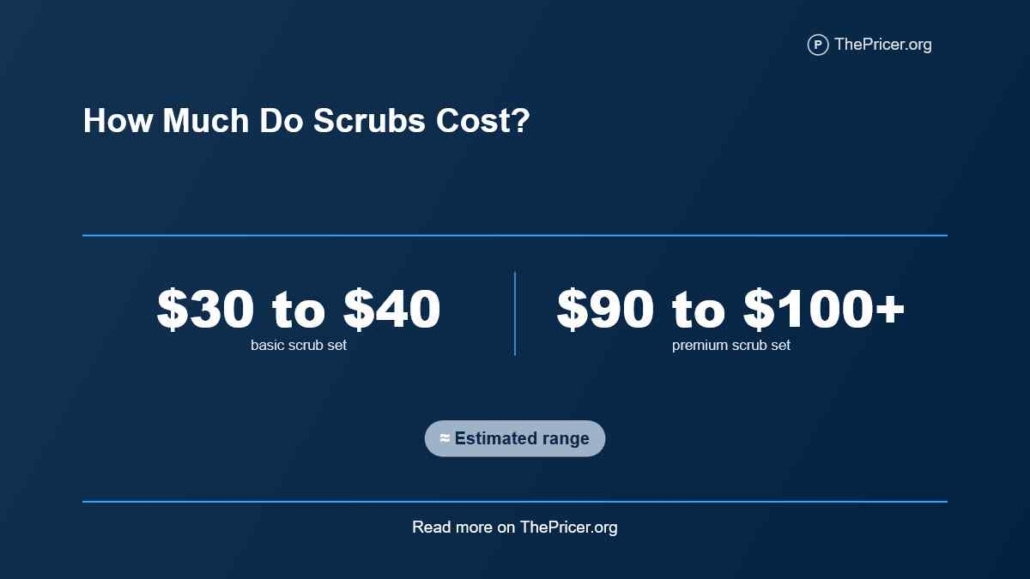
A complete pair of medical scrubs currently costs about $30 to $40 at the budget end, around $50 to $60 for many midrange sets, and roughly $90 to $100+ for premium core styles. Individual tops and pants in the current examples checked start around $15 to $19, while premium pieces commonly reach $42 to $52 each before embroidery, jackets, shipping, or other extras.
The cheapest scrub is not automatically the cheapest uniform to own. Healthcare workers may wear the same set dozens or hundreds of times, which makes durability and cost per wear more useful than sticker price alone. Using current regular prices, a $90 FIGS set costs about 2.43 times as much as a $37 Cherokee Workwear Originals set. The premium set therefore has to survive more than 2.43 times as many shifts before it becomes cheaper strictly on clothing cost per wear.
There is another important distinction: not every healthcare worker buys every scrub they wear. Many workers purchase their own everyday uniforms, while some hospitals issue and launder surgical scrubs through controlled exchange systems. Check the employer’s dress, reimbursement, and laundering policies before building a personal scrub wardrobe.
Article Highlights
Jump to sections
- A current basic Cherokee Workwear Originals set costs about $37 (at $30 per hour, earning that amount would take about 1.2 hours of work, before taxes) at regular price.
- A Cherokee WW Revolution set using a $26 top and $30 pant costs about $56.
- A current FIGS Catarina top and Uman pant total $90.
- Technical features are no longer limited to expensive scrubs. One Cherokee Originals Ultra combination totals about $32 and includes stretch and odor-control features.
- A $90 premium set must last about 2.43 times as many wears as a $37 basic set to beat it on clothing cost per wear.
- Five $37 sets cost $185, while five $90 sets cost $450, a difference of $265.
- Simple embroidery can start around $7.98 per line, far below the old assumption that customized scrubs automatically start at $70.
How Much Do Scrubs Cost?
| Current scrub example | Top | Pants | Set total | Price tier |
|---|---|---|---|---|
| Cherokee Workwear Originals | $18 (about 36 minutes at $30 per hour) | $19 | $37 | Basic |
| Cherokee WW Originals Ultra | $15 | $17 | $32 | Budget performance |
| Cherokee WW Revolution | $26 | $30 | $56 | Midrange |
| FIGS Catarina + Uman | $42 | $48 | $90 | Premium |
These are current regular-price examples rather than clearance prices. Promotions can temporarily lower the checkout amount, and size, color, fit, or specialty styles can change the price. Clearance items below $10 or $15 sometimes exist, but they are not a stable benchmark for someone budgeting a long-term work wardrobe.
What You’re Actually Buying

A scrub set is normally a separate top and pant, even when shoppers think of the pair as one uniform. Price differences come from fabric, fit, pocket configuration, construction, brand positioning, available sizes and lengths, stretch, moisture management, odor-control treatments, and design.
Performance features do not automatically mean premium pricing. The current Cherokee Originals Ultra top listed above costs $15 (about 30 minutes at $30 per hour) and advertises 360-degree stretch, moisture control and odor-fighting technology. The matching $17 pant produces a $32 set. That is actually $5 less than the simpler $37 Workwear Originals example.
That makes it difficult to justify a simple rule such as “technical fabric costs more.” Some inexpensive lines now contain features that were once concentrated in premium workwear. The more useful comparison is whether the particular fabric, fit, pockets and construction work for your job and survive your laundering routine.
When Premium Scrubs Become Cheaper
Price-per-wear comparisons often assume an arbitrary lifespan. We can avoid that assumption by calculating the exact durability break-even point.
Take the current regular prices:
- Cherokee Workwear Originals set: $37
- FIGS Catarina and Uman set: $90
The price ratio is:
$90 ÷ $37 = 2.43
Therefore, the $90 FIGS set must deliver about 2.43 times as many usable wears as the $37 Cherokee set before it becomes cheaper strictly on garment cost per wear.
If the $37 set lasted 100 shifts, its clothing cost would be $0.37 per shift. The $90 set would need to last about 243 shifts to reach approximately the same cost per wear.
If the $37 set lasted 150 shifts, the premium set would need to reach about 365 shifts. This does not predict how long either brand will actually last. It tells the buyer exactly how much additional durability the premium price must buy before the higher upfront cost pays for itself.
Worked five-set wardrobe comparison
Many workers want several complete sets in rotation. Using five sets gives another useful comparison:
- Five Cherokee Originals sets: 5 × $37 = $185
- Five Cherokee Revolution sets: 5 × $56 = $280
- Five FIGS sets: 5 × $90 = $450
The premium five-set wardrobe costs $265 more than the basic one. That is about a 143% premium over the $185 basic wardrobe.
At $30 per hour, the additional $265 equals about 8.8 hours of gross work. A shopper can therefore frame the decision very simply: are the preferred fit, fabric, pockets, styling and potential durability worth almost nine additional hours of work for a five-set rotation?
Do You Have to Buy Your Own Scrubs?
There is no single rule across healthcare employers. Many nurses, medical assistants, technicians and outpatient workers purchase personal uniforms that comply with their employer’s required color and dress code. Other facilities supply specific garments for work areas such as operating rooms.
Hospital scrub dispensing machines should not be confused with retail vending machines. The UCSF scrub station system, for example, uses employee ID badges to dispense authorized scrubs. Staff return the used top and bottom to restore their scrub allocation. There is no ordinary $8 to $12 retail purchase occurring each time a set is issued.
This can reduce a worker’s personal uniform expense substantially. Someone working entirely in facility-issued surgical attire could spend very little on work scrubs, while another employee required to provide five personal sets might spend hundreds of dollars upfront.
Before buying a wardrobe, ask whether the employer provides scrubs, requires a particular brand or color, offers a uniform allowance, uses an approved vendor, supplies surgical attire, or reimburses embroidery. Those policies can matter more than finding a $5 sale.
Embroidery and Other Hidden Costs
Customization does not automatically turn scrubs into a $70+ purchase. One current Cherokee embroidery option starts at $7.98 per line on eligible tops.
Adding one embroidered line to a $37 Cherokee Originals set produces a starting personalized cost of about $44.98. Adding the same single line to five tops costs another $39.90, bringing the five-set $185 wardrobe to approximately $224.90.
That is different from tailoring. Hemming, waist alterations, sleeve changes, logo digitization, multiple embroidered lines, custom department logos and specialty sizing can create separate charges. Shipping also matters when an online order falls below a retailer’s free-shipping threshold.
Extra garments can raise the wardrobe budget as well. Jackets, underscrubs, compression socks, scrub caps and specialty footwear should not be mixed into the scrub-set price unless the employee actually needs them.
Laundry, Contamination, and Replacement
There is no credible universal rule that nurses must replace scrubs every 9 or 12 months. Replacement depends on fabric condition, staining, seam failure, fading, fit, employer appearance standards and whether the garment still performs its intended job.
The CDC’s healthcare laundry guidance notes that ordinary uniforms without blood or body-substance contamination are not appreciably different from street clothes in their normal soil level and that home laundering would generally be expected to remove that soil. Facility policies can still differ.
Contaminated protective clothing is a different category. OSHA’s bloodborne-pathogen guidance distinguishes ordinary scrubs from garments used as personal protective equipment. When clothing functions as required PPE, employer responsibilities for provision and laundering apply.
Perioperative environments can also have stricter attire rules. The 2025 AORN surgical-attire guidance specifically addresses laundering and contamination control for attire used in operating-room settings.
For budgeting, it is better to replace scrubs based on actual wear and employer requirements than to assume every set has a one-year expiration date.
Three Scrub-Buying Scenarios
Case 1: New healthcare worker on a tight budget
Three current Cherokee Originals sets cost about $111. Five sets cost $185. A worker who knows the required color and can wash frequently may choose the smaller starting rotation and add sets later instead of buying an expensive wardrobe before the first shift.
Case 2: Midrange five-set rotation
Five Cherokee Revolution combinations at roughly $56 each cost about $280. This is $95 more than five basic $37 sets, or an extra $19 per uniform. The worker can decide whether the preferred stretch, fit and construction justify that smaller premium.
Case 3: Premium five-set wardrobe
Five current $90 FIGS combinations cost approximately $450. Compared with the $185 basic rotation, the premium is $265. To become cheaper strictly on cost per wear, each premium set needs to deliver approximately 2.43 times the useful lifespan of the $37 alternative.
None of these scenarios assumes one brand lasts longer than another. They turn current prices into the durability hurdle each option has to clear.
What We Verified
- Current budget pricing: Cherokee Workwear Originals currently lists a women’s top at $18 and utility pant at $19 before temporary promotions.
- Current premium pricing: FIGS currently lists the Catarina scrub top at $42 and Uman jogger pant at $48.
- Performance features: inexpensive Cherokee Originals Ultra garments currently advertise stretch and odor-control features, so those technologies are not confined to premium price tiers.
- Employer-issued scrubs: current hospital examples use badge-controlled scrub exchange systems where garments are taken and returned rather than purchased from a vending machine.
Related Healthcare Costs
Uniforms are only a small part of the financial picture for healthcare professionals. Families can compare the cost of a well-baby doctor visit, while diagnostic care such as an EMG test shows how medical-service pricing differs from retail workwear.
For clinicians considering the broader cost of practice, medical malpractice insurance costs can dwarf annual uniform spending and vary significantly by profession, specialty and location.
Answers to Common Questions
How much does a full set of scrubs cost?
Current named examples put basic sets around $30 to $40, midrange sets around $50 to $60, and premium core combinations around $90 to $100+. Sales and clearance prices can be lower.
How much should a nurse budget for five sets of scrubs?
Using current examples, five sets can cost approximately $185 at the basic level, $280 at a midrange price, or about $450 for a premium FIGS combination.
Are expensive scrubs cheaper in the long run?
Only if the added lifespan or other value justifies the price. A $90 set costs about 2.43 times a $37 set, so it would need to last more than 2.43 times as many wears to become cheaper strictly on garment cost per shift.
Do nurses have to buy their own scrubs?
It depends on the employer and work area. Many employees buy personal uniforms, while some hospitals provide and launder surgical scrubs or offer uniform allowances and approved-vendor programs.
How many pairs of scrubs should I own?
There is no universal number. Buy enough clean sets for your normal sequence of shifts plus a practical laundry buffer. Confirm the employer’s color and uniform rules before buying several sets.
How much does embroidery add to scrubs?
Simple embroidery can start below $10. One current Cherokee option begins at $7.98 per line, although logos, multiple lines and special customization can cost more.
Disclosure: Educational content, not medical advice. Pricing varies by provider, location, and insurance. Confirm eligibility, coverage, and out-of-pocket costs with a licensed clinician and your insurer. See our methodology and corrections policy.