
How Much Does Toilet Installation Cost?
Updated on | Written by Alec Pow
This article was researched using 10 sources. See our methodology and corrections policy.
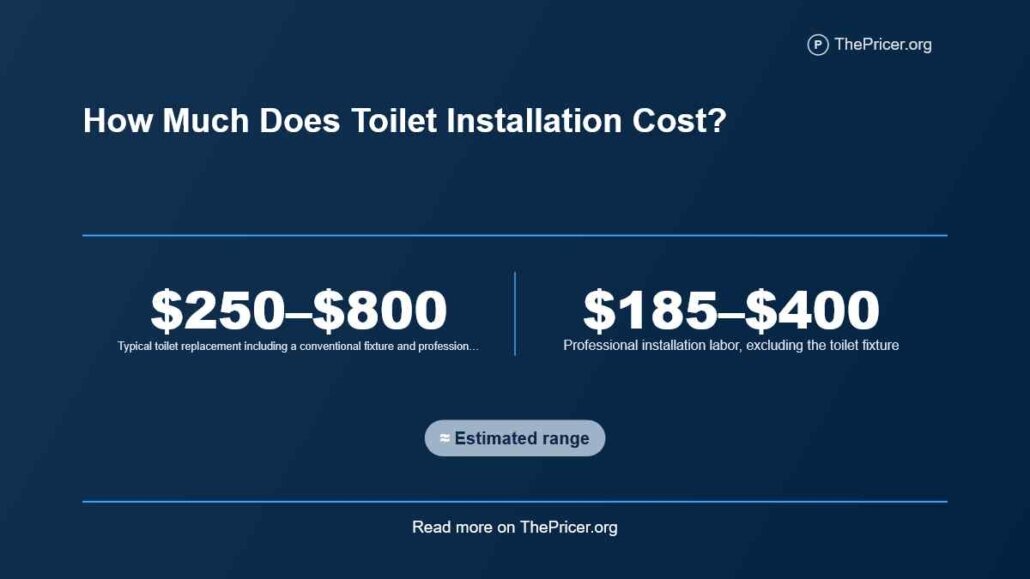
Toilet installation typically costs $250 to $800 in the United States for a straightforward replacement, including a new toilet and professional labor. A common midrange project costs approximately $450 to $600, while premium fixtures, damaged plumbing, or changes to the toilet’s location can push the total above $1,000.
The price depends on whether the plumber is replacing an existing floor-mounted toilet or installing one where no toilet previously existed. Reusing sound plumbing is generally less expensive because the installer does not need to reroute the drain, vent, or water supply.
Homeowners should also distinguish the toilet’s retail price from installation labor. Some retailer quotes cover only labor, while others include the fixture, removal, sealing materials, and disposal. Comparing those figures without matching the work included can lead to an inaccurate budget.
Article Highlights
Jump to sections
- A standard toilet replacement commonly costs $250 to $800 installed, with a national midpoint near $450.
- The Home Depot estimates professional installation labor at $185 to $400.
- Budget toilet models can cost less than $100, while upgraded conventional toilets often cost $300 to $500 or more.
- Damaged toilet flanges can add roughly $145 to $165 for a straightforward professional replacement.
- Removing and disposing of the old toilet may add $50 to $200 if the service is excluded.
- EPA WaterSense toilets can reduce water consumption substantially when replacing older, inefficient models.
How Much Does Toilet Installation Cost?
The 2026 Fixr cost study estimates toilet installation at $250 to $800, with a national average of $450 for materials and labor.
A separate HomeGuide installation comparison places typical completed jobs between $350 and $800, with an average near $600. The difference reflects varying project assumptions and data sources.
| Installation type | Typical or published cost | What the amount represents |
|---|---|---|
| Basic replacement | $250–$800 | Common toilet and professional installation |
| Professional labor alone | $185–$400 | Home Depot installation benchmark |
| Budget toilet fixture | $94 | Selected Glacier Bay retail model |
| Upgraded conventional toilet | $373–$442 | Selected American Standard and Kohler fixtures |
| One-piece toilet installation | $250–$1,100 | Fixr’s broader installed price range |
| Wall-hung toilet installation | $500–$2,000 | Selected wall-mounted projects, scope-dependent |
| First-time toilet installation | $1,000–$3,500+ | New plumbing connections and installation |
The figures are not all-inclusive quotes for the same project. The retail toilet examples exclude labor, while the installation ranges vary in their assumptions about materials and existing conditions.
Homewyse provides a higher planning benchmark. Its September 2026 installation calculator estimates $654 to $1,189 per toilet for its modeled project. That calculation includes a broader set of job-related costs and should not be treated as a contradiction of lower-scope labor quotes.
The practical approach is to obtain a price for the exact replacement being performed, including the specified toilet, labor, removal, supplies, and any necessary repairs.
How Much Does a New Toilet Cost?
The fixture itself is one of the easiest expenses to research before contacting a plumber. Prices vary by bowl shape, flushing system, seat height, construction, finish, and built-in features.
Budget two-piece toilets
A conventional two-piece toilet has a separate tank and bowl. These are widely available and often among the least expensive choices for residential bathrooms.
For a concrete retail benchmark, Home Depot’s Glacier Bay model was listed at $94. It is a 12-inch rough-in, round-bowl toilet rated at 1.28 gallons per flush, with a seat, wax ring, and mounting hardware included.
This illustrates how a low-cost fixture can reduce the overall budget. It does not mean that professional installation of the entire toilet will cost less than $100.
Midrange and comfort-height models
More expensive toilets may offer elongated bowls, taller seating, upgraded flush mechanisms, easier-cleaning surfaces, or decorative designs.
An American Standard Champion 4 tall-height elongated toilet was listed at $373. It uses 1.28 gallons per flush and does not include the seat.
A Kohler Highline model with a 10-inch rough-in was listed at $442.05, also without the seat.
These examples show why checking the included accessories matters. A toilet with a lower shelf price may require a separately purchased seat or installation components.
One-piece and smart toilets
One-piece toilets combine the tank and bowl into a single ceramic body. Their construction can simplify exterior cleaning, although weight and handling may affect installation.
Smart toilets introduce heated seats, washing systems, drying functions, automatic flushing, and electronic controls. The Home Depot pricing guide identifies basic toilets from around $100 and premium smart models above $3,000.
Electronic features may also require a suitable electrical connection. That work is separate from a conventional toilet replacement and should be priced before ordering the fixture.
Professional Labor
Professional installation normally involves shutting off the water, draining and removing the old toilet, inspecting the connection, positioning a new seal, securing the replacement, connecting the supply line, and checking for leaks.
The Home Depot quotes approximately $185 to $400 for installation labor and describes a standard professional replacement as taking roughly one to two hours when no complications arise.
Fixr provides a broader professional labor range of $150 to $440, with local plumbers commonly charging approximately $75 to $150 per hour.
A flat-rate quote can differ from labor multiplied by time on site. The contractor may account for travel, dispatch, insurance, administrative expenses, equipment, and the minimum charge for a small job.
The installation is usually faster when the existing drain, toilet flange, supply valve, and flooring are in good condition.
Lowe’s installation service describes a replacement package that includes pickup, delivery, removal of the existing toilet, and installation of the new one with wax ring, mounting bolts, and supply line. Availability depends on location.
That makes a retailer’s bundled installation service worth comparing against a separate plumber’s quote, especially when the fixture has already been selected.
The Hidden Cost of Toilet Replacement
 The most expensive surprises often appear after the old toilet has been removed. A concealed flange defect, deteriorated floor, damaged shutoff valve, or leaking drain connection can change the scope of the work.
Toilet flange and wax ring
The toilet flange connects the fixture to the drain system and anchors it to the floor. A damaged flange can prevent the toilet from remaining stable or sealing correctly.
According to Angi’s September 2026 estimate, straightforward professional flange replacement averages approximately $155, with a common range of $145 to $165. More extensive damage can make the repair substantially more expensive.
Not every toilet replacement needs a new flange. If the existing connection is intact, properly positioned, and securely anchored, a new seal may be sufficient.
The wax ring is another commonly misunderstood expense. The seal itself is inexpensive, but replacing one independently requires lifting and resetting the toilet. That labor explains the difference between a cheap seal and the cost of a standalone toilet wax ring replacement.
Old toilet removal
Some installers include removal and disposal in their standard quote. Others charge separately.
Fixr estimates that separately billed hauling and disposal can add approximately $50 to $200. A homeowner should confirm whether removal means simply disconnecting the old toilet or physically taking it away for disposal.
Floor and plumbing damage
A leaking toilet may damage the subfloor before anyone notices moisture. Replacing damaged plywood, flooring, or drain components goes beyond a normal fixture swap.
Similarly, a seized shutoff valve may need replacement before the plumber can safely reconnect the toilet. Drain relocation, new venting, and significant piping changes can create much larger bills than a replacement in the existing position.
The related toilet flange repair guide provides a closer look at the difference between replacing a damaged mounting connection and repairing surrounding water damage.
A Complete Toilet Installation Example
A practical budget should combine a published toilet price with labor and clearly identified allowances for the particular job.
Consider a straightforward replacement using the American Standard Champion 4 priced at $373. Assume the existing plumbing is in good condition and the homeowner hires a professional.
- American Standard toilet at $373
- Installation labor at an illustrative $250
- Compatible toilet seat allowance of $35
- Additional installation supplies allowance of $25
- Old toilet disposal allowance of $75
- Calculated complete project budget of $758
The toilet price is from a published retail listing. Labor, supplies, seat, and disposal are planning allowances within the broader market context, not a confirmed contractor offer. Sales tax is excluded.
The fixture accounts for approximately 49.2% of the modeled total. The other $385 represents installation and supporting expenses.
Now suppose the plumber discovers a damaged flange and charges an additional $155, using Angi’s average as the illustrative repair amount. The project increases to $913.
That single repair raises the planned expenditure by approximately 20.4%. It illustrates why a written estimate should identify what happens if the existing flange or surrounding flooring needs repair.
The lower-priced Glacier Bay fixture offers a different scenario. Substituting its $94 retail price for the $373 American Standard unit reduces the fixture component by $279. However, its included seat and installation hardware also change the materials list, so a true like-for-like total requires removing any duplicated allowances.
Water Savings and Toilet Efficiency
Efficiency can influence the long-term cost of the replacement, particularly when the existing toilet uses substantially more water than modern models.
The EPA WaterSense program identifies qualified toilets that use no more than 1.28 gallons per flush while meeting independent performance requirements.
Older toilets can use considerably more water. The EPA estimates that replacing inefficient toilets with WaterSense-labeled models can save an average family nearly 13,000 gallons annually, depending on the previous fixtures and household use.
The agency’s current consumer guidance puts potential annual water-cost savings above $170 for an average family replacing older inefficient toilets. This is a household-level illustration, not the guaranteed savings from replacing one toilet.
Actual financial benefits depend on the original flush volume, number of toilets replaced, household usage, and local water and sewer rates.
For a more conservative illustration, assume one toilet saves 3,000 gallons annually and the combined local water and sewer charge is $12 per 1,000 gallons. The annual savings would be $36.
If the efficient model costs $100 more than a comparable alternative, the modeled savings recover that premium in approximately 2.8 years. Both usage and local rate are stated assumptions, not measured results.
The calculation demonstrates why selecting a low-consumption toilet can be financially useful without promising that every replacement will produce the EPA’s full household savings.
DIY Installation or Hiring a Plumber
A conventional toilet replacement can be manageable for a homeowner comfortable with basic plumbing, lifting heavy fixtures, and checking seals. It becomes more difficult when the flange is corroded, the floor is uneven, or the supply valve does not shut off reliably.
Doing the work independently avoids the professional labor bill but does not eliminate fixture, hardware, disposal, or repair costs. Incorrect sealing can cause concealed water damage.
Before attempting the job, confirm the rough-in measurement. Common toilets are designed for 10-inch, 12-inch, or 14-inch rough-ins, measured from the finished wall to the drain centerline. The selected fixture must suit the existing configuration.
Homeowners should also check bowl clearance, seat height, supply connection, and the condition of the floor.
Basic fixture replacement often does not require a permit, but rules differ by jurisdiction. Moving the toilet, adding new drain piping, or altering the vent system is more likely to trigger permit and inspection requirements.
For a larger renovation that includes shower work, compare the new toilet’s scope with the surrounding bathroom project. An Onyx Collection shower installation involves substantially different materials, plumbing arrangements, and labor than a simple toilet swap.
When Should You Replace a Toilet?
Replacement can make sense when the bowl or tank is cracked, the toilet regularly clogs because of an unsuitable design, or an older inefficient unit is contributing to unusually high water use.
A toilet that runs continuously does not always need replacing. A worn fill valve, flapper, or flush seal may be repairable at a much lower cost.
Before purchasing a replacement, identify whether the problem comes from the fixture itself or from the drain and plumbing connections.
Makes sense if
- The porcelain is cracked or the existing toilet is unsafe to keep in service.
- The toilet has recurring problems that repairs have failed to resolve.
- A WaterSense model would replace a substantially less efficient fixture.
- The existing plumbing can accommodate the new toilet with limited modifications.
Does not make sense if
- An inexpensive valve, seal, or internal component will solve the problem.
- The selected model has an incompatible rough-in or insufficient clearance.
- The installation price excludes necessary plumbing work that has not been assessed.
- A major bathroom redesign is planned soon and could require relocating the toilet again.
What We Verified
- Fixr and HomeGuide report typical installed toilet costs broadly within $250 to $800.
- The Home Depot separately publishes an installation labor range of $185 to $400.
- Current retail listings confirm significant price differences between budget and upgraded conventional toilets.
- Some retailer installation packages include removal, a new seal, mounting hardware, and supply connections.
- Flange replacement and water-damaged flooring are distinct repair expenses, not automatic parts of every toilet installation.
- EPA WaterSense savings depend on the old fixtures and household usage.
Answers to Common Questions
How much does a plumber charge to install a toilet?
Professional installation labor commonly costs approximately $185 to $400, although location, service minimums, and job complexity affect the quote. The new toilet may be charged separately.
How long does it take to replace a toilet?
A straightforward professional replacement often takes one to two hours. A damaged flange, difficult access, plumbing modifications, or floor repairs can extend the job.
Does toilet installation include removing the old toilet?
Some installation packages include removal and disposal, while others charge separately. When excluded, disposal may add approximately $50 to $200. Confirm the scope before scheduling.
Can you install a new toilet yourself?
Yes, when the existing plumbing is sound and the homeowner has the appropriate skills and equipment. A damaged flange, unreliable shutoff valve, or unfamiliar drain configuration is a good reason to hire a qualified plumber.
Is it cheaper to repair or replace a toilet?
Replacing a flapper, fill valve, or seal is usually less expensive than replacing the entire fixture. Cracked porcelain, repeated failures, or major performance problems may justify a new toilet. Compare a repair quote against the complete installed replacement cost before deciding.
Disclosure: Educational content, not financial advice. Prices reflect public information as of the dates cited and can change. Confirm current rates, fees, taxes, and terms with official sources before purchasing. See our methodology and corrections policy.