
Trump’s $5,000 Dividend: Who Would Get It and How Much Would It Cost?
Updated on | Written by Alec Pow
This article was researched using 19 sources. See our methodology and corrections policy.
President Donald Trump’s proposed $5,000 “Trump Dividend” would cost about $1.23 trillion if the promise were applied literally to every adult U.S. citizen. At the Republican midterm convention in Dallas on September 9, 2026, Trump said the payment would go to adult citizens if Republicans retain both the House and Senate, and that the money would have to be spent in the United States, according to reporting on Trump’s exact promise.
The proposal has since become more concrete politically but not financially. Trump said on September 13 that the government could afford the payments and reaffirmed that he intends to deliver them. House Speaker Mike Johnson, meanwhile, said Congress would need to act. Vice President JD Vance, Commerce Secretary Howard Lutnick, National Economic Council Director Kevin Hassett and Sen. Bernie Moreno have now floated several different ways the payments might be financed or authorized, but none has yet produced an enacted funding mechanism covering the full cost.
ThePricer’s baseline uses the U.S. Census Bureau’s latest American Community Survey table that combines adulthood with citizenship status. At $30 per hour, one $5,000 payment equals about 167 hours of work, a little over four 40-hour workweeks.
Article Highlights
Jump to sections
- Trump proposed $5,000 (at $30 per hour, earning that amount would take about 4.2 full-time workweeks, before taxes) for each adult U.S. citizen if Republicans keep both chambers of Congress.
- ThePricer estimates a literal adult-citizen version at about $1.226 trillion.
- Using all U.S. adult residents instead produces figures near $1.35 trillion.
- No payment program has been enacted, and no checks have been scheduled.
- Trump initially said he did not think congressional approval would be necessary, but House Speaker Mike Johnson now says Congress would have to act.
- Administration and Republican officials have floated tariffs, immigration-program revenue, government investment gains and budget reconciliation, but no announced funding source currently covers the full $1.226 trillion baseline.
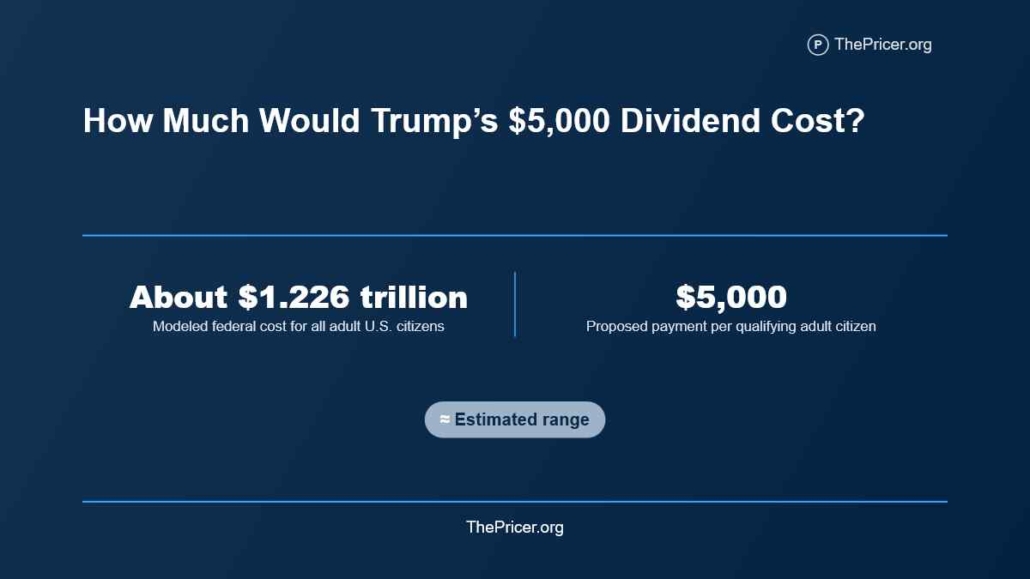
How Much Would Trump’s $5,000 Dividend Cost?
The cleanest baseline starts with citizenship, because Trump did not say every resident would receive a check. The 2024 ACS citizenship table reports 107,955,939 native-born adult men and 11,626,768 naturalized adult male citizens. It also reports 112,168,388 native-born adult women and 13,524,031 naturalized adult female citizens. Adding those groups produces 245,275,126 adult citizens.
The worked federal-cost calculation is 119,582,707 adult male citizens plus 125,692,419 adult female citizens, giving 245,275,126 qualifying adults under the literal wording. Multiplying that population by $5,000 (about 4.2 full-time workweeks at $30 per hour) produces $1,226,375,630,000, which is best presented as about $1.226 trillion. This is a ThePricer estimate based on Census population data, not a Congressional Budget Office score of legislation. No final bill has fixed the eligible population.
That baseline also excludes administrative expenses, interest costs and any payment to minors. Those items could move the final federal price in opposite directions if Congress narrowed eligibility, added dependents or chose a different delivery structure. The face value of the checks remains the dominant cost, so the 245.3 million adult-citizen count is the most useful starting point until legislative text exists.
| Population scenario | People | Payment | Modeled federal cost |
|---|---|---|---|
| 2024 ACS adult U.S. citizens | 245,275,126 | $5,000 | $1.226 trillion |
| 2024 ACS all adult residents | 267,181,678 | $5,000 | $1.336 trillion |
| 2025 Census all adult residents | 269,763,509 | $5,000 | $1.349 trillion |
Who Would Get the $5,000?
Trump’s announced wording points to two basic tests. A recipient would need to be an adult and a U.S. citizen. If legislation follows those words, minors would not qualify and lawful permanent residents who are not citizens would fall outside the stated group. A household with two qualifying adults would receive $10,000 (about 8.3 full-time workweeks at $30 per hour). A household with two qualifying parents and a qualifying adult child would receive $15,000. Two parents with minor children would still be at $10,000 if no child payment is added later.
Trump used broader shorthand on September 13, referring to payments for “all adults in the country,” rather than repeating the original adult-citizen formulation. He did not announce revised eligibility rules or explicitly extend the proposal to noncitizens. Until legislation or a formal plan says otherwise, the adult U.S. citizen population remains the more defensible denominator for estimating the cost.
Vice President JD Vance later suggested the payments could be focused on the middle class and that wealthy Americans could be excluded, which creates an unresolved difference from Trump’s broad “every adult citizen” formulation. One modeled high-income exclusion used a hypothetical household ceiling of $400,000 and produced a cost near $1.15 trillion. That $400,000 figure is an analyst assumption, not an announced Trump eligibility threshold.
Appears to apply if
- You are an adult U.S. citizen under the wording announced so far. In practice, legislation would still need to define the age cutoff, with age 18 the most obvious benchmark.
- You are one of several qualifying adults in the same household, since the promise was phrased per adult rather than per household.
- You are a naturalized citizen, because the Census citizenship category used in the baseline includes naturalized citizens.
Does not appear to apply if
- You are a minor under the current adult-only wording.
- You are a U.S. resident who is not a citizen if the citizenship requirement is retained.
- You fall above a future income limit, if lawmakers add the restriction Vance suggested.
Some Estimates Reach $1.35 Trillion
The higher estimate comes from a different denominator. The same 2024 ACS table contains 267,181,678 adult residents, including 21,906,552 adult noncitizens. Paying every adult resident in that single dataset would cost $1.336 trillion. Restricting the same 2024 population to citizens reduces that modeled cost by $109.53 billion. That is the cleanest apples-to-apples measure of the citizenship distinction.
The Census Bureau’s 2025 adult population estimate is newer and counts 269,763,509 residents age 18 or older. Multiplying that figure by $5,000 gives $1,348,817,545,000, almost exactly $1.35 trillion. The newer population series does not apply Trump’s citizenship test, so it is useful for explaining the larger headline estimate but weaker as the denominator for the literal proposal. The difference between the 2024 citizen count and 2025 all-resident count is not a precise count of excluded noncitizens because the datasets also cover different dates.
Where Would the $1.2 Trillion Come From?
There is still no single administration funding plan. Vice President JD Vance has suggested tariff revenue could help fund the dividend, while other officials have pointed to entirely different revenue sources. That makes it useful to test each claim against the roughly $1.226 trillion cost of paying every adult citizen.
The Congressional Budget Office originally projected $418 billion in customs-duty revenue for fiscal 2026. Following the Supreme Court ruling that eliminated a major group of tariffs and subsequent changes in trade policy, CBO said projected net customs revenue would be roughly $250 billion below that February forecast. That implies a revised level near $168 billion, based on CBO’s updated tariff projections.
Compared with ThePricer’s $1.226 trillion adult-citizen estimate, approximately $168 billion would cover only about 13.7% of one dividend round. The checks would cost roughly 7.3 times that amount of annual customs revenue.
Commerce Secretary Howard Lutnick has proposed a different source. He said revenue could come from a planned “Trump Platinum Card” program under which certain wealthy foreign nationals would pay as much as $5 million to extend their U.S. stays. Lutnick said more than 100,000 prospective applicants were on a waiting list and argued that this could generate $500 billion, according to a transcript of his funding explanation.
Even accepting that $500 billion estimate at face value, it would finance only about 40.8% of ThePricer’s $1.226 trillion baseline. The remaining gap would still be approximately $726 billion. The $500 billion itself is also a projection based on prospective participants paying the full stated amount, not revenue already collected and available for distribution.
National Economic Council Director Kevin Hassett has pointed to budget reconciliation as a possible legislative path and said the details of offsets would need to be negotiated with Congress. Republican Sen. Bernie Moreno is separately drafting legislation that would use what he describes as market-access fees on foreign goods to finance the one-time payments. These ideas are not identical funding plans, and no enacted legislation has combined them into a package that covers the full cost.
The issue resembles the earlier $2,000 tariff dividend proposal, where the promised payments were also larger than the dedicated revenue stream. Tariffs can additionally feed into the tariff costs for U.S. families, so federal receipts and household price effects are separate parts of the policy.
The Hidden Price: What If It Is Borrowed?

If Congress authorized the checks without enough new revenue, spending cuts or another offset, the immediate increase in federal borrowing could approach the program’s $1.226 trillion face value. That would not include the additional interest Treasury would ultimately pay on the extra debt.
Because Trump has conditioned the dividend on the November 3, 2026 election, a 2027 budget comparison is more meaningful than simply adding the proposal to the fiscal 2026 deficit. The Committee for a Responsible Federal Budget estimates that a $5,000 dividend would cost more than $1.2 trillion and could push the projected 2027 total federal deficit to about $3.1 trillion if it were not offset. Its analysis estimates a deficit equal to roughly 9.4% of GDP under that scenario.
The financing cost would not stop at the face value deposited into recipients’ accounts. A larger federal deficit generally requires additional Treasury borrowing, and that debt generates interest costs in later years. Reuters has cited estimates that the proposal could add hundreds of billions of dollars in interest over time depending on borrowing costs and how long the added debt remains outstanding.
The distinction between an annual deficit and accumulated debt matters when comparing the proposal with presidential debt changes over time or with other large federal package costs. The earlier $1.15 trillion income-limited analyst scenario is about $76 billion below the $1.226 trillion adult-citizen baseline, although the analyst figure is rounded and uses different eligibility assumptions.
Is the $5,000 Dividend Approved?
No. Trump announced a political proposal, not an enacted payment program. No federal law currently creates a $5,000 Trump Dividend or schedules checks for American adults.
Trump initially said on September 10 that he did not believe congressional approval would be necessary. The political picture changed further over the weekend. On September 13, House Speaker Mike Johnson said Congress would have to act before the payments could be made and indicated that Republicans would work through the proposal if they retained control.
Trump also renewed his commitment during his visit to Ireland. When asked about the cost and legislative questions surrounding the payments, he said the country could afford them and again insisted that the $5,000 dividend would happen if Republicans win. The latest reporting on Trump and Johnson’s positions therefore leaves a clear difference between the president’s confidence that the checks can be delivered and the congressional process Johnson says is required.
The political condition attached to the dividend has also become less certain. A Reuters/Ipsos poll released September 14 found that 63% of Americans disapproved of the $5,000 proposal, including about four in 10 Republicans. The same poll put Democrats ahead of Republicans 44% to 37% on the national congressional ballot. National polling does not determine individual House and Senate contests, but it matters here because Trump explicitly conditioned the dividend on Republicans retaining both chambers.
The Constitution’s Appropriations Clause provides that federal money can leave the Treasury only under an appropriation made by law. Congress.gov’s Constitution Annotated explains that an appropriation made by law is required before Treasury funds can be disbursed. A presidential announcement by itself does not create a new trillion-dollar appropriation.
That legal structure is now consistent with what congressional Republican leaders are saying publicly. Johnson said congressional action would be necessary, while Hassett has identified reconciliation as one possible route. Reconciliation can allow qualifying budget legislation to move through the Senate without the 60 votes normally needed to overcome a filibuster, although any proposal would still have to satisfy the rules governing that process.
Republican Sen. Bernie Moreno has said he is preparing legislation for action after the election. Other Republicans have been more cautious, particularly over inflation, borrowing and the national debt. Retaining Republican control of both chambers would therefore satisfy Trump’s political condition, but it would not automatically enact the payments.
Trump has also said the $5,000 would have to be spent in the United States. No detailed mechanism has been announced for enforcing that condition. A normal Treasury check or bank deposit does not by itself restrict where money is spent, so an enforceable domestic-use rule would require lawmakers or the administration to define qualifying transactions and how compliance would be tracked.
This distinction matters for anyone seeing social posts that describe the money as approved or scheduled. There is still no basis for treating the proposal as a receivable $5,000 payment. The income limits, exact citizenship rules, funding mix, payment method and timing can all change before any program becomes law.
This Differs From Trump’s Earlier Dividends
The new Trump Dividend should not be merged with the earlier tariff-dividend proposal. Trump had previously floated payments of at least $2,000 tied to tariffs, but by July 2026 the plan still had not become a consumer payment program. The latest tariff-check status described the proposal as uncertain and noted that no regular consumer payout came from the tariff-refund process after the Supreme Court ruling. The new pledge more than doubles the proposed individual amount to $5,000 and ties it directly to the 2026 congressional election outcome.
The 2025 DOGE dividend was different again. It originated as a proposal from James Fishback to return 20% of hypothetical Department of Government Efficiency savings to taxpaying households. The original DOGE dividend proposal modeled $5,000 per taxpaying household if DOGE achieved $2 trillion in savings and 20% were returned across 78 million households.
It was not a $5,000 entitlement for every adult citizen. The current proposal uses the same headline dollar amount but a much broader per-adult base, which is why its modeled federal cost moves above $1 trillion. Readers searching for a “DOGE check” are looking at a different eligibility unit, funding premise and policy history.
Could the Payments Push Inflation Higher?
A payment above $1.2 trillion could add demand to the economy, especially if recipients are required to spend the money rather than save it. Research from the Federal Reserve Bank of San Francisco on pandemic-era fiscal support found that cash transfers had faster inflation effects than some other forms of support in the period studied. That evidence supports an inflation-risk discussion, but it does not provide a defensible percentage-point forecast for a Trump Dividend enacted under different economic conditions.
The financing method would matter. A deficit-financed payment places new purchasing power into household hands without an equal immediate reduction elsewhere in the federal budget. A program genuinely financed through new revenue or spending cuts would have a different net fiscal effect.
Timing matters too. A single round spread over months is different from a recurring annual payment. The proposed domestic-spending requirement could increase the share used for current purchases if it were enforceable, but no mechanism exists yet that lets analysts model that effect with confidence. The economic effect could also differ if recipients use much of the payment to repay debt instead of buying goods and services.
The concern is no longer only theoretical. Independent budget analysts have warned that an unfunded payment exceeding $1.2 trillion could increase deficits, demand and borrowing costs at the same time. Some Republican lawmakers have raised similar objections, while supporters argue that new revenue or economic gains could offset the payments. Until there is legislation showing the funding source and recipient pool, assigning a precise inflation rate to the proposal would go beyond the available evidence.
When Could the Checks Arrive?
There is no payment date. Trump made the proposal conditional on Republicans retaining both the House and Senate in the November 3, 2026 midterm elections. Even if that political condition is met, there is currently no enacted program, payment schedule or administrative process for sending the money.
The latest statements make a payment before the election even less plausible. Johnson says Congress would need to act, Hassett has discussed using reconciliation, and Moreno is preparing legislation for after the election. Those steps would have to occur before Treasury could administer a new payment program unless Congress had already provided some other applicable spending authority.
Implementation would require another set of decisions. Policymakers would need a recipient database, rules for adult dependents and mixed-status households, any income phaseout, treatment for Americans living abroad, a payment method and instructions for the domestic-spending restriction. Coverage of the proposed checks still treats them as a conditional political promise rather than a scheduled federal payment. Giving readers a specific month for checks would therefore be invented at this stage.
Verification
- Checked the population-series timing against the Census Bureau’s Vintage 2025 release material, which identifies Vintage 2025 as the latest completed population-estimate series.
- Confirmed the federal spending scale against CBO’s 2026 budget outlook, which puts baseline fiscal 2026 outlays at $7.4 trillion. The $1.226 trillion dividend baseline equals about 16.6% of that annual spending level.
- Checked CBO’s subsequent tariff revisions, which lowered projected fiscal 2026 customs revenue by roughly $250 billion from the original $418 billion forecast. The resulting level near $168 billion would cover only about 13.7% of ThePricer’s full adult-citizen dividend estimate.
- Cross-referenced past direct payments with GAO’s COVID payment accounting. GAO’s detailed breakdown shows approximately $837.5 billion across the three Economic Impact Payment rounds, plus $93.5 billion in advance Child Tax Credit payments. ThePricer’s $1.226 trillion dividend baseline is about 46% larger than the three EIP rounds alone.
Answers to Common Questions
Is Trump really giving every adult $5,000?
Not yet. Trump has proposed $5,000 per adult U.S. citizen if Republicans retain both chambers of Congress, but no payment program has been enacted or scheduled.
Would a married couple receive $10,000?
Under the announced per-adult wording, two qualifying adult citizens would imply $10,000. Final rules could add income limits or other eligibility restrictions.
Do children qualify for the Trump Dividend?
The current wording is limited to adults, so minor children are not included in the promise as announced. A future law or program could define different rules.
Is there a $400,000 income limit?
No official $400,000 threshold has been announced. That amount was used in an analyst’s illustrative cost scenario after Vance suggested wealthy recipients could be excluded.
Can Trump send the $5,000 without Congress?
Trump initially said he did not think congressional approval would be necessary, but House Speaker Mike Johnson has since said Congress would need to act. The Constitution also requires federal Treasury money to be disbursed pursuant to appropriations made by law. No existing mechanism has been identified that already authorizes more than $1 trillion for these payments.
Would tariffs pay for the Trump Dividend?
Not at their current projected scale. CBO’s revised fiscal 2026 customs-revenue level works out to roughly $168 billion, only about 13.7% of ThePricer’s $1.226 trillion adult-citizen estimate. Other funding ideas have been proposed, but none currently fills the entire gap.
Could the Trump Platinum Card pay for it?
Not by itself under Lutnick’s own estimate. His proposed $500 billion in potential revenue would equal about 40.8% of ThePricer’s baseline cost and leave roughly $726 billion still to finance. The $500 billion is also projected revenue, not money already collected by the government.
When would the $5,000 checks be sent?
No payment date exists. The proposal first depends politically on the November 3, 2026 election, and Congress would still have to resolve major questions involving authority, funding, eligibility and implementation before checks could be issued.
Disclosure: Educational content, not financial advice. Prices reflect public information as of the dates cited and can change. Confirm current rates, fees, taxes, and terms with official sources before purchasing. See our methodology and corrections policy.