
How Much Does a Walmart Franchise Cost?
Updated on | Written by Alec Pow
This article was researched using 14 sources. See our methodology and corrections policy.
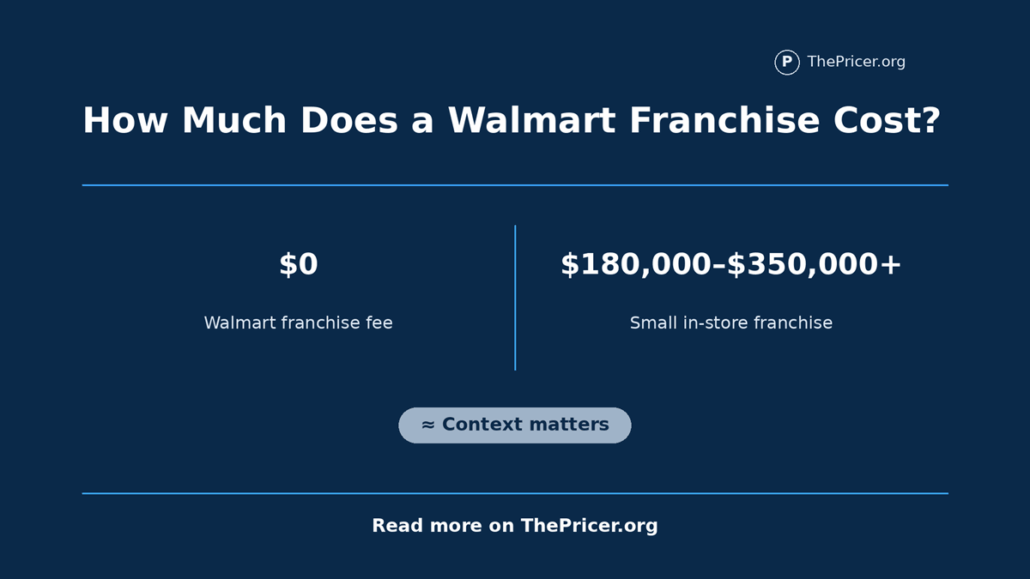
A Walmart franchise costs $0 because Walmart does not sell franchises or grant private operators the right to own Walmart-branded stores. There is no Walmart franchise fee, royalty schedule, required net worth, territory payment, or standard startup package. Walmart Supercenters, Neighborhood Markets, Sam’s Club locations, and other Walmart retail formats are operated by Walmart Inc. rather than independent Walmart franchisees.
An entrepreneur can still build a business around Walmart’s customer traffic, but each available route has a different price structure. A separate franchise may lease approved space inside a Walmart, an independent company may apply for an in-store or adjacent tenancy, a product maker can apply to become a supplier, and an online seller can join Walmart Marketplace. Buying Walmart stock is another route, but it provides an ownership interest in the public company rather than control of a local store. A small in-store service franchise can require $180,000 to $350,000+ after franchise fees, construction, equipment, deposits, inventory, insurance, payroll, and working capital.
Walmart reported fiscal-year 2026 revenue of $713 billion, about 2.1 million associates, and more than 10,900 stores and e-commerce sites across 19 countries. That scale explains the demand for Walmart-related opportunities, but it does not turn Walmart into a franchise system.
Article Highlights
Jump to sections
- The Walmart franchise fee is $0 because no Walmart franchises are offered.
- A business inside Walmart remains an independent tenant or a franchise of another brand.
- A current SmartStyle salon franchise requires about $184,440 to $336,340 (at $30 per hour, earning that amount would take about 3 to 5.4 years of full-time work, before taxes).
- Walmart Marketplace has no setup or monthly seller fee, but referral fees vary by category.
- Becoming an approved Walmart supplier does not guarantee purchase orders or reimbursement.
- A modeled small service kiosk needs about $235,000 before opening.
- Modeled annual occupancy costs of $84,000 require substantial sales before payroll or royalties.
How Much Does a Walmart Franchise Cost?
| Walmart-Related Opportunity | Planning Cost | What the Buyer Actually Gets |
|---|---|---|
| Walmart retail franchise | $0 | No opportunity exists because Walmart does not franchise its stores |
| Small in-store service franchise | $180,000 to $350,000+ (about 2.9 to 5.6 years of full-time work at $30 per hour) | A separate franchise brand plus an approved retail location |
| Independent kiosk or service tenant | $75,000 to $250,000+ | Lease or license rights, buildout, equipment, inventory, and working capital |
| Food or beverage tenant | $250,000 to $1.5 million+ | Restaurant franchise or independent concept, kitchen buildout, permits, and equipment |
| Walmart Marketplace seller | $0 setup or monthly fee | Online seller account with referral fees charged on completed sales |
| Walmart product supplier | Application is $0 | Eligibility for review, not a guaranteed order or shelf placement |
| Walmart stock investor | Current share price | Equity in Walmart Inc., not ownership or control of a store |
The correct price depends on which of these businesses the reader has in mind. An entrepreneur opening a hair salon inside Walmart may sign a franchise agreement with the salon brand and a separate lease or occupancy agreement for the site. An online merchant pays marketplace referral fees rather than rent. A packaged-food company may spend heavily on manufacturing, testing, packaging, logistics, and compliance even though the Walmart supplier application itself does not carry a franchise fee. These prices should not be compared without matching the legal relationship, location, equipment, inventory, staffing, and continuing fees.
What You Are Actually Buying
A franchise gives an operator the right to use another company’s trademark, operating system, products, training, and business format under a franchise agreement. The franchisee usually pays an initial fee and continuing royalties while accepting rules about suppliers, advertising, territory, store design, hours, and quality control. Walmart does not offer that package for its own retail stores. A person cannot pay Walmart for a territory, put the Walmart name on a privately operated Supercenter, or receive a Walmart Franchise Disclosure Document.
An in-store tenant buys something narrower. The agreement may provide the right to occupy a defined space and operate an approved business for a stated term. Walmart remains the landlord, property owner, or host retailer rather than the tenant’s franchisor. Approval to occupy the site does not create rights to Walmart’s name, products, management system, profits, or customer data. The tenant also does not receive a guaranteed share of shoppers simply because the business sits near a store entrance.
The Federal Trade Commission requires a franchisor to provide its Franchise Disclosure Document at least 14 days before the prospective franchisee signs a binding agreement or pays the franchisor. The document covers the separate brand being purchased. It is not a Walmart franchise disclosure.
Leasing Is Not Franchising
A business operating inside or beside Walmart may have to secure approval from two parties. The franchisor decides whether the operator, market, and proposed nontraditional site meet its requirements. Walmart or the property manager decides whether the concept fits the store, lease area, customer needs, construction limits, operating hours, and tenant mix. A franchise approval does not force Walmart to provide a location, and a Walmart leasing opportunity does not force the franchisor to approve the site.
The occupancy agreement may include base rent, a security deposit, utilities, shared expenses, insurance requirements, maintenance duties, opening hours, signage rules, remodeling obligations, permitted products, delivery windows, relocation language, and renewal terms. Some locations may use fixed rent. Others may add a percentage of sales or other charges. No public national Walmart rent card applies to every store, so a claimed monthly rent without an address, square footage, term, and included services is not useful evidence.
Foot traffic is not guaranteed revenue. Walmart can sell products or services that compete with the tenant, and a space near a busy entrance can still convert poorly when the concept does not match the shopper. Lease economics should be tested against actual transaction count, average ticket, gross margin, payroll, royalties, inventory losses, local competition, and store operating hours.
Real In-Store Franchises

SmartStyle is a clearer current example than the old directory of Subway, Quiznos, Saladworks, Cellairis, and ghost-kitchen proposals. SmartStyle salons operate in Walmart stores, but their owners are SmartStyle franchisees rather than Walmart franchisees. A 2026 review of the brand’s 2025 disclosure document places the required investment at $184,440 to $336,340, including a $39,500 (about 7.6 months of full-time work at $30 per hour) initial franchise fee, $60,000 to $120,000 in leasehold improvements, and $30,000 to $50,000 for furniture, fixtures, equipment, and supplies.
The $39,500 fee buys rights and support from SmartStyle, not Walmart. Site costs, construction, rent, deposits, payroll, supplies, training, professional fees, and opening cash form the rest of the investment. The franchise fee represents only 11.7% to 21.4% of the disclosed total range. That ratio exposes the flaw in searching only for a “Walmart franchise fee.” The trademark payment may be a small slice of the money needed to open the actual business.
Restaurant brands have also operated inside Walmart, but the presence of one Subway or McDonald’s location does not prove a new Walmart-specific franchise program is available. A standard McDonald’s franchise investment can reach seven figures, and McDonald’s currently requires at least $500,000 in nonborrowed personal resources before it will evaluate many U.S. applicants. That capital requirement exists independently of Walmart.
Three Startup Budgets
Small service kiosk: Use a modeled $25,000 franchise fee, $12,000 for deposit and initial occupancy costs, $75,000 for kiosk construction and improvements, $30,000 for equipment and point-of-sale systems, $15,000 for permits, insurance, legal work, and other professional expenses, $18,000 for initial inventory, $10,000 for training and preopening payroll, and $50,000 in working capital. The startup total reaches $235,000. The franchise fee accounts for only 10.6% of the complete opening budget.
Independent vending operation: Begin with $5,000 for a modern machine, then add $800 for delivery and installation, $1,000 for payment hardware and software setup, $1,200 for opening inventory, $1,000 for insurance, permits, and business formation, and $5,000 in working cash. The modeled total is $14,000 before any host commission or placement charge. Current vending machine costs show why securing a site before buying equipment is safer than purchasing first and hoping Walmart accepts the machine.
Small food tenant: Use $35,000 for the franchise fee, $40,000 for deposits, design, permits, and professional work, $225,000 for leasehold improvements and utility connections, $150,000 for cooking, refrigeration, ventilation, and point-of-sale equipment, $25,000 for signs and furniture, $30,000 for opening inventory and training, and $100,000 in working capital. The modeled startup cost reaches $605,000. A compact format saves dining-room expense but still needs food-safe construction, plumbing, electrical capacity, fire review, storage, and labor.
ThePricer Occupancy Test
A Walmart location should be tested with occupancy math before the entrepreneur relies on the store’s shopper count. In ThePricer’s modeled service-business example, base rent is $5,000 per month, utility and common charges add $1,000, insurance allocated to the location adds $400, and required service or operating charges add $600. Fixed occupancy reaches $7,000 per month, or $84,000 per year.
At a 60% gross margin, the business needs $140,000 in annual sales merely to generate the $84,000 gross profit needed for occupancy. That calculation leaves nothing for payroll, franchise royalties, advertising fees, inventory shrinkage, credit-card processing, software, loan payments, owner pay, taxes, or profit. At an average ticket of $35, the tenant needs 4,000 transactions per year, or about 333 per month, just to fund occupancy from gross margin.
Add modeled payroll of $144,000, royalties and advertising of $30,000, and other operating expenses of $42,000. The business now needs $300,000 in annual gross profit. At the same 60% margin, required sales rise to $500,000. The Walmart address may help, but the lease works only when customer conversion and ticket size support this sales level.
Supplier Costs Hide Elsewhere
Walmart’s supplier application does not create a franchise cost. Walmart currently says its supplier pool includes more than 100,000 businesses and asks U.S. companies to complete the relevant supplier application process for products sold in stores or online. Acceptance for review does not mean the business has received an order, contract, shelf placement, minimum volume, or reimbursement.
The expensive work often happens before and after approval. A product company may need barcodes, packaging design, production capacity, audits, product testing, liability insurance, warehousing, electronic data interchange, freight, returns handling, chargeback management, marketing, and enough cash to manufacture inventory before payment arrives. Walmart’s supplier requirements state that products, facilities, and records may be subject to audits, inspections, certifications, and tests.
Service and non-resale suppliers face another warning. Walmart states that becoming an approved supplier means only that the company is eligible to receive orders, while money spent obtaining or maintaining approval remains at the supplier’s risk and will not be reimbursed. The current non-resale supplier terms make this distinction explicit. Approval should not be used as the basis for borrowing money unless a real contract and order economics support the debt.
Marketplace Selling Fees
Walmart Marketplace offers a lower-entry route because there is no physical store buildout and no Walmart franchise fee. Walmart currently advertises no setup or monthly seller fee. Sellers pay a referral fee after a completed sale, with rates changing by category and price tier. The current Marketplace pricing schedule lists examples such as 6% for personal computers, 8% for consumer electronics, 12% for many tools and musical instruments, and 15% for several home, grocery, office, and accessory categories.
A seller with $250,000 in annual marketplace revenue and a 15% referral rate would pay $37,500 in referral fees before advertising, fulfillment, returns, product cost, storage, customer-service labor, and taxes. If the merchandise has a 40% gross margin before the fee, product gross profit is $100,000. The referral charge absorbs 37.5% of that gross profit, leaving $62,500 before the remaining expenses.
Walmart’s 2026 seller registration guide advertises no setup or monthly fees and temporary new-seller incentives that can reduce referral, fulfillment, search-marketing, or advertising expenses when conditions are met. Promotional savings should not be treated as permanent unit economics. The product still needs a margin that works after the full standard fee resumes.
Other Walmart Routes
Walmart Open Call gives selected entrepreneurs with qualifying U.S.-made, grown, or assembled products a chance to pitch Walmart and Sam’s Club merchants. A meeting is an opportunity to present a shelf-ready product, not a franchise sale or guaranteed purchase. The current Open Call program says selected participants may receive purchase opportunities, but the applicant still carries manufacturing, packaging, freight, insurance, and working-capital costs.
A business seeking a vending route should obtain written placement approval before buying a machine. A specialized pizza vending machine can require much more capital, electrical capacity, refrigeration, cleaning, food permits, and maintenance than a packaged-snack unit. The fact that Walmart operates high-traffic vestibules does not prove that a particular store accepts third-party equipment.
Buying Walmart stock is not a substitute operating route. A shareholder owns a small economic interest in Walmart Inc. and may receive dividends when declared, but has no right to run a store, claim a local territory, lease space, direct employees, or receive one store’s profit. Share price and dividends can fall as well as rise.
What to Verify Before Investing
Ask which legal agreement creates the opportunity. A franchise requires a current Franchise Disclosure Document and franchise agreement. A Walmart tenancy requires a site-specific lease, license, concession, or occupancy contract. A supplier relationship requires the approved supplier process and actual purchase terms. A Marketplace business requires seller approval and category economics. One approval does not replace the others.
For an in-store business, request the exact address, square footage, floor plan, permitted use, term, base rent, percentage rent, utility allocation, shared charges, deposit, required hours, construction duties, signage rights, insurance limits, exclusivity terms, renewal rights, relocation clauses, default rules, and conditions tied to Walmart remodeling or closing the host store. Review the franchise agreement separately to see whether the franchisor permits the proposed nontraditional location.
The FTC’s current FDD review guidance confirms the 14-day disclosure period and encourages buyers to examine the complete agreement before paying. Item 7 deserves close attention because it estimates the initial investment, while other sections cover fees, territory, restrictions, litigation, closures, financial statements, and franchisee contacts.
What We Verified
- Checked: Walmart reported $713 billion in fiscal-year 2026 revenue and about 2.1 million associates.
- Confirmed: Walmart Marketplace currently advertises $0 monthly and setup fees, with sellers paying category-based referral charges.
- Cross-referenced: Walmart’s supplier development programs prepare businesses for retail requirements but do not constitute a franchise opportunity.
- Verified: The FTC requires delivery of the Franchise Disclosure Document at least 14 days before a prospect signs or pays the franchisor.
Answers to Common Questions
Can I buy a Walmart franchise?
No. Walmart does not franchise its retail stores, so no Walmart franchise units are available for purchase.
What is the Walmart franchise fee?
The practical fee is $0 because Walmart has no franchise program. The absence of a fee does not mean a Walmart store can be opened for free.
Can I open another franchise inside Walmart?
Possibly, when both the franchisor and the specific Walmart property approve the operator and site. The business remains a franchise of the outside brand.
How much does an in-store Walmart business cost?
A small service franchise or kiosk may require about $180,000 to $350,000+. Food concepts and larger buildouts can cost far more.
Can I sell products through Walmart without leasing a store?
Yes. A business can apply for Walmart Marketplace or a supplier relationship. Approval is not guaranteed, and seller, fulfillment, compliance, inventory, and referral costs still apply.
Disclosure: Educational content, not financial advice. Prices reflect public information as of the dates cited and can change. Confirm current rates, fees, taxes, and terms with official sources before purchasing. See our methodology and corrections policy.
Franchising interest