ThePricer Media
  • Latest: The Cost to Cool an AI Data Center
  • Cost Guides
  • News & Investigations
  • Daily Price Puzzle (60s)
  • Methodology
  • Press & Mentions
  • Contact
  • Click to open the search input field Click to open the search input field Search
  • Menu Menu
Family & Lifestyle, Weddings

How Much Does Wedding Draping Cost?

Updated on July 11, 2026 | Written by Alec Pow
This article was researched using 10 sources. See our methodology and corrections policy.

Wedding draping costs about $400 to $1,500 for a professionally installed backdrop, sweetheart-table feature, or limited wall treatment. Draping several walls or creating a more detailed reception design often costs $1,500 to $5,000, while full ceiling draping, tent liners, and ballroom transformations can reach $5,000 to $10,000 or more.

Basic pipe-and-drape rental is often priced at $8 to $20 per linear foot, but that rate may cover only the freestanding hardware and standard fabric. Delivery, installation, removal, ceiling lifts, lighting, custom colors, fire-rated materials, and venue access fees can double or triple the equipment price.

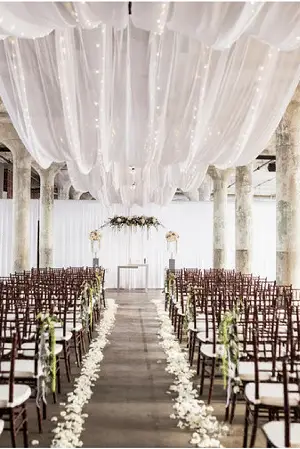
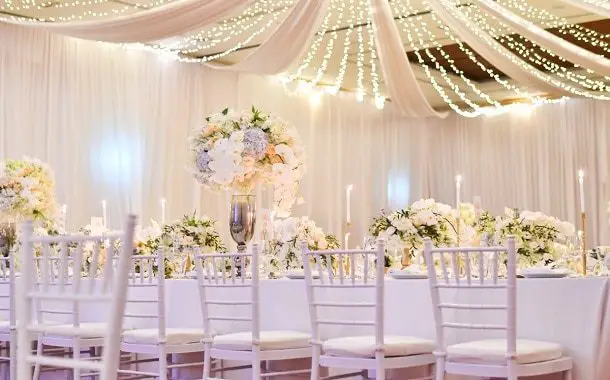
Wedding draping can refer to a small ceremony backdrop, fabric covering a ballroom wall, ceiling swags, tent liners, column wraps, or a full room installation. The size of the covered area, ceiling height, fabric fullness, and labor needed to install it safely matter more than the wedding guest count.

Article Highlights

Jump to sections
  • Does Wedding Draping Cost?
  • What You Are Renting
  • Backdrop, Wall, or Ceiling
  • Fullness Changes the Math
  • The Ten-Foot Billing Rule
  • High Ceilings Cost More
  • What a Quote Leaves Out
  • Small professionally installed draping features cost about $400 to $1,500 (at $30 per hour, earning that amount would take about 0.3 to 1.3 full-time workweeks, before taxes).
  • Wall draping commonly costs $8 to $20 per linear foot before some setup, delivery, and specialty-fabric charges.
  • Full ceiling or ballroom draping can cost $2,500 to $10,000 or more.
  • A shipped DIY backdrop kit can start near $100 to $160, but it is not comparable to an installed ceiling or ballroom design.
  • Ceilings above 12 to 14 feet may require a lift costing $600 or more.
  • Fabric fullness can require two or three times the visible wall width in material.
  • Venue labor rules, fire certification, rigging limits, and short setup windows can add more than the fabric itself.
Wedding Draping Cost

How Much Does Wedding Draping Cost?

Draping project Expected price Common scope
DIY backdrop kit $100 to $300 (about 0.4 to 1.3 full-time workdays at $30 per hour) Freestanding frame, standard fabric, customer setup
Installed ceremony backdrop $400 to $1,200 One focal area with fabric, frame, setup, and removal
Sweetheart table or stage draping $500 to $1,500 Layered fabric around one reception feature
Basic pipe and drape $8 to $20 per linear foot Standard 8- to 12-foot freestanding wall system
100 feet of wall draping $800 to $2,000 Equipment and standard fabric before some labor and transport charges
Partial ceiling draping $1,500 to $4,000 Several ceiling swags above a dance floor or central area
Full ceiling or ballroom design $3,000 to $10,000+ Large quantities of fabric, rigging, lifts, lighting, and installation crews
Tent ceiling liner $2,500 to $12,000+ Fabric fitted to the tent size and structural layout

Current vendor listings show how much local rates vary. Brooklyn Party Rental prices 8- or 10-foot-high pipe and drape at $14 per foot. Ultimate Events lists 12-foot-high black pipe and drape at $11.20 per linear foot. Rent For Event posts colored 10-foot draping between about $10.18 and $11.28 per foot.

These rates are useful starting points, not complete wedding quotes. One rental company lists $11.50 per foot for 12- or 14-foot draping but states that setup is not included.

Related guides

  • How Much Does a Rancho Las Lomas Wedding Cost?
  • How Much Does An Engagement Party Cost?
  • How Much Does Elite Singles Cost?

What You Are Renting

Pipe and drape is a freestanding system made from weighted floor bases, upright poles, horizontal crossbars, and fabric panels. It can hide an unattractive wall, divide a ballroom, create a ceremony backdrop, frame a stage, or block service areas from guest view.

Decorative wedding draping may use the same hardware, but it can also include fabric attached to approved ceiling rigging points, tent beams, trusses, arches, columns, or custom frames. Ceiling installations take longer because the crew must measure the room, calculate fabric runs, inspect attachment points, and work above floor level.

The fabric may be sheer voile, chiffon, polyester, satin, velour, velvet, blackout cloth, or a textured specialty material. A standard white polyester rental is not comparable to a layered velvet installation or custom-colored ceiling design.

Draping also differs from wedding linens. Tablecloths and chair covers are fitted to furniture, while draping is part of the room or production design.

Backdrop, Wall, or Ceiling

A small backdrop is the least expensive form of wedding draping. It may cover an area 8 to 20 feet wide and can be assembled from a shipped kit or installed by a local decorator.

Ship Our Wedding advertises a five-day DIY backdrop rental for $159.99, including shipping for qualifying orders. Other shipped backdrop kits start near $99 (about 3.3 hours of work at $30 per hour). These low prices exist because the customer receives a standardized package and handles assembly, placement, and repacking.

Wall draping is commonly priced by linear foot. Covering 50 feet at $12 per foot produces a base rental of $600. Covering 150 feet at the same rate produces $1,800 before delivery, setup, tax, or upgraded fabric.

Ceiling draping is rarely priced with a simple per-foot figure. The vendor must account for ceiling width, length, height, rigging locations, number of swags, fabric drop, lift access, sprinkler clearance, lighting fixtures, and installation time.

A design covering only the space above the dance floor may cost $1,500 to $3,000. Fabric spreading across an entire ballroom can exceed $5,000, especially when several lifts or setup days are needed.

Fullness Changes the Math

A 100-foot wall does not always use only 100 feet of fabric. Fabric looks flat when its width closely matches the covered span. Decorators create folds by using more material than the visible width.

At 1.5-times fullness, a 100-foot wall needs about 150 feet of fabric width. At two-times fullness, it needs about 200 feet. A dense three-times treatment uses about 300 feet.

The frame still covers 100 linear feet, but the material, steaming, handling, storage, and cleaning requirements rise with the fullness ratio. This is one reason two vendors can quote the same wall length and arrive at very different totals.

A vendor pricing standard pipe and drape at $10 per foot might quote $1,000 for 100 feet. A decorator using layered sheer fabric, a colored rear panel, and twice the fullness may quote $2,000 to $3,500 for the same wall.

Ask the vendor to state the fullness ratio, number of fabric layers, panel height, and type of textile. “100 feet of draping” does not describe those details.

The Ten-Foot Billing Rule

Pipe-and-drape hardware is often rented in fixed sections rather than exact one-foot increments. Lounge Party Rentals charges $9 per linear foot but bills its system in 10-foot sections. A customer requesting 25 feet is charged for 30 feet because the third crossbar and supporting hardware are still required.

That raises the equipment price from a theoretical $225 to $270. The difference is small on one backdrop but becomes more visible when several separate walls, doorways, or room dividers are installed.

Corners and gaps can also change the quantity. Two separate 15-foot walls may require four 10-foot sections, or 40 billed feet, rather than 30 feet. The extra hardware helps each run stand independently.

The quote should identify measured feet, billed feet, height, number of separate sections, and whether corners require added uprights and bases.

High Ceilings Cost More

An 8- or 10-foot-high freestanding backdrop can often be installed from the floor. Ceiling draping and tall wall systems may require ladders, scaffolding, scissor lifts, boom lifts, or approved venue riggers.

My Wedding Team states that its ceiling décor pricing assumes a ceiling no higher than 12 feet. Taller spaces require a lift with an additional charge starting near $600. Large rooms may require two or three lifts.

One $600 lift raises a $2,500 draping design to at least $3,100 before extra operator time or venue charges. Two lifts raise it to $3,700.

The crew may also need access the day before the wedding. A venue that charges $500 for an extra setup day turns that same project into a minimum $4,200 installation.

Tall ceilings can increase labor even when a lift is already available. Every fabric panel must be raised, positioned, secured, adjusted, and later removed without damaging the room.

What a Quote Leaves Out

A low rental rate may cover only poles and fabric. Full-service companies may bundle design, delivery, installation, steaming, inspection, emergency adjustments, teardown, and collection into a higher headline price.

Possible additions include:

  • Delivery and pickup: $100 to $500+
  • Installation and removal labor: $300 to $2,000+
  • Lift rental: $600 to $1,500 per lift
  • Lighting package: $700 to $2,000+
  • Custom monogram projection: $400 to $700
  • Extended venue access: $250 to $1,500+
  • Rush or after-hours setup: quote dependent
  • Damage waiver, deposit, and tax: based on the rental contract

Party Rental Ltd. lists transportation, damage waiver, and tax as separate charges and applies more fees to certain emergency orders under its delivery and fee policy.

The lighting line requires special attention. A small battery-powered uplight is not the same as a gobo projector, pin spot, chandelier, or full ballroom lighting design. Lighting & Sound Co. posts ballroom uplighting at $700 to $2,000, monogram projection at $400 to $700, and chandeliers at $225 to $500 each.

A 100-Foot Example

Consider a couple covering 100 feet of ballroom wall with standard 10-foot-high white fabric.

The vendor charges $12 per linear foot, producing a base equipment price of $1,200. Delivery and collection add $250. Installation and removal cost $600. Twelve uplights add $360, and the damage waiver and tax add another $190.

The complete draping bill is $2,600:

  • Pipe, bases, crossbars, and fabric: $1,200
  • Delivery and collection: $250
  • Installation and removal: $600
  • Twelve uplights: $360
  • Damage waiver and tax: $190

The advertised $12-per-foot rate accounts for less than half of the final invoice. Removing the uplights would reduce the bill to $2,240. Picking up and installing a suitable floor-level system without professional labor could reduce it further, but only when the venue allows customer installation.

Three Draping Budgets

Small ceremony feature: A couple rents a shipped 10-foot backdrop for $160, adds $60 of faux greenery, and pays $40 for return packaging or incidentals. The finished DIY total is about $260.

Partial reception design: A decorator installs 50 feet of draping behind the couple’s table and cake display at $14 per foot. Equipment costs $700, labor and transport cost $550, and six uplights cost $240. The project totals $1,490.

Full ballroom installation: Wall and ceiling draping is quoted at $5,500. Two lifts add $1,200, a lighting package adds $1,500, and extended venue access costs $600. The complete project reaches $8,800.

A recent wedding discussion included a reported $7,000 draping and lighting quote that covered ceiling fabric. That is an anecdotal market signal rather than a standard rate, but it shows why full-room work should not be compared with a small backdrop rental.

Fabric and Fire Rules

Many hotels, ballrooms, convention spaces, and public assembly venues require documentation showing that decorative fabric meets the applicable flame-spread test. NFPA 701 is a common test standard for curtains, drapes, and similar textiles.

Meeting NFPA 701 does not mean the fabric cannot burn. It means samples were tested under the standard’s procedures and met its performance criteria. Local fire officials and the venue decide which certificates and rules apply.

Event Drape Rental notes that temporary decorative fabrics may be tested under NFPA 701, California Title 19, New York City requirements, or Boston IX-1, depending on the location. Its flame-certification guidance recommends checking local requirements.

A venue may reject unmarked fabric purchased online even when the fabric seller describes it as fire resistant. Ask whether the decorator can provide the certificate for the exact material being installed.

Drapes must also stay clear of emergency exits, exit signs, heat sources, and sprinkler systems. Ceiling work should be approved by the venue before a deposit is paid.

When DIY Works

DIY draping can make sense for a freestanding ceremony backdrop, photo booth, dessert table, or short wall section that can be installed from floor level. A standardized rental kit also avoids purchasing poles and storing large quantities of fabric after the wedding.

It is a poor match for a high ceiling, outdoor canopy, heavy velvet, large room perimeter, or installation attached to the building. Outdoor fabric behaves like a sail in strong wind, and many venues prohibit customers from attaching materials to ceilings, beams, walls, or sprinkler pipes.

Professional installation also makes more sense when the venue allows only a short setup window. A couple may save $500 in labor but lose that saving by paying for early access, hiring helpers, purchasing tools, or replacing damaged material.

Ask the venue whether outside draping vendors are allowed, whether they need liability insurance, and whether an in-house production team must supervise the installation.

When Draping Pays Off

Makes sense if:

  • The venue has walls, partitions, service doors, or fixtures that will remain visible in photographs.
  • A backdrop can replace several smaller décor purchases.
  • The room is large enough for fabric without feeling closed in.
  • The same installation defines the ceremony, reception stage, and photo area.
  • The vendor has worked with the venue and knows its rigging and fire rules.

Does not make sense if:

  • The venue already has strong architecture that the fabric would hide.
  • The quote consumes money needed for food, photography, music, or guest comfort.
  • Only a few dim or distant areas will appear behind the draping.
  • The venue charges large setup fees or requires union labor.
  • The design depends on outdoor fabric remaining still in unpredictable weather.

A strategically placed backdrop may have more effect than covering every wall. Draping the ceremony focal point, sweetheart table, or band stage can provide the visual benefit at a fraction of a full-room price.

Related wedding expenses may include a wedding planner, wedding rings, and wedding corsages. A planner or venue coordinator may also need to be present during an extended draping installation.

What We Verified

  • Checked: Current rental listings place standard pipe and drape near $9 to $14 per linear foot, with height, fabric, and location changing the rate.
  • Confirmed: Some vendors bill in 10-foot sections, so a 25-foot request may be invoiced as 30 feet.
  • Cross-referenced: Setup is excluded from some posted per-foot prices, while other companies sell complete installed packages.
  • Verified: Ceiling work above 12 feet may require lift equipment starting near $600.
  • Checked: NFPA 701 is a fabric testing standard used for many temporary drapery installations, but local venue and fire rules still control approval.

Answers to Common Questions

How much does it cost to drape a wedding venue?
Limited installed draping costs about $400 to $1,500. Several walls or a partial ceiling often cost $1,500 to $5,000, while a full ballroom can exceed $10,000.

How much does wedding draping cost per foot?
Basic pipe and drape commonly costs $8 to $20 per linear foot. Labor, delivery, specialty fabric, lighting, and high ceilings can push the installed rate higher.

How much does it cost to drape a 100-foot wall?
The equipment may cost $800 to $2,000. A realistic installed total with delivery, labor, and lighting can reach $1,500 to $3,500.

Is ceiling draping more expensive than wall draping?
Yes. Ceiling draping requires more fabric, rigging work, installation time, and sometimes lifts. Partial ceiling work may start around $1,500, while full coverage can exceed $5,000.

Does wedding draping include lighting?
Not always. Some full-service quotes include uplights or string lighting, while equipment-only rentals do not. Ask for fabric, hardware, lighting, labor, transport, and removal to be listed separately.

Disclosure: Educational content, not financial advice. Prices reflect public information as of the dates cited and can change. Confirm current rates, fees, taxes, and terms with official sources before purchasing. See our methodology and corrections policy.

by Alec Pow
ThePricer cost research Independent price research used by media, universities and public institutions.

We research provider pricing, market examples, buyer reports, hidden fees and public records.

Methodology · Citations · Newsroom
© 2014 - 2026 - ThePricer Media, LLC, 4 Grove Street, New York, NY, 10014, Phone: (212) 431-2441
We don’t use affiliate links or paid placements. All sources are cited only for verification.
  • Link to X
  • Link to LinkedIn
  • Link to Facebook
  • Link to Instagram
  • Link to Pinterest
  • Link to Youtube
  • Contact Us
  • About Us
  • Press & Mentions
  • Careers
  • Meet the Founder
  • Privacy Policy
  • Editorial Ethics
  • Methodology
  • Corrections
  • Disclosure
  • Terms and Conditions
Scroll to top Scroll to top Scroll to top