
What Was Trump’s $810 Million Pocket Rescission Cut?
Updated on | Written by Alec Pow
This article was researched using 12 sources. See our methodology and corrections policy.
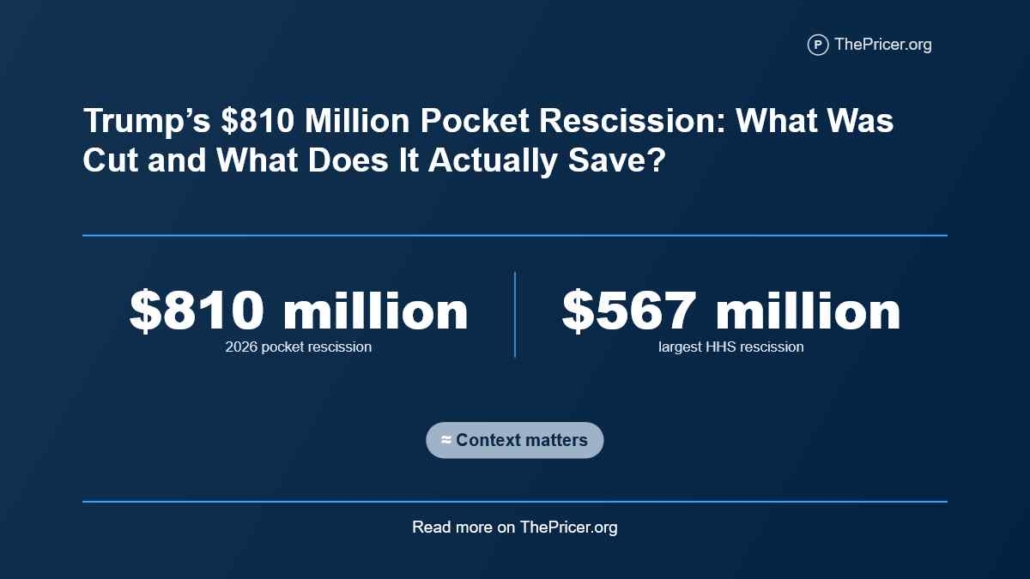
President Donald Trump’s September 25, 2026 pocket-rescission package targets $810 million in previously approved federal budget authority across 11 items. The White House describes the package as nearly $1 billion, but the listed amounts add to $810 million. Most of the money is concentrated in a few accounts, led by $567 million in HHS funding connected with services for refugees, asylees, and other noncitizens.
The story changed again on September 29. The Government Accountability Office concluded that the Impoundment Control Act does not allow the administration to withhold the targeted money through its expiration unless Congress completes action on a rescission bill. That turns the package from a simple spending-cut announcement into an active fight over whether the money can legally be allowed to expire at the end of the fiscal year.
Article Highlights
Jump to sections
- The 11 White House line items add to $810 million (at $30 per hour, earning that amount would take about 13 thousand years of full-time work, before taxes).
- The largest HHS item is $567 million, exactly 70% of the package.
- Three immigration-connected items total $607 million, about 74.9% of the package.
- The three largest cuts of any type total $693 million, or about 85.6%.
- GAO says the administration cannot lawfully keep the funds withheld through expiration without congressional action.
- A separate 2026 public-charge policy carries an estimated $5.07 billion per year federal transfer effect, but that is not part of this rescission.
Where the $810 Million Goes
The White House rescission list contains 11 amounts. The largest is $567 million (about 9.1 thousand years of full-time work at $30 per hour) from HHS programs that the administration says support refugees, asylees, other noncitizens, and organizations serving those groups. Education programs for international education account for $70 million, HUD housing counseling accounts for $56 million, HHS research programs account for $28 million, and Special Programs for Migrant Students account for $25 million.
The smaller items include $15 million for DHS case-management services, $15 million for the Justice Department’s Community Relations Service, $10 million in DHS immigration-related grants, $10 million for the Minority Business Development Agency, $9 million for Treasury debt-relief activity tied to forests and coral reefs, and $5 million for the HHS Office of Minority Health.
| Targeted program or account | Rescission | Share |
|---|---|---|
| HHS refugee and noncitizen services | $567M | 70.0% |
| International education programs | $70M | 8.6% |
| HUD housing counseling | $56M | 6.9% |
| HHS research programs | $28M | 3.5% |
| Migrant-student programs | $25M | 3.1% |
| DHS case-management services | $15M | 1.9% |
| DOJ Community Relations Service | $15M | 1.9% |
| DHS immigration grants | $10M | 1.2% |
| Minority Business Development Agency | $10M | 1.2% |
| Treasury debt-relief item | $9M | 1.1% |
| HHS Office of Minority Health | $5M | 0.6% |
Immigration-Linked Cuts Dominate
The biggest policy feature is the concentration of spending connected with immigrants, refugees, asylum seekers, and migrant students. The $567 million (about 9.1 thousand years of full-time work at $30 per hour) HHS item by itself represents 70% of the full package. Add the $25 million migrant-student item and the $15 million DHS case-management item and those three lines reach $607 million. Divide $607 million by $810 million and the share is about 74.9%.
That calculation does not mean every dollar in those accounts is a direct payment to immigrants. Much of the money supports grants, services, nonprofit providers, education, case management, legal assistance, mental-health services, or program administration. The current funding dispute also includes programs focused on housing counseling, minority business development, HHS research, and racial conflict mediation.
The White House argues that lower border crossings reduce the need for some services and describes the targeted programs as wasteful or harmful. Critics in Congress dispute both the process and several policy characterizations. Republican Senate Appropriations Chair Susan Collins has argued that the administration cannot cancel appropriated funds without Congress. The accounting point is narrower. The package is dominated by immigration-connected services, but it is not an $810 million check written directly to immigrants.
What GAO Changed
GAO’s September 29 decision is the most important new development. The agency reviewed the President’s September 25 special message and the OMB reapportionment that withheld the proposed rescissions. In its September 29 decision, GAO said the plain language of the Impoundment Control Act requires amounts proposed for rescission to be made available unless Congress completes action on a rescission bill within the statutory period.
The timing matters because the request was sent only five calendar days before September 30, the end of fiscal 2026. The governing rescission statute provides a 45-day period for congressional action. GAO’s view is that an administration cannot create a practical cancellation by withholding fixed-period funds until they expire before Congress has used that process.
AP reported on September 30 that the dispute remains active and may be resolved in court. Its September 30 report says GAO concluded the withholding would violate federal law, while administration officials defend the maneuver. GAO can issue legal decisions and report violations to Congress, but this is not the same as a final Supreme Court judgment resolving every pocket-rescission argument.
Budget Authority Is Not Cash
The $810 million figure is budget authority, meaning legal authority for agencies to incur obligations. It is not necessarily $810 million of cash that otherwise would leave the Treasury on September 30. Agencies can obligate funds through grants, contracts, or other commitments, while outlays can occur later as those obligations are paid.
This distinction changes the meaning of the word “saving.” Canceling unobligated authority can prevent later federal outlays, but the eventual cash effect depends on what agencies would have obligated, whether any funds were already committed, when payments would have occurred, and whether Congress or a court changes the availability of the money. A one-for-one same-day cash saving should not be assumed from the rescission amount.
The federal scale also looks different depending on the denominator. CBO projects $7.4 trillion in FY2026 outlays. The $810 million rescission equals about 0.011% of that annual figure. CBO estimated a $2.0 trillion deficit through the first 11 months of FY2026. Against that amount, $810 million equals roughly 0.041% under a purely mathematical comparison rather than an expected deficit reduction.
How Big Are the Program Cuts
A small share of the federal budget can still represent a large share of a targeted program. Congress provided $52.123 million for Special Programs for Migrant Students in the relevant funding table. The proposed $25 million rescission equals about 48% of that amount. The program represents only 3.1% of the full rescission package, yet the proposed cut is close to half of its funding benchmark.
HUD creates an even sharper account comparison. An FY2026 Housing Counseling Assistance apportionment shows about $56.55 million in total budgetary resources brought forward. The proposed housing-counseling rescission is $56 million. Comparing those two published figures gives about 99%. The HUD apportionment record does not prove that every rescinded dollar maps directly to that one line, so the result is a close account comparison rather than a confirmed percentage cut to every counseling activity.
The concentration is also visible by department. HHS accounts for $600 million once its $567 million, $28 million, and $5 million items are combined. Education accounts for $95 million, and HUD accounts for $56 million. Together those three departments reach $751 million, about 92.7% of the full package. The other departments and international item share the remaining $59 million.
How This Compares With 2025
 The 2026 package is much smaller than Trump’s 2025 pocket-rescission effort. AP has reported the prior foreign-aid package at about $4.9 billion. The current $810 million amount equals about 16.5% of that figure, making it roughly 83.5% smaller. Add the two announced totals and they reach about $5.71 billion in targeted budget authority across the two years.
That $5.71 billion should not be presented as verified cash savings. The two packages involve different accounts, different fiscal years, different legal disputes, and different amounts of budget authority. The 2025 case also reached the Supreme Court in an emergency posture. The 2025 Supreme Court docket shows that the Court stayed part of a lower-court order involving expiring foreign-assistance funds but did not issue a final merits judgment establishing that every pocket rescission is lawful.
The domestic emphasis is different too. The 2025 package focused heavily on foreign aid and international organizations. The 2026 package reaches refugee services, migrant education, housing counseling, health research, minority health, Justice programs, and business-development spending. A smaller federal total can create a larger percentage effect inside an individual domestic program.
The Broader Immigrant-Spending
The rescission is not the administration’s only 2026 policy that could reduce federal spending connected with immigrants. A separate public-charge rule is expected to affect enrollment in programs such as Medicaid, CHIP, and SNAP. States challenging that rule cite DHS estimates that reduced or forgone enrollment could lower federal Medicaid and CHIP transfers by about $4.05 billion per year and SNAP transfers by about $1.02 billion per year.
The combined estimate is $5.07 billion per year, according to the Minnesota litigation summary. That is about 6.3 times the one-time $810 million rescission package. The comparison is useful only as scale. The $5.07 billion figure is an estimated change in federal transfers tied to expected enrollment behavior, not a rescission, not money already saved, and not part of the $810 million package.
That broader issue deserves separate treatment because benefit eligibility differs by immigration status and by program. Folding Medicaid, SNAP, refugee resettlement, state-funded services, and U.S.-citizen children into this rescission article would blur the core question. Here, the relevant point is narrower. The public-charge estimate shows that the administration’s other immigrant-related spending policies could have a much larger annual federal transfer effect than this particular pocket rescission.
What Happens Next
The immediate question is what happens to the targeted budget authority after GAO’s decision. Congress could enact rescissions, extend the availability of particular funds, or pass other appropriations language. The administration could release funds for obligation or continue defending its interpretation. Litigation could also determine whether agencies must make the money available before it expires or whether any legal remedy remains after expiration.
The White House and GAO are not debating the same policy question. The administration says the spending should end because it views the programs as unnecessary, harmful, or inconsistent with its priorities. GAO’s decision addresses whether the executive branch can achieve that result through withholding without congressional approval under the current statute. Readers should separate the merits of each program from the legal mechanism used to cancel funding.
Applies if
- The figure is described as targeted budget authority rather than automatic cash savings.
- The $567 million HHS line is identified as the dominant item in the package.
- GAO’s legal conclusion is separated from any future court ruling.
- The public-charge estimate is treated as a separate policy comparison.
Does not apply if
- The $810 million is described as money already saved.
- The entire package is described as direct benefits paid to immigrants.
- The 45-day rescission process is reduced to a five-day statutory deadline.
- The separate $5.07 billion estimate is added to the rescission as if it were part of the same action.
For related federal-money comparisons, see the cost of a government shutdown, SNAP government spending, and national debt by president.
Verified
- Checked current GAO pocket-rescission guidance against its legal explanation.
- Confirmed the current federal-budget scale with CBO’s August budget review.
- Cross-referenced congressional objections in current Reuters reporting.
Answers to Common Questions
How much is Trump’s 2026 pocket rescission?
The 11 published line items total $810 million in targeted federal budget authority.
How much of the package is tied to immigrant and refugee programs?
The $567 million HHS item, $25 million migrant-student item, and $15 million DHS case-management item total $607 million, about 74.9% of the package.
Did GAO rule the pocket rescission illegal?
GAO concluded that the Impoundment Control Act does not allow the administration to keep the proposed rescissions withheld through expiration without congressional action. A court could still address related legal questions.
Does the rescission immediately save $810 million?
No one-for-one immediate cash saving can be assumed. The figure is budget authority, and the eventual outlay effect depends on obligations, payments, congressional action, and litigation.
Is the $5.07 billion public-charge estimate part of this cut?
No. The $5.07 billion per year estimate concerns expected reductions in federal Medicaid, CHIP, and SNAP transfers under a separate 2026 policy.
Disclosure: Educational content, not financial advice. Prices reflect public information as of the dates cited and can change. Confirm current rates, fees, taxes, and terms with official sources before purchasing. See our methodology and corrections policy.