
Who Gets Trump’s $500 Obamacare Refund?
Updated on | Written by Alec Pow
This article was researched using 9 sources. See our methodology and corrections policy.
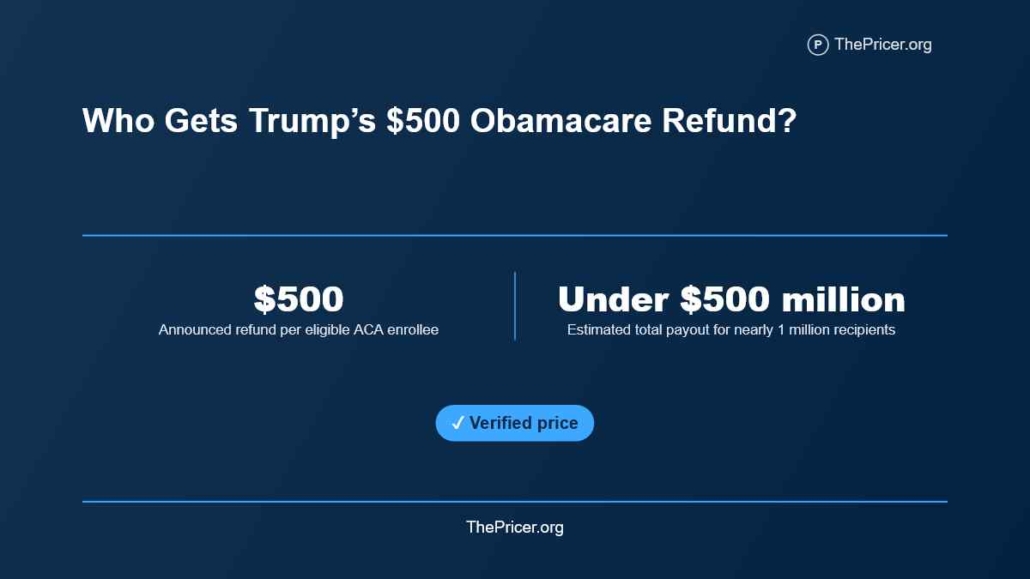
Nearly 1 million Americans are receiving $500 Affordable Care Act refund checks from the Trump administration, with the U.S. Treasury beginning distribution in October 2026. The payments go to a narrow group of people who bought coverage through HealthCare.gov in 30 states and did not receive federal premium assistance.
The size of that group is one of the more revealing numbers behind the announcement. CMS recorded 15,771,397 HealthCare.gov plan selections for 2026. Even if a full 1 million people receive checks, the refunds reach no more than about 6.3% of federal Marketplace plan selections, or fewer than one in 16. Most ACA Marketplace customers will not receive $500.
There is another distinction behind the word “refund.” The White House says the money returns excess HealthCare.gov user fees that were passed through insurers into premiums. The government has not published an individual calculation showing that every recipient personally paid exactly $500 too much. The payment is a flat $500 per eligible person, not a conventional tax reconciliation tied to each household’s precise premium history.
The checks also arrive after a difficult year for ACA customers. Average net Marketplace premium payments rose from $113 per month in 2025 to $178 in 2026, while the average deductible climbed from $2,759 to $3,786. For many households, $500 is meaningful cash. It is still only one piece of a much larger health-insurance bill.
Article Highlights
Jump to sections
- The Trump administration is sending $500 (at $30 per hour, earning that amount would take about 2.1 full-time workdays, before taxes) per person to nearly 1 million qualifying ACA enrollees.
- Treasury began sending the checks in October 2026.
- Recipients are in the 30 states using HealthCare.gov and did not receive premium assistance for the coverage tied to the refund.
- Nearly 1 million recipients represent fewer than 6.3% of the 15.77 million HealthCare.gov plan selections recorded for 2026.
- The White House describes the money as a return of excess federal Marketplace user fees.
- No public recipient-by-recipient calculation establishes that every eligible person personally overpaid exactly $500.
- The 2026 federal Marketplace user fee is 2.5% of monthly premiums.
- Average Marketplace premium payments rose 58% from 2025 to 2026, from $113 to $178 per month.
- Reuters reports that 13 politically competitive states account for about $339 million, or 71%, of the payments. The eligibility rule itself follows the federal Marketplace and subsidy status rather than a published electoral classification.
Checks Are Going Out
The program has moved beyond the September announcement. The White House said on October 1 that the Treasury had begun sending refund checks to nearly 1 million ACA enrollees. Each qualifying person receives $500 (about 2.1 full-time workdays at $30 per hour).
The original September 10 announcement described the money as a refund of excess user fees collected through the federally operated ACA Marketplace. The White House refund fact sheet says eligible recipients are people in the 30 HealthCare.gov states who did not receive premium assistance and therefore paid their premiums without that federal help.
The phrase “nearly 1 million” also puts an upper boundary on the direct cash cost. If exactly 1 million people received $500, total payments would equal:
1,000,000 × $500 = $500 million.
Because the administration says the actual recipient count is below 1 million, the payout should be below $500 million unless the number of recipients or payment amount changes.
This is separate from the ordinary ACA premium tax credit. The IRS describes that credit as assistance based on factors including household income and Marketplace coverage. The $500 program instead selects a group that did not receive premium assistance and sends each eligible person the same flat amount.
Who Gets $500?
The eligibility rule is narrower than “people with Obamacare.” Reuters reported that the recipient pool consists primarily of people above 400% of the federal poverty level who received no premium subsidy, together with some people between 100% and 400% of the poverty level who also received no premium assistance. The administration says the eligible recipients were identified using existing Marketplace information.
That creates situations where two people buying ACA coverage in the same state can get different results. An enrollee who paid the entire Marketplace premium without federal assistance may qualify for $500 (about 2.1 full-time workdays at $30 per hour). A neighbor who purchased coverage through the same federal Marketplace but received an advance premium tax credit is outside the announced refund group.
Income by itself is therefore not a reliable eligibility test. The central question is whether the person was covered through the relevant federal Marketplace and received premium assistance for that coverage.
The ordinary premium tax credit works differently. Eligible households can have estimated credits paid to insurers throughout the year and later reconcile those amounts on Form 8962. The new $500 payment is not that tax reconciliation.
The White House describes the new refund as $500 per person. That wording means a household could receive more than $500 if multiple people independently satisfy the final matching criteria, but the government has not released enough household-level operational detail to assume a specific payment for every family configuration.
Fewer Than 1 in 16
The recipient count sounds large until it is compared with the federal Marketplace population. CMS recorded 15,771,397 HealthCare.gov plan selections for 2026 across the 30 states using the federal enrollment platform.
Using 1 million recipients as a maximum:
1,000,000 ÷ 15,771,397 = 6.34%.
That is approximately one recipient for every 15.8 federal Marketplace plan selections. Since the actual recipient number is described as fewer than 1 million, the final share should be lower.
This calculation uses plan selections rather than current effectuated enrollment, so it should not be interpreted as the exact percentage of people currently insured through HealthCare.gov who receive checks. It does establish the scale of the announced program against the official 2026 enrollment pool.
The narrow reach follows directly from the eligibility design. Most Marketplace customers historically receive some premium assistance. The $500 program moves in the opposite direction by targeting people who paid without that assistance.
Marketplace participation also changed sharply in 2026. KFF found that February effectuated ACA enrollment fell from 21.8 million people in 2025 to 19.2 million in 2026. States relying on HealthCare.gov experienced a weighted 15% decline, compared with 6% among state-based Marketplaces. Those figures describe broader ACA enrollment changes rather than eligibility for the $500 check, but they provide important context for the small unsubsidized group receiving the refund.
Were You Overcharged $500?
The White House calls the payments refunds of excessive Marketplace user fees. That description refers to the way HealthCare.gov is financed, but it does not mean the government has publicly shown that every recipient personally paid an extra $500.
Insurers selling qualified health plans through the federal Marketplace pay CMS a user fee based on premiums. CMS set the 2026 federal Marketplace fee at 2.5% of monthly premiums. Insurers account for such expenses when setting premiums, so consumers can bear the cost indirectly even though they do not see a separate “HealthCare.gov fee” on their monthly bill.
A flat refund and an individualized overcharge calculation are different concepts. Suppose a full-price Marketplace premium were $800 per month. A 2.5% user fee applied to that premium equals:
$800 × 2.5% = $20 per month.
Across 12 months:
$20 × 12 = $240.
A $500 payment would equal more than two years of that illustrative current fee amount. That does not establish what the same enrollee paid through previous years, how much surplus is associated with that person, or how the government selected $500 as the individual payment amount.
The safest description is therefore the government’s own structure: a flat $500 refund financed from excess Marketplace user-fee collections, rather than a verified $500 personal billing error for every recipient.
The Hidden Price
The $500 payment also looks different when placed beside the cost of ACA coverage. KFF reports that the average net Marketplace premium payment rose from $113 per month in 2025 to $178 in 2026. That is a $65 monthly increase.
Across one year:
$65 × 12 = $780.
A $500 check is equal to about:
$500 ÷ $780 = 64.1%
of that broad average annual increase in consumer premium payments.
This is an illustrative comparison, not a calculation of what refund recipients personally lost. The KFF average includes subsidized and unsubsidized Marketplace consumers, while the new refund specifically excludes people receiving premium assistance. Full-price enrollees can face very different premiums based on age, location, insurer and household composition.
Deductibles moved sharply too. KFF found the average Marketplace deductible rose 37%, from $2,759 to $3,786 in 2026 as more people selected lower-premium bronze plans. A $500 check does not reduce that deductible, and it does not restore the enhanced federal premium subsidies that expired after 2025.
That distinction is central to evaluating what $500 means financially. Readers comparing their own bill can see current ACA health insurance costs, including premiums and cost sharing that can dwarf a one-time payment.
Why These 30 States?
The state list follows the structure of the ACA Marketplace. For 2026, CMS says 30 states use HealthCare.gov, while the other states and the District of Columbia operate their own state-based enrollment platforms.
The refund states are Alabama, Alaska, Arizona, Arkansas, Delaware, Florida, Hawaii, Indiana, Iowa, Kansas, Louisiana, Michigan, Mississippi, Missouri, Montana, Nebraska, New Hampshire, North Carolina, North Dakota, Ohio, Oklahoma, Oregon, South Carolina, South Dakota, Tennessee, Texas, Utah, West Virginia, Wisconsin and Wyoming.
California and New York are absent because they operate state-based exchanges. Georgia, Illinois and Virginia also use their own state enrollment systems in 2026. The federal-platform boundary explains why living in a state with ACA coverage is not enough to receive the federal refund.
The distinction matters when interpreting maps of the payments. The 30-state pattern is not a national distribution proportional to population, ACA enrollment or health-care costs. It begins with the administrative boundary created by HealthCare.gov.
Some states also reacted differently to the expiration of enhanced premium subsidies. KFF found that state-based Marketplaces with their own supplemental assistance tended to experience smaller enrollment losses, while federal-platform states saw larger declines on average. That does not determine who receives $500, but it helps explain why the 2026 ACA experience differs sharply from state to state.
The Midterm Timing
The timing has become part of the news because the checks began going out roughly a month before the November 2026 midterm elections. Reuters reported that 13 politically competitive states receive about $339 million, equal to 71% of the payment total cited in its analysis.
That concentration has prompted Democratic officials and other critics to question whether sending checks immediately before an election gives the program a political purpose. The Trump administration describes the payments differently: as a return of excess federal Marketplace fees to unsubsidized consumers who paid the full premium.
The available evidence supports two separate facts. The checks are arriving immediately before the midterms, and a large share of the money is going to states containing competitive races. The eligibility mechanism is also tied to HealthCare.gov participation and lack of premium assistance. Publicly released program rules do not classify recipients according to party registration or voting history.
Those distinctions matter because the state distribution alone does not establish why any individual recipient was selected. Texas, Florida and Ohio contain large federal Marketplace populations, while California and New York are excluded because their exchanges are state-run.
The timing is therefore a legitimate part of the current story, but determining political motive goes beyond what the payment records themselves establish.
Where the Money Comes From
The refund is being financed from money collected through Marketplace user fees rather than from a new $500 tax credit. CMS charges participating insurers to finance operations of the federally facilitated Marketplace. The 2026 rate is 2.5% of monthly premiums.
The administration says earlier fee collections exceeded what was needed to operate HealthCare.gov, creating a surplus that can be returned to unsubsidized customers. Independent reporting has placed the available pool around $500 million, which closely matches the maximum cash requirement implied by nearly 1 million $500 payments.
The arithmetic is useful:
| Refund scale | Amount |
|---|---|
| One eligible person | $500 |
| Two eligible people | $1,000 |
| 500,000 recipients | $250M |
| 900,000 recipients | $450M |
| 1 million recipients | $500M |
The payment should also not be confused with ACA insurer rebates under medical-loss-ratio rules. Those are separate payments that can arise when an insurer spends too little of premium revenue on medical care and quality improvement. This program instead involves federal Marketplace user-fee balances.
It is also separate from Trump’s proposed $5,000 dividend and earlier discussions around a $2,000 tariff dividend. Those proposals involve different funding claims, populations and legal status.
What $500 Does Not Fix
The refund arrives during a broader affordability problem that is much larger than the payment. Enhanced federal premium tax credits expired at the end of 2025, changing what millions of ACA customers paid in 2026. KFF found that consumers responded partly by switching into plans with lower premiums and larger deductibles.
The effects can be seen in enrollment. KFF’s analysis of CMS data found that effectuated Marketplace enrollment fell about 12% from 2025 to 2026. HealthCare.gov states experienced a larger weighted decline than state-based Marketplace states.
The $500 refund does not reinstate the enhanced premium tax credits, reduce an enrollee’s deductible by $500, or guarantee lower premiums for 2027. It is a one-time cash payment to a limited group of unsubsidized federal Marketplace enrollees.
For households that lost enhanced federal help, the financial change can run into thousands of dollars depending on income, age and local premiums. The earlier 2026 ACA subsidy-expiration scenarios show why the same $500 payment can be relatively meaningful for one household and small compared with the annual increase faced by another.
That is the useful way to interpret the check: $500 is a real cash payment, but it should not be mistaken for a measure of each recipient’s total ACA cost increase or for a replacement of the subsidy system that changed in 2026.
Answers to Common Questions
Who gets Trump’s $500 ACA refund?
The announced recipient group consists of nearly 1 million people in the 30 states using HealthCare.gov who did not receive premium assistance for the qualifying Marketplace coverage.
Are the $500 checks being sent now?
Yes. The White House said on October 1, 2026 that the Treasury had begun sending the ACA refund checks.
Does every Obamacare enrollee get $500?
No. The recipient count is less than 1 million compared with 15.77 million HealthCare.gov plan selections for 2026, and customers receiving premium assistance are outside the announced group.
Did every recipient actually overpay by $500?
No individualized public calculation demonstrates that. The administration describes the checks as refunds from excess Marketplace user-fee collections. The payment is a uniform $500 per eligible person.
Why don’t California and New York residents get these checks?
The program is tied to the federally operated HealthCare.gov Marketplace. California and New York use their own state-based enrollment platforms.
Is $500 the same as an ACA premium tax credit?
No. Premium tax credits are calculated under separate tax rules and can reduce premiums during the year or be reconciled on a federal tax return. The new $500 check is a separate refund program.
How much will the entire refund program cost?
If exactly 1 million recipients were paid $500, the cash total would be $500 million. Since the administration says fewer than 1 million people qualify, the final payout should be lower unless eligibility or payment amounts change.
Is the $500 ACA refund the same as Trump’s proposed $5,000 dividend?
No. They are separate initiatives with different eligibility rules, funding claims and legal status.
Disclosure: Educational content, not financial advice. Prices reflect public information as of the dates cited and can change. Confirm current rates, fees, taxes, and terms with official sources before purchasing. See our methodology and corrections policy.