
How Much Does Chalazion Surgery Cost?
Updated on | Written by Alec Pow
This article was researched using 11 sources. See our methodology and corrections policy.
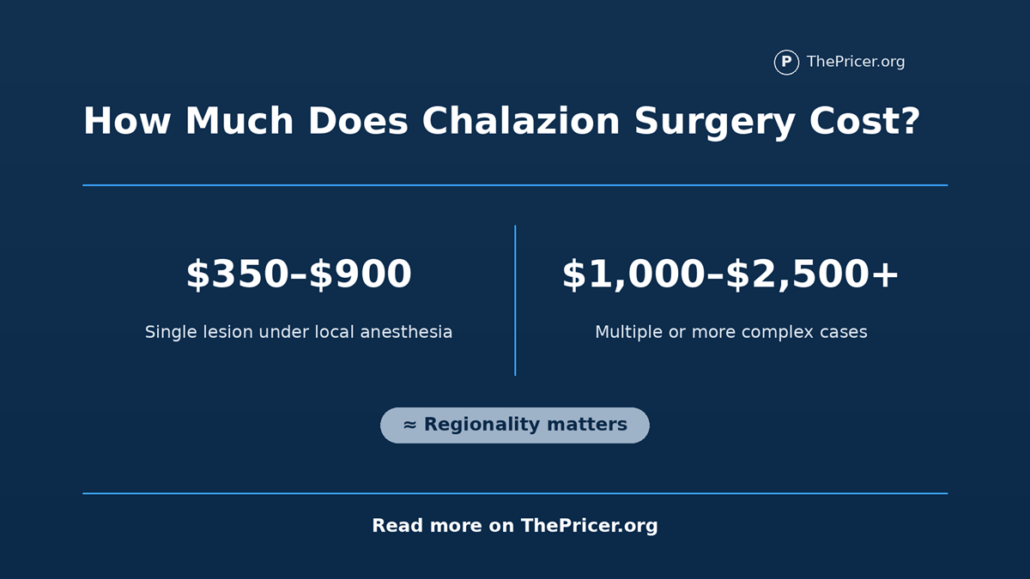
Chalazion surgery usually costs about $350 to $900 for one lesion removed under local anesthesia when paying without insurance. A current ophthalmology clinic lists removal at $350, while current prepaid local-anesthesia packages range from $744 to $860. Multiple chalazia, general anesthesia, hospital care, pathology, or a separately billed examination can raise the total to $1,000 to $2,500+. One current hospital-based general or regional anesthesia example reaches $5,430.
The price is not accurately described as a flat amount “per eyelid.” Billing changes with a single lesion, multiple lesions on one lid, lesions on different lids, the anesthesia level, place of service, pathology, insurance network, and whether the initial eye examination and follow-up are included.
A chalazion is a chronic inflammatory eyelid lump caused by retained oily secretions from a blocked meibomian gland. It differs from a stye, which is an acute infection involving an eyelid gland or eyelash follicle.
The usual surgical treatment is incision and curettage. The eyelid is numbed, turned outward with a clamp, opened from the inner surface, and the retained material is removed with a curette. A standard internal approach normally leaves no visible skin scar and does not routinely require an external stitch.
Article Highlights
Jump to sections
- Single office self-pay removal: one current price is $350
- Prepaid single-lesion package: $744 to $860
- Multiple lesions under local anesthesia: one current package is $2,234
- Hospital or general-anesthesia example: $5,430
- Potential added bills: initial examination, pathology, medication, anesthesia professional, and later visits
- Main clinical safeguard: recurrent or atypical lesions may need biopsy or pathology
- Routine approach: local anesthetic and a same-day inner-eyelid procedure
How Much Does Chalazion Surgery Cost?
| Price situation | Current price signal | What the price may represent |
|---|---|---|
| Office self-pay removal | $350 | Published clinic price for chalazion removal |
| Single lesion under local anesthesia | $744 to $860 | Current MDsave prepaid package range |
| Multiple lesions on one eyelid | $2,234 | Hospital outpatient bundle with physician, facility, and local anesthesia |
| General or regional anesthesia case | $5,430 | Current hospital-based Florida example |
| New ophthalmology evaluation | $331 current example | Separate office visit when the procedure package excludes evaluation |
| Established-patient evaluation | $270 current example | Separate return visit before or around the procedure |
Gwinnett Ophthalmology currently publishes a $350 self-pay price for stye or chalazion removal on its cash pricing page. The page does not establish a national rate, and patients should ask whether the examination, medication, pathology, and follow-up are included.
MDsave currently lists single local-anesthesia packages from $744 to $860, with an MDsave national average of $794. Its current Florida single-lesion price is $860.
What the Procedure Does
A chalazion forms when a meibomian gland becomes blocked and oily material triggers chronic inflammation inside the eyelid. The lump is often firm and less tender than a stye. Small lesions may shrink without surgery over several weeks or months, while larger lesions can press on the cornea and cause blurred vision or astigmatism.
Conservative treatment may include warm compresses, lid massage, and treatment of associated blepharitis or meibomian-gland dysfunction. Antibiotics are not an automatic cure because an uncomplicated chalazion is usually inflammatory rather than a routine bacterial infection.
Persistent or symptomatic lesions may be treated with a steroid injection or incision and curettage. The American Academy EyeWiki review describes local anesthetic injection, eyelid eversion, an incision through the conjunctival surface, and removal of the retained inflammatory material with a curette.
Office Care vs Hospital Billing
A straightforward adult procedure may be completed in an ophthalmology clinic with local anesthetic supplied by the treating clinician. That structure can keep the price close to the current $350 office example because it does not automatically create separate operating-room and anesthesiologist bills.
A hospital outpatient package can include a physician fee, operating and recovery space, supplies, and local anesthesia or moderate sedation. The current MDsave multiple-lesion package costs $2,234 and states that it includes the facility and physician but excludes the initial evaluation and pathology.
The same provider currently lists a new ophthalmology visit at $331. Adding that examination to the $2,234 procedure creates a known subtotal of $2,565 before pathology or an outside anesthesiologist. The details are published on the provider’s multiple-lesion package page.
Hidden price: ask whether the quote includes the diagnostic examination, procedure, facility, local anesthetic, postoperative visit, pathology, prescribed ointment, and treatment of more than one lesion. “All-inclusive” applies only to the services named in the package.
Single and Multiple Lesion Billing
The procedure is not always charged as one price per eye or eyelid. The CPT coding family distinguishes a single chalazion, multiple chalazia on the same lid, multiple lesions on different lids, and procedures performed under general anesthesia or requiring hospitalization.
- CPT 67800: excision of a single chalazion
- CPT 67801: multiple chalazia on the same eyelid
- CPT 67805: multiple chalazia on different eyelids
- CPT 67808: single or multiple lesions under general anesthesia or requiring hospitalization
The current chalazion coding family explains why a quote for one small lesion cannot be multiplied or compared directly with a hospital price for several lesions. Ask the provider which procedure code and eyelid modifiers are expected.
MDsave’s current multiple-lesion Florida package is $2,234, which is $1,374 more than its $860 single-lesion package. That difference reflects a separate bundled product and should not be interpreted as a universal fee for each added chalazion.

Insurance and Medicare Costs
Private insurance does not use a universal 70% or 80% payment rule. The patient’s share can be a specialist copay, deductible, coinsurance, facility copay, pathology charge, or the full negotiated amount before the deductible is met. HealthCare.gov defines a deductible as the amount paid for covered care before the plan starts paying and explains that copays or coinsurance may apply afterward in its deductible guidance.
Coverage is more likely when removal is medically necessary because the lesion is persistent, painful, recurrent, inflamed, or affecting vision. Removal requested only for appearance may be handled differently. Prior authorization is plan-specific rather than automatic.
Original Medicare Part B covers medically necessary outpatient doctor and surgical services under its rules. After the Part B deductible, the patient usually pays 20% of the Medicare-approved amount for the clinician’s service, while a hospital outpatient copayment may also apply. Medicare explains these charges in its outpatient surgery coverage.
Before scheduling, request the expected CPT code, diagnosis code, place-of-service code, network status, allowed amount, authorization requirement, and written estimate. Confirm whether pathology and the first consultation will be separate claims.
Pathology and Recurrent Chalazia
A recurrent, atypical, unusually firm, bleeding, ulcerated, lash-loss-associated, or repeatedly returning eyelid lesion may need biopsy or histopathological examination. Some benign and malignant eyelid conditions can resemble a chalazion.
The EyeWiki review recommends pathological evaluation for recurrent or atypical chalazia and notes the need to exclude sebaceous gland carcinoma in recurrent cases. Moorfields also states that repeated lesions may be biopsied in its chalazion treatment guidance.
Pathology can be medically important and can generate a separate laboratory bill. The current $2,234 MDsave multiple-lesion package explicitly excludes pathology. Ask whether tissue will be submitted, where it will be processed, and whether the pathology group is in the insurance network.
Alternatives and Recovery
Surgery is not the first step for every chalazion. Observation, warm compresses, lid hygiene, treatment of underlying blepharitis, and an intralesional steroid injection may be considered depending on the lesion and patient. Steroid injection can cause skin color change, tissue atrophy, incomplete resolution, or other uncommon complications, so it is not simply a cheaper version of surgery.
Moorfields describes chalazion removal as a same-day procedure using local anesthetic and an incision on the inner eyelid. Ointment and an eye pad may be used afterward. The procedure itself can be brief, but the complete visit includes examination, consent, numbing, preparation, surgery, dressing, and discharge.
Bruising, swelling, mild soreness, blood-stained discharge, and a remaining lump can persist after the procedure. The eyelid inflammation may take several weeks to settle fully. Increasing pain, vision changes, heavy bleeding, or signs of infection require prompt advice from the treating clinician.
Three Realistic Chalazion Bills
Case 1: Single office self-pay procedure. The published cash price is $350. At a wage of $30 per hour, that equals about 11 hours and 40 minutes of work. The patient should confirm whether the eye examination and postoperative medication are included.
Case 2: Prepaid single-lesion package. The current Florida local-anesthesia package is $860. It costs $510 more than the $350 office example, a difference of about 146%. The two offers may not include identical services or use the same setting.
Case 3: Multiple lesions with a separate examination. The hospital outpatient package costs $2,234, and the listed new-patient visit is $331. The known subtotal is $2,565 before excluded pathology or an outside anesthesiologist. At $30 per hour, that equals about 85.5 hours of work.
A current hospital anesthesia example reaches $5,430. That price should not be used as the normal cost of a routine one-lesion office procedure.
When Surgery Makes Sense
Surgery may be discussed if:
- The lesion remains after an appropriate period of conservative care.
- It is large, painful, repeatedly inflamed, or pressing on the eye.
- It affects vision, comfort, contact-lens wear, or daily activity.
- The diagnosis has been confirmed by an eye-care professional.
- The expected procedure, anesthesia, and pathology plan are documented.
Further evaluation is especially important if:
- The lump repeatedly returns in the same location.
- It has an unusual appearance or does not behave like a typical chalazion.
- There is lash loss, bleeding, ulceration, or progressive eyelid distortion.
- Several lesions occur with chronic blepharitis, rosacea, or meibomian-gland disease.
- The patient is being quoted for hospital care without being told why office treatment is unsuitable.
What We Verified
- Checked: A current clinic lists self-pay removal at $350.
- Confirmed: Current prepaid single-lesion local-anesthesia prices run from $744 to $860.
- Cross-referenced: Multiple lesions and general-anesthesia cases use different billing categories and can cost much more.
- Verified: Recurrent or atypical lesions may need pathology to exclude another eyelid condition.
Other eye-care costs can be much larger because they involve the eye muscles, lens, or operating room. Compare the price of strabismus surgery, a routine Walmart eye exam, or medically necessary cataract surgery.
Answers to Common Questions
How much is one chalazion removal without insurance?
A reasonable current self-pay range is $350 to $900 for one lesion under local anesthesia. Consultation, pathology, medication, or hospital fees may be separate.
Does chalazion surgery require general anesthesia?
Most straightforward procedures are performed under local anesthesia. General anesthesia or hospital care belongs to a different billing category and can cost several thousand dollars.
Are stitches used after chalazion surgery?
Not usually when the incision is made on the inner eyelid. An external or unusual approach may be handled differently, so the surgeon should explain the planned method.
Will insurance cover the procedure?
Coverage depends on medical necessity and the plan. A persistent or vision-affecting lesion may qualify, but the patient can still owe a deductible, copay, coinsurance, facility charge, or pathology bill.
Why might a recurrent chalazion be biopsied?
Other eyelid conditions can resemble a chalazion. Recurrent or atypical lesions may be examined by pathology to confirm the diagnosis and exclude a more serious condition.
Disclosure: Educational content, not medical advice. Pricing varies by provider, location, and insurance. Confirm eligibility, coverage, and out-of-pocket costs with a licensed clinician and your insurer. See our methodology and corrections policy.