
How Much Does it Cost to Widen a Driveway?
Updated on | Written by Alec Pow
This article was researched using 11 sources. See our methodology and corrections policy.
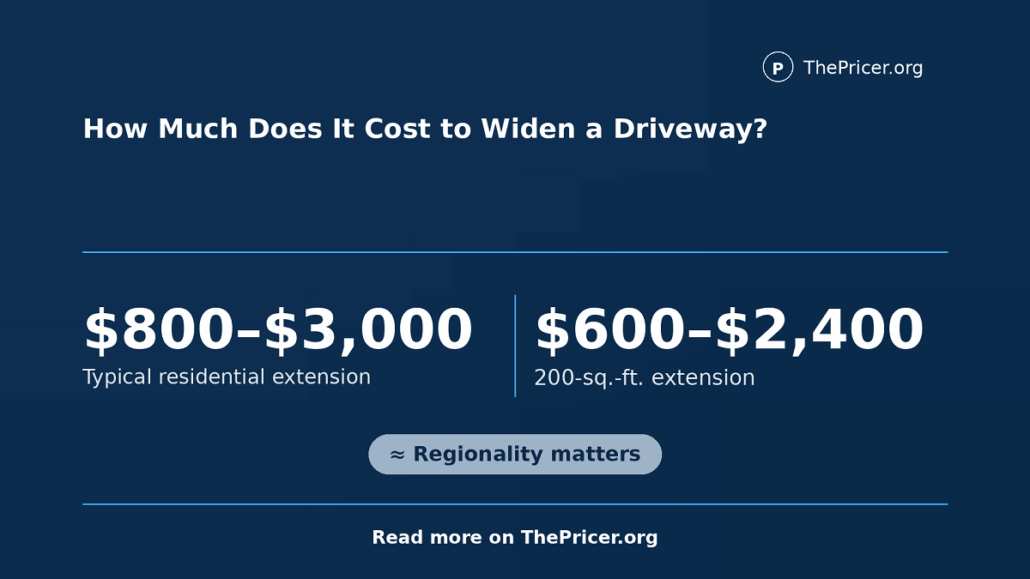
Widening a driveway usually costs about $800 to $3,000 for a modest residential extension, with current Angi data putting the midpoint near $1,900. A separate 2026 driveway-cost dataset from HomeGuide puts a 200-square-foot extension at about $600 to $2,400 before unusually expensive drainage, curb, retaining-wall, or utility work. The current driveway-extension cost data show that material choice and site preparation drive much of the spread.
A one-car-width addition is a useful planning unit. Current driveway-width guidance uses roughly 10 to 12 feet for a single-car driveway and about 18 to 20 feet of parking length, so a 10-by-20-foot widening adds 200 square feet. At that size, an asphalt extension can price around $500 to $1,000 from extension-specific square-foot rates, concrete around $2,000, and pavers around $3,000 to $6,000 before unusual site work.
The pavement is not always the expensive part. Changing the legal driveway opening, rebuilding a curb or apron, correcting slope, adding a trench drain, removing a retaining wall, or rebuilding a weak base can push a small extension well past the surface-only calculation.
Article Highlights
Jump to sections
- A modest residential driveway extension currently runs about $800 to $3,000 (at $30 per hour, earning that amount would take about 0.7 to 2.5 full-time workweeks, before taxes) in Angi’s 2026 cost data.
- A 10-by-20-foot addition creates 200 square feet, enough to model an extra parking bay beside an existing drive.
- Extension-specific material rates put asphalt around $2.50 to $5 per square foot, concrete near $10, and pavers around $15 to $30.
- A driveway trench or channel drain can add about $400 to $2,400, depending on width and drain materials.
- Widening the paved area inside the property is not the same as widening the curb cut at the public street.
- New concrete beside older weathered concrete may remain visibly different even when the new slab is structurally sound.
How Much Does It Cost to Widen a Driveway?
HomeGuide places new construction and driveway extensions around $3 to $12 (about 6 to 24 minutes at $30 per hour) per square foot across common materials and gives $600 to $2,400 for a 200-square-foot addition. Angi’s extension-specific data gives a project range of $800 to $3,000. Those figures overlap well for uncomplicated residential work, but premium pavers and difficult sites can move beyond them.
| Extension material | Current installed benchmark | 200-square-foot example |
|---|---|---|
| Asphalt | $2.50 to $5/sq. ft. | $500 to $1,000 |
| Gravel | $4 to $5/sq. ft. | $800 to $1,000 |
| Concrete | About $10/sq. ft. | About $2,000 |
| Brick | $10 to $15/sq. ft. | $2,000 to $3,000 |
| Pavers | $15 to $30/sq. ft. | $3,000 to $6,000 |
The paver end of the table is not an outlier caused by a small sample. HomeGuide’s separate 2026 driveway-paver data puts installed pavers at $10 to $30 per square foot and a paver widening at about $10 to $25 per square foot. That makes pavers a design upgrade, not the cheap way to widen an existing driveway.
What You’re Actually Paying For
A driveway extension is a small pavement project built beside an existing structure. The contractor first removes sod, soil, old pavement, roots, or other material that cannot support vehicle loads. The site is graded, a compacted base is installed, forms or edge restraints are set where needed, and then the surface material is placed and tied visually and physically into the existing drive.
Current driveway construction guidance uses about 4 inches for a standard concrete driveway and roughly 4 to 6 inches of gravel base beneath it. Local soil, freeze-thaw conditions, vehicle weight, drainage, and existing construction can call for a different section. The quote should identify excavation depth, base material, compaction, pavement thickness, reinforcement if used, disposal, and restoration rather than listing only square footage.
Small jobs can also carry a higher effective square-foot price because mobilization does not shrink in proportion to pavement area. The contractor still needs equipment, labor, material delivery, base preparation, finishing, and cleanup for a narrow extension.
What a One-Car Widening Costs
Current driveway guidance uses 10 to 12 feet as a common single-car width and 18 to 20 feet as a useful parking length. A 10-by-20-foot extension gives a simple 200-square-foot model for adding space beside an existing driveway.
For a concrete example, extension-specific pricing of about $10 (about 20 minutes at $30 per hour) per square foot produces a surface-and-installation benchmark near $2,000. Forbes’ concrete-driveway data puts a complete 10-by-20-foot concrete driveway around $2,100 to $3,200 and notes that unusual site work, thicker concrete, decorative finishes, and permits move the price higher in its concrete driveway cost breakdown.
Worked example: start with a 200-square-foot concrete widening at roughly $2,000. If the new paved area also needs a one-car-width channel drain at $400 to $1,200, the modeled project becomes roughly $2,400 to $3,200 before any permit, curb, utility, or yard-restoration work. In that example, drainage adds about 20% to 60% to the pavement-only budget.
Curb Cuts and Drainage
The street end of the driveway can turn a simple widening into a different class of project. Seattle requires a curb-cut permit when creating a new driveway through an existing sidewalk curb, with review tied to width, location, and right-of-way rules under its current curb-cut permit process. New York City also requires plan approval and work permits before curb-cut construction and notes that other city agencies regulate sidewalk and curb work under its current curb-cut rules.
Those city examples are not national fee schedules. They show why a contractor quote should state whether the project widens only the private parking surface or also alters the legal driveway entrance, apron, sidewalk, or public right-of-way.
Drainage can be just as expensive. Current HomeGuide data puts a driveway trench or channel drain at about $400 to $2,400, with a one-car-width installation around $400 to $1,200, in its 2026 drainage cost guide. A widened surface that sends runoff toward the garage, foundation, sidewalk, or neighboring property may need grading or drainage work rather than another strip of pavement alone.
New Concrete and Old Driveway

A concrete extension can be structurally successful and still look different from the driveway beside it. The old slab has years of weathering, stains, aggregate exposure, repairs, and color change. A fresh pour begins with a different surface age, so matching the concrete mix does not automatically create an invisible seam.
That matters financially when appearance is a priority. One option is to accept a deliberate joint between old and new concrete. Another is to use a contrasting paver border or another intentional border detail. Resurfacing or replacing a larger area can produce a more uniform appearance, but then the job is no longer priced as a narrow extension.
Decorative concrete also costs more than plain gray material. Forbes currently puts stamped concrete around $7 to $15 per square foot in its driveway dataset, far below the old $150 per square foot claim that sometimes appears in older cost guides. A complex premium driveway can exceed ordinary prices, but $150 per square foot should not be used as a normal stamped-concrete widening benchmark.
Three Driveway Widening Scenarios
Simple asphalt strip: A flat 200-square-foot area beside an existing asphalt driveway, with no curb work or drainage change, can model around $500 to $1,000 using extension-specific asphalt rates. A very small asphalt job may quote higher because crew and equipment mobilization still have to be covered.
Concrete parking bay with drainage: A 200-square-foot concrete extension models near $2,000. Adding a one-car trench drain moves the modeled total to about $2,400 to $3,200 before local permits and other site work.
Paver widening with excavation: At $15 to $30 per square foot, a 200-square-foot paver extension models around $3,000 to $6,000. HomeGuide notes that paver work can also add grading, thicker base preparation, edging, and excavation costs. Pavers can make sense for appearance or a deliberate contrast with an older driveway, but they are not the low-price material in this comparison.
When Widening Beats Replacing the Driveway
Keeping the existing driveway can save a large amount when the old pavement is still stable and the extra parking area can be built without rebuilding the street entrance. Replacement becomes more attractive when the old drive already has widespread failure, poor drainage, or a layout that would leave the extension looking and performing like a patch.
Widening makes sense if:
- The existing driveway is in serviceable condition.
- The extra space can stay inside the private property without widening the curb cut.
- The new area can be graded without a retaining wall or major drainage rebuild.
- A visible seam or intentional material change is acceptable.
Replacement may make more sense if:
- The existing driveway already needs major removal and repaving.
- Drainage problems affect both the old driveway and the proposed extension.
- The driveway entrance and apron need major reconstruction anyway.
- A uniform finish matters enough that resurfacing or replacing most of the existing pavement is already planned.
If much of the old pavement already needs demolition or repaving, ask for a second quote covering the larger rebuild. That side-by-side number shows whether preserving the remaining driveway is still saving money after demolition, drainage correction, and finish-matching work are counted.
What We Verified
- Checked: The 200-square-foot parking model against Angi’s July 2026 driveway-width guidance, which uses 10 to 12 feet as a common single-car width and 18 to 20 feet as a common parking length.
- Confirmed: The wider market context against HomeAdvisor’s June 2026 paving data, which puts complete professional driveway paving around $2,523 to $7,292 and separates demolition when removal is required.
- Cross-referenced: The repair-versus-rebuild decision against current driveway repaving data, where size, demolition, slope, and material all change the larger-project price.
Related Driveway Costs
The surface material can be researched separately through the cost of a concrete driveway. If runoff is the main complication, compare the extension quote with the cost of a French drain. A wider driveway can also change the entrance layout, which makes the cost of electric driveway gates useful when a gate or posts must be moved.
Answers to Common Questions
How much does it cost to widen a driveway by one car?
A 10-by-20-foot widening adds 200 square feet. Current data puts uncomplicated projects in the low thousands, with surface benchmarks from roughly $500 to $1,000 for asphalt, about $2,000 for concrete, and $3,000 to $6,000 for pavers before unusual site work.
What is the cheapest material for widening a driveway?
Gravel is often the lowest-cost full-driveway surface, while extension-specific asphalt pricing can also be very low per square foot. The cheapest finished quote depends on the existing driveway material, contractor minimums, base preparation, and whether a mixed-material extension is acceptable.
Do I need a permit to widen my driveway?
Local rules control this. Work that changes a curb cut, sidewalk, apron, or public right-of-way is much more likely to require approval than an extension that stays completely inside private property.
How much can driveway drainage add?
A current national benchmark for a driveway trench or channel drain is about $400 to $2,400. A one-car-width drain is commonly quoted around $400 to $1,200.
Can I pour a concrete extension directly over grass?
No. A vehicle-bearing extension needs excavation and a prepared, compacted base rather than concrete placed directly over sod or topsoil. The required section depends on local soil, climate, vehicle loads, and contractor design.
Disclosure: Educational content, not financial advice. Prices reflect public information as of the dates cited and can change. Confirm current rates, fees, taxes, and terms with official sources before purchasing. See our methodology and corrections policy.