
How Much Does It Cost to Treat a Dog’s Broken Leg?
Updated on | Written by Alec Pow
This article was researched using 14 sources. See our methodology and corrections policy.
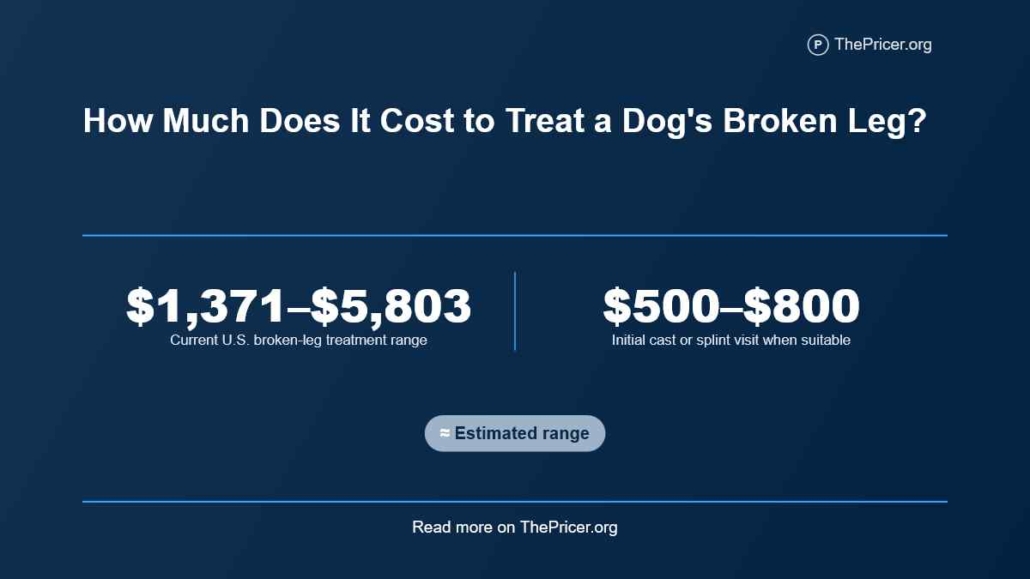
Treating a dog’s broken leg can cost about $500 to $800 for the initial nonsurgical visit when a cast or splint is medically suitable, while a complete fracture episode can reach several thousand dollars. Current broken-bone guidance puts the initial cast or splint visit near that lower range. 2026 national fracture data place broken-leg treatment at $1,371 to $5,803, fracture surgery at $1,444 to $3,500, an emergency exam at $107 to $246, and a splint-change or recheck visit at $56 to $129.
The final bill depends on which bone is broken, whether the fracture is open or closed, whether the joint is involved, how stable the pieces are, the dog’s size and health, the fixation method, and whether emergency or referral care is needed. A cheap first visit can also create several later bills for bandage changes, X-rays, rehabilitation, or another procedure.
Article Highlights
Jump to sections
- An initial cast or splint visit can run about $500 to $800 (at $30 per hour, earning that amount would take about 2.1 to 3.3 full-time workdays, before taxes) when nonsurgical care is suitable.
- Current U.S. broken-leg treatment data span $1,371 to $5,803.
- Current direct fracture surgery examples run from about $1,444 to more than $6,000.
- Six weekly splint rechecks can add roughly $336 to $774 to the initial treatment cost.
- Plate fixation can cost far more than pin-and-wire repair even at the same surgical practice.
- Pet insurance can cover eligible fractures, but pre-existing injuries and waiting periods can block reimbursement.
How Much Does It Cost to Treat a Dog’s Broken Leg?
Current provider prices show a wide spread because the surgery line does not always buy the same thing. Veterinary Surgical Solutions in Austin publishes fracture fixation prices from $1,444 to $1,619 (about 1.2 to 1.3 full-time workweeks at $30 per hour) for pin and wire repair up to $2,732 to $3,016 for a large plate, with radiographs included. Healing Hearts lists large-plate fracture repair at $3,200 to $4,200. Coldwater Animal Hospital places fracture stabilization and repair at $3,500 to $6,500.
| Current U.S. example | Published price | Scope |
|---|---|---|
| Initial cast or splint visit | $500 to $800 | Exam, X-rays, pain care, and splint or cast in the cited estimate |
| Veterinary Surgical Solutions | $1,444 to $3,016 | Pin-and-wire through large-plate fixation, radiographs included |
| Healing Hearts | $2,200 to $4,200 | Pin-and-wire through large-plate repair |
| Coldwater Animal Hospital | $3,500 to $6,500 | Fracture stabilization and repair estimate |
The low and high prices should not be blended into one supposed clinic average. Referral pricing can include different staffing, anesthesia, implant systems, imaging, monitoring, and follow-up. Ask what the surgical figure includes before comparing two quotes. The bundle matters just as much. That distinction matters most when diagnostics and aftercare are billed outside the operating-room line.
Splinting Can Add Repeat Bills
A cast or splint can be appropriate for selected stable fractures, especially some breaks below the elbow or knee. It is not a budget substitute that can be chosen for every broken leg. The American College of Veterinary Surgeons warns that splints require frequent evaluations and can produce a longer care period if complications develop. Upper-arm and thigh fractures are difficult to stabilize externally because the shoulder and hip cannot be immobilized the same way as lower-leg joints.
The repeat-visit math changes the apparent bargain. The initial nonsurgical range cited in the opening is $500 to $800 (about 2.1 to 3.3 full-time workdays at $30 per hour). The same 2026 national fracture data put a splint change or recheck at $56 to $129. Six weekly visits add $336 to $774. Combining those published inputs produces a modeled treatment-course subtotal of $836 to $1,574 before an unexpected bandage problem, extra imaging, or a change in treatment plan.
This is the hidden price of external immobilization. The first invoice can be far below a surgical quote, but the gap narrows when a dog needs repeated bandage work and rechecks. The medical question comes first because a fracture that cannot be held stable in a cast is not comparable with a fracture that can.
Surgery Price Follows the Fixation
Fracture surgery can use pins, wires, screws, plates, external skeletal fixation, or combinations of those methods. The choice is tied to the bone, fracture pattern, dog size, stability, soft-tissue injury, and forces the repair must resist. A quote for pin-and-wire repair is not the same service as a quote for a large plate on a weight-bearing long bone.
The Austin prices cited above show the size of that difference inside one practice. The midpoint of its pin-and-wire range is about $1,532. The midpoint of its large-plate range is $2,874. That is a difference of about $1,343, or roughly 88%, before any lines that sit outside the surgical estimate. The spread comes from hardware choice and surgical scope inside one published fee sheet, so it is a cleaner comparison than placing two unrelated hospitals side by side.
The fracture decides the hardware. Price shopping is most useful after the veterinarian has identified a medically reasonable fixation method. Comparing a low pinning quote with a plate repair for a different fracture pattern can create the false impression that one clinic is charging far more for identical work.

The First Emergency Bill
A fracture caused by a fall, vehicle strike, or other major trauma can start with an emergency exam before an orthopedic plan is set. The exam line from the national data cited in the opening is $107 to $246. X-rays commonly add another charge. PetMD currently places current dog X-ray prices at $200 to $500+, with sedation, anesthesia, or extra views able to raise the imaging cost.
Some surgery packages absorb several of those lines. Anicira publishes a humeral fracture repair package at $2,622 for a dog under 50 pounds, including anesthesia, surgery, IV catheter, fluids, monitoring, and pain medication. Its weight adjustment is $121 for a dog weighing 51 to 75 pounds, and pre-anesthetic bloodwork is $130 when required.
A modeled 60-pound case at those published rates is $2,622 + $121 + $130 = $2,873. That subtotal excludes services not named in the package and should not have a separate anesthesia or pain-medication line added again. This is why itemized estimates matter. A lower surgical fee with separate diagnostics can finish near a higher bundled fee. Owners facing an after-hours injury can also compare the intake component with current emergency vet visit costs.
Recovery Can Keep Adding Cost
The bill does not always stop at discharge. Repeat examinations and imaging may be used to check alignment and bone healing before activity increases. Cast and splint cases can need frequent bandage checks. Surgical cases can need incision checks, repeat radiographs, activity restriction, medication, or rehabilitation. Some clinic packages include part of this work, while others bill it after the operation.
Rehabilitation is one possible extra rather than an automatic charge for every fracture. CareCredit’s 2026 dog rehabilitation cost data put the initial consultation near $180, with individual treatment sessions around $58 to $98. A modeled course with the consultation plus six sessions would cost about $528 to $768. The arithmetic is $180 + 6 × $58 at the low end and $180 + 6 × $98 at the high end.
That calculation is useful only when rehabilitation is part of the dog’s plan. It should not be added automatically to every surgery estimate. The same rule applies to repeat X-rays and implant-related procedures. Ask which rechecks are included, when new images are expected, and which services would create a new invoice. Current dog X-ray costs can help when follow-up radiographs are billed outside the surgery package.
Fracture Type
A broken leg is not one procedure. The veterinarian looks at whether the fracture is open or closed, simple or comminuted, near a joint or through a joint, and whether the broken pieces can be held in stable alignment. Dog age, size, activity, health, and injuries elsewhere on the body also change the repair choice. High-energy trauma can create chest, abdominal, pelvic, or neurologic injuries that need attention before the leg becomes the only concern.
The fixation method follows those mechanical demands. Internal plates and screws resist forces differently from pins and wires. External skeletal fixation can be useful for some open or highly fragmented fractures. A splint works best when it can control the joints above and below the break. These differences explain why one dog may qualify for a $500 to $800 initial nonsurgical pathway while another moves quickly into a multi-thousand-dollar operation.
Open fractures can also carry extra wound-management and infection concerns. A fracture involving a joint can add surgical complexity and can move the repair into a different scope from a simple long-bone break. Owners comparing orthopedic bills can also read about luxating patella surgery costs, where implant choice, imaging, and follow-up create similar quote-comparison problems.
Insurance and Payment
Pet insurance can cover an eligible broken bone when the accident occurs after coverage begins and applicable waiting periods have passed. Embrace lists broken bones under orthopedic coverage and also describes coverage for eligible diagnostic testing, hospitalization, surgery, and rehabilitation. The deductible, reimbursement percentage, annual limit, exam-fee terms, and prescription coverage still control what the owner receives back.
A newly purchased policy does not erase an injury that already happened. A fracture documented before enrollment can be treated as pre-existing, and orthopedic waiting rules can delay eligibility. Owners should read the policy before counting an expected reimbursement against a hospital estimate. Coverage does not tell you when the hospital expects payment, so ask the clinic about payment timing before relying on reimbursement.
If self-pay is the issue, ask the hospital which financing products or payment methods it accepts. Do not assume the clinic itself offers an in-house payment plan. The strongest cost comparison is still a written estimate that states the fracture, fixation method, imaging, bloodwork, anesthesia, implants, hospitalization, take-home medication, rechecks, and repeat imaging. A lower headline surgery line can be less attractive if many of those items sit outside it.
What to Do Before the Estimate
This is emergency care. An obvious fracture, inability to stand, or major trauma warrants prompt veterinary assessment. The American Kennel Club’s fracture first-aid guidance advises against owner-applied splints, recommends a carrier or flat board for transport, and warns against human medications unless a veterinarian directs their use.
Keep movement limited while getting the dog to care. The clinic needs to examine the patient, look for injuries beyond the limb, obtain the necessary images, and decide whether external support or surgery can keep the fracture stable enough to heal. A fracture after a vehicle strike or major fall may be only one part of the trauma.
Once the medical plan is known, compare estimates on the same scope. A quote for a stable lower-leg fracture in a splint cannot be matched directly with a plate repair for an unstable upper-leg fracture. The same applies to spinal injuries that may look like leg weakness after trauma. Current dog slipped disc surgery costs cover a separate neurologic surgery pathway rather than ordinary limb-fracture fixation.
Makes sense if
- You compare quotes only after the fracture pattern and repair method are known.
- You ask whether diagnostics, anesthesia, implants, hospitalization, medication, and follow-up are bundled.
- You budget for repeat visits when a cast or splint is chosen.
- You review insurance eligibility before counting reimbursement toward the bill.
Does not make sense if
- You choose splinting only because the first invoice is lower.
- You compare a pin repair with a plate repair as though they are identical procedures.
- You add every diagnostic line to a surgical package that already includes it.
- You delay emergency assessment while trying to stabilize the fracture at home.
What we verified
- Checked VCA’s current urgent-care triage guidance, which sends obvious fractures and major-trauma cases to emergency care.
- Confirmed Anicira’s orthopedic package inclusions, including the pre-anesthetic exam, anesthesia plan, monitoring, pain control, and listed follow-up support.
- Cross-referenced Embrace’s orthopedic waiting-period details, which vary by state and can affect early fracture coverage.
Answers to Common Questions
How much does it cost to treat a dog’s broken leg?
A current national treatment range is $1,371 to $5,803. A selected cast or splint case can start around $500 to $800, while surgery and referral care can reach several thousand dollars.
How much does dog broken-leg surgery cost?
Current published surgical examples in the article run from about $1,444 to $6,500. Fixation method and package inclusions account for much of the spread.
Is a cast cheaper than surgery?
The initial visit can be cheaper, but repeated splint changes and rechecks can add hundreds of dollars. A modeled six-week pathway using current published inputs totals about $836 to $1,574 before complications.
Will pet insurance cover a broken leg?
It can when the fracture is eligible under a policy that was active before the injury and applicable waiting periods have passed. Deductibles, reimbursement percentages, limits, and exclusions still apply.
Should I splint my dog’s leg before going to the vet?
No. Minimize movement and transport the dog carefully. Improvised splinting can worsen pain or injury, so let the veterinary team handle stabilization.
Disclosure: Educational content, not medical advice. Pricing varies by provider, location, and insurance. Confirm eligibility, coverage, and out-of-pocket costs with a licensed clinician and your insurer. See our methodology and corrections policy.